Jeremy Harris
-
Posts
26430 -
Joined
-
Last visited
-
Days Won
360
Everything posted by Jeremy Harris
-
I did just as you've said, just showed clearly that the development was above the flood risk zone. One page of written text, plus a plan provided by the EA and one by me overlaying our development on the EA data seemed appropriate to me, as the EA had specifically requested that I provide a "site specific and proportionate FRA". The EA did state that the site was in the flood risk zone, probably as they work on a fairly coarse grid:
-
Not at all hard to build, TBH. The main problem is finding reliable parts, I found.
-
The letter I had from the EA did say that the FRA I needed to do should be "site specific and proportionate" to the level of risk: As I had quite a lot of data, both from the EA and courtesy of the FRA that my neighbour had done, I opted to do the FRA myself, on the basis that the worst that could happen would be that they ask me for a better one. My simple. DIY, FRA was accepted without a murmur, so saving us a significant cost. Here's a copy of the DIY FRA I did (and I fully accept that it isn't "professional", but it did the job, saved us a few hundred pounds, so I just don't care what it looks like!): Flood risk assessment - redacted.pdf
-
Just found a (very tatty) copy of the part of the FRA that was included in his D&A, as an annex. Somewhere I have the whole FRA, with all the sections through the brook, likely levels, flow rates, etc, but I have a feeling that it must be archived, probably on an old PC, as it dates back to when we were submitting our planning application back in 2012. This is the tatty file that I've been able to find on the planning website: 12792.pdf
-
I can assure you that my neighbour did pay around £4k for his flood risk assessment. He complained bitterly to me that he felt it had been done by a bunch of students as a part of their course work (no idea if that's true or not).
-
Same here, still have unpleasant memories of post-PE showers; it was a golden opportunity for the class bully. Communal showers continued twice a year through much of my career, after dinghy drills, often not exactly warm. All that changed as we got older was that we started comparing hernia scars...
-
One (expensive!) option to maintain a low roof line yet be able to tolerate flooding, might be to do as that riverside Grand Designs build did a few years ago, and make the whole house able to float upwards if the area floods. Bit extreme, but I wonder how cheaply such an arrangement could be designed? It must be possible to design a floating raft "foundation", held in place by piles that extend above ground level, for less than the giant floating concrete structure they used on the GD build. Maybe just using off-the-shelf floating dock stuff? Probably too wild an idea...
-

Supplier recommendations
Jeremy Harris replied to bissoejosh's topic in Air Source Heat Pumps (ASHP)
It was via eBay, before some of the cheaper options came along. I bought it in 2014, so a fair time ago now. -
Anecdote about flood risk: When we were gathering information for our planning application, during 2012, part of it came from the village history group (historical use of our plot). They were very helpful, and I asked when the area had last flooded. The answer came back that it had never flooded in living memory. We were also in zone 3, so a 1:100 year risk. We got our PP in 2013 and started the build proper in October. We went away for Christmas 2013, and whilst travelling down to Devon we got caught in some pretty bad flooding, and only just made it to our hotel in time. When we got home in the New Year we found that many houses in the village had flooded, including the lower area at the entrance to our plot (had we been living there we'd not have been able to get in or out for a couple of days). Since the house has been finished we've had two more, smaller, flooding events, both of which restricted access in or out of the house for a time. We've concluded that "living memory" has nothing to do with risk probability...
-
A part of our plot is in the flood risk zone. The chap over the road tried to get PP for some of his land and spent ~£4K on a flood risk assessment, to no avail. I was asked to provide a similar flood risk assessment by the EA, as a part of the initial planning consultation. I didn't want to spend £4k, so I rang the EA and asked them what they wanted. A helpful lady there said they had the flood risk maps for the area, and she emailed them to me. I overlaid these on to our plot, added the house, drive and garage locations and asked the EA for advice. They came back with a recommended finished floor level for the house, garage and drive parking area. I wrote a three page flood risk assessment myself, giving the positions and levels. I ended up with planning consent with a condition imposed by the EA as to the finished floor/parking levels, which were the same as those I'd been given informally.
-
I'm not sure, but we had the same problem at this time of the year at our old house, particularly with the windows that faced West. We also have the same problem here, both on the West and East facing windows. Thankfully I've yet to find a casualty, but we do have a couple of feather prints on the glass, following loud bumps, that make it clear that birds have hit the windows in full flight. I had wondered if it was something to do with the light at this time of the year, perhaps combined with young, inexperienced birds that have only fledged earlier in the same year. Short of coating the glass with something to make it more visible/less reflective, I'm not sure if there is anything to be done. Wish there was.
-
Supplier recommendations
Jeremy Harris replied to bissoejosh's topic in Air Source Heat Pumps (ASHP)
I also bought a new, old stock, rebadged Carrier (badged Glowworm) unit, but I paid a fair bit more (£1,700, inc VAT, delivered, with the command unit etc). Ours has been running for about 4 years now, with no problems. -
I designed and built a wireless alarm for our treatment plant, and intended to offer it as a kit of parts here (went as far as buying all the components - they are sat here on the shelf, this is the old thread about it, with photos: https://forum.buildhub.org.uk/topic/225-ideas-for-treatment-plant-alarms/ ). I did mean to write the design of the thing up as a set of plans with the code etc, but it seems to be one of those things I've just not got around to doing! The thing uses two sensors, a pressure sensor that reads the pressure coming from the aeration pump, and a level sensor that detects if the effluent level in the pump chamber gets too high. It has a 433 MHz wireless link that sends data on it's status every few seconds to an indoor unit. The indoor unit both displays data on a small alphanumeric LCD and has a beeper for an alarm condition. This would work OK for detecting a power failure, as the pump pressure would drop if the power failed.
-
Welcome. We have a passive raft foundation, with underfloor heating pipes cast into it. Thermal expansion is tiny, as the temperature changes are also tiny. When our heating is running flat out, in very cold weather (-10°C), the floor will be a bit over 23°C, for a room temperature of 21°C. In very hot weather, we cool the floor, using the UFH pipes, with the ASHP working in reverse. Typically the floor may cool to about 18°C in very hot weather. That's a tiny temperature change, just 5°C between the absolute coldest the slab gets and the hottest. Parts of the slab get used to get much hotter just from the sun shining on them in summer, until we fitted solar reflective film on some windows to stop the house getting too hot. I measured parts of the floor at ~30°C at that time, but there's no indication of any thermal movement. Our slab is 100mm thick, and includes steel reinforcement mesh to strengthen it, and give something to fix the pipes to. I've worked in all-concrete buildings, with a concrete roof, that have experienced very much greater temperature swings than a floor slab will ever see. The concrete roof of a hardened shelter would reach maybe 40°C in very hot weather in summer, and drop well below freezing in winter, yet I never saw any sign of cracking from this.
-
Insulated ducts MVHR
Jeremy Harris replied to Oz07's topic in Mechanical Ventilation with Heat Recovery (MVHR)
Yes, as the insulation needed on the externally connected ducts is less than that needed on the internal ducts, when the thing is fitted in a cold loft. -
This can be a real PITA to resolve on sale. We bought a house without realising that it shared the electricity, water and sewage arrangements with a small carpenter's workshop that was next door. Because of the way the pipes and cables ran it would have been a nightmare to give the workshop it's own services. It wasn't picked up before purchase; we only spotted it when we noticed that the electricity bill seemed high. I found an odd looking armoured cable in the garage, coming from our supply, and just isolated it, as I couldn't see where it went. Next thing I knew was that I had the landlady who owned the (rented out) workshop knocking on our door to ask why I'd turned her power off. I agree to fit a meter to her supply, and charge her for the electricity her tenant used, which was sort of OK. The ultimate fix was that we bought the workshop from her a year or so later, so the problem went away.
-
I've found that our Genvex is silent when running normally, but there is some flow noise when it boosts. The main noise issue with it was from the compressor motor. Whenever that runs it is audible in our utility room, which is directly underneath where the unit is mounted, and audible in the services room. Silencers probably won't have much impact on that noise, I think, as it mainly seems to be transmitted through the mountings. I did install the thing on anti vibration mounts, but these aren't, perhaps, as effective as they could be. This compressor noise doesn't bother us, as the compressor rarely runs at night, and we can't hear it in our bedroom, anyway.
-
Bugger - big chip in glass induction hob
Jeremy Harris replied to jack's topic in Kitchen & Household Appliances
I wonder if that's the same stuff they use for invisible chip repairs in car windscreens? I believe that's a UV curing resin of some sort, probably an acrylic. May well be the same sort of resin that my 3D printer uses. That's available as a clear resin, although I've not tried any yet, so don't know how clear it really is. -
If you can get away without having one internally then it is worth doing, as they are always a thermal bridge, wasting a bit of heat. The key thing is to recognise that SVPs have two functions. One is to vent any gasses that may build up in the foul drain, the other is to allow air to enter above any slug of waste that goes down the pipe after a toilet is flushed. These two functions can be separated out, and doing this removes the thermal bridge. An external vent can be fitted to the foul drain, outside the house. This doesn't need to go to roof level, it's OK to have it above any flood level, in a location where any slight odour won't be noticed. Putting a vent near, or in, a hedge or some bushes will avoid any odour, as plants seem to be pretty good at neutralising smells. To resolve the requirement to allow air into the soil pipe after a toilet flush, you can fit a short internal pipe up above the highest drain point, and cap it with an air admittance valve. We've done this, and have no visible vent pipes at all. The AAV sits in the eaves space, where it can be accessed if needed.
-
Insulated ducts MVHR
Jeremy Harris replied to Oz07's topic in Mechanical Ventilation with Heat Recovery (MVHR)
In that Genvex note, fresh air and exhaust are the external ducts that run to the terminals outside the house. Supply and extract are the ducts inside the house leading to the various rooms. -
Just about to start the first fix electrics
Jeremy Harris replied to Triassic's topic in Electrics - Other
Yes, happens to us a fair bit in summer. We're at the end of a few hundred metres of wire, and have a normal supply voltage of around 245 VAC or so, with no PV generation. The two of us on the end of this wire both have PV arrays, ours is 6.25 kWp and our neighbours is 3.6 kWp. The display on our inverter quite often shows over 250 VAC, and the inverter will sometimes start to limit output with the display reading 253 VAC. I've been trying to get the DNO to drop a couple of taps on the transformer for ages, but they just aren't interested. I'm getting to the point where I'm going to insist that they fit a voltage logger to the supply, so they can see for themselves that we are consistently well above the nominal supply voltage. -
Insulated ducts MVHR
Jeremy Harris replied to Oz07's topic in Mechanical Ventilation with Heat Recovery (MVHR)
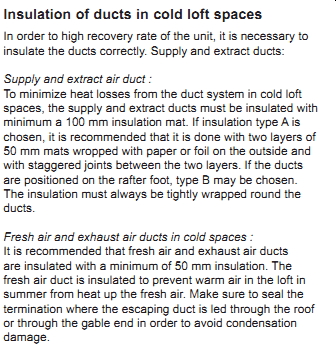
The diagram below is taken directly from the MIs for our Genvex MVHR: Together with this text: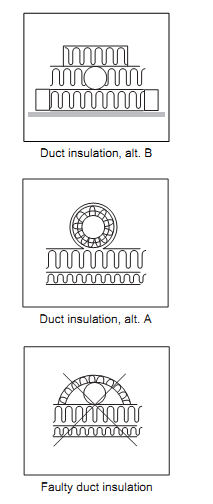
-
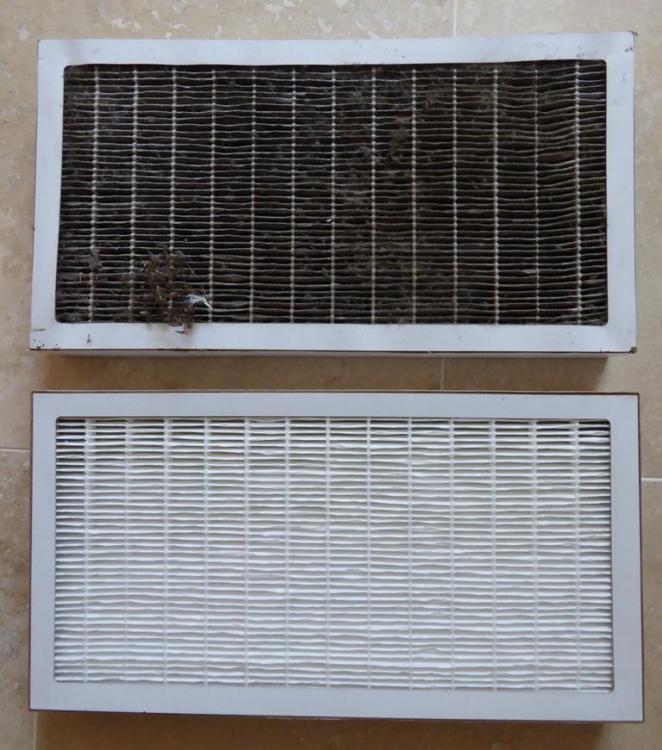
The chamber on the outside of both filters gets a bit grubby, especially the intake side. The room extract side gets a bit of fine dust in the chamber, but far less than the intake side. I also find loads of dead flies, spiders etc in the intake side chamber, before the filter, and the filter always looks pretty grim. Here's a photo comparing a new intake filter with one that's been used for 6 months: I took the heat exchanger out this summer, to check it and wash it if needed, but found that it seemed very clean, so just put it back. I suspect that the filters in the Genvex do a good job of keeping stuff out of the heat exchanger, especially the one on the intake side (the intake has an F7 pollen filter, the extract has a G4 dust filter).
-
+1 to the above. I retrofitted silencers to both extract and supply and it would have been a heck of a lot easier to do during the original install. Given that silencers aren't that expensive, I'd be inclined to always fit them, even if you think you may not really need them.
-
Just about to start the first fix electrics
Jeremy Harris replied to Triassic's topic in Electrics - Other
Still not right, or compliant with the regs though. You can argue all you like, but putting over 13 A through a 13 A fuse for a few hours will make it run hot. It's fundamentally unacceptable to overload a connection like this. The reason that it used to be OK to get away with doing this is that immersion heaters were often rated at our old mains voltage, of 240 VAC, although any newer one may well be rated at our current nominal mains voltage of 230 VAC. A 240 VAC rated 3 kW immersion will draw ~12.5 A at 240 VAC, and ~ 13.17 A at the max grid voltage of 253 VAC, so only slightly over the spec, but still unacceptable.