


Jeremy Harris
-
Posts
26430 -
Joined
-
Last visited
-
Days Won
360
Everything posted by Jeremy Harris
-

Reusing planning drawings without permission
Jeremy Harris replied to willbish's topic in Planning Permission
The issue really is one of what laws, if any, have been breached. There's a possible misuse of copyright material, in that the copyright holder hasn't given consent for publication of their material for a purpose other than that for which they granted a limited licence to the LA. This needs to be checked, as it may well be that the publication licence implicitly granted to the LA when submitting plans is broader than just publication relating to the copyright holders specific application (this should be buried in the small print somewhere, either in the Planning Portal or the LA terms and conditions). It's well worth reading the law regarding libel, as there is a specific public interest clause that allows information to be published that may, possibly, otherwise be considered libellous if it is in the public interest to do so. There would seem to be a very strong argument here that the LA considered that including this information to give context to another application was in the public interest. The key point is whether or not it was appropriate to include the signature box, identifying the author. It could be argued that this part should have been redacted, but equally it could be argued that the LA are required to identify the copyright holder, as they are using material under the terms of the licence granted by that copyright holder, which may require them to include the attribution. That seems a wholly unreasonable comment, as it implies that a group of people are acting in concert, when I know beyond any doubt whatsoever that this is not the case. Of course, it may be that those to whom you have falsely referred in this statement consider that comment to be defamation of their good character, simply because the comment is demonstrably false and harmful to their reputation. That is indeed libel... -
I used to do ours annually. Took about 20 mins. I also filled the case up with neat inhibitor when refitting it, to keep the concentration up in the system. Seemed to work very well.
-
Reusing planning drawings without permission
Jeremy Harris replied to willbish's topic in Planning Permission
Just to be clear, the only legal issue here is possible breach of copyright, nothing else. It's entirely up to the copyright holders as to whether they feel that it's worth taking action over, and my experience is that such action can be a lot of effort for no gain. I'm still in a copyright battle over use of my images as advertising by a company that I have never contracted with. Been going on for years now, and the images are still up, and I have no way to get them taken down, it seems. I just hope they aren't convincing anyone to do business with the company, as if they do they will probably lose out. -
No, a LLH doesn't provide any separation.
-
Yes, should be fine. The tank will work as a fill and expansion tank, to cope with the change in volume as the tank heats up and cools down. Just need to watch the level, in case there's a leak, plus the very small evaporation loss (with the vented lid on the evaporation loss should be very low).
-
It also needs a low pressure relief valve, as most tanks that are intended to be vented are only rated to around 1.5 bar max. Even with an EV, which will need to have its charge pressure set to something like 0.5 bar, there is still a risk that the system pressure could exceed the burst pressure of the tank if there's a fault (something like the EV losing its charge). A small header tank gets around the problem. As @ProDave says, this need not have a float valve, overflow etc, it could be a small tank like one of these: https://www.tanks-direct.co.uk/water-tanks/water-storage-tanks/10-50-litre-water-tanks/12-litre-water-tank-t12na-4.html fitted with a vented cap and bottom outlet. Just need to check the level from time to time.
-
Just clipped direct, maybe add a batten or board for the wiring runs if need be. Easy to do, keeps cables up off insulation, makes inspection easy, etc. Need to use 18th Ed compliant clips now, but that's no big hassle. TBH, despite the fact that they are more expensive, I prefer the metal clips. I recently tidied up some wiring using the Schneider metal clips and they seemed more robust.
-
Looks like the valuer came out two weeks after the date of the application and payment of the fee, although there was some additional correspondence between those dates, relating to requests for proof of income, etc, so I'm not 100% sure when it was triggered.
-
If retrofitting to an existing house, then PP may be required (seems to be often ignored here, though), but if it's a new build then adding an ASHP is a NMA. My planning consent had no ASHP, as we were, at that time, going to install a GSHP. When I realised just how much more expensive a GSHP was going to be over an ASHP, I called the planning officer and asked if I needed to submit a new application. He just asked for an amended plan showing the location of the ASHP outdoor unit, then emailed me to say he'd made a note in the file that there was now an ASHP included. No fee payable, no forms to fill in, just a phone call and exchange of emails.
-
VAT for dummies
Jeremy Harris replied to Davidkw's topic in Self Build VAT, Community Infrastructure Levy (CIL), S106 & Tax
The general rule is that you can only reclaim VAT on items that are incorporated in the build, so you cannot claim VAT on purchased scaffolding, containers, Portaloos etc, but if you bought a loo, plumbed it in temporarily as a site toilet, then later included it in the build, that should be OK. -
Reusing planning drawings without permission
Jeremy Harris replied to willbish's topic in Planning Permission
Copying anything from any website doesn't give anyone the right to use it for any purpose, other than their own enjoyment, or, possibly, under a "fair use" type condition (limited quotation for review, to illustrate a point, etc, with an acknowledgement to the copyright holder). Using copyright material for gain, (which is what this is - it's avoiding paying someone to do a similar set of plans) is a breach of copyright. It may well be unintentional, and we all know that people breach copyright all the time, but that doesn't make it lawful or right in any way. The problem is that there are a lot of people who have the false assumption that anything that's published on the internet is free for them to use as they wish. For example, years ago a student from Lancaster University copied an article I'd written for a magazine, changed the name etc, and submitted it as his own work. By pure coincidence his supervisor was a friend of mine I used to go flying with, recognised the article as being mine, and called me to ask if I knew the student in question. I didn't, but apparently when challenged the student exclaimed that he'd found the article on the internet, therefore it must be OK for him to use it... -
I think the simple answer is that all materials are probably water vapour permeable, but there is a massive variation in that vapour permeability, from materials that can be considered, to all intents and purposes, to be water vapour impermeable, to those that could be considered to be highly water vapour permeable. Perhaps worth just creating a list of likely materials, ranked in order of water vapour permeability, and using that, in conjunction with material thickness, to do a basic design that maintains a safe vapour permeability gradient. Also worth trying to model the worst case transient/dynamic conditions for the outer part of the structure, too, something that many models don't deal with that well. It is possible to have a situation, for example, where after a cold night, that cools the outer part of the building fabric, you may then get a warm, wet morning, that drives vapour inwards, towards the cool area. This may then condense, and if that part of the structure is then in shadow, it may not receive enough sensible heat in the area where moisture has condensed to be able to turn that moisture back into vapour, so it can move out of the structure.
-
As far as planning consent goes, then generally no, it's not an issue. For a new build, an ASHP isn't normally an issue, either, especially as planners are now realising that in most cases ASHPs are very quiet (my experience has been that a modern inverter controlled ASHP is a lot quieter than the two GSHP installations I've experienced). Noise is a consideration, as all inverter controlled ASHP are now very quiet indeed, whereas there are still a lot of pretty noisy GSHPs around. We spent a week on holiday in a place with a GSHP that was so noisy it kept us awake at night. The owner of that holiday let has now relocated the GSHP away from the building, in it's own (soundproofed) shed, in an attempt to reduce the noise level indoors.
-
Worth seeking better advice, I think, as the installed cost of a GSHP will be very significantly greater than that for an ASHP, for a very tiny improvement in performance (probably around 5% to 10%, in practice). Many have found that when the installed cost difference between the two is compared with the running cost saving through life the GSHP still ends up being a great deal more expensive. For us, the installed cost of a GSHP was around three times the cost of an ASHP, and the few pounds a year it would have saved in running cost wouldn't even have covered the increased servicing cost that a GSHP installation incurs, let along the big difference in initial cost. As @SteamyTea mentioned earlier, the heating technology used is unrelated to the size of the house. An ASHP would work every bit as well as a GSHP, or pretty much any other heat source, come to that.
-
We had our plot valued at the end of the initial ground works stage, so the plot was cleared and levelled, the big retaining wall was in and there was a rough access track. There were no services in at all at that stage, although the sewage treatment plant had been installed, but not commissioned. It didn't seem to make any difference at all to the valuation as far as I could tell.
-
Reusing planning drawings without permission
Jeremy Harris replied to willbish's topic in Planning Permission
In that case you own the copyright and can take action to prevent it being used, or demand a fee for the use of it. You don't have to explicitly state on the drawing that you own the copyright, as I believe the law is that copyright is assumed to apply to the named author. -
Reusing planning drawings without permission
Jeremy Harris replied to willbish's topic in Planning Permission
Depends who owns the copyright. All my drawings are either assigned to me uniquely, or have a shared attribution with the OS, which requires that I include the OS limited licence reference. No one else can use or publish those drawings without my express consent. If they do, then they would be in breach of my copyright. I've made the copyright position explicit, by including reference to it on drawings and plans, but my understanding is that this isn't essential, as copyright is assumed to belong to the author, unless rights have been reassigned. In my (limited) experience the main area for confusion is around assignment of rights. For example, the first time I sold an article for a magazine, I made the mistake of agreeing an "all rights" contract. This meant I got paid once, and the magazine then owned the rights to publish. They went on to publish the article in their US and Australian sister publications, without paying me. I learned the lesson, and have since only ever agreed to limited rights, single publication, so if a publisher wishes to re-publish something they have to come back to me an negotiate another fee for doing so. -
Placing LED drivers (transformers) in safe spaces.
Jeremy Harris replied to ToughButterCup's topic in Lighting
Main rules are that they have to be accessible and they must not be buried in insulation, as they need a bit of free space around them for ventilation/cooling. They only run slightly warm to the touch, so nothing like as hot as halogen lights or transformers.. Some of ours are in the ceiling void, accessible through the holes where the lights clip in, with small baskets of chicken wire over them to keep the acoustic insulation a few inches away from them. They are just resting on the plasterboard ceiling. Others are either inside the light enclosures or are behind the eaves walls, and can be accessed via the doors I built in to those (we use those spaces as storage areas).- 2 replies
-
- 2
-

-
- led
- transformer
- (and 2 more)
-
Probably worth having a look at all the other ICF systems around, too, as there are quite a few, and each has its own pros and cons.
-
Week 4 - out of the ground, or is that in?
Jeremy Harris commented on Red Kite's blog entry in Self Building two in North Wiltshire
I think the muck away cost alone for our ground works came to over £9k. Sadly we had no topsoil worth saving, as the whole plot had been overgrown with small trees, shrubs, brambles etc for years, so the top stuff was full of roots. Landfill tax was a fair hunk of the cost, too. -
Air change rate - fresh air flow rates
Jeremy Harris replied to daz1984's topic in Air Source Heat Pumps (ASHP)
Also worth reading the compliance guide, as well as Part F, plus the NHBC guidance and, perhaps, also the PassivHaus guidance, as all are useful: NHBC MVHR Commissioning.pdf Passivhaus MVHR Commissioning Requirements V121.pdf domestic_ventilation_compliance_guide_2010_edition.pdf -
14th International Dark Sky Reserve
Jeremy Harris replied to Jeremy Harris's topic in Environmental Building Politics
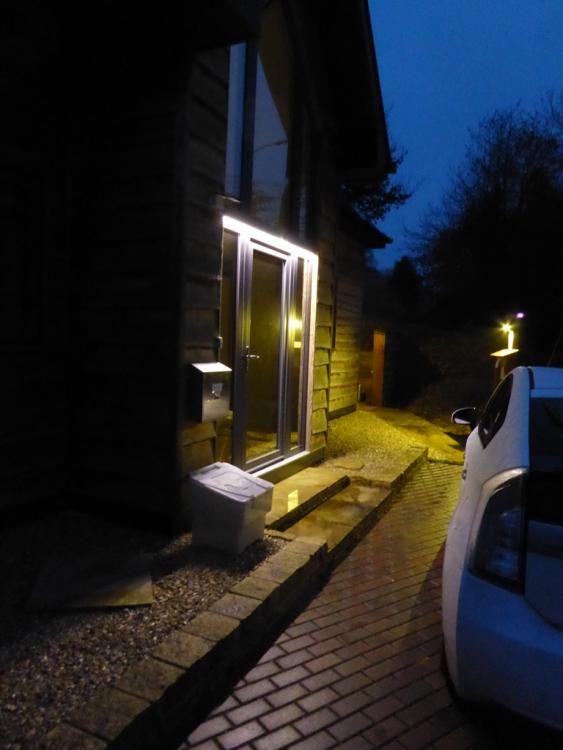
The lights I have are mainly cast aluminium ones with COB LEDs and a glass front, with the exception of an LED strip that is fitted into a downward facing channel in the stacking cill above the front door. They don't seem to have too much sideways spread: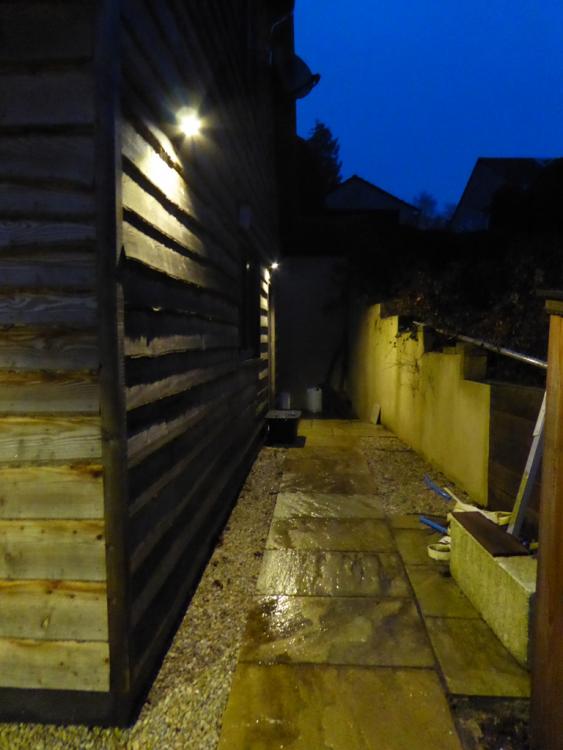
-
14th International Dark Sky Reserve
Jeremy Harris replied to Jeremy Harris's topic in Environmental Building Politics
Earlier this year we spent a week on Sark, an island that also has Dark Skies status. We had several clear nights, and the view of the sky there was just incredible. We both spent about an hour sitting outside, after dinner one evening, just looking at the stars, plus the occasional satellite passing over. I have to say that the sky there seemed darker than here, but that may have something to do with the variation in cloud cover and the much broader horizon on Sark. -
14th International Dark Sky Reserve
Jeremy Harris replied to Jeremy Harris's topic in Environmental Building Politics
I have a lot of outside lights, but all are downward facing LED floodlights, rated at 10 W each, and all are PIR activated, so they only stay on for around 30 seconds. I also opted to use warm white LEDs, as they seem to be a bit kinder on the eyes than the cold white ones. What we did notice this summer, was that the local bats had learned how to fly around the garden, in a racetrack pattern, triggering the lights on the shed and the garage, It seems they managed to work out that by keeping these lights on they attracted more insects, so their feeding flight pattern was more effective. Really interesting to sit outside, listening to the bats on a bat detector, as they whizzed around above our heads. It was easy to hear when they found prey, as the pulse repetition rate of their calls rapidly increased, as they homed in for the kill. Most kills were around the lights. -
Fire regulations package for build control
Jeremy Harris replied to hallega's topic in Building Regulations
Yes, you can do this yourself, but what's needed depends on where you are. Wales, for example, insist that sprinkler systems are fitted, England, Scotland and NI don't (yet). Worth reading the Approved Documents that cover fire safety, as although they are a bit tedious, the solutions are pretty straightforward, but are dependent on the layout of the house to some extent. All the Approved Documents are here: https://www.gov.uk/government/collections/approved-documents The one you need to focus on is Part B, but bear in mind that there are some interactions with other parts of the building regs, for example the fire door provisions in Part B (if required) also have to comply with Part M, regarding disabled access. These may look a bit daunting, but a great deal of the content of the Approved Documents doesn't apply to many dwellings, so it helps to just pick out the bits that only apply to dwellings, and then those bits that only apply to your particular style of dwelling (for example, the regs for a three storey house are more onerous than for a single or two storey house). The key things I noted for our 2 storey house was to make sure that any habitable rooms that were on the same level, and not connected to a main entrance lobby, had an independent means of escape from fire, either by another door or a window large enough to use for escape. The same applied upstairs, with both bedrooms needing windows that opened with a big enough space to use for escape. Linked fire/smoke alarms will be required, that are positioned so that all occupants can hear the alarm and be woken by it if it goes off. Best to use a heat-triggered alarm in the kitchen, linked to smoke alarms in other areas (saves getting false alarms when the toast gets burned). We have a heat alarm in the kitchen, linked to a smoke alarm upstairs on the landing, high up, and positioned so that it can be clearly heard in both bedrooms. Not expensive to install (maybe £50 for the alarms plus some wiring). Worth getting alarms that take a PP3 backup battery, rather than a built-in for life battery, as the latter need replacing after ten years. If a lithium PP3 battery is fitted to the other type all that's needed after ten years is a battery change.



