Jeremy Harris
-
Posts
26430 -
Joined
-
Last visited
-
Days Won
360
Everything posted by Jeremy Harris
-
Can you angle the hole through the wall to reduce the angle of the bends?
-

A charity with self-build track record
Jeremy Harris replied to tonybythesea's topic in Introduce Yourself
More likely that the company realised that you just cannot contradict well-established laws of physics. It seems that heating is an area where companies often seem to spring up making all sorts of improbable claims about performance and efficiency. -
low voltage electric UFH e.g. Warmfloor
Jeremy Harris replied to tonybythesea's topic in Underfloor Heating
The other point about PV is that there is virtually no excess PV generation for the months of the year when heating may be needed. PV generation pretty much drops off a cliff around October and doesn't pick up again until about March, so it's really of no use as far as heating is concerned. Agreed. Wet UFH run from an ASHP is relatively cheap to run, especially if the UFH pipes are arranged like ours, inside the concrete floor slab. This allows us to pretty much only heat the slab overnight, during the E7 off peak rate period, so the running cost for the ASHP is much less than the cost of a boiler run from mains gas. The ASHP has a COP of over 3, and off-peak electricity is about 8.148p/kWh at the moment, so we're paying about 2.716p/kWh for heating. Mains gas is currently about 4.3p/kWh, but when boiler efficiency is taken into account this increases to about 5p/kWh. -
Small pipe kink is this a problem?
Jeremy Harris replied to DIY_Amateur's topic in Underfloor Heating
Sounds like the flow is OK, if the loop is balanced with the others. My guess is that that pipe will be OK for decades, as the relatively low temperatures that UFH runs at are unlikely to cause any degradation. It probably looks a lot worse than it really is, in terms of possible damage, too, given how robust UFH seems to be. -
low voltage electric UFH e.g. Warmfloor
Jeremy Harris replied to tonybythesea's topic in Underfloor Heating
The technology used for resistance type underfloor heating has absolutely no impact whatsoever on the performance or running cost, I'm afraid. Any resistance heating element will be 100% efficient at the element itself, in terms of converting electrical energy into heat energy. Similarly, any underfloor heating system will always be less efficient than free standing heating, as there will always be some heat loss down into the ground, or the ventilated underfloor void, even with very good insulation (we have 300mm of insulation under our floor and still lose ~8% of the heat from the UFH to the ground beneath). The voltage the system operates at has no effect, other than that a low voltage system of a given power may lose a bit more in the wiring, because of the higher current needed. The only advantage of using a lower voltage for any resistance heating system is that it may reduce the electrical insulation requirements around the heating elements, or make the installation safer if there is a risk that someone may put a nail or screw through it. With any underfloor heating system, of any type, the most important factors are to ensure there is good insulation beneath it, to reduce heat losses, and to ensure that the heating requirement for the room/house is low enough that it can be met by the modest heat output that UFH can provide. A reasonable rule of thumb is to assume that UFH can provide around 50 W to 60 W per square metre of heated floor area. If this is enough for the room in question then it should work OK, if not, then UFH may struggle. You can push UFH up to about 80 W/m², but the losses increase. If you can aim to run the UFH at around 20 W to 40 W/m² then the losses shouldn't be too great, assuming adequate underfloor insulation. -
VAT for dummies
Jeremy Harris replied to Davidkw's topic in Self Build VAT, Community Infrastructure Levy (CIL), S106 & Tax
Here's the spreadsheet version of the VAT form (which is acceptable to HMRC): VAT Claim Form 431 - Blank - extra sheets added.xls -
Small pipe kink is this a problem?
Jeremy Harris replied to DIY_Amateur's topic in Underfloor Heating
I can confirm that UFH pipe is pretty tough stuff. It looks as if it somehow got a bit twisted as the nut was tightened originally, which is possible, as until the inner part of the fitting is tight to the manifold it is possible for the nut to rotate the pipe, especially if it's at a bit of an angle. Once the inner part of the fitting is located tight in the manifold then it will tend to stop the pipe twisting. If it's not leaking, and the flow is OK, then I'd just leave it, as the chances are that trying to fix it now would do more harm than good, given that there's so little room to do anything. -
Cladding cavity insect/rodent barrier
Jeremy Harris replied to Jeremy Harris's topic in Timber Frame
Bear in mind that these mice won't have been living in my garage, they will have travelled maybe 300 metres or so from the nearest open farmland to get to it. They aren't there during the spring or summer months at all, being field mice they will all be living around the local field margins, in exactly the same habitat as I release them. I could just kill them using an approved rodenticide, but that carries some risk to other animals, even if done in an approved way, plus I'd end up with smelly carcasses in very difficult to access locations, which themselves are likely to attract other pests, like flies. Lethal trapping wouldn't be very effective, as these field mice are arriving in fairly large numbers at this time of the year, both the live capture traps I currently have are normally occupied when I check them in the morning. BTW, the guidance you've copied and pasted applies mainly to house mice, not field/yellow necked mice. The two species of field mouse in the UK, don't normally live in or near habitation, they migrate to it at this time of the year, usually as a consequence of their habitat being disturbed by harvest and ploughing related activities. plus the change in temperature. House mice are a different issue - despite my reservations, if we had a house mouse problem I'd use lethal traps, as there is no way to relocate them, as this would mean moving them to someone else's house, as they don't survive long in the open. It's easy enough to tell the difference between house mice and field, or yellow necked, mice, although pretty hard to distinguish between field mice and yellow necked mice. These photos may help if anyone wants to know which sort of mouse problem they have: House Mouse Field Mouse Yellow Necked Mouse


-
One of these from Screwfix: https://www.screwfix.com/p/drayton-rts3-24003sx-frost-thermostat/9578r I have it set to come on at about 5°C, the mid-point on the dial. I'm pretty sure it's never come on, though, as the temperature in the shed doesn't seem to drop below about 8°C, even in cold weather. That's probably because it's fairly well insulated, plus there are two 300 litre pressure vessels in there filled with water at around 8°C or 9°C. There's a lot of heat stored in the pressure vessels and the filtration tanks, plus there's usually a fair throughput of water, so the shed doesn't normally have much time to cool down.
-
+1 to @Ferdinand's suggestion. I fitted one of these in the airing cupboard at our old house, after the hot cylinder had been removed when we changed to a combi boiler. I also have one in our water treatment shed, on a frost thermostat, just to protect things from freezing. One would easily hide away behind the bed, and if run from a time switch wouldn't cost much to run. At a guess I would think the 40 W model might well be enough, as all that is needed is a small temperature increase, plus a bit of air movement from convection. I suspect that the air movement from convection might be just as useful as the warming effect on the wall.
-
Our screen is 900mm wide and I wish it was 100mm wider. Splashing only happens around the first 100mm past the end of the glass panel. I went for a 900mm wide panel to maximise the entry space, but in reality a 1000mm panel would have been fine.
-
The DHW supply may not be potable water, hence the reason for insisting on filling from the cold supply. The filters are needed if you have hard water and don't have any other water treatment on the incoming supply. They are just a mix of an activated carbon filter and often a phosphate dosing filter. The activated carbon is there to reduce any adverse taste (like chlorine), the phosphate dosing is there to reduce the chance of any solid limescale build up inside the boiler. It may well be cheaper to just use a whole house filter and phosphate dosing unit than use the very expensive filters that come with these taps. If you don't have hard water, then the phosphate dosing treatment is pointless, anyway. We reduce the power consumption of ours by having it run from a time switch, so the boiler is off overnight. I also fitted an easy to access isolator switch, to turn it off when we go away.
-
The snag is that the supply might be sized to run the grain dryer, so have spare capacity for 11 months of the year, but what's the house going to do for power when the grain dryer is running? The 1000V marking is the cable maximum voltage rating I suspect, not the actual voltage that it's carrying.
-
I doubt it would be any cheaper, TBH. The price of cable doesn't vary much, and the chances are that the DNO can supply cable for less than you can buy it. Looking at the broken down cost for our works it looks like I paid more per m for the 25mm² three core SWA I ran from the meter box to the house than the DNO charged for their 35mm² run of concentric to the meter box. The legality depends how you do things. If you take a supply from the consumer side of the farm supply, then no, it's not illegal, although you would need to work out a way of being billed from the farm (not hard, just do what landlords do and fit a private meter). Not a good option, though, as the cable needed will be hefty, for the reasons that @ProDave has given, and the chances are it would be a fair bit of hassle for little or no gain in the long run. It also ties the house to the farm, which may be OK now, but may well present a problem in years to come. The farm supply also has to have enough spare capacity to be able to tolerate a ~100 A supply being pulled from one of the phases.
-
The DNO will supply it, as they have to specify it, plus they are allowed to use cable types underground that mere mortals aren't supposed to. You cannot normally piggy back off an existing supply for a new dwelling as a DIY job, the DNO have to be involved.
-
The key points in that report are that poor ventilation caused by, amongst other things, badly installed/commissioned/used mechanical ventilation has contributed to high humidity levels (especially in bedrooms) and the occurrence of mould on walls. We are still going up a learning curve when it comes to ventilation in mass built homes, I think. From the time that man first built shelters, up until around 20 to 30 years ago, dwellings had pretty good ventilation, courtesy of fires. A fireplace and chimney is an excellent and powerful ventilation method. It wastes a lot of heat, but it does shift a great deal of air. Once we shifted to building houses without fireplaces, improving airtightness and relying on central heating, we lost a key means of ventilation. We've been creating building regulations to try and make up for that loss of "natural" ventilation, but the evidence seems to be that those ventilation systems may not be working well in practice. There seems to be a fair bit of evidence that building inspectors haven't been properly checking that mechanical ventilation systems comply with the regs. This doesn't surprise me, mine wasn't the slightest bit interested in the commissioning report I produced, and others here have reported much the same thing. I'm sure your system is working as well as it should, as you spent a lot of time getting it adjusted and commissioned so that it complied with the requirements in Part F. I suspect the wall is just getting a bit too cool, and the vagaries of air flow around the room, and behind the bed, are conspiring to cause the problem you're having.
-
Silencers work in any orientation, so horizontal is fine. Based on my experience, I'd definitely silence both extract and supply. Our noisiest terminal before I fitted silencers was the extract in the utility room. It's a short duct run, and the fan and compressor noise from the MVHR was very prominent until I fitted the silencers.
-
There's a consultation at the moment going on for the Future Homes Standard. As a part of that there is a paper on ventilation, that highlights some failings in air quality in houses built in the last decade or so: https://www.gov.uk/government/publications/ventilation-and-indoor-air-quality-in-new-homes It's worth a read, as it supports the views I've expressed here before that trickle ventilators don't seem to work well in practice, and that many MVHR systems are badly installed/set up/balanced. We've seen examples on the forum recently of a ventilation system that aren't working properly, as well as one installed in a new build a decade ago that had clearly never worked from the day it was commissioned.
-
As I'd no recollection of ever having discussed this topic before, despite the incorrect assertion by @Sensus that I had, I took the time to locate the thread in question: It appears to have been posted here, and locked for some reason, during the time I was away from here, in October 2016.
-
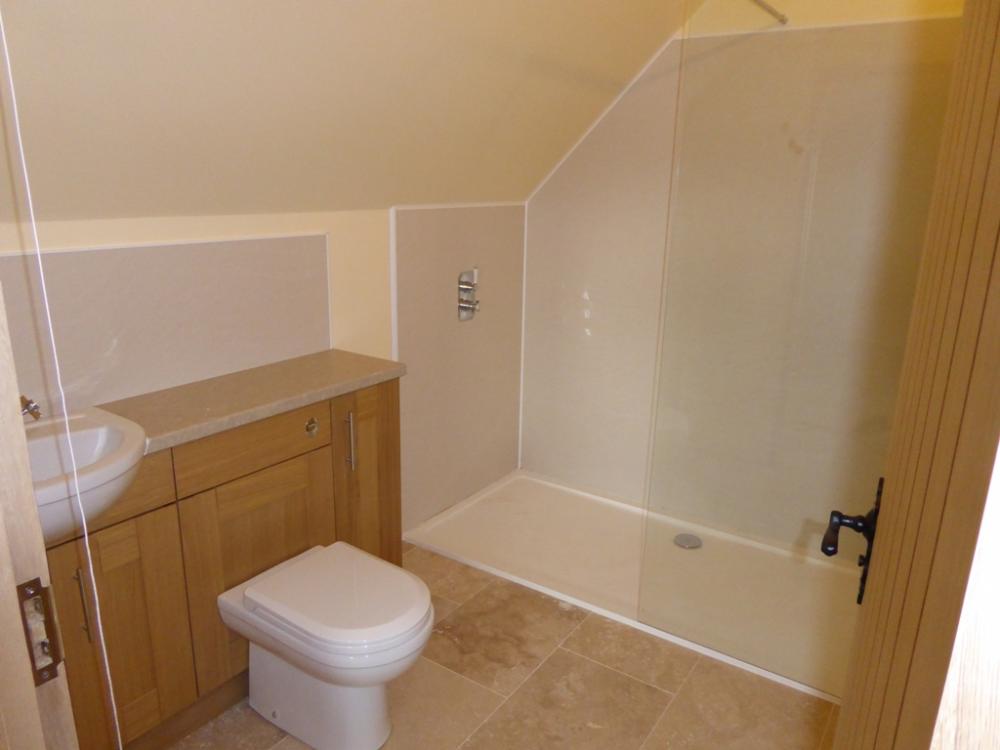
I fitted a 2000 x 900 tray, with a fixed glass screen. The screen just sits on the tray edge with a bit of clear sealant:
-
Shower tray at floor level
Jeremy Harris replied to Pocster's topic in Bathrooms, Ensuites & Wetrooms
Choice of shower head makes a difference, too. The hotel we stayed in last week had a really nice design of shower head that directed the spray over a fairly wide area, but with no tendency to splash out. By contrast, the head we have has a narrower spray pattern, but it does tend to splash, so we have to remember to turn it to face the wall a bit before turning it off. It'd be really useful if bathroom showrooms were plumbed in, so that the spray pattern of a shower could be checked. FWIW, the shower head at the hotel was (I think) a Grohe Rainshower Next Generation Solo. It was definitely Grohe, because I made a note of it, but I'm not 100% sure of the exact model yet. -
Could also be that, as it's behind the bed headboard, the local RH is slightly higher, from exhaled moisture. The combination of a cool wall, plus a dead space as far as ventilation is concerned, and a locally elevated RH could well be the cause. The fix I used in our old house for a problem area like this (behind a chest of drawers) was to fit a small, low voltage, computer fan behind the chest, run from a DC power supply that was plugged in to a time switch, so that the fan ran during the daytime to ventilate that area, but turned off (for noise reasons) at night. Seemed to work well.
-
"strength" of a standard concrete slab with UFH
Jeremy Harris replied to Tom's topic in General Construction Issues
I have a feeling that floor loadings are now all in one or other of the Eurocodes (don't have that one to hand). IIRC, Part A just references Eurocodes for various floor construction methods. In practical terms, our 100mm thick slab, that has A142 steel fabric in the centre, UFH pipes tied to this, and uses C30 concrete, is compliant. -
I don't recall ever being involved such a discussion with you here before, and cannot seem to find any thread in my posting history where the topic of ventilation/MVHR and air quality has been debated with you. All I can find from a quick general search is a thread from October 2016 (when I was away and not posting here) where you seem to have been debating this with others here. It's not something I'd read before, TBH, as it seems the thread was locked for some reason. I also believe this is very much "on topic", given that the OPs problem seems related to ventilation, plus, I suspect, the internal surface of an external wall that is dropping below the local dew point.
-
Shower tray at floor level
Jeremy Harris replied to Pocster's topic in Bathrooms, Ensuites & Wetrooms
I went sort of half way, and set the base of our shower tray part way down below the level of the finished floor. I used 9mm marine ply as a sub-base for the tiles, glued and screwed to the OSB flooring, and fitted this after I'd put the shower tray in. The flooring is 12mm thick travertine, so, allowing for ~2mm of tile adhesive, the base of the shower tray ended up around 22mm lower. This left the top of the tray sticking up around 15mm above the finished floor. I did seal around the tray before fitting the marine ply, then sealed it again after fitting the marine ply and before laying the travertine, then ran a final seal around after finishing off the travertine. With luck I don't think it's likely to leak.