Jeremy Harris
-
Posts
26430 -
Joined
-
Last visited
-
Days Won
360
Everything posted by Jeremy Harris
-
I did indeed do exactly this. The house took days to cool down. It's really important to not put too much heat into the slab too quickly, I've found, to prevent overshoot.
-
 When we were looking around at different build options, we were invited by a timber frame company to look at a small development of 6 houses they were building. Part way through being shown around, the sales chap was called away to the site hut to take a 'phone call, leaving us in one of the houses with a chap that was busy taping up inside. I asked a few questions, and the chap volunteered the information that the taping was for the third attempt to get an airtightness pass. He also added that it was a good job that they didn't need to faff around wasting time like this on the others, as only one of the six needed to be tested... Things I spotted just walking around for half an hour were badly fitting/missing cavity wall bats, no cavity closers around windows, the poor approach to airtightness and generally poor build quality pretty much everywhere. Worst bit was having to be polite to the sales chap whilst making an excuse to just go home, as we'd seen enough to be cross that firm off our list.
 -
It most probably wasn't ever tested. Mass house builders don't have every house inspected or air tested, they are trusted to make all their houses the same as the small sample of houses that actually do get inspected.
-
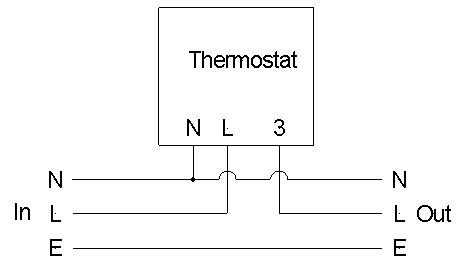
The connections on the thermostat are neutral, line in and switched line out (terminal 3). Connect the incoming neutral (blue) to the N terminal, and also to the heater neutral (either cut the plug off or add a single gang outlet wired to the thermostat). The incoming line (brown) goes to the thermostat L terminal and the thermostat terminal 3 connects to the line on the heater (or the socket, if you opt to wire it that way). The supply that goes to the thermostat needs to be fused or otherwise protected to match the size of cable used in this case. You can either choose to wire it up to a lead with a 13 A plug, using a 3 A fuse, or you could wire it to a switched fused connection unit, also with a 3 A fuse. Make sure the incoming earth connects to the heater (there's no earth on the thermostat).
-
Probably not very. Somewhere I have a hot plate oxide CO2 sensor, I'll try and dig it out. Main problems I found were drift, relatively high power consumption, a fair bit of temperature instability and not great at measuring CO2 levels below a couple of thousand ppm. The best sensors are the NDIR ones, that use the variation in absorption of a specific light wavelength to measure CO2 concentration. The ones I have are older versions of these: https://www.amphenol-sensors.com/en/telaire/co2/525-co2-sensor-modules/321-t6613
-
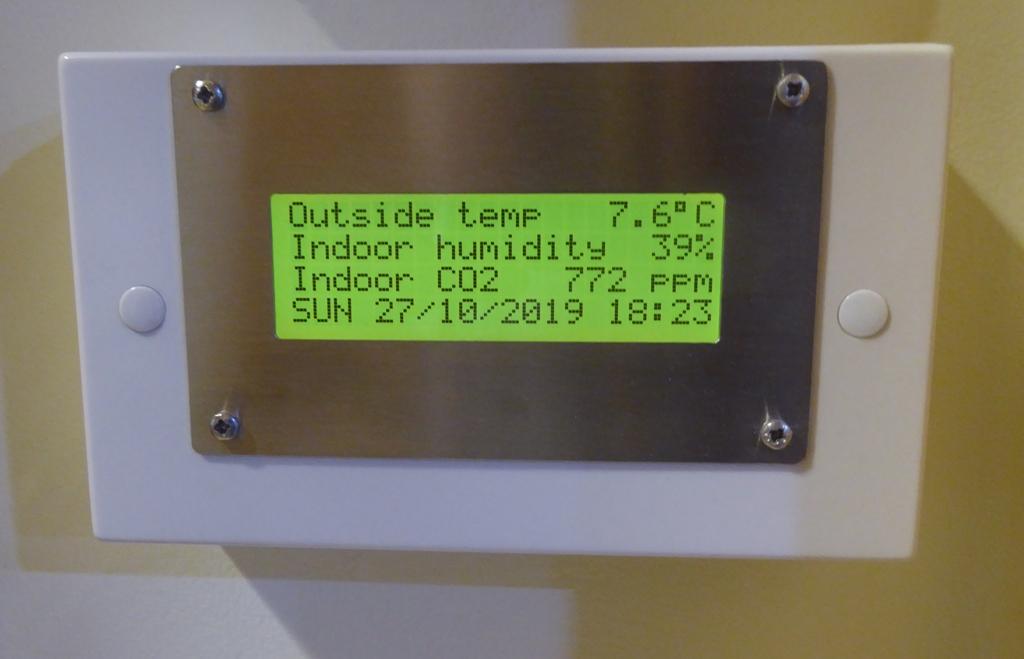
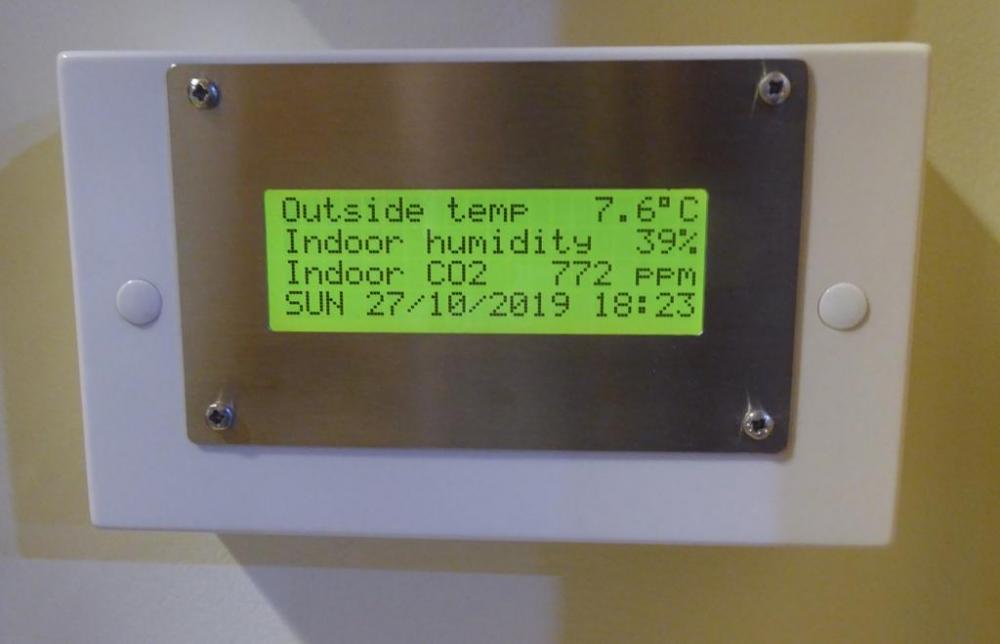
The main problem is that decent CO2 sensors are still fairly expensive. I bought some surplus ones from the US, as a batch of 5, but even those were around £20 each, IIRC (their list price was around £80 I think). I have this display on the wall in the hall, which is a subset of all the data that's logged to a USB stick every 6 minutes. It's also a handy time reference, as it gets time from a GPS module mounted high up in the services room. GPS time is pretty accurate, and not hard to adjust in code to allow for daylight saving time.
-
Uponor balancing using return lockshield
Jeremy Harris replied to DIY_Amateur's topic in Underfloor Heating
We have exactly the same thermostatic valve system, with a remote capillary sensor that fits in the flow manifold. Two things I've discovered are that the calibration of the valve head is pretty rough and ready and the dial-type thermometers are very inaccurate. I've looked around in vain for anyone that stocks replacement thermometers, in the hope that I can find some accurate ones. In the end, I just stuck self-adhesive liquid crystal temperature measurement strips to both manifolds. Not easy to read, but they do seem to be consistent with each other. The ones I bought have a scale that runs from 18°C to 34°C, in 1° steps. -
Mine wouldn't have, either. Thankfully she was every bit as switched on when she became really infirm as she always had been. Stubborn, too. Practically every time we spoke she mentioned leaving us all an inheritance, to be split equally, and every time she mentioned it I told her I didn't need it, and she should just spend my share. Of course, being stubborn she refused.
-
First I'd heard of this, seems like a really good idea, and a way to get a bequest to a charity included in wills: https://freewillsmonth.org.uk/
-
Buried IBCs will need to be in some sort of shored up hole, as they probably won't tolerate the pressure of the surrounding earth without collapsing, I suspect. If worried about them floating up, then some concrete sleepers over the top should work OK, and form a solid lid on the hole, one that can be lifted in sections for access, if need be.
-
@NSS is our resident Sage glass expert, hopefully he'll be able to shed more light on these questions. When I looked into it as a retrofit, the cost looked to be ~£1000/m², and the wiring connections did look as if they could be accommodated in a fairly wide range of frame options. Whether the wiring can deal with multiple hinges in a bifold I don't know, especially given that bifolds are already pretty challenging to get to a reasonable airtightness level, and airtightness is known to get worse with time. I suspect it might be fairly dependent on the way the hinge and seal systems work. AFAIK, the thermal performance is pretty much on a par with ordinary 3G, with the added benefit of being able to control the amount of solar gain. This ability to control solar gain is the thing that I think makes Sage glass really attractive as an option. As I understand it, the solar gain can be varied over a fairly wide range, so if some additional heat is needed on a sunny day in cool weather that can be fairly accurately dialled in.
-
Yes, and the new Tesla... We'd already planned things so we have what we think will be enough of a savings buffer, together with our pensions, to sustain us in old age, plus a "holiday fund" that we've been saving towards for years, so we can have holidays each year. The inheritance came with instructions to not just put it into more savings, so I've opted to spend about half of it now, and will decide later what to do with the rest. Mind you, it's anyone's guess as to how much we may need in old age. I just hope that neither of us ends up like my grandmother, who spent her last few years not knowing who anyone was, or even where she was. If we had a pet that was in that state we'd do the "humane" thing, perhaps.
-
I thought my Mother had pretty much spent all she had, and knew she'd taken out an equity release on the farm, years ago, to give her a bit more cash. I was a bit gobsmacked a week or so ago to find that she'd left us all a pretty substantial inheritance, TBH, came completely out of the blue.
-
The custom sizes I used last time were 417mm x 220mm x 50mm for the F7 intake filter and 417mm x 220mm x 25mm for the G4 extract filter and these fit the Premium 1L unit we have OK. However, I have found that the filters tend to get slightly squashed, lengthwise, by the neoprene seals, so I'm going to get the next batch made up 2mm shorter, 415mm long rather than 417mm long. I've measured the filters after they've been in the unit and they seem to compress to a bit under 415mm long.
-
Perhaps worth considering the likelihood of a high water table event coinciding with an empty tank event, too. It seems probable that the only times the tank(s) may be empty is in dry weather, when the local water table will almost certainly be low. If the weather's wet then there won't be any need to use water from the tanks for watering plants, plus the tanks will fill up fairly quickly, .
-
Welcome @Rob Johnson. I find the intake filter (F7) tends to get very grubby after 6 months. Sometimes I can vacuum it out and re-use it, sometimes it's too grubby to clean that way so gets replaced. The room extract side filter (G4) barely gets dusty, and can easily be vacuum cleaned a couple of times or more before replacement. Filters are an odd size and spec, and very expensive from the UK Genvex agent (as are the Genvex units themselves - their markup is massive). I had a batch of filters made up by Jasun Envirocare a couple of years ago, and am just about to have another batch made, as I'm down to the last spare intake filter. In my next order I'm going to get twice as many intake filters as exhaust filters made up, as I still have four exhaust filters left over from the last batch I had made. The last batch cost £12.19 + VAT each for the F7 intake filter and £5.50 + VAT for the extract side filter. The filters that were supplied looked absolutely identical to the Genvex ones, apart from the label. Quite how the UK Genvex agent can charge £41.87 + VAT for the intake filter and £12.15 + VAT for the extract filter I don't know. It seems that rip-off Britain is alive and well!
-
unbearable stench - what have I done wrong
Jeremy Harris replied to Tin Soldier's topic in Waste & Sewerage
Possibly enough of a pressure build up behind the blockage to force gases up through a trap, or maybe even the AAV? It probably doesn't take a lot of back pressure to allow bubbles to pass backwards through a trap. -
If run at typical UFH flow temperature then the towel rails wouldn't even feel warm to the touch, I think, plus you may well find, as we have, that in the heating season the UFH only comes on for an hour or two every couple of days. I opted to fit electric towel rails, wired to a circuit that includes a time switch, so that circuit comes on for a couple of hours each morning and evening. Seems to work well.
-
"Padding" GRP to improve falls at raised edge / above rooflight
Jeremy Harris replied to andyscotland's topic in Flat Roofs
Polyurethane foam sheet is the stuff used with polyester/vinylester resins usually. Available in fairly thin sheets from many GRP suppliers, like this: https://www.cfsnet.co.uk/acatalog/CFS_Catalogue__Polyurethane_Foam_Sheet_417.html It can usually be shaped and sanded without too much hassle, although it's a messy job. PIR should work as well, but may be a bit harder to shape. -
Boiling Water taps. What and where to buy.
Jeremy Harris replied to ProDave's topic in Kitchen & Household Appliances
Our tap came with a tee and fitting to connect the tundish outlet to the waste pipe: The parts look like standard 1 1/2" compression waste fittings to me.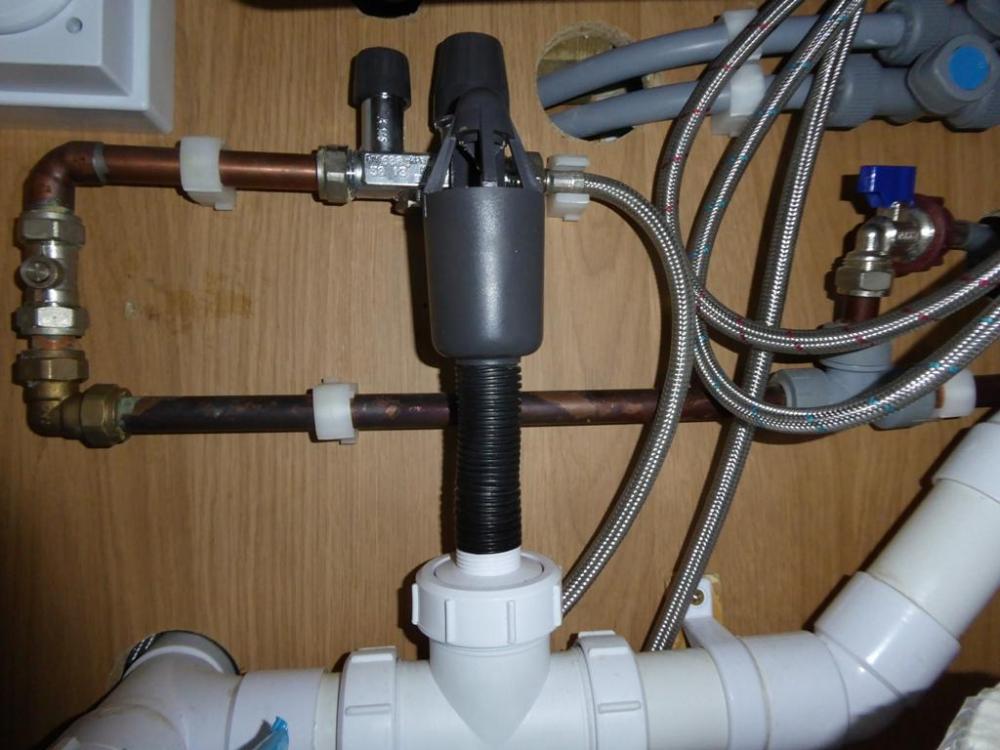
-
I'm not, but others are. Yes, you can both heat hot water and cool the floor with an ASHP, it just needs a motorised valve to close off the tank when the floor cooling is on, plus a valve to open and close the UFH, with the hot water set to priority. What happens is that if the tank calls for heat, if the floor cooling is on then the UFH valve closes, the tank valve opens and the ASHP is turned on in hot water mode. When the tank is up to temperature, the ASHP turns off, the tank valve closes and the UFH valve opens. If cooling is still needed the ASHP then turns on in cooling mode.
-
Boiling Water taps. What and where to buy.
Jeremy Harris replied to ProDave's topic in Kitchen & Household Appliances
I'm not convinced of this at all, as our tap very definitely delivers water at 100°C , has this engraved on the tap itself and the spec states that the boiler operates at 105°C . There's no doubt at all that the water coming out is boiling, probably as a result of the pressure reduction as superheated water comes out of the nozzle. Our unit is WRAS approved and was supplied by a UK supplier. -
I like the idea, but there are serious social consequences from having isolated houses in the countryside. My late mother lived in a farm that was only about 5 miles from the nearest large town, but was a bit isolated, being set on what was almost moorland, on the side of a hill. When she became infirm, through age, it turned out to be near-impossible for her to have care at home. The contracted care providers weren't paid for travel time between visits, so they were really unable to either spend enough time with her on their twice daily calls, or complete all they needed to do before they had to rush off to look after someone else. My brother worked hard to get better care, but even trying to buy it, rather than use the NHS/LA facilities proved very difficult, as all of the care providers much preferred to have clients living within an easy to access conurbation. Add in the impact of bad weather (Cornwall tends to be wet and windy) and the disbenefits from living in an isolated home multiplied. Even simple things, like getting someone out to repair the heating, were made significantly harder by being away from a town. One reason we've opted to build in the middle of a village, that has pretty good health and social care available, is the thought of what might happen if we live long enough to need support and care at home.
-
Boiling Water taps. What and where to buy.
Jeremy Harris replied to ProDave's topic in Kitchen & Household Appliances
Not a bad overall decision to make, it depends very much on just how much drinking ion exchange softened water changes your daily sodium intake, and how that effects the balance between sodium and calcium ion intake overall. There isn't a lot of sodium in softened water from moderately hard water areas, and it was something I looked at closely, as I've been on a low sodium diet for over 30 years now. I added up my average daily sodium intake, allowing for 3 or 4 mugs of tea made from softened water (at the water hardness level we have here) and found that the additional sodium from the softened water about the same as that from the milk I put in my tea. Overall, four mugs of tea made with softened water added up to about 4% to 5% of the NHS recommended daily sodium intake. I'd caveat this by saying that our water isn't super hard, so our softener doesn't exchange lots of calcium ions for sodium ions, and for those who have very hard water it may be that the sodium ion concentration could be a bit higher. To put this into perspective, 1 packet of crisps contains around 140 to 150mg of salt. For our water, that is equivalent to about 1.2 litres of softened water. -
The real problem is that the government is inept at dealing with commercial stuff like this, and seemingly always has been. Many years ago I went out with a young lady that worked in the land and property management bit of MOD, at Chessington. They were our supposed "experts" on land management, sales etc, but frankly my impression was that they were pretty hopeless, and regularly got well and truly shafted by the big commercial players in that market. The same seemed to be the case when we privatised and rationalised defence research. In that case we managed to employ a character who turned out to be extremely adept at lining his own (and his wife's) pockets at our expense. He did nothing wrong (except morally, IMHO), he was just astute enough to see how he could exploit the lack of expertise within government. As a former colleague, Les Salmon, said to me more than 20 years ago, he was a man "unencumbered by self-doubt". Pretty much the opposite of most of the senior civil servants I ever worked with.