Jeremy Harris
-
Posts
26430 -
Joined
-
Last visited
-
Days Won
360
Everything posted by Jeremy Harris
-
Mine has a bit of 15mm armorflex neoprene insulation over the handle, wrapped with black electrical tape. Works OK.
-
The majority of ant powders use permethrin or a similar pyrethroid, and will break down within a few days in soil, so I doubt that adding this to the sand would be anything other than a short-term solution. With luck, the low temperature under the insulation will be below that at which ants can thrive. Ants seems to do very well under paving that gets warmed by the sun, but rarely seem to appear under colder paving, at least around our old house. We have some slabs by our old front door that is plagued with ants every year, and that sees a fair bit of sunlight. The same slabs laid the same way by the back door never seem to attract ants, but that are is always in shade.
-
The last boat I built I used some water-based two pack epoxy floor paint to finish the interior and floors. I'm so impressed with the stuff that it's what I'm going to use in the new garage/workshop. Not as expensive as some epoxy floor paints, either, my only reservation with the stuff is that it is quite thick and fairly hard work with a roller, but it does give a fairly non-slip and extremely tough finish. It was this stuff: http://www.resinstore.com/conseal-utility.html.
-

Help me deal with a neighbour!
Jeremy Harris replied to hmpmarketing's topic in General Self Build & DIY Discussion
Yes, that's right, and I had a running battle at our old house with people going to church on the other side of the road parking across our drive and stopping us getting out. The police got so fed up turning up to get cars shifted they asked the council if they would consider painting yellow lines, the council replied they didn't need to as it was already illegal parking, both because it was blocking our exit and because it was less than 30m (I think) from a junction. In the end, the problem was only sorted by a change of vicar at the church. The new one agreed to read out a regular notice at each service about consideration for others when parking. -
No, there's no need to at all, as the UFH will always be just a degree or two above room temperature. Standing on the floor in bare feet makes that bit a lot warmer than the UFH! We used a flexible adhesive, standard set, I can't recall the brand but think it was one Nick had mentioned as being pretty good.
-
Your UFH will run a great deal cooler than any bit of floor exposed to the sun in summer, so there's near-zero risk of it cracking. We have around two thirds of our ground floor in 12mm thick travertine, which is very similar to limestone in composition. Our UFH runs the floor at an absolute maximum of around 23 deg, if that; most of the time it sits at 22 deg C or less.
-
I went through this with the TRADA detailing, and they too advise vertical counter battens, with a gap at the bottom of any that are over window and door heads to allow cross-ventilation. Their detail calls for specially formed aluminium flashing, made to slip under the breather membrane, with a tall enough upstand to be trapped under the counter battens. This then continues down and out, to deflect any penetrating moisture away from the inner structure. The heads are fixed to short intermediate counter battens fitted between the main counter battens, so that the ventilation path is maintained. I didn't have time to find someone to bend up custom aluminium flashing (but have since heard that the people that made our aluminium dry verge will do it) and so I used non-lead flashing, the stuff that has something like aluminium mesh embedded in some form of plastic, that is lead-coloured. It was easy to shape this to fit. Don't be tempted to use lead, as it may stain the glass underneath permanently if any run-off gets blown onto the glazing..
-
Excessive Cost of Sewage Treatment Plants
Jeremy Harris replied to Ferdinand's topic in Waste & Sewerage
The non-digestible stuff can't disappear, whether it's eaten by aerobic bacteria or worms, so there will always be some solids build up in any system. The issue is really how long it takes for the sludge build up to cause a problem. Some manufacturers advise optimistic sludge pump out periodicity, like ours, at three years. @PeterStarck had a problem with sludge build up blocking the aeration holes and causing an early pump failure, so my inclination is to either check regularly to see how much sludge is building up, or play safe and de-sludge the system every couple of years. The cost of a pump-out around here is about £120, so not too bad over a couple of years, and still cheaper than mains drainage. -
This is going to sound daft, but I use a cheap, heavy duty plastic builders bucket, fitted with one of these: http://www.ebay.co.uk/itm/Makita-Tool-Bucket-Tote-Bag-P-72095-Toolbag-Fixings-Bag-Organiser-18-Pockets-/150847742556?hash=item231f39e25c:g:ohIAAOSwLnBX4UKe and it works well. I think the key thing is that it's deep, so the centre of gravity is low when it's full of stuff, plus the pockets make it easy to get at stuff.
-
Design Help - Plumber not helping
Jeremy Harris replied to DeeJunFan's topic in Other Heating Systems
You need a very high air flow rate, so make the duct very large - think US-style warm air heating duct size. Air has such a low heat capacity that you need to move a lot of it to shift a reasonable amount of heat, especially if the temperature difference between the "hot" area and the "cool" area is small, say a couple of deg C. The sums are reasonably easy. Air has a heat capacity of around 1.297 J.l.K, so 1 litre of air that's 2 deg C warmer than the surrounding air will hold around 2.594 J of heat energy, or about 0.0000007205555556 kWh of heat energy. If you had an air flow rate of 10 times more than the MVHR kitchen extract rate in the regs, of 130 l/s, then, with a 2 deg C temperature differential the heat transfer rate would be around 337 W. If you want to do the sums for any flow rate and temperature differential, then 1 litre per second of air flow rate, with 1 deg C temperature differential between the "hot" and "cold" ends, gives a heat transfer rate of 1.297 W. You can determine the heat transfer rate for any air flow rate and temperature differential you like from these numbers. For example, for a 10 deg C temperature differential and 10 litres/second air flow rate the heat transfer rate (in watts) = 1.297 x 10 x 10 = 129.7 W. As another example, let's say you wanted to shift 1 kW of heat energy from one room to another, with the "hot" room being 22 deg C and the "cold" room being 20 deg C. A 2 deg C differential temperature means a 1 litre per second air flow rate can transfer 2.594 W of heat. To transfer 1 kW would mean having an air flow rate of 1000 / 2.594 = 385 litres per second. These poor transfer rates illustrate one of the reasons why MVHR cannot move a significant amount of heat around; the flow rates and temperature differential is just too small. It's also why warm air heating systems need very large ducts (US ones I've seen are around 18" wide and maybe 12" high) to allow high air flow rates with a relatively low flow velocity. -
British Geological Survey for ground source heat pumps
Jeremy Harris replied to vivienz's topic in Research Resources
That BGS/NERC study was done a long time ago, now (2005), but was what our hydrogeologist used when producing the report for us when we were looking at using a borehole system for a GSHP. The second borehole would have been cheap for us (relatively speaking) as we had to have a borehole for water, anyway. Even with this much-reduced collector cost, we still still couldn't justify a GSHP, as it was still never going to come close to paying back the saving in running cost, in fact the periodic antifreeze replacement was going to cost more than the energy saving over an ASHP. The ASHP only uses about £20 worth of antifreeze, whereas the GSP was going to need more than £250 worth of the stuff, plus the waste disposal cost. Given the poorer thermal conductivity and heat capacity of antifreeze/water mix when compared to just water, I did look at whether it would be possible to limit the return temperature to ensure it was always above freezing point, so that corrosion-inhibited water could be used in the primary circuit, as there's about a 10 to 20% performance improvement by doing this. I also looked at using a standing column primary side system, using the same borehole as used for the water supply, as used in Canada and the US. Sadly the sums didn't workout for this option, unless the heat pump is massively over-sized, which just pushes the capital investment up even higher. The other thing that hits overall GSHP efficiency, and which I found wasn't always included in the COP calculations, is the circulating pump power on the primary, collector, side. Often a fairly sizeable pump is needed, especially with a standing column collector, and this effectively reduces the COP a bit, unless it's already been accounted for by the manufacturer. -
@Ted Nicholls, like a few others here, our new build is zero carbon (it's actually CO2 negative, at -0.9 tonnes of CO2 per year, compared with a UK average home at around 6 tonnes of CO2 per year) and it didn't cost any more to build the basic airtight, insulated, structure than a conventional house. However, the problem isn't not being able to build houses like this, it's that people buying houses don't, in the main, give a stuff about energy efficiency. When completed, our house was valued at 5% below the value it would have had if it had used energy, rather than being a net generator, because the valuation surveyor rightly pointed out that the majority of buyers just aren't interested in energy saving, and many might be put off buying our house because of it's energy efficiency rating (A107). Apparently, buyers are more swayed by kitchen and bathroom bling than they are by energy efficiency or zero carbon, so people, as in consumers, are not likely to be the ones to drive any change in the building industry, at least whilst energy is relatively cheap.
-
Help me deal with a neighbour!
Jeremy Harris replied to hmpmarketing's topic in General Self Build & DIY Discussion
Looking at the plot, it looks as if both number 14 and number 12 have already done some deal to allow the entrance, as corners have been chopped off each plot. I suspect this means they are both 100% aware of the need to keep that entrance clear, and also are aware of the fact that no one has a right to park on the road right outside their house. As @joe90 says, this is the council's problem to deal with, perhaps with whoever owned the land that your plot is now on (Number 14 by any chance?), as the access must have been a significant planning consideration when granting permission for your plot. If your plot was owned by number 14, or his predecessor in title, then there is even less reason for you to be concerned about the removal of the white lines on the road. -
Design Help - Plumber not helping
Jeremy Harris replied to DeeJunFan's topic in Other Heating Systems
I think I've related this before, but a couple who came to the open weekend event we held, under the Green Doors scheme, had just completed a house that was very like ours in terms of spec, but they'd fitted the smallest room-sealed woodburner they could find, as they wanted a real fire in the living room. The unit they fitted looks like one intended for a canal barge, it's that small, and has an output of around 3 or 4 kW, IIRC. The Christmas before last they lit it for the first time. Within half an hour they all had to abandon the living room, with all the windows left open, as the room temperature got well over 30 deg C. It pretty much spoilt their Christmas, as the room stayed too hot to enter until Boxing Day. They've never used it since, and when I last spoke to them they were looking at fitting an LCD screen inside the fire so they could make it look as if it was lit. Like us, their house barely needs any heating in winter, and chucking around ten times the whole house heating requirement into one room was the cause of their problem. When it comes to MVHR with heating/cooling, then I can say from experience that delivering heat this way is unpleasant and not very effective. We have an MVHR with a built in reversible air to air heat pump, and it's pretty good for summer cooling, but it makes the air very dry if used for winter heating. I have the heating part disabled, because of this, and just use the cooling function on very hot days. -
Can you get Brick-Built cubicles from Jewsons?
Jeremy Harris replied to ToughButterCup's topic in Electrics - Other
I mentioned in the other thread about address registration the delay some companies have in updating their address records from the PAF database. I can say that our electricity supplier (also our DNO) is far and away the worst, and is still wrongly addressing correspondence, after at least 4 calls from me to correct the address. Each time they promise they've updated their database whilst I'm on the phone; three months later it is always still wrong.............. -
Welcome. I think it hinges on who the "us" is in this part of the covenant: You could argue that consent is being "unreasonably withheld or delayed", as the planners don't have a problem with it and it's presumably not in breach of any byelaws. I think you probably need some legal advice as to how to interpret this, but my view would be that there isn't much the objecting co-owners could do. They could only sue you if the alteration in some way damaged their enjoyment of their own property, or if there was some other negative impact. Not liking the look of something wouldn't be grounds for action, I'm sure.
-
My experience with CEF, the local branch, was that their prices were pretty steep. IIRC, they were nearly £2k more, just for the cable, outlets, switches, boxes, CU, wagos etc than the price we paid for the same brand of stuff online. To out that in perspective, the total cost of all the electrical materials (excluding appliances etc) we paid was around £2.6k, and CEF quoted around £4.5k. To be fair, they weren't that much more than the two other electrical factors locally; all of their quotes were well over £4k.
-
With an unheated space below I think a little heat in the bedroom above makes sense. I've been logging temperatures around our house for a few months now, and with both our bedrooms over heated rooms they stay a pretty constant 1 deg C cooler than downstairs, in winter. The floors aren't, apparently, cold to walk on upstairs, according to my other half, who tends to walk around barefoot, but I bet they would be if sat over a garage, no matter how good the insulation is underneath.
-
I do hope we don't have any tank problems, as that would be expensive to sort, now that the price has been hiked up so much. It's been OK for a couple of years, so fingers crossed it's got over the initial part of the reliability bath tub curve. There was a change to the design of the push button that pre-dated our first tap, as Itho have instructions on how to replace a moulded plastic part with a newer design of metal part on their website. Our old tap already had the newer part fitted, it just had the drilling flaw. I get the feeling that they may have marketed this before they'd ironed out some reliability problems, from the sound of things. At a guess, I'd say it may well have been a consequence of trying to get a combination 3 way tap to the market before some of the competition. When we were looking around in late 2013, early 2014, the choice was limited. The Qooker at that time looked a bit dire, and when I found the Itho, at a better price than the Qooker, it looked like the best choice. Since then, Qooker have revised the styling, and if we were looking to buy one now I'm pretty sure it would be a Qooker. In some ways it's a pity that Qooker didn't update their range a year earlier.
-
Concrete Screed for wet UFH - advice please
Jeremy Harris replied to JohnW's topic in Underfloor Heating
I should be able to take a stab at this with the next lot of data, but I think it's a bit better than 3:1 pretty much all the time, with the relatively low flow temperature and no defrost cycling. It seems that, in winter, I'm probably putting between 0.5 and 1.5 kWh as heat energy into the house per day, so around £0.02 to £0.06 per day in electricity cost. The air pump in the sewage treatment plant costs about £0.135 per day to run, so a fair bit more than the heating for the house. -
Concrete Screed for wet UFH - advice please
Jeremy Harris replied to JohnW's topic in Underfloor Heating
To be honest, once you get down to low heat energy input levels it doesn't much matter what you use to get that heat energy. In our case, the additional overall cost of an E7 electricity tariff here makes it pointless, we're better off using the lowest standing charge standard tariff. We find that the input power to our ASHP rarely exceeds about 800W, and then only for an hour or so every couple of days, and most of the time it's on for that hour or so it's only drawing around 400W. The cost is so low as to be less than the cost of running things like the sewage treatment plant air pump and the UV water disinfection unit we have. Hot water is far and away the highest energy demand, far greater than heating the house, and it was a challenge to come up with a reasonable compromise. I've concluded that once you get down to only needing such a low level of heating, it makes more sense to separate out hot water system design from the heating system design, because they have such differing requirements. -
We have low walls in our vaulted rooms and so I just fitted the ducts and terminals in there, around 1.2m above the floor. In one bathroom I made a narrow ceiling so I could run the duct for it along there, and the duct for the adjacent bathroom, that comes out high on a dividing wall.
-
Concrete Screed for wet UFH - advice please
Jeremy Harris replied to JohnW's topic in Underfloor Heating
Bear in mind that for a new build Part L ( https://www.gov.uk/government/uploads/system/uploads/attachment_data/file/540326/BR_PDF_AD__L1A__2013_with_2016_amendments.pdf ) has tightened up on things like thermal bridging and heat losses from UFH, so what may have been acceptable under the last edition may not under the current regs. The changes are mainly intended to stop the horse trading big developers were doing, by fitting a handful of solar panels on the roof and then cutting back on insulation, as the PV improved the TER enough to get a pass despite the house being pretty poor in terms of insulation. There are also notional model design guideline values for fabric U values that are suggested as a way to get a low enough TER/TFEE, and the floor U value in that table is now 0.13 W/m².K, not the limiting fabric value of 0.25 W/m²/K. UFH must also not lose more than 10W/m² into the ground, maximum. This isn't a tough target to meet if you have a low overall heating requirement, but would be tough to meet if you build to the limiting fabric U values, I think. Edited to add: This is the compliance guide for new build domestic building services, including UFH: https://www.gov.uk/government/uploads/system/uploads/attachment_data/file/453968/domestic_building_services_compliance_guide.pdf -
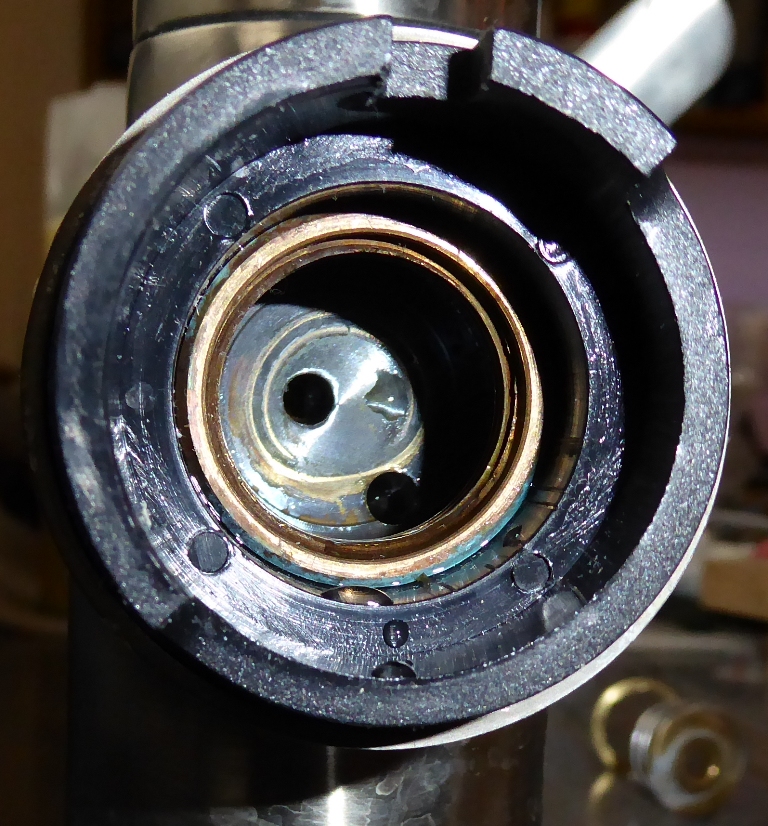
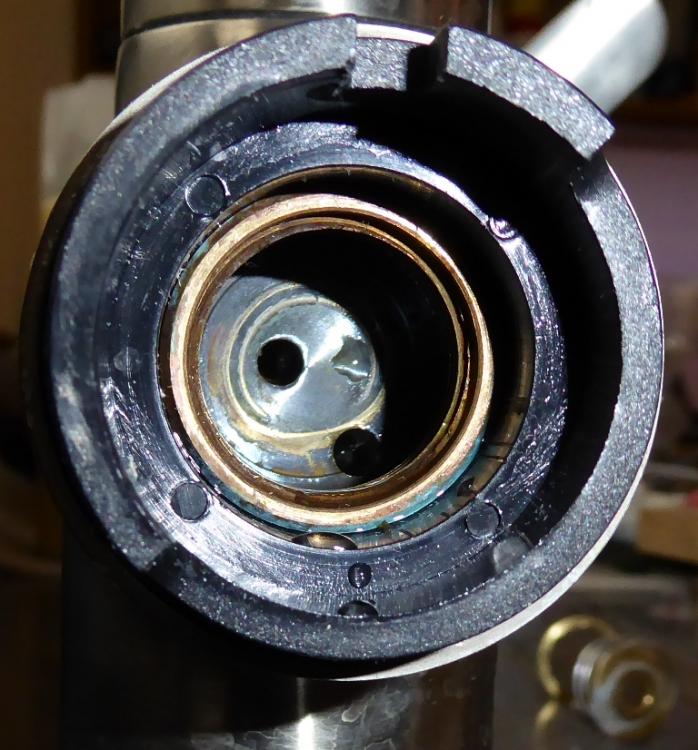
Out of interest, was it the taps that failed with the Franke? The reason for the failure of our tap (2013 model, now superseded with a different design) was the drilling in this photo being far too close to the edge of the ceramic valve base seal: You can clearly see where the bottom drilling is right where the seal should be seating (the mark is the stain left by the seal). On the new design that drilling isn't there, it comes in from the side of the bored hole, leaving the bottom of the recess flat for the seal to bed on properly.
-
Can you get Brick-Built cubicles from Jewsons?
Jeremy Harris replied to ToughButterCup's topic in Electrics - Other
Our box is on the back of a thick fence that is the screen for the wheelie bin storage area. The front of this fence is clad with larch, the same as the house, to hide the back of the meter box from view. Like Dave's, it has a single pitch "roof" over the top to keep the weather out. The meter box is completely out of sight now, and only visible from the rear, but still easy to access by the meter reader just by walking up the path by the side of the house.