Jeremy Harris
-
Posts
26430 -
Joined
-
Last visited
-
Days Won
360
Everything posted by Jeremy Harris
-
 I've just had a poke about on ebay, and it looks like one of these speed controllers should work OK with a normal electric car radiator fan: http://www.ebay.co.uk/itm/20A-Universal-DC10-60V-PWM-HHO-RC-Motor-Speed-Regulator-Controller-Switch-AM-/253089458063?epid=874428193&hash=item3aed4ea78f:g:W3wAAOSweNxZjSGv
 -
Interesting policy nudge in North Dorset
Jeremy Harris replied to vivienz's topic in Planning Permission
Some payments can be due when work is started, some are on completion. For example, in my last job we had an S.106 for road improvements and new traffic lights. We had to pay that up front. Part of that was due to the requirements to provide better access for construction traffic, but a "side effect" was that it also meant a much-improved road junction and some resurfacing work that the council had scheduled to do anyway. The council will also be able to account for receiving the payment of S.106 and CIL at a future date, I think. I've never really got my head around the way accounting works, but do remember that I was allowed to take account of future guaranteed revenue when I was running a business unit within a Trading Fund. I would assume that councils can do much the same. -
I'll see if I can dig around for a suitable DC brushed motor speed controller later. As for the smoke issue, I can confirm that it definitely does get sucked in through an MVHR intake and then efficiently spread through every room in the house. Our neighbour lit a bonfire a while ago and the whole house smelt of smoke within a few minutes. I shut the MVHR off, but the smell then stayed in the house for ages, and didn't really clear until the bonfire had gone out and I turned the MVHR back on again. TBH, I can't see an activated carbon filter being that useful, as it would need changing very regularly if exposed to smoke regularly and would probably be pretty expensive in terms of additional running cost. With a fairly regular source of smoke the capacity of the activated carbon would quickly get used up. It might be OK for a situation where someone has a bonfire a couple of times a year, but I can't see it dealing with smoke on a near-daily basis, somehow.
-
I agree, although it did throw our building control officer into a bit of a wobble, as he'd never seen one over 100 and assumed that 100 was as high as you could get.
-
Interesting policy nudge in North Dorset
Jeremy Harris replied to vivienz's topic in Planning Permission
Yes, they can, but they get deal of money from granting PP to sites that won't be developed for some time, in both CIL and S.106 payments. For a cash-strapped local authority (and Wiltshire was proud of keeping Council Tax increases at 0% for 5 years, during a time when inflation was running at a couple of percent), getting a lot of infrastructure payments from big developers is a hell of an incentive to "play the game"..................... -
Interesting policy nudge in North Dorset
Jeremy Harris replied to vivienz's topic in Planning Permission
I agree, but the curious thing was that at least one of these sites started closing up about a week or so before the Northern Rock fiasco, so the developers could clearly see the writing on the wall an acted very quickly to close down this development (followed by two other large developments shutting down shortly afterwards). The frustrating thing is that here, house prices didn't crash, they just levelled out a bit, then started increasing again, albeit at a much slower pace. To me that indicates that demand was still strong, and that finance was still available to those who wanted to buy here. This fits with the pattern of local employment. I was in the process of moving around 800 to 900 families into the area, the majority of whom were moving from areas where house prices were fairly high, so they had a fair bit of equity. That alone accounts for around two to three years worth of house sales and purchases in this area. In addition, the financial sector companies operating locally were doing much the same, albeit on a smaller scale, and rationalising operations from their local offices, so also moving people into the area on relocation schemes. The problem we faced was the shortage of houses. We dearly wanted the developers to build some houses, as there was a local shortage (it's why prices didn't crash here, I believe). However, talking to one of the former sales people, who was laid off when the site was mothballed, her view was that her former employer had forecast profits based on the prices of the houses on the new development rising as each phase was released, and would rather sit back and wait for the "recession" to end, and house prices to start rising at a faster rate again, then sell them for a slightly reduced profit. Given the number of local tradespeople that lost jobs over this, I'm pretty sure the build cost could have been reduced a bit in order to regain some of the lost profit, but for whatever reason that just didn't happen. It did give local companies a tough time; our ground works chap was right on the verge of shutting up shop when we hired him. By the end of our ground works he had a full year's order book and was expanding again. We now have a situation where we have far more than the required 5 year housing supply, in terms of PP granted and developments started and then stopped, or just ticking over slowly in order to keep prices up. Soon we will be like Shaftesbury, and drop below the deliverable 5 year target. I'm pretty sure this is the case as one of the big developers has just made a bid for a large field nearby. There's no way they will gain PP on it until we reach the fall back of being below the 5 year deliverable target, and given the slowing down on other developments I suspect we're only a year or so away from being in that position. I'm generally in favour of a free market, but in this case we have a very distorted market, because of the combination of the near-total control of the market by suppliers, with customers not really having much of a choice. The planning system is one of the main issues, as currently it is being gamed very effectively by developers, in order to maintain a sufficient housing shortage as to keep prices increasing. Planning controls are artificially distorting the market, and contributing to house price inflation, and I can't help but think that there has to be a better way to do things. -
The MVHR should not only be turned off, but the external vents most be totally sealed during the test, otherwise the result is pretty meaningless, as most of the air leakage will be via those vents.
-
pro's & cons of different ICF systems
Jeremy Harris replied to mvincentd's topic in Insulated Concrete Formwork (ICF)
As a former chemist, I can say with certainty that the majority of the reactions will have completed within around 2 to 5 days. After that time, the only reactions taking place will be very, very slow ones, relating to changes deep within the structure of the concrete, that cause it to harden gradually over the next few decades. I refer you to the Grenfell Tower thread here. Read that, understand the research several of us have done, and then comment. Better still. put a sheet of PIR/PUR foam on a non-flammable surface and point a blow torch at it. Then do the same with a sheet of EPS/XPS and tell us what you discover by experiment. I've extensive experience with using PUR foams in foam core aircraft structures (where certification requires fire resistance testing) and agree that the products given off when polyols and isocynates are heated are potentially nasty, and the gasses and vapours are flammable, hence the fires seen on the videos I posted here earlier this year in the Grenfell Tower thread on the PIR cladding tests. However, on that same thread you will also find a video I posted of an EPS facade fire. Given that, chemically, polystyrene is significantly more flammable than PUR or PIR, that isn't surprising. I suggest a look at the basic polymer chemistry and, in particular, the way that these products react when heated and subject to oxidation might be useful. The differences between the extreme flammability, and ability to sustain a fire, that polymers like polystyrene exhibit, particularly when compared to foamed polyol/isocynate , are very clear. Both will contribute to fire, but polystyrene is inherently flammable, whereas it is the heat breakdown products of isocyanates, in particular (as used on Grenfell Tower) that are flammable, the core foam chars, rather than burns (there are lots of images of the charred residual PIR on Grenfell Tower, for example). The chemistry of flame propagation and development within, or on the surface of, these products is fairly complex, particularly with PUR/PIR, where outgassing is the most significant cause of flammable product release. Polystyrene, be it XPS or EPS is easier to get to grips with, as the entire polymer is flammable in any form. Both can be treated with additives to reduce the initial flammability; things like the addition of melamine to a polyol before foaming can reduce flammability, for example. Don't believe everything you read on Wikipedia - check the flash point of hydrogen cyanide for example, then look back and see if you think it's realistic that it would be released without igniting in a fire............... -
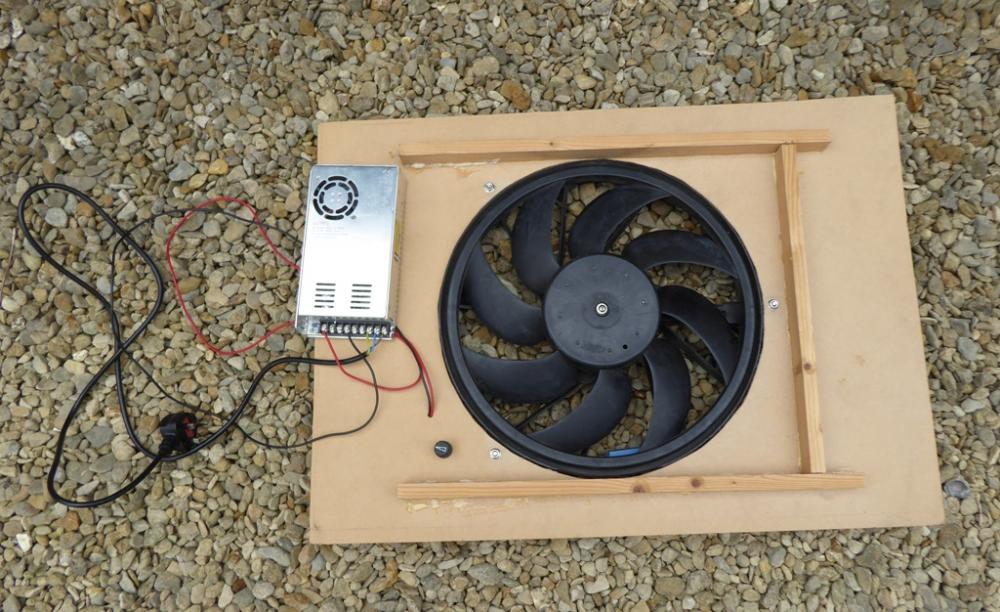
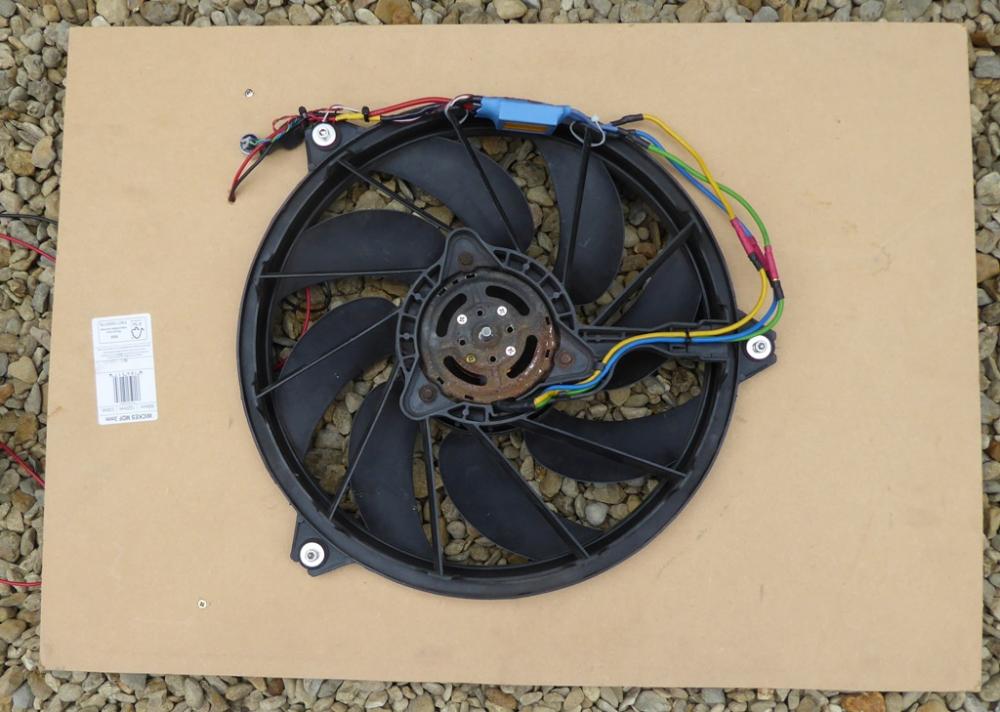
Car radiator fans work very well, and are massively over-powered for the job, even in a very leaky house. This is the set up I built some years ago now: This fits tightly into one of the windows in our old house, and has a speed control knob that allows the fan speed to be adjusted. In practice the fan only needs to turn slowly, if it's run at full speed there is a howling gale blowing through the house. The old radiator fan I bought from the local scrapyard had a rusted out motor, which was a nuisance, so I had to replace it with a brushless model aircraft motor I happened to have. This then allowed the model aircraft motor electronic speed control to be used, connected to a servo tester that has the knob wired to it. If you can get hold of a working 12V car radiator fan, then you can use a cheap speed controller from Ebay, plus a 12V car battery or decent mains power supply (radiator fans draw around 10 to 20 A, so need a decent supply) to do pretty much as I did. I found that the bigger leaks, like all the wall to ceiling junctions, howled like a banshee when the house was de-pressurised, so were easy to find!
-
Interesting policy nudge in North Dorset
Jeremy Harris replied to vivienz's topic in Planning Permission
Living nearby, I think that they are being "gamed" by the big developers. Certainly around here there are several large developments that have PP, but are practically on hold. There is a lot of demand for housing in Dorset, particularly around the Shaftesbury area. There's also land that had been granted PP, but which has only been partially developed, or even not developed at all, because the developers want the "housing land supply" to drop below the 5 year limit. This works massively in the favour of developers, who can then gain PP for more land, partially develop it, or just sit on it, until once more the 5 year supply rule comes into play, when they get a virtually free hand to gain PP on yet more land. Where we are (just over the border in West Wiltshire) the "real" supply of housing is around 12 years, yet the supply of housing according to the rules is just about 5 years. If all the houses that have planning permission were built in the next three years, there would be no requirement for new houses here for at least five or six years, maybe more, but that's the very last thing the developers want. I've been watching this game being played ever since we started plot hunting, around 6 or 7 years ago now. The big developers are extremely good at what they do, so good that they even seem to have pre-empted the slow down in the market, and mothballed several large developments just before the "crash". They delayed restarting these afterwards, too, and used the 5 year rule to get PP on more land, rather than just build the houses they already had PP for. -
pro's & cons of different ICF systems
Jeremy Harris replied to mvincentd's topic in Insulated Concrete Formwork (ICF)
I have some mortar that's been sitting on one side of a sample of Celotex for a few days now. I'll remove it later and then do a test on the other side of the board, so see what difference there may be between the "silver paper" side and the very thin foil side. I doubt any effect will be significant, as the amount of material available to react, plus the fact that people have put concrete onto foil-faced material without ill effects showing, would seem to indicate that this isn't likely to be a serious real world problem. As to the flammability of PIR, then it's not really very flammable when compared to other foam products, certainly no where near as flammable as EPS or XPS, for example, which has been the fuel for some very nasty facade fires in the past, far worse in many ways than PIR, because of the way EPS/XPS drips burning, molten, polystyrene down walls and over openings. At least PIR just degrades, chars and gives off flammable decomposition products when subjected to continuous heating, yet it remains a solid, albeit a very charred one, on the surface to which it is attached. It also tends to be non-sustaining for small fire (see the "blowtorch test" results, for example), whereas EPS/XPS is very self-sustaining once ignited, the spread of fire through it only really being limited by the availability of oxygen. -
I don't think the door closing thing is relevant, really. Our new house has a tested air permeability of well below the Passivhaus 0.6 ACH level, yet I can slam any of the internal doors if I wish, with no obvious restriction. I'm more inclined to think that pressure causing a door to be reluctant to slam may well be as a result of directional air leakage. When I made up and fitted my home made blower rig to our old house, it tended to make internal doors slam on its own, or make some doors difficult to close, when it was running. This was just because it was pressurising or depressurising some rooms from leakage and it doesn't take much to get a door to be hard to close, I found.
-
Spot on again. My neighbour over the road bought what was a trout farm (so the land was designated for light commercial use, can't recall the category), and has tried to get change of use for the old trout hatching/rearing ponds in what is now really a meadow in his back garden for years. Eventually he managed to get change of use to agricultural, but that's it. Now it is designated as agricultural land they are unlikely to allow it to be changed back to even light commercial use; they will not contemplate any other change of use. It caused a stir locally, as when he bought the place it was a viable trout farm (doing quite well) and it was clear from the start that he never wanted to run it as a business, he only wanted the house and large area of land that the trout ponds covered. Pretty much every man and his dog guessed that he bought the place with the plan of getting residential PP for the land covered by the trout ponds, as one of the first things he tried was to get a new entrance in off an adjacent lane (something there was no need for, as there's a perfectly good access lane alongside his property to the trout farm). That was repeatedly refused, and I strongly suspect that the AONB guessed exactly what his plan was, and now the planners are well and truly alerted to the potential issue. The above process went on over about 7 or 8 years. I think the final thing that has stopped him from trying to go down the housing development route were the floods over the Christmas 2013 period. That inundated the whole of the trout farm area under a couple of feet of water, flooded his basement and the lane outside our new build. As a consequence the flood risk has now been elevated and that has added to the planning challenge. I believe he's now given up on getting PP to develop the land for housing, and has settled for having it as agricultural land, with the view that it can be used as a paddock for ponies, and be of greater value that way (pony paddocks on flat land seem to attract a premium over plain agricultural land around here). As a general rule. an AONB is pretty close to a National Park in terms of planning restrictions, the main difference being that an AONB doesn't have delegated planning powers, whereas a National Park does, I believe. To all intents and purposes though, an AONB may as well be a National Park. We had to go through much the same in terms of having the design, materials etc all separately approved, pretty much as we would have had to if building in a National Park.
-
Screws driving us screwy
Jeremy Harris replied to ToughButterCup's topic in General Self Build & DIY Discussion
There is, except for some oddball, usually Chinese made, screws that don't follow the standard. Posi screw heads should have embossed lines between the slots, Phillips screws don't. Also, Posi screws have a different angle and a flat bottom to the cross. The Wiki page has a quick ID chart on the right: https://en.wikipedia.org/wiki/List_of_screw_drives -
Screws driving us screwy
Jeremy Harris replied to ToughButterCup's topic in General Self Build & DIY Discussion
For the Posi screws I've found that it pays to splash out on the diamond-coated Wera bits and an impact screwdriver. Not cheap bits, but they last longer and, more importantly, they grip into the screw head, with far less chance of ramping out. There's a world of difference between driving screws with an ordinary drill/driver and a proper impact driver, too. As I already had a fair few Makita tools, I just bought a bare body impact driver, probably the second most useful cordless tool I've ever bought. -
Designing the duct runs and terminal positions is pretty easy, especially with a radial ducting system, so there's no real need to employ someone to do it, IMHO. MVHR won't do much about moving heat in or out of any room, as the flow rate is far to low to be of any real use. Similarly, unless the house is pretty airtight (a lot better than required by building regs) then MVHR may well not work very well. I doubt a 1968 built bungalow is anywhere near airtight enough, there are likely to be large leaks around all the wall to ceiling joints, leaks that look invisible until you do a blower test and then hear them all whistling away. Our old 1980's built bungalow was just like this, wet plastered block walls, decent uPVC Dg windows and doors, lots of time spent by me going around sealing up every leak I could find and I doubt I got the airtightness below about 20 ACH................... Smoke is a problem with MVHR. We had a neighbour that used to have bonfires, and the MVHR would quickly suck smoke in and circulate it through the whole house. The filters don't remove smoke at all (we have the finest input filter, a pollen filter). All you can do when there is smoke around outside is turn the MVHR off until such time as the smoke has cleared, unfortunately. You can run MVHR intake and exhaust pipes up through the roof OK.
-
I've related this tale before, but near us we have a friend who breeds chickens, the rare breeds that are more often seen at shows than pecking around a farmyard. She's been running this business for at least 15 years that I know of, on a plot of land given to her by her family. She has a range of pens and chicken coops around the place, plus a mobile home that she lives in. She keeps having to re-apply for permission to live in the mobile home, as it's in the open countryside and an AONB, and the LA won't grant permanent permission, just permission for five years at a time, IIRC. She's tried to get planning permission to build a small house on the site, on the basis that she needs to be onsite 24/7 in order to care for her chickens, shut them up at night, protect them from foxes etc. The local authority accept that she has to live on site as a requirement for her agricultural business. However, they have persistently refused to grant PP for a permanent dwelling, even one with an agricultural tie, because they are hard over on not allowing new development in the open countryside. The situation is beyond ludicrous, as the lady has the support of her neighbours, the parish council etc, and seems to meet the exceptional conditions that allow limited development in the countryside if that development is sustainable and there is a demonstrable occupational need to live adjacent to an agricultural workplace. Last I heard she was going to appeal over her latest refusal - I'm pretty sure if she'd gained PP by now then I'd have heard about it. Her planning battle has been going on for well over 10 years now.
-
I can't recall exactly what I wrote, but I think it was just that 6mm polyprop was so cheap that I just bought a 220m reel from the local BM for around £20. That's been more than enough for all our duct draw ropes, plus the safety rope on our borehole pump, with the odd bit left over.
-
That's exactly my thinking! It sounds to me as if the owner, or his/her predecessor, may have tried to pull a fast one by doing a conversion on the QT, got found out and as a consequence the building is now known to the planners. Alternatively, it may have been used for seasonal workers at some time in the past, perhaps as a wash house and kitchen. Lots of farms use seasonal workers that they accommodate in huts, caravans etc, and some provide communal kitchen/toilet/washing facilities. Either way, from the estate agents description of it having very little chance of getting residential PP, then I think there is more information lurking as to the planning history of this building. If there was even the slightest chance that it might get PP, then the estate agent would probably mention that.
-
Hi Tom, We're also in an AONB, and have some experience of gaining PP within one. There seems to be one key element of information missing here, and that is whether or not the building has been used, albeit unlawfully, as a dwelling in the past, and if so, what has been done about it. It's not at all uncommon for illicit conversions to take place out in the countryside, sometimes people get caught, sometimes they don't. If anyone can get away with doing this, and prove they have lived in it without getting caught for a long enough period of time, then they can retrospectively apply for a certificate of lawfulness, that, in effect, retrospectively grants planning permission. Don't trust estate agents to be knowledgeable about planning, my experience is they know next to sod all about it, their expertise is in selling land and houses, not planning law. Your best first step would be to search your local authority planning applications part of their website, looking for all application, perhaps going back a decade or more, for that address. Some local authorities have a map application that allows easy identification of previous applications, others don't, and the job can be a bit tedious. Armed with the planning history we'll be much better placed to advise. If there has been a refusal to grant PP for residential use in the past, then I'd say this is a non-starter, as getting permission for residential development within the open countryside, especially where that happens to be an AONB, is near impossible without a very strong argument, one usually relating to the need for an agricultural tie (and even then it's not easy in an AONB).
-
TBH, it's jumping the main queue and getting free coffee that wins it for me.......................
-
Screwfix happily accepted my 30+ year old 15th Ed vintage G&G as "evidence" that I was a qualified electrician............
-
I know that our LABC didn'r communicate with the council tax people at all, as the council tax people (in Trowbridge) hadn't a clue who our building control body was, plus they had the wrong name for the owner of the plot. Our LABC are based in Salisbury, too, so that probably doesn't help with any possible communication. I'm pretty sure that LABCs run as independent trading entities, anyway, a bit like Trading Funds, and are self-funded from fees, so not truly a part of the local authority. There's also the point that we had an inspection before first fix, when the insulation was being blown in, and then no other inspections until the final one, so LABC would have had no way of knowing when first fix was finished. As our council tax people employ at least one snooper to just break in to sites unlawfully to assess whether they are ready to be served with a notice of intended completion (and they do this unlawfully, without a shadow of doubt, if the site is a still secure and signed building site and they visit outside normal working ours, without making a request) I would guess this means that they cannot rely on any building control body for information.
-
MVHR visible ducting
Jeremy Harris replied to graeme m's topic in Mechanical Ventilation with Heat Recovery (MVHR)
Our battens were 45 x 45, so not a big enough gap for the rectangular duct. We have one bit of rectangular rigid duct hidden inside a walk in wardrobe, but the main bedroom feed ducts run up inside the eaves apace and come out about 1.2m up on the small walls that separate the eaves storage from the bedrooms. Instead of using the omnidirectional "mushroom" terminals at these locations I used directional terminals so I could point the airflow upwards, along the ceiling. These can be rotated to direct the flow where you wish, and came from here: http://cart.vacuumsdirect.co.uk/index.php?p=product&id=489&parent=66 -
MVHR visible ducting
Jeremy Harris replied to graeme m's topic in Mechanical Ventilation with Heat Recovery (MVHR)
The terminals don't have to be in the ceiling, unless they are extract ducts. Fresh air feed terminals can be in the walls. We have this arrangement in our bedrooms, because we have vaulted ceilings with the battens in the service void running the wrong way to be able to feed slim ducts into and it works OK.