Jeremy Harris
-
Posts
26430 -
Joined
-
Last visited
-
Days Won
360
Everything posted by Jeremy Harris
-

Building Regs Compliance
Jeremy Harris replied to Woodgnome's topic in Mechanical Ventilation with Heat Recovery (MVHR)
As above, for a lot of houses the background rate in the regs is higher than the other rates. If you actually ventilate at the building regs background rate then you will probably find, as we, and others, have that the ventilation rate is too high. I don't know where BRE came up with the background ventilation rate, but it does seem to be much higher than the normal ventilation rates in non-MVHR houses, and higher than most feel comfortable with in a house with MVHR. -
Our case isn't that typical, as the heating input is so low that I just leave the whole house set to the same temperature, 20.5 deg C. This week I think the heating has come on once, after that very cold night on Tuesday, the rest of the time the heat from the slab plus incidental gains have kept the house around 21 deg C. Similarly, our hot water system is a low loss, on-demand, system now, as I found the losses from having a big tank of water sat at 60 deg C were too high, no matter what I did to try and reduce them. When it comes to hot water return loops then the heat loss can be significantly reduced by careful controls. These things only need to operate for short periods of time before you're actually going to need hot water. As an example, hot water at a WC basin is only normally going to be needed maybe a minute after entering the room, so a PIR switch to turn on the circulating pump as you enter the room, and turn it off maybe a minute later, or even as soon as the hot tap is operated, will prevent a fair deal of heat loss (and some circulating pump energy). The same goes for most other areas where there are hot water outlets, most will only need to provide hot water 30 seconds or more after entering the room, more than enough time for the circulating pump to have moved hot water around to the tap. I can't think of any good reason to leave a recirculating hot water system on for any length of time; all it need to do is make sure that there is hot water at the tap when you need it. Once it's done that it can turn off, and save heat loss and energy, until the next time you may need to use the hot tap.
-
No need to lose the deep reverals, with a stone skin you're going to get them by default, as the frames need to sit inside the insulation layer. This sounds like a great idea with some compromise on loss of internal volume. The benefits are significant, though, if you canget the planners to accept the idea.
-
OWL start charging a subscription
Jeremy Harris replied to ProDave's topic in General Self Build & DIY Discussion
I think it's a general North American thing, to over chlorinate city supplies. I noticed it a fair bit all over Canada and the USA, and think a lot of it has to do with the custom of keeping large closed tank reservoirs of clear water, then treating it just before it enters the distribution system. The residual chlorine levels always seem to be on the high side, and I know that there are growing concerns in the US that the resultant chloramine content of city water may well be harmful (chloramines being breakdown products from chlorination). Rather than change the system, some places are switching to ozone treatment, as a way around the problem. Ozone breaks down to oxygen, leaving no harmful break down products, but it only has a short life, so doesn't work as well as chlorine in keeping water in dead leg pipes disinfected. The flip side is that ozone is very roughly 2500 times more effective than chlorine at killing all bugs, so the water downstream of any ozone disinfected system should stay disinfected, unless it somehow gets contaminated (by road works, for example). -
I started off with near-zero knowledge about this, but was spurred into having to do something when Ebuild went down, taking a lot of the most useful blog content with it (all the attachments and photos were made inaccessible when it was made read-only). Like an idiot, it hadn't occurred to me to make a back up.......... There followed a fairly frantic few days where I and a few here who kindly helped me out managed to scrape most of the content from the Ebuild server, although it was incomplete, because there were only broken links to the photos and attachments. I then rebuilt every blog entry, one by one, as a set of documents, with the attachments and photos as links to where they were locally stored (and backed up). I was very firmly convinced that the only way to keep things safe was to go for a paid for hosted service. I chose Fasthosts, for no other reason than they were already looking after my domain registration and providing me with a handful of email accounts on that domain. I wasn't using the web space associated with that domain name at all, it was just sitting idle. I had no idea as to how to use Wordpress, or set it up on a server, but managed to get it running locally on my own PC after a bit of playing around. This was a nice and safe way to experiement, as if it all went horribly wrong I could just delete it and start again, without having to deal with something on a remote server somewhere. There are some good guides for doing this on the web, and if using Windows there is a package available that allows you to fairly easily set up a local environment that behave like a remote server. After playing around for a time, and transferring my old blog documents to Wordpress blog entries OK, I felt reasonably comfortable with transferring these across to a bit of paid for webspace (not expensive, I think I paid around another ten pounds a year on top of the email hosting and domain name renewal fees I was already paying for. Then this forum came to life, and the blog function was activated, so to help kick start things here I but my own blog on hold for a while and copied everything across to here. Sadly I ended up getting some abuse and ended up locked out of that blog when I took a break from posting here for personal reasons, associated with stress (and I wasn't the only founder member to take a break at this time, either, setting this place up and building a house was tough for a time). For reasons I to this day don't fully understand, I ended up getting some abuse and effectively being locked out of the blog here when I returned, so I then had no real choice but to get on and go back to the original plan, of putting everything on my own web space using Wordpress. That turned out to be very easy, as the hosting company have an automatic set up option that does practically everythign for you. All you need to do is choose a theme and write (or copy) the content across. You also need to remember to back it up, as blogs hosted on any webspace, anywhere, are not backed up for you as a rule. There are some easy to use back up tools available in for Wordpress, and generally they do a basic back up to your home PC, or some other storage, OK, but none of them seem that comprehensive. Havig had two experiences where I risked losing control of content I'd written (and I can't access or edit my blog here, as it's locked, for example, and a lot of it is now out of date, where I've edited errors in the live version and added some new content over the past year). I've become a bit paranoid, and have spent more time learning how to make a full backup. I now have an exact mirror of my blog running here at home on a Raspberry Pi, plus the same Raspberry Pi has incremental back ups of everything on the hosted server, taken every night, just to be safe. Once a week I copy the latest back up to another hard drive as insurance, too! Based on my unfortunate experiences, I'd probably avoid the "free" Wordpress, Blogspot etc offerings and opt to pay a small fee to host your own website. Not only can you run multiple blogs for different family members, but you can also use it for file storage. I keep a few handy files stored on mine, that I can access using FTP from pretty much anywhere. It's not ultra secure, but none of the files are sensitive, they are things like calculation utilities I've written, that are handy to access easily, a bit like some of those I've added as downloads to the top of my blog front page, for others to download and use.
-
OWL start charging a subscription
Jeremy Harris replied to ProDave's topic in General Self Build & DIY Discussion
Do you mean the activated charcoal filters made from coconut husk? If so,then they remove organic contaminants reasonably well, and improve the taste and smell of the water. In block form they can also filter down to around 10µ or so, will tend to polish the water a bit. Activated carbon granule filters don't really have the filtration capability but are just as effective at removing organic contaminants and making the water taste better. The original Brita jug filters were nothing more than activated carbon granule filters. Not sure where the carbon came from, but it was pretty fine, finer than the compressed coconunt husk derived granules that are often sold in bulk for pond water treatment, but which can be put into refillable water cartridges and used for tap water treatment (you can buy refillable inserts for standard and jumbo filter housings). I have a similar set up, a jumbo carbon block filter that both removes any residual stuff from the water and filters to around 10µ plus a pleated jumbo filter that filters to 5µ. It's probably complete overkill, but is a hang over from before I fitted the ozone injection system, when we still had a very slight trace of hydrogen sulphide in the water. The carbon block filter was OK at removing very low concentrations of hydrogen sulphide, but not effective as the only means of removing it from our raw incoming supply. If anyone wants to soften just their water for making tea or coffee, then Brita do a range of commercial ion exchange filters, at a price. Those concerned about using water softened by ion exchange (these things are like water softeners, they just use pre-charged ion exchange resin) then they should be equally concerned about these filters, as they do as their name suggests, and exchange calcium ions in the incoming water for sodium (or perhaps potassium) ions. They are also expensive to run, as a replacement filter cartridge is costly, and there's no good reason that I can see that the ion exchange resin in the old cartridge cannot just be regenerated for a fraction of the cost. I have a feeling that they are sold as a sort of premium product for the coffee industry, who probably don't realise that an ordinary ion exchange softener would do the same job for a much lower running cost................ -
Wordpress is easy to use, but I'd fork out the small annual fee for a domain name and set up wordpress on that. easy to to, as all the main hosts provide a wordpress set up, and it frees you from dependence on something that could close down at any time. My hosting fees are just a few pounds a year, and I can both back up my blog easily and keep a local copy for testing things out. AFAIK, none of the free blog sites offer and easy or free backup service, so having control of the whole LAMP stack running on your hosted server space, being able to FTP files in and out easily and being able to backup and change things carefully makes a paid for package worthwhile. It also means you can host your email on the same domain, so having a neater email address, or addresses.
-
It depends a lot on how uneven the wall is and on how heavy handed you are with it, but in general I reckon that one tube fixed around 6 m of 120mm high oak skirting. I may have got away with less, but I wanted the skirting well sealed at the bottom edge. As above, I just bought the stuff in boxes...........
-
OWL start charging a subscription
Jeremy Harris replied to ProDave's topic in General Self Build & DIY Discussion
I've long thought it was barking mad to rely on an uncertain technology, reliant on one or more third parties , to run critical functionality in your home. Anything in a house has to have a supported design life of decades, and that just doesn't fit with things like smart phones that change every year. As for water softeners and coffee machines, it's all a bit fraught. All ion exchange filters, be they salt renewable or "salt free" rely on replacing calcium ions with sodium , or sometimes potassium, ions. In fact, the ion exchange resin used in the expensive (Brita, Pozzani etc) replaceable commercial units can be regenerated with brine, in exactly the same way as the non-replaceable softness, by the simple expedient of flushing them through with brine and rinsing them out, when the cartridges will be as good as new. Brita, Pzzani etc are careful not to reveal this basic truth, and AFAICS, they don't mention that their replaceable ion exchange columns replace calcium with sodium, just like salt water softener. The alternatives are to use potassium chloride as the ion exchange agent, which replaces calcium ions with potassium ions. More expensive to run, and as far as I know, there is no hard and fast evidence that it's in any way healthier, or makes coffee taste better, Finally, there are two other demonstrably effective systems. The first is phosphate dosing. This prevents scaling, but doesn't remove any calcium ions and I have doubts as to whether it makes better coffee. The creme de la creme has to be to use a combination of a reverse osmosis unit to remove just about everything from the water, then dose the output with a balanced mineral supplement to get a near-perfect form of water for making coffee. Not cheap, and expensive to run, but for the fanatics it's probably the best solution. -
As mentioned earlier, I used loads of the Screwfix No Nonsense, solvent free stuff, and found it brilliant. Not only that, but it has a long shelf life. I've just pulled out half a dozen tubes from the loft to finish off the skirting around my study (the last room to be finished) and although a year out of date they were all fine. In contrast, I had a couple of unused tubes of solvent based gripfix that were of the same vintage and they had set rock solid in the tube so got binned. The only flaw with the Screwfix Non Nonsense stuff is that it doesn't bond to non-porous surfaces. I tried to bond a bit of OSB to the inside of our metal shed and it failed miserable. The good news was that it all flaked off, or could be sanded off, when dry and Sikaflex stuck the OSB up a treat (it was only to give me somewhere to fix hooks etc for tools).
-
Don't use either WD-40 or 3-in-1, as both have the potential to damage seals from the solvents they contain and neither is a particularly good lubricant. WD-40 is most definitely not a lubricant, the name is an abbreviation of "Water Dispersant Type 40", and "3-in-1" is a mixture of light machine oil and solvents, intended to work as a short duration lubricant, a cleaning agent and an anti-seize agent. High temperature silicone grease is generally pretty safe on anything, and is most probably what is used as the assembly lubricant originally. I keep an aerosol can of "O ring safe" motorcycle chain lubricant around for jobs like this. You can be sure that the solvent that allows it to penetrate won't damage seals, and the resulting heavy grease is non-corrosive and resists pretty high working temperatures OK.
-
Plasterboard behind kitchen cabinets
Jeremy Harris replied to PeterW's topic in Plastering & Rendering
I boarded and skimmed everywhere, even behind where I knew cabinets would be, and also laid all the flooring right up to the walls under the cabinets. I didn't fit skirting, but I did bond on some wide white PVC angle into the wall/floor corner behind all the units and sealed it well with silicone. The idea was that if there should ever be a leak, the water wouldn't be able to get at the walls (the flooring is travertine stone). -
MBC build- a year later
Jeremy Harris replied to dogman's topic in General Self Build & DIY Discussion
What I find interesting, as a practical demonstration of the effectiveness of triple glazing, is on mornings like today, when it' been pretty cold overnight, the condensation is always on the outside of the windows. Even with the pretty good double glazing fitted to our old house we would sometimes get some condensation around the edges inside, but there's never a trace of that with the triple glazing. It does mean you can't see out of some of the windows for an hour or two first thing in the morning, though. -
I had one fitted to our old house, with steel rads and a combi, because the extended warranty on the combi provided by the installer (which turned out to be useless - long story) was dependent on a Magnaclean being fitted. TBH, I was very sceptical, especially as the whole system was power flushed for hours before the new boiler was fitted. However, when I check and clean the filter every year, and top up the inhibitor (easy, just put a drop in the filter housing when it's off) I'm always amazed at how much black crud there is on the central magnet. The thing clearly works in these circumstances, but only because the crud is magnetic. With UFH it would be pointless, as there's no ferrous metal in the system usually, so there can't ever be any magnetic crud to filter out. All I have on ours is a Y strainer, and on the one occasion when I drained the system down and checked it, all I found in there were a couple of bits of what looked like sealant residue, almost certainly from where I was a bit careless with one or two of the plumbing joints to the buffer tank (in my defence they were at the back and a real sod to get to......).
-
Building Regs Compliance
Jeremy Harris replied to Woodgnome's topic in Mechanical Ventilation with Heat Recovery (MVHR)
If you have MVHR, then you only need to comply with the MVHR parts, i.e. what they call "whole dwelling ventilation". If the MVHR is turned off for a long period, then the recommendation is that you set it to boost for a short time when switched back on in order to provide the required purge ventilation. -
Vat claim
Jeremy Harris replied to nod's topic in Self Build VAT, Community Infrastructure Levy (CIL), S106 & Tax
@Temp knows the VAT rules inside out, but I'm pretty sure that essential boundary fencing materials are included as an allowable VAT reclaim, as is anything shown on the approved plans or landscaping plan (if you provided one as a part of the planning permission).. -
Solutions for making a small house feel big
Jeremy Harris commented on caliwag's blog entry in caliwag
I'm impressed with the effectiveness of the one internal window I designed in. By necessity (the planners wouldn't allow windows anywhere on the North elevation, plus I was averse to them because of the heat loss) our bathrooms ended up without external windows. Adding a high level window, made of glass bricks (both for aesthetic and noise reduction reasons from the wide open, and very light, central hallway, to the main bathroom, is surprisingly effective at both allowing in light and making that room seem more connected to the rest of the house, especially when there is sun shining in. The idea behind using glass bricks was just taken from an article in a Sunday newspaper, that had a photo of an old glass brick wall in an Art Deco building, so I hunted around and found that a French company still made a range of glass bricks. They have a very slight tint, but that barely shows, and they are very good at both letting light in whilst seeming to have the solidity of a wall. -
Domestic Lift or Stairlift
Jeremy Harris replied to Ferdinand's topic in New House & Self Build Design
I fitted structural supports in the wall, behind the plasterboard, adjacent to our stairs, and made sure there was plenty of space at the base of the stairs for the chair to be parked, out of the way, when I designed our house, specifically because I could see a time when one or other of us might need a stairlift. I also fitted very wide doors and flush door thresholds everywhere, to make wheel chair access easier, with clear areas around doors to allow a wheelchair user room to turn and line up with the doors more easily. This was based on all the hassle we had when I was growing up, with a father that had MS. Our 1930's built house was damned awkward for anyone with a disability and ended up having to be very extensively modified so my father could continue to live in it. We had to build a large extension, with a downstairs bedroom, wheelchair friendly toilet and bathroom and widen most of the doorways downstairs - not easy, as the lintels had to come out to allow wider doors to be fitted. My memories of doing that, plus things like spending a summer holiday building brick walls for raised rose beds, and a wheelchair path alongside it, so he could carry on growing roses, had a fairly big influence on the design of our house and garden. -
There are loads of ways of demonstrating compliance, but you often need to do a fair bit of work to track down enough information to keep BC happy. Bear in mind that, as mentioned above, what we loosely refer to as the "building regulations" are really the Approved Documents that suggest some ways that the building regulations may be complied with - the Approved Documents are not the regulations, just guidance, in effect. For example, for structures, then Approved Document Part A gives guidance based on standard details that are known to be OK, but equally you can use very non-standard details (like our passive slab, that sits on load-bearing expanded polystyrene) and show that this meets the regulations themselves. In that case demonstration of compliance with the regulations was by a structural engineer's report, plus the specifications for the EPS, concrete floor and steel reinforcement. When designing light aircraft (a hobby job I had for a time) I constantly had to battle a similar problem. The UK CAA has a set of regulations, and a set of guidance documents, that are exact parallels to the way the building regulation system works, but maybe a couple of orders of magnitude more comprehensive. I regularly had to show that materials and components imported from other countries, that did not have a recognised UK CAA or EASA (the European equivalent of the CAA) approval were OK. Sometimes this was easy - for example AISI material specifications ( the US standard) often had a near-enough direct read across to European or UK standards. An example would be that the common US structural light alloy, 6061-T6, was accepted as being equivalent to the far more common in the UK 6082-T6 alloy. Sometimes I had to go back to basics, and compare tests showing material properties undertaken in another country with tests that would be more normal in the UK. The most challenging job I did was convert all the data for a Hungarian aircraft design (before Hungary was in the EU) into the equivalent UK spec - it involved a fair few hours translating Hungarian to English and convincing a UK CAA surveyor that the materials used were equivalent to UK materials. I doubt that there will be any significant problem if you are importing building materials from anywhere within the EU, as they will almost certainly have some form of specification and certification that can be read across. There are a lot of agreements in place to accept certification from other countries as being equivalent to BBA. For example, the Irish certification scheme, NSAI is almost always accepted as being OK in place of BBA certification (just as well, as our entire house and garage only carries NSAI certification for all the structural materials!). You may need to provide evidence to show things like this, though - our building inspector wasn't aware of the read across from NSAI to BBA, for example, until I pointed it out.
-
Vat claim
Jeremy Harris replied to nod's topic in Self Build VAT, Community Infrastructure Levy (CIL), S106 & Tax
We had no problem at all in claiming back the VAT on all the boundary fencing materials as well as the hedging (we used a non-VAT registered chap to erect the fencing). Boundary fences are normally considered to be a part of the build, I believe, but I'd actually marked on the approved landscaping plan (that was a planning condition) the fences, anyway. HMRC didn't question any of the landscaping materials cost, even the patio stone, that I did half expect them to question (although, again, it was shown on the approved landscaping plan). -
Bloody excellent job, and for a very impressive cost, too. I can appreciate the amount of effort you must have put in to achieve such a brilliant outcome at such an amazingly low cost, as even with all the work I've put in myself I struggled to get under £1400/m².
-
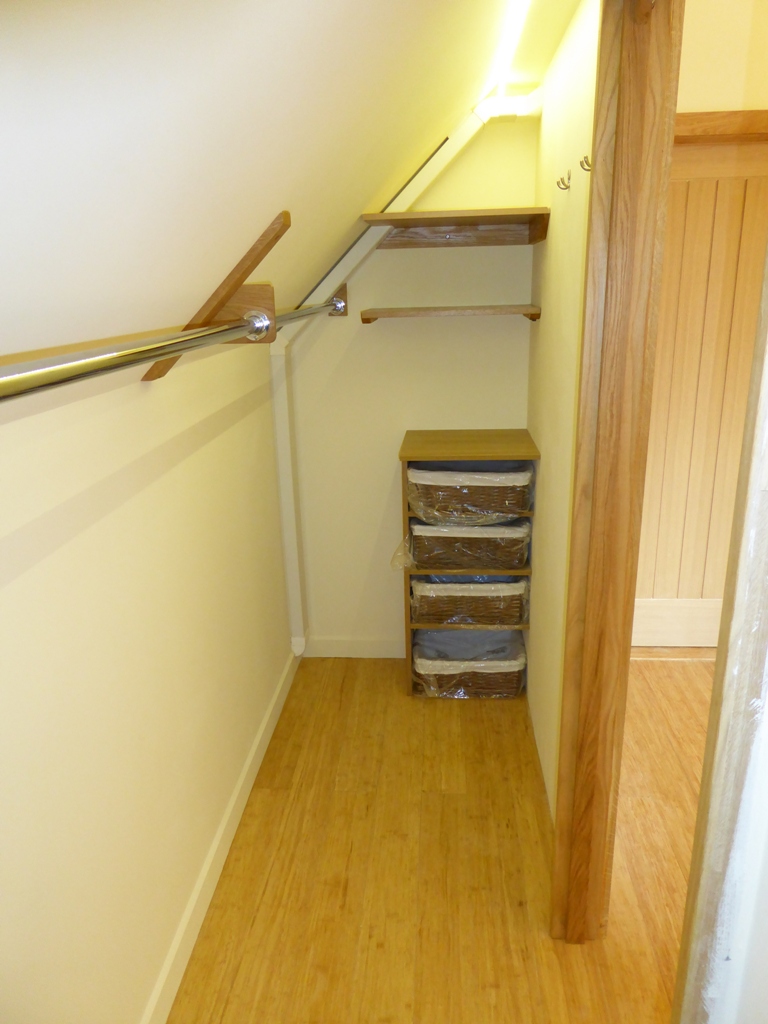
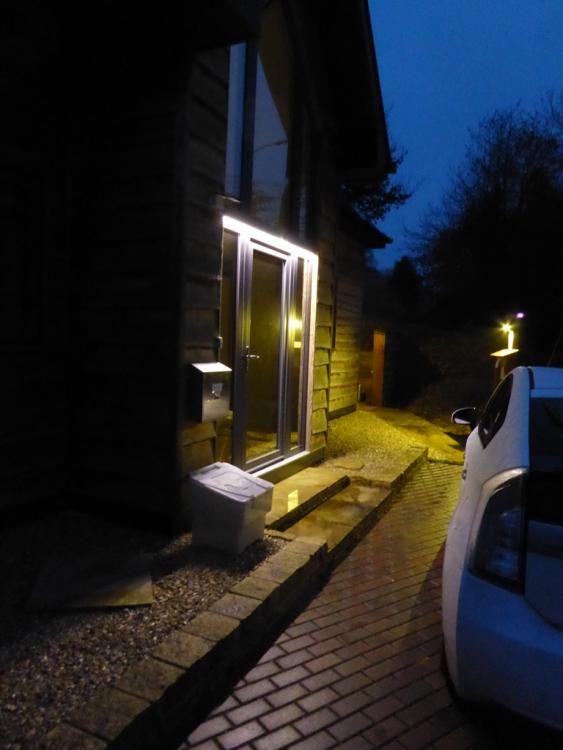
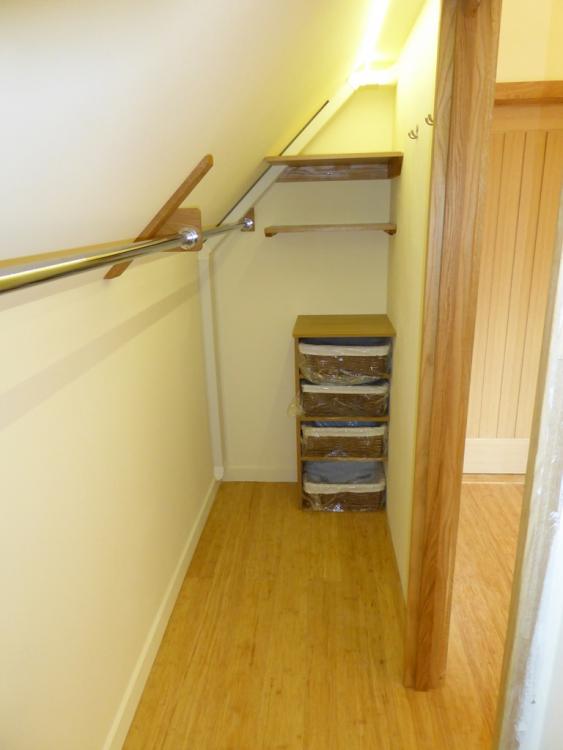
I've used lots of LED strip, ranging from these inset into the rain drip groove on the joining cill above our front door: to strips under our wall units in the kitchen, to locally light the work surfaces. I also used long lengths to light up our walk-in wardrobe, set right up in the apex of the ceiling: A couple of weeks ago I fitted long lengths in our eaves storage areas, just to make it easier to find stuff. I've also fitted strips under the shelf above my workbenches and in the cupboard under the stairs. Generally, the lower powered stuff doesn't really need a heat sink at all, and I have found no difference at all in terms of quality from LEDHut or a couple of Ebay sellers. I had one duff roll of 5630 warm white strip (the stuff that I used for the light over the front door), where the bonding between the main flexible PCB and the secondary flexible PCB underneath it (the one that's there to take the higher current of 5630 LEDs) was poor, but that was easily fixed by just gluing the separated parts back together again. Only the section outside, over the front door, is effectively mounted on a heat sink, as it was exactly the same width as the groove in the alloy cill (which was a bit of luck). What I have found is that the self-adhesive tape is fussy about what it sticks to, but the fix I've come up with for all the strips where you can't really see them directly is to stick a layer of aluminium tape down first, then burnish that with something very smooth so it bonds down well, and then stick the LED strip to that. Not only does that give a much better bond, but the aluminium tape adds a bit of back reflection (and a very tiny bit of heat sinking). The major difference between these strips is in the type of surface mount LED they use and the colour of the light. At the very low output end there are strips that use 3528 LEDs, which are not at all bright, but OK for places where you just want a very gentle light. I've used some low power 3528 strip as outside lighting, solar powered, like all out outside lights (including the strip over the front door) and they are good enough, but only really as light to mark the edge of the drive. Next up come the 5050 LEDs, and these are pretty good general purpose lighting - the wardrobe above has warm white 5050 strip. Top of the light output seems to be the 5630 LEDs, and these are what I used above the front door. They are very bright, but they also draw a lot of current, and for long lengths they either need to be fed with power at both ends or they need to be the type with the extra flexible PCB bonded under the main one. It's hard to tell without getting samples which is which. As a final not of caution, then choose the 12V power supply for these carefully. Some of the cheaper ones can emit a fair bit of RF interference, creating noise on radios and interfereing with wireless remote controls. Also, I made the mistake of using some dimmable electronic 12V DC halogen light power supplies, and these do not put out clean DC, but rather pulses of DC at a high frequency. There was no radio interference, but the high frequency flicker was noticeable when you made a sudden head movement, and sufficiently annoying that I ended up replacing them.
-
Building Regs Compliance
Jeremy Harris replied to Woodgnome's topic in Mechanical Ventilation with Heat Recovery (MVHR)
No, all they need is evidence that the flow rates for the defined extract rooms (kitchen, bathrooms, utility room, WCs) meet the requirements in the table in Part F, and also that the whole house ventilation rate meets the requirement. -
Moira, you've had a far worse time than I did, and I got pretty low at one point during our build ( http://www.mayfly.eu/2015/08/part-thirty-seven-a-long-tale-about-water-and-life/ ). Stress and depression are, I found, pernicious and depression, in particular, can creep up on you almost without you noticing. It surprised me then, and I still look back at that time and wonder how I got to that state without noticing. I watched a video on the BBC website this morning, made by a group of Macmillan nurses, and found it quite inspiring, in particular the comment from one that "Life is too short, do the things that you want, do the things that make you happy": http://www.bbc.co.uk/news/av/uk-england-41932797/what-do-people-say-before-they-die We both regret that my father in law, who I'd known a lot longer than I'd ever known my own father, died before we finished the build: http://www.mayfly.eu/2013/09/part-fourteen-things-can-only-get-better/ but on the positive side, he'd been diagnosed with stage 4 lung cancer nearly four years earlier and told by his oncologist that, with good treatment, he may have a year to live. He had a great time for the best part of four years after that, even with the ups and downs of palliative treatment. I dearly hope that your problems lessen and that the completion of your build is achieved without too much more stress.
-
Building Regs Compliance
Jeremy Harris replied to Woodgnome's topic in Mechanical Ventilation with Heat Recovery (MVHR)
Mechanical Ventilation and Heat Recovery system Test Report.pdf This is what I did and BC had no problem with it at all. It's not 100% in accordance with the guidance note for Part F https://www.gov.uk/government/uploads/system/uploads/attachment_data/file/456656/domestic_ventilation_compliance_guide_2010.pdf , but that didn't seem to matter, as they thought that it adequately addressed every requirement.