
Jeremy Harris
-
Posts
26430 -
Joined
-
Last visited
-
Days Won
360
Everything posted by Jeremy Harris
-

Passivhaus training course
Jeremy Harris replied to graeme m's topic in General Self Build & DIY Discussion
But it does pay a heavy price, in terms of balance of payments, for that, as believe they import a great deal of their fuel. They also have issues with their electricity infrastructure that has shaped how they deal with microgeneration, I believe, and that may well be why they've not been so keen to encourage it via subsidies. I suspect that the dire financial situation after the crash of the Celtic Tiger economy hasn't helped, but at least they got decent roads out of it! -
Carbon Air Filter
Jeremy Harris replied to MikeGrahamT21's topic in Mechanical Ventilation with Heat Recovery (MVHR)
They look like they would do the job, especially as it looks as if they are designed for things like spray booths, so will presumably have a pretty high capacity for VOCs. I wonder what sort of flow resistance they have? MVHR probably needs a more free-flowing filter than something like a spray booth, with it's higher flow rate/greater available dynamic pressure. Might need some experiments to see what sort of pressure drop you get across one. I've been thinking that a long, thin, carbon granule panel filter might be a good option. If you made up a long box, with a rectangular carbon granule filter fitted as a divider down the centre, then fed air in at one end, on one side, and took air out at the other end on the other side, I have a feeing that the air would have a longer exposure time to the carbon, yet not be overly restrictive. -
Carbon Air Filter
Jeremy Harris replied to MikeGrahamT21's topic in Mechanical Ventilation with Heat Recovery (MVHR)
I'm not sure, it depends on its resistance to air flow. In my head I had visions of using two sheets of fine wire mesh, maybe around 1m square, separated by a gap of around 10mm, which was filled with carbon granules. That's pretty much how our old cooker hood filter is made up, although the wire mesh either side has a thin layer of non-woven fluffy filter stuff that helps keep the carbon granules in place. -
The counter battens provide the much-needed under-panel ventilation, IMHO. I suspect that without them, and without the vertical ventilation path up under the slates or tiles, then things might get a lot hotter, with a decrease in PV output.
-
Not in Scotland, but we do have 22mm OSB sarking boards and a GSE in-roof system, so I think our experience may be relevant. We counter battened over the sarking with 50 x 25 roofing battens nailed along the lines of the underlying rafters. We then laid a non-tenting membrane across the counter battens so that it drooped slightly between them, as per the membrane manufacturers instructions. Roofing battens were then fitted to the required pitch for the slates, with additional timbers being fitted as per the GSE instructions. The ridge was fitted with a continuous ventilation strip under the ridge slates and similar ventilation was provided at the eaves, This not only helps keep things dry but it provides essential ventilation to the rear of the solar panels, helping to keep them cool.
-
Another vote for using GRP. Pretty easy to DIY, just need to be sure everything is DRY and stays DRY. Best place for all the stuff to do it is CFS in Cornwall: https://www.cfsnet.co.uk/acatalog/CFS_Catalogue__FLAT_ROOFING_21.html https://www.cfsnet.co.uk/acatalog/1project-roofs.html
-
Treatment plant without power. Biorock- clearfox etc
Jeremy Harris replied to albert's topic in Waste & Sewerage
Ours is around 6 or 7 metres from the stream it discharges to, and BC didn't have any problems with that at all. They were also pretty flexible about the location, because there wasn't much room to play with when it came to positioning the thing and still keeping reasonable falls. -
ASHP - Defrost cycle - MVHR exhaust
Jeremy Harris replied to MarkA's topic in Air Source Heat Pumps (ASHP)
Ours is very quiet, too, but it does shift a heck of a lot of air! -
Insulating to Min Building Regs
Jeremy Harris replied to Ian's topic in Energy Efficient & Sustainable Design Concepts
The EPC recommendations are hilarious, especially the pay back periods. Here's a screenshot from ours: It doesn't mention any band change presumably because we're already well above Band A. If solar thermal cost £5k, then at £195 over three years it would take over 76 years just to recover the investment, not accounting for repairs, maintenance and replacement of out-of-life parts.....................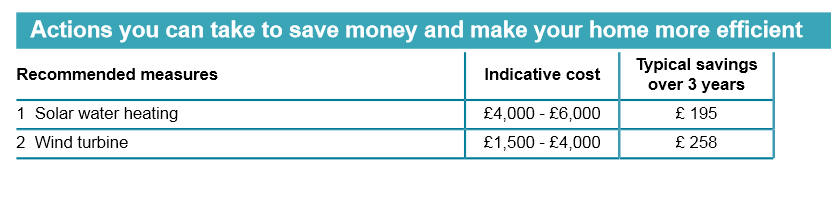
-
ASHP - Defrost cycle - MVHR exhaust
Jeremy Harris replied to MarkA's topic in Air Source Heat Pumps (ASHP)
My own view is that it's not worth the hassle for the miniscule return. The ASHP air flow rate is massive - ours has a fan that's around 450mm in diameter and blows a small gale when it's running. By contrast the MVHR exhaust is 150mm in diameter and only flows at a pretty low rate most of the time, barely enough to feel. I suspect that the ASHP flow rate on the suction side may well serious unbalance the MVHR, too. -
The way to tell the difference between wet and dry rot is that wet rot hyphae look like plant roots, are usually brown or black, grow vertically a long way up walls on plaster and remain flexible enough that they can be pulled off as you did in the video. Dry rot produces white or yellowish hyphae that are generally very brittle, and wouldn't peel off the way those did. Both are signs that there is rot in the timber underneath the floor, as that's what they are feeding on. The hyphae growing up the wall are just the fungus looking for more damp timber as food.
-
The doors and liners came from an online place, something like "door deals direct"? I can check later. The staircase was made by Pear Stairs: https://www.pearstairs.co.uk/ who I can highly recommend. Everything was a perfect fit, and the whole staircase, including the landing balustrade and 10mm glass, came to just over £2k, IIRC.
-
The video looks very like wet rot hyphae to me. Compare with these photos: Dry rot does something similar, but looks a bit different, with white hyphae: The good news is that wet rot is generally easier to treat, the bad news is that the floors are going to have to come up for sure, to see what's under there.
-
Carbon Air Filter
Jeremy Harris replied to MikeGrahamT21's topic in Mechanical Ventilation with Heat Recovery (MVHR)
@Cpd, spot on, for all those reasons. I'm having to move our external intake with a short length of externally mounted ducting, just to get around the wind-induced imbalance, which is a significant issue. At the moment we have the exhaust facing away from the prevailing wind and the intake at righ angles to it, which is far from ideal. Had I realised the impact this would have I'd have not fitted the intake terminal where it is. -
Insulating to Min Building Regs
Jeremy Harris replied to Ian's topic in Energy Efficient & Sustainable Design Concepts
My experience has been that SAP massively over-estimated our energy demand, particularly the space heating requirement. SAP also puts a really daft COP figure on the ASHP, in reality were getting a COP of between 3.5 and 4, over 4 sometimes, whereas SAP seems to assume that the COP will only be 2.5. This makes a pretty big difference to the primary energy figure, especially since SAP seems wholly unable to account for either the ASHP preheating the water or that most of the hot water comes from diverted PV energy. The net result is that the SAP primary energy consumption figure is massively in error, so much so as to be meaningless, really. Equally meaningless is the way SAP just subtracts the PV generation from the total - it's crude and wholly non-representative, IMHO. In fairness, I suppose SAP was never intended to be useful for a passive house, so perhaps being critical of these gross inaccuracies shouldn't really be blamed on the SAP methodology. -
Carbon Air Filter
Jeremy Harris replied to MikeGrahamT21's topic in Mechanical Ventilation with Heat Recovery (MVHR)
I love the idea of a shipping container being used as a giant filter! -
Carbon Air Filter
Jeremy Harris replied to MikeGrahamT21's topic in Mechanical Ventilation with Heat Recovery (MVHR)
It seems that a fair few of these odour-reducing filter manufacturers have sprung up from the need to ventilate indoor cannabis farms without letting the distinctive, and rather strong, odour escape.............. Making a home brew carbon filter with fish-tank granules should be really easy. The cross sectional area needs to be large, as the granules will restrict flow, so I would suggest trying to find a carbon granule based recirculating cooker hood cartridge, as large as you can find, and then make a case to house it inline with the fresh air feed to the rooms (not on the intake side of the MVHR, on the fresh air outlet side, so it has the benefit of being warmed up and pre-filtered). If you include an ozone generator before the carbon filter you may well be able to extend the life of the granules before they need changing/regenerating. All told not a hard thing to DIY, and it would have the added advantage of acting as a silencer on the fresh air feed side, too. Fish tank granules are cheap when bought in bulk, I still have around 5 or 6 kg of them from the 10kg I bought years ago to replenish our cooker hood filter. -
Insulating to Min Building Regs
Jeremy Harris replied to Ian's topic in Energy Efficient & Sustainable Design Concepts
This is all from our SAP report, and doesn't reflect some minor improvements made since completion. 130m² net internal floor area, 1 1/2 stories, internal volume 344m³. 6.25kWp PV array built in to ~South facing roof pitch Heating, hot water etc all electric, with ASHP for heating and hot water pre-heat. Hot water heat loss 1.3 kWh/day (this was from SAP, when we had the thermal store, before we fitted the Sunamp PV, that reduced this to 0.6 kWh/day). Average fabric U values: Roof = 0.09 W/m².K External Walls = 0.12 W/m².K Floor = 0.1 W/m².K Openings = 0.74 W/m².K (all 3G) Air permeability: Actual air test result = 1.22m³/m²/h @ 50 Pa MVHR fitted with 83% Appendix Q efficiency Energy demand from SAP: Heating demand = 3319 kWh/year or 25.53 kWh/m² Hot water demand = 1283.2 kWh/year (now reduced by ~300 kWh/year due to replacing the thermal store with the Sunamp PV) Space heating fuel used = 1327.57 kWh/year (10.2 kWh/m²/year, but this is way out, the real figure is less than half this even in really cold weather) Hot water fuel used = 1283.19 kWh/year Electricity for pumps and fans etc = 617.56 kWh/year Electricity for lighting = 484.47 kWh/year Total electricity demand = 3712.79 kWh/year = 28.56 kWh/m² (this is massively in error - PHPP gives 12 kWh/m², in practice the house uses close to this, around 1450 kWh/year (11.16 kWh/m²), ignoring the PV generation) Electricity generated by PV = -5270 kWh/year Primary energy "demand" = -35.05 kWh/m²/year CO2 emissions: -868.31 kg/year -6.69 kg/m² SAP EPC Rating = A 107 EI Rating= A 107 -
ASHP v GSHP. ST or PV diverter.
Jeremy Harris replied to Nestor's topic in Air Source Heat Pumps (ASHP)
I couldn't see any merit in solar thermal, it's expensive to buy and install, produces very little output in winter, needs regular maintenance and doesn't perform as well as might be expected from the apparent efficiency difference between that and PV. There are some interesting comparisons of costs etc here (although a bit out of date now): https://edavies.me.uk/2011/12/pv-heating/ https://edavies.me.uk/2012/01/pv-et-flat/ https://edavies.me.uk/2012/01/solar-per-area/ https://edavies.me.uk/2012/11/pv-dhw/ Yes you can have both, but you have to bear in mind that solar thermal can only ever deliver heat energy when the collector on the roof is hotter than the tank or other thermal storage system. PV can deliver heat into a tank or other thermal storage system no matter what the temperature. -
ASHP v GSHP. ST or PV diverter.
Jeremy Harris replied to Nestor's topic in Air Source Heat Pumps (ASHP)
I'm pretty sure it's OK to pump biodegradable GSHP antifreeze into a main sewer, but the chances are a packaged treatment plant wouldn't tolerate that volume of the stuff. -
ASHP v GSHP. ST or PV diverter.
Jeremy Harris replied to Nestor's topic in Air Source Heat Pumps (ASHP)
Yes, for the same, or similar, reasons, the anti-corrosion inhibitors become ineffective with time. The same goes for car antifreeze, too, although at least you can use longer-life products, as you don't have to meet the biodegradability requirement needed for a GSHP. -
ASHP v GSHP. ST or PV diverter.
Jeremy Harris replied to Nestor's topic in Air Source Heat Pumps (ASHP)
The main problem is that the anti-corrosion inhibitors within the antifreeze used in GSHP brine solutions become less active with time, to the point where they are generally ineffective after around 8 to 10 years. That's the main reason for changing the antifreeze, and is really unavoidable, as oxygen will find it's way into the system and deplete the ability of the anti-oxidants to function. They are needed as there are mixed metals in the ground loop side, usually a brazed stainless steel heat exchanger, perhaps copper pipe work internally, a pump that is probably a mix of cast iron and brass, etc. Yes, the manufacturers do play down the cost of antifreeze replacement, but I've yet to hear of a "sealed for life" system that doesn't need the (pretty expensive) non-toxic, biodegradable, antifreeze replaced during the life of the system. It's a bit like PV, in that the cost of replacing or repairing the inverter around every ten years is rarely factored in either, yet few inverters will run for longer than around 10 years, as that's about the maximum life of the capacitors in them, as a rule. -
ASHP v GSHP. ST or PV diverter.
Jeremy Harris replied to Nestor's topic in Air Source Heat Pumps (ASHP)
A basic monobloc inverter ASHP, of a good, known and trusted brand, can be had for less than £1000 if you hunt around. Any ASHP that is using £300W of electricity in a month is either absolutely massive or is set up so badly as to not be worth having. There are a LOT of badly specified/set up/installed heat pump installations around. In this cold weather I've been keeping an eye on the energy used by our ASHP. It heats the whole house to around 21 deg C, using UFH, and pre-heats the hot water. In the past month of pretty cold weather (nights down as low as -3 deg C around here) the electricity used by the heat pump has totalled 67 kWh over that month, so a cost of under £15, including the standing charge. That's a daily cost of around £0.50, not taking account of the fact that some days (like right now) the heat pump is being powered entirely by the PV, so is costing nothing at all to run. At a guess I'd say the true cost in electricity for heating over the past month would be well under £0.50 per day, allowing for those clear and sunny cold days where we've had quite a bit of PV output. -
One of ours (the extra I bought when I decided to add the walk-in wardrobe) is a Geneva from Wickes. It's almost indistinguishable from the Mexicano doors we bought for the rest of the house, but is nowhere near the quality. Luckily I didn't need to trim it, as I built the frame and lining to fit it, but I would have had problems if I had, especially at the top and bottom where the trimming allowance was pretty modest. It also had a much softer chipboard core, and it was easy to over-tighten the handle screws. I ended up using a syringe to inject glue into several of the handle screw holes. The Mexicano doors had what seemed to be a laminated oak strip core around the edges where the handles and hinges fit, so were a lot more robust. I'm not convinced you can tell by just the weight, as the soft chipboard cored door from Wickes seemed as heavy as the others, although it's had to be sure as it's a bit smaller.
-
You have a big "dead" air space to the left, because the air from the centre supply terminal will tend to "short circuit" across the extract duct opposite. Ideally you want a fresh air terminal in the bedroom at the bottom right in that sketch, and another in the living area in the bottom left. As you can't get them there, can you fit one at the far right centre over the bed and would it be possible to run an exposed rigid duct from the shaded area across to the extreme left? Maybe try to make it into a feature, with a bit of small section galvanised duct, the sort if industrial look? The extracts are OK where they are.