


Jeremy Harris
-
Posts
26430 -
Joined
-
Last visited
-
Days Won
360
Everything posted by Jeremy Harris
-

What about cooling
Jeremy Harris replied to Visti's topic in Mechanical Ventilation with Heat Recovery (MVHR)
It's easy enough to do, but not sure if there's an off-the-shelf product that will do it. You can either sense relative humidity (not great as an indicator in my experience - too much seasonal variation) or sense CO2. The latter is far better and a lot more reliable. Just set the MVHR to come on if the CO2 concentration exceeds a set limit, say 500ppm or so, then stay on unless the CO2 concentration drops below about 450ppm. It will normally sit at around 400 to 450 ppm with either the MVHR on or the house empty. I'm not sure if you can buy a controller to do this, but I had thought of building one, as my house monitoring system already monitors CO2 level anyway, so it would be pretty simply to just pull that data out and use it to control the MVHR. Not a practical solution for you, though, unfortunately................. -
You should be able to run a startup script that does everything you want, with the question mark over the lid switch/sensor and whether or not there is a way to disable that from software (may be, take a look in settings and see if there is a way to disable it - probably a "do nothing" option when closing the lid). Sadly writing Linux scripts is not my forte, I've done a few, including one recently to force my new Linux box to default to 1280 x 1024 graphics on power on (before this res wasn't even a settings option), but @TerryE know a millions times more than me about it. One issue is where to put the script so it executes at power on, and that varies from one Linux variant to another. For example Mint 18.3 needs my resolution changing script in a different location to Lubuntu, even though both are forks from Ubuntu. Best place to get an answer might be to ask on Reddit (accepting that there are some socially dysfunctional individuals there). There's a sub-reddit for Zorin OS here: https://www.reddit.com/r/zorinos/
- 1 reply
-
- 1
-

-
Just been doing some more digging around, and found some photos that seem to show that a 40mm pipe can be connected to the unit that has the integral drain:
-
Yes, should be. AFAICS, the main issues are sourcing them at a fair price (the Heatrae Sadia price is just very silly, and the Greentherm price isn't much better) and the fact that they do need annual cleaning. The latter seems easy - they recommend a standard bathroom cleaner like Mr Muscle plus the long narrow brush they can supply.
-
What about cooling
Jeremy Harris replied to Visti's topic in Mechanical Ventilation with Heat Recovery (MVHR)
My personal view is that the idea of using massive loops of buried pipe for cooling is barking mad. It would cost more than a cheap air-to-air cooler, would cost a small fortune in ecologically approved antifreeze/inhibitor and overall there would be little, if any, saving over the whole life cost. If someone already had UFH plus an ASHP then it's a doddle to just switch it to cooling mode, accepting that almost all units sold in the UK will have this mode well-hidden, because if MCS approved for RHI they are supposed not to allow cooling. -
I'd say it definitely needs a thermostatic shower to work, as it's going to take a few minutes to heat up and during that time the "cold" water feed to the mixer will change in temperature a fair bit. A thermostatic shower should compensate for that change with no adjustment needed to the shower temperature. You can buy them from Ireland for €243 from here, not sure of the shipping cost: https://www.greentherm.ie/product-category/energy_efficiency_upgrades/waste-heat-recovery/ Or HeatraeSadia stockists sell the same unit here for about £800: https://www.heatraesadia.com/products/renewables/waste-water-heat-recovery/megaflo-horizontal-izi-shower-heat-recovery-unit (yes, rip-off UK is seemingly alive and well...................)
-
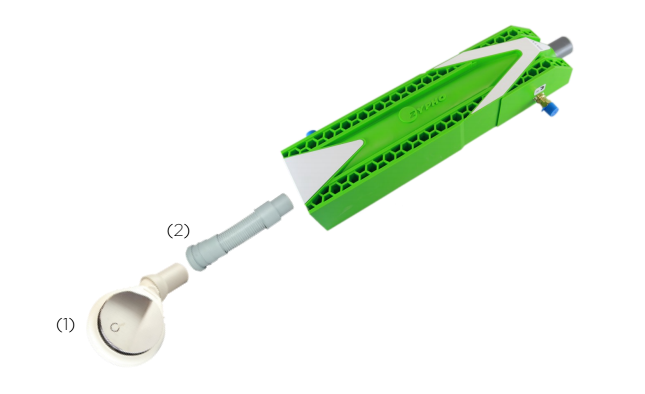
Which is why I linked to the other model in that post that does have a 40mm inlet and outlet: https://www.zypho.eu/products/zypho-izi/ I've found an Irish supplier, but they want €243 for it, and a UK supplier, but they want £800 for it......................
-
Just spotted this on Ebay: https://www.ebay.co.uk/itm/Zypho-Shower-Waste-Water-Heat-Recovery-Unit-Ref-Z8DWPT3-/222784960687?clk_rvr_id=1477658349340&rmvSB=true I've checked out the manufacturer, Zypho, and although the efficiency isn't great, the units look like they are easy to fit and reasonably affordable. If retrofitting to an existing installation, then this unit looks a better bet, as it accepts a 40mm inlet and outlet pipe and is under 500mm long: https://www.zypho.eu/products/zypho-izi/ Payback periods look reasonable, too.
-
As a general rule, if any bit of electrical kit gets a good soaking, as long as it's turned off and unplugged, then allowed to dry out thoroughly before being plugged in again, it will often be OK, unless it has batteries internally, in which case if may well be buggered. I've rescued small stuff that's been dunked in water by putting it in a bag of rice and leaving it in the airing cupboard before now. Even better is to wash the thing (with no battery in) in distilled water and then dry it out - that will wash away any residues the mucky water would have left behind. Stuff with batteries in is the big problem, as unless you can remove the battery very quickly after the incident there's a good chance the damage will be done, just from the current flowing from the battery to the power control circuitry.
-
The standing charge for E7 is the killer for us, one issue being that both the tariff and standing charge varies by post code, it seems, as well as varying with supplier, so what may work out well for one person may not for another. Last time I looked a standard tariff with the maximum discounts for monthly payment, paperless billing etc, was best value for us and E7 was way down the list, with the standing charge being the biggest single factor between suppliers. Sadly our gross import (not our net import) is slightly higher than would make sense for a zero standing charge supplier, but equally that could change with the next round of tariff changes, as the whole thing is very fluid. I've found it a real PITA to compare real prices for our pattern of use between different suppliers, the only golden rule is to never use the comparison websites as they are always way out, you're much better of trawling around and getting the actual unit price and daily standing charge direct from as many suppliers as you have the patience to check out.
-
I think you probably need to think of something like PV with the same mind set as when choosing a kitchen or bathroom. Do you invest in a more expensive kitchen because you know it will add value to the house and give you added pleasure when living there, or do you go for a budget kitchen, accepting that by the time you come to sell it may well look a bit tired and need replacing, or a bit knocked off the sale price to compensate? In my view a fair bit of the value of PV comes from self-consumption, a little bit comes from the FIT and generation payment, and an unknown bit comes from the "feel-good" factor of doing something to reduce your carbon emissions. There's also the rapid drop in the price of battery storage - that's now down to around 8p/kWh lifetime cost, and dropping. When it gets down to around 5 or 6p/kWh then it makes sense to fit it to increase self consumption from PV, I think. I reckon that with about 6 kWh of battery storage at 6p/ kWh life cycle cost we would knock our electricity consumption from the grid, even in winter, down to virtually zero, nd would easily use no grid electricity at all for around 8 months of the year.
-
I looked at one. It would take 10 seconds with a pair of big scissors to cut through the steel sheeting. At a guess I'd say that the thickest stuff might have been around 18g, much is 20 or even 22g. it's about the same as cutting through a tin can. Don't even think of it for site security for tools etc, as it would be pretty useless. I bought a smaller, near-identical, 8 x 4 steel shed and that's much the same, so I beefed it up by lining it with ply to make it secure enough to store garden tools.
-
It is a no brainer, but then I paid in another FIT cheque yesterday for the winter quarter and that was £150, more than it cost to heat the house through all this cold weather by a significant amount. Being able to run the heat pump in reverse in summer is a bonus, as although it only draws around 800W maximum when cooling the house, that is always far less than our surplus PV generation in hot weather, so the cooling is completely free.
-
What about cooling
Jeremy Harris replied to Visti's topic in Mechanical Ventilation with Heat Recovery (MVHR)
We just reverse our heat pump to cool the floor, much, much easier to do than plumb in a brine loop, and cheap, just add one extra thermostat. All air to water heat pumps are reversible, they have to be in order to defrost. However, the best solution is to keep the heat out with external shading, external blinds etc. Summer is not the worst case for us, it's low angle sun around this time of the year and in autumn, when the sun can get under the shading and deep into the house, so external blinds or movable external shading seems a better thing to try and do, and something I wish we've been allowed to do by the planners. Getting rid of heat once it is in the house is really a last resort, and it seems better to try and stop it getting in in the first place. -
You must be one of the tiny minority that put a decent peripheral run around the edges - 99% of dot'n'dabbers don't, and just create a plasterboard tent inside the house, with cold air able to get behind the boards easily. Mind you, with no parge coat on the inside you're still going to get some cold air infiltration through the masonry, as it's generally pretty porous.
-
Looking at a plot with PP but scary soil survey!
Jeremy Harris replied to Dreadnaught's topic in Foundations
Sure, it's here as a pdf on my blog: http://www.mayfly.eu/wp-content/uploads/2013/09/Elevation-Sections-for-BC-A4.pdf Here's the blog entry with some photos of the foundations going down: http://www.mayfly.eu/2013/10/part-sixteen-fun-and-games-in-the-mud/- 20 replies
-
- 1
-
-
- soil survey
- piles
- (and 1 more)
-
Simple AAV and Extractor Vent Questions
Jeremy Harris replied to Tin Soldier's topic in Bathrooms, Ensuites & Wetrooms
As a general rule, you only need a single adequate SVP per foul drain run, often for more than one house, and can fit AAVs above the highest level of all the drains fitted to all the other soil pipes. Worth reiterating that there are two functions for a foul drain vent, both of which are separate and don't need to be met by the same solution. The first is that there must be an open vent that allows the foul drain pressure to equalise with the local air pressure, and to allow the escape of any gas build up in the foul drain (not a very realistic possibility for a house, but can happen in larger sewers). The second function is to prevent a vacuum developing behind the slug of water that is rapidly discharged down the soil pipe when a toilet flushes. If this was allowed to happen then is could suck the water out of the basin/bath traps that may be connected on the vacuum side of the soil pipe, allowing foul odours into the house. For the sake of cheapness, a combined soil vent pipe is most commonly fitted. This can both allow the pressure to equalise and prevent a vacuum build up when a toilet flushes. Form the perspective of a builder this is cheap and easy. From the perspective of an energy efficient house it's a lousy idea, as the SVP acts as a chimney, allowing cold outside air to flow up/down it, so causes a thermal bridge. It's preferable to avoid an internal SVP and use AAVs and an external vent for the foul drain if possible. -
Looking at a plot with PP but scary soil survey!
Jeremy Harris replied to Dreadnaught's topic in Foundations
We have a passive slab type reinforced raft over hard clay. The make up is 200mm of crushed clean stone (18-35 no fines) laid over terram in a 200mm deep excavation below ground level, with perimeter perforated drains just outside the edge of the building envelope, grit blinding laid over the stone and very carefully levelled, 300mm of EPS insulation laid directly on the blinding in 100mm layers, with the DPM being between the top layer and the lower two layers. The edge has a 200mm wide upstand that is 400mm above ground level, and creates a 200mm deep reinforced ring beam around the edge of the slab. Most of the slab is 100mm thick RC35, laid on to A142 reinforcement fabric sat on 40mm chairs, the ring beam is 200mm thick. The UFH pipes are tied directly to the 200mm pitch of the fabric. In structural terms it's an absolutely massive overkill, as the bearing load on the ground, allowing for the additional load spreading from the 200mm thick layer of stone underneath, is less than 15% of the max allowable for the actual soil conditions. The main advantage (apart from the main one of being very thermally efficient, with virtually no thermal bridging) is that the whole foundation laying process, from the start to the completed dead flat power floated concrete slab took four days, for three people plus the concrete truck.- 20 replies
-
- 2
-

-
- soil survey
- piles
- (and 1 more)
-
Hot tub waste water - where can it go?
Jeremy Harris replied to readiescards's topic in Waste & Sewerage
As above, it depends entirely on the treatment system that's fitted to the tub. If it is a chlorine based one (as a lot are, especially older, or dare I say it cheaper, ones are) then you cannot put the waste into a treatment plant, as there is a chance that the chlorine will kill off the aerobic bacteria in it for a while. If the water in the tub hasn't been chlorinated recently (as I suspect it may not have been over the winter) then you could probably put it through the treatment plant OK, but it would tend to dilute the contents a fair bit and may slow it down due to lack of nutrients. On the other hand, often (as @SteamyTea has mentioned) these things do tend to accumulate a lot of pretty nasty anaerobic bugs in their pipe work, so it may well be better to empty it via the treatment plant to that the effluent that is finally discharged has a lower biological oxygen demand. I did some work on a tub that had no treatment system at all (not sure how they are allowed to sell them like that, really) that belongs to an acquaintance who had read my exploits with water treatment. I fitted a Mazzei injector and ozone generator in a bypass arm fitted to the main circulation pump and it's worked very well indeed. The water and pipe work stays nice and clean now. I have to say that our first go at cleaning out the mucky pipes before fitting the ozone system was a dreadful job - you really do not want to look at what grows inside those things, it's bloody dire, to say the least. We ended up fitting new pipes throughout, as neither of us could face the idea of cleaning all the pipes, they were that bad.- 27 replies
-
- 2
-
-
-
- hot tub
- waste water
- (and 1 more)
-
Funnily enough, I had half a mind to suggest photinia, but bigg'ish ones around here seem a bit pricey, perhaps the price varies a bit from one area to another. They do look very nice though, in my view, although my other half doesn't like them, which is a shame, as they would be ideal for the screening we need, having been to see some of around the right size.
-
When I was asked to give a talk about our house in the village hall, I had to think of a way of trying to make the numbers mean something. Having a SAP EI rating of -0.9 tonnes of CO2 is OK, but doesn't mean much to most people. Finding out that trees have a lifetime CO2 sequestration rate of around 20kg per year on average through life, meant I could represent our house in terms of the equivalent number of trees grown on our small plot. It turns out that we effectively sequester the same amount of CO2 as around 40 to 45 trees. At most we could grow around 10 to 15 mature trees on our plot if it was intensive woodland. As our solar array is only on a small area of the whole plot, it further illustrates just how poor trees are at turning CO2 into biomass.
-
Hot tub waste water - where can it go?
Jeremy Harris replied to readiescards's topic in Waste & Sewerage
A hot tub will usually have either a chlorine dosing system, an ozone dosing system or, perhaps, a UV exposure system, built in to the circulating pipework, so where it goes depends on which system your tub uses. If it uses a chlorine-based treatment system, then don't put it in the treatment plant, if it uses an ozone or UV system then it's fine to do down the treatment plant. The same really goes for draining it directly to the local dyke - if it uses a chlorine based system then I'd be inclined to drain it over a wide area of ground that has nothing growing on it to allow the chlorine to evaporate out as it drains away. If the hot tub has no treatment at all, then personally I'd be very wary of using it at all. Apart from the abundance of faecal coliforms that will inevitably colonise it, there's also a fairly significant risk of legionnaires. Adding ozone treatment via a venturi and ozone generator into the pump pipework isn't hard to do, and is probably one of the simplest and lowest maintenance ways of keeping the water safe.- 27 replies
-
- 1
-
-
- hot tub
- waste water
- (and 1 more)
-
There are some slightly better varieties of Leylandii around now, I've been told. Worth asking about, as the traditional sort tend to go bare at the base if left for just a little bit too long before trimming, and never regrow down there, but the lady at the tree place told me that there were two or three species that were a lot better and around the same sort of price. If I get time later I'll try and go through their list (sadly it's only available as a PDF download) and see if I can recognise their names.
-
I reckon you probably have to trade "cheap" versus "quick". My limited research has shown that "instant" hedging is fast growing, cheap initially, but expensive in the long term because it needs constant and regular pruning. Buying larger, mature, hedging is relatively cheap if it's a fast-growing species, but very expensive if it's something slow growing that needs little attention; As an example, I've been trying to buy some holly trees. Small ones, around 300 to 400mm high are cheap, ones around 2m high are well over £100 each, 3m high are over £300. I've been quoted between £600 and £1200 for 3.5 to 4m high holly standards. The reason is they grow very slowly, great for low maintenance, but not good for the wallet! Some of the laurels are reasonable, not especially cheap, but not overly expensive either, and some grow relatively slowly, so don't need constant trimming. I found that going to visit a good tree/hedge nursery that mainly supplies the trade was the best thing I did. We got lots of really good advice, could wander around acres of trees and hedging plants and see first hand what they looked like. Well worth doing, IMHO. In fact the lady from Landford Trees (highly recommended for anyone around our area, in my view) has just left an hour or two ago, having dropped off a load of trees that are going to be planted on Monday. They won't take any payment until after the trees have been planted and are seen to be OK, either, something I found a very pleasant surprise. Plus deliver for a truck load of big trees was only £10.
-
Over on the other place I remember debating the same point with the same person as @SteamyTea, and relating my experience indirectly gained from an experiment that was being conducted at my first place of work (what was then The Radiochemical Centre, and then a part of the UKAEA). I've found some of the posts I wrote years ago about this, and will paste some them here for added interest. These are from September 23rd 2011: I was then questioned on whether I was using the oil yield from the biomass crop (which I was in the context of the debate back then) and gave this reply): I followed up with this: @SteamyTea then asked: and I replied: I was then denounced on the basis that I was a scientist, so "great in theory and the lab but when they get down to the practical application there common sense goes out the window". It's fun debating with those who are so narrow-minded and unwilling to face facts for a time, but it does get tedious after a while. Needless to say, the owner of that forum was a great supporter of burning wood, and convinced it would save the planet, so I was booted off a while later for being a heretic (well, not quite, but not far off!).
