Jeremy Harris
-
Posts
26430 -
Joined
-
Last visited
-
Days Won
360
Everything posted by Jeremy Harris
-
Not sure, TBH. Last time I used fart mode I selected Ludicrous Mode and set it to fart on turn signal, with the default seat position for farts to be the front passenger seat. SWMBO was not amused when I indicated to pull out of our lane . . .
-

Temporary heat source for UFH: Willis heaters
Jeremy Harris commented on oranjeboom's blog entry in Kentish RenoExtension
@TerryE is referring to the way he's using some homemade smart stuff to both control his heating and to use local weather forecast data to predict how much heat needs to be put into his slab for the following day. A rough translation: The "240 V stuff . . . needs to be part P compliant" refers to the fact that all electrical work of this type must be undertaken by a competent person that is registered with one of the Part P accreditation cartels. Most electricians will be. The alternative is to get the installation inspected and tested by a building control body, but that may not always be that easy, as in some areas building control don't have anyone competent to undertake third party inspection and test. The electrical installation will need to have a part P IEC lodged on the database, as it's a legal requirement. My guess is that your electrician will be able to do this, as most can. @TerryE uses a microcontroller to switch the Willis heaters, using solid state relays (SSRs) that have an isolated low voltage input and are able to switch a high AC current. Crydom is just a well-respected manufacturer of these. IoT refers to "internet of things", and specifically in this case to the many cheaper "smart" switches that are around that may not be able to handle the high continuous load presented by a Willis heater. "TTL outputs" refers to a 5 V logic level output that can often be used to switch an SSR directly. The Raspberry Pi General Purpose Input/Outputs (RPi GPIO) operate at 3.3 V, so may not be able to directly control an SSR. A level shifter is a simple electronic circuit that converts 3.3 V logic levels to 5 V logic levels, usually in both directions. The MCP23008 is an integrated circuit that can interface with any microcontroller than has an Inter-Integrated Circuit (abbreviated to I²C) serial interface. It has a higher current drive capability than the GPIO ports on a Raspberry Pi, so can drive an SSR directly. -
Dipping a toe into MVHR
Jeremy Harris replied to Moonshine's topic in Mechanical Ventilation with Heat Recovery (MVHR)
Yes, it does. Failure to make it vapour tight can lead to it getting waterlogged and very soggy over time. I used closed cell neoprene insulation around our intake and exhaust[1] ducts. PITA to fit and tape up, but I can be reasonably confident that it won't end up as a soggy mess. [1] The reason for doing the exhaust duct is only because the Genvex MVHR we have can exhaust air at about -5° C if it's ever run in heating mode. -
Easy to see the savings on running cost for something like an electric bus. I worked out my "fuel" running cost, assuming I always charge at home overnight, which isn't always the case, I charge from the PV system when there's enough generation. My car costs about 2p/mile for the electricity used to charge it. My wife's Toyota Yaris hybrid does about 50mpg and costs around 11p/mile, in fuel, to run. With that sort of fuel cost saving it probably doesn't take very long for a bus operator to recover the additional cost of purchase.
-
TBH, I doubt anyone could tell that it's a budget basin from B&Q. When it comes to ceramic bathroom stuff it's hard to see the difference between some of the budget stuff and some of the high end stuff. I've never been sure where the money goes on the high end stuff, either, as I can't see how a £200 ceramic basin can possibly cost more to manufacture than a £50 one.
-
Temporary heat source for UFH: Willis heaters
Jeremy Harris commented on oranjeboom's blog entry in Kentish RenoExtension
One for both is more than big enough, even if buried in insulation. -
If that much heat was leaking out somehow then it would be pretty noticeable, the case of the Sunamp would be getting pretty warm. The Eddi has no way of knowing the state of charge of the UniQ at all, this is one of the major issues with the Sunamp, that it's impossible to tell the state of charge, or even know whether the thing is charged at all (unless you take the lid off the controller and see if the call for heat LED is on). If I had to guess, knowing that there have been a few issues with the firmware in the Eddi controller, I'd say it's more likely to be an erroneous display on the Eddi than anything else, and may possibly be related to the way the Eddi senses power. The Eddi can only very roughly guess what the Sunamp state of charge is, and can only possibly know one state, which is fully charged (it can probably work this out because the Sunamp controller will stop accepting power). We boost our 9 kWh Sunamp with E7 every night as a matter of course. We have a 6.25 kWp PV array, but it's rare that we get enough generation to provide hot water in winter. Today is one day when we have fully charged the Sunamp from PV, but it's the first day for a week or so that this has happened, and I only know that the Sunamp is charged because mine has the controller cover removed, so the LED is visible (I don't suggest doing this, as there are live terminals exposed with the cover off).
-
Temporary heat source for UFH: Willis heaters
Jeremy Harris commented on oranjeboom's blog entry in Kentish RenoExtension
You can always just increase the cable size to 6mm² to be absolutely safe, although the cable ratings in the blue book are very conservative. The reality is that the middle runs of cables very rarely suffer from overheating, most of the time it's the terminations at the ends of cables that cause problems. -
Firstly, I'm most definitely not a "Tesla fanboy", whatever that is. The company has some serious shortcomings, as I've highlighted in another thread here very recently, for example the hassle in getting hold of customer service, their intrinsically broken IT systems that cannot even deal with email, their failure to get the basics, like sending a customer an accurate invoice (I had eleven invoices before they got it right, believe it or not). Their "no dealership" model is a serious embuggerance if you need service, too, and their pre-delivery inspection is virtually non-existent. The car is, however, superb, and it's really hard to find fault with it. That's just the way it is. It's well designed, well built and doesn't have any of the issues you've highlighted, like cheap or poor quality interior materials. I'm not a fan of the Cybertruck, either. Not at all my thing, and way too big to be practical around the narrow lanes where I live. Whether it gets delivered or not I really don't know, but if I had to guess I'd say it almost certainly will, if only because the big truck market in the US is a big segment. VAG aren't comparable to Tesla, you're right. So far, VAG have been proven, beyond any doubt, to be a company that has cheated and lied to their customers on a massive, global, scale for years, so far Tesla has done neither.
-
I suspect that those in rural areas, where taxis are expensive and public transport has been in decline for years, may well have a long wait until such services become profitable. I doubt very much that I'll live long enough to see the end of private car ownership, TBH, although it does seem very likely that those living in cities will be able to give them up fairly easily. A friend of mine lives in Regent's Park, and pays four times the cost of our electricity bill just to park his car outside his house.
-
Plumbing for Dummies: who's the Dummie?
Jeremy Harris replied to ToughButterCup's topic in Waste & Sewerage
Straight couplers, for joining two lengths of soil pipe, come in two flavours. The normal one has internal stops to allow the pipe to be inserted and then be restrained from further penetration. The snag with this is that sometimes you have a constraint that stops you moving the two bits of pipe to be joined far enough apart to be able to fit the coupler. A slip coupler has no internal stops, so can be slid completely on to one pipe, the pipes positioned so they are virtually touching each other, and then the coupler slipped back so that it's centred over the joint. Slip couplers are less foolproof to use, as they need to be positioned in exactly the right place over the joint, but are very useful at times. -
Plumbing for Dummies: who's the Dummie?
Jeremy Harris replied to ToughButterCup's topic in Waste & Sewerage
In my case I only realised we needed a slip coupler after the chap with the digger had dug a hole, when we spotted that it would be the easy way to quickly reposition a P trap. I could either do a 20 mile round trip to buy a slip couple for around a fiver, or pay nearly three times that from the BM a mile and a half up the road (who's well known to be a rip-off merchant). Overall it was cheaper to just get the more expensive once, so we could get the job done whilst the digger was still on site. Still rankles, though. -
MBC raft foundation - what to do with membrane hanging over EPS
Jeremy Harris replied to Coops85's topic in Foundations
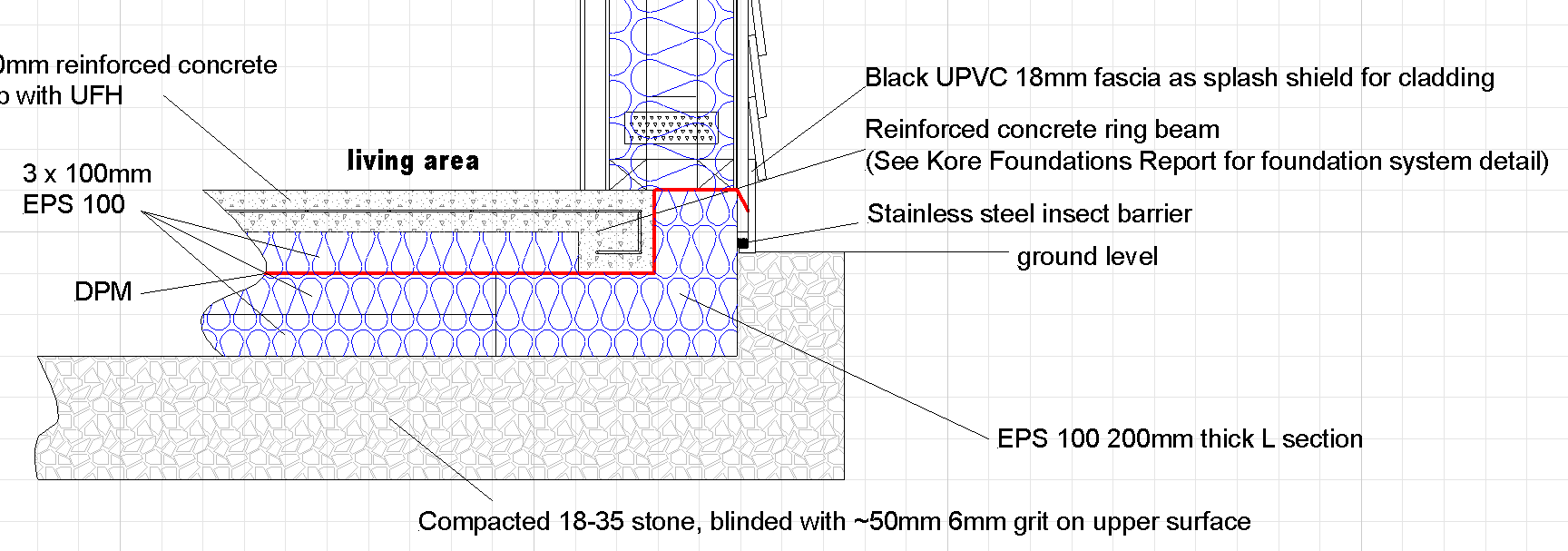
Here's a cross section of the lower part of our external walls that may help: This isn't quite as I did it, as I left the DPM layer where it was, running right down to ground level, rather than trim it. The cladding I used was the widest width of L shaped fascia I could find, I think it was probably this one, or one like it, but in black: https://www.eurocell.co.uk/fascia-boards/replacement-fascia-18mm/250mm-x-18mm-fascia-board-in-white-x-5m As our house is clad with waney edge larch, the 18mm thickness of the uPVC worked OK. I just extended the vertical battens on which the cladding is fixed down to a few inches above ground level, and the L shape of the uPVC partially closed off the ends of them. These battens also held the galvanised mesh in place, that was trapped behind the battens, and helped to keep the DPM flat against the EPS.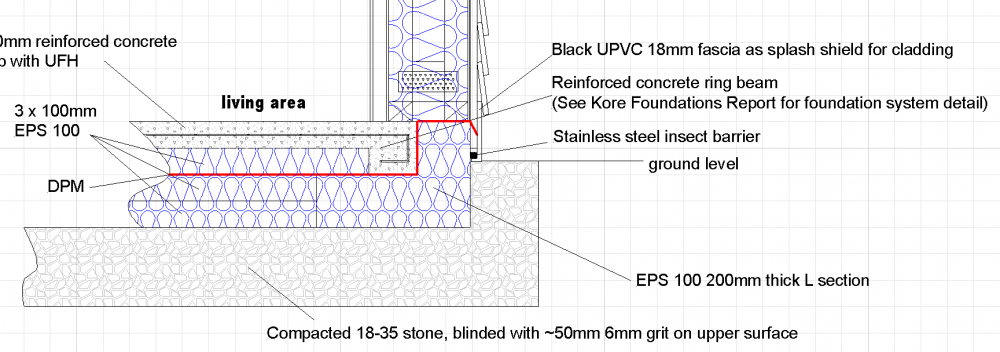
-
MBC raft foundation - what to do with membrane hanging over EPS
Jeremy Harris replied to Coops85's topic in Foundations
I left it as was, covered it with galvanised expanded mesh for rodent protection, then fitted black uPVC cladding around the lower part of the house. As a precaution against insects getting in the cavity behind the cladding I used unwound catering size stainless steel pan scourers to close the bottom of the gap up, but I've since discovered that you can buy rolls of stainless steel wool, intended for filling motorcycle silencers, that is easier to use than pan scourers. -
Spray painting inside of house white after plasterers
Jeremy Harris replied to Homer92's topic in Decorating
We painted the whole of our house before second fix. It did mean a bit of touching up here and there afterwards, but overall I'm happy we chose to do it this way around. Not only did it make for a cleaner look, with skirtings, architraves, kitchen units etc all fitting to an already decorated surface, but it was also an incentive to take a bit more care during second fix. I did leave unpainted areas wherever I needed to bond something to a wall, though, like in the bathrooms where the wall board was to be fitted around the bath, shower and basins. It made painting a lot quicker and easier, too, as it didn't really matter if a bit of paint splashed on to the floors. It also made it easier when moving the scaffold tower around (needed to paint the ~6m high bits in the hall) -
Bio-pure or ClearFox sewage plant feedback wanted, please
Jeremy Harris replied to Julian's topic in Waste & Sewerage
So is ours. Even before I moved the pump to a separate enclosure it was only barely audible when within a couple of metres of it. One thing worth noting is that there can be quite a wide disparity between the amount of power each units consumes. We fitted the low power air pump option to our BioPure, which not only reduces the power down to ~27 W, but is also a bit quieter. Some units can use as much as 60 W to 80 W, making them significantly more costly to run (maybe 22p to 30p/day versus ~ 10p/day). -
I'm not surprised, given that diagram they provided!
-
I'd second doing all visible pipework in copper, even if other hidden pipework is in plastic. I used plastic for all the long pipe runs, as we had no water on site when I was doing first fix, so I had no easy way to leak test long runs of pipe that would end up being inaccessible. Where these plastic runs terminated, behind units, I switched to copper pipe, really just because it looks so much neater, plus it's easier to fix so that it's really solid, something that makes operating isolation valve and fitting flexible tap connectors a fair bit easier.
-
Temporary heat source for UFH: Willis heaters
Jeremy Harris commented on oranjeboom's blog entry in Kentish RenoExtension
It's ground floor, I think, as it's not likely that UFH would be set in concrete on the first floor. -
Temporary heat source for UFH: Willis heaters
Jeremy Harris commented on oranjeboom's blog entry in Kentish RenoExtension
Standard for acoustic inter-floor insulation is 100mm though, plus I did make it clear by adding "you could just about get away with" as a qualifier. -
This diagram has a very major omission, and should not be implemented as shown, under any cirumstances. There is NO over current protection, apart from the main fuse, which may well be rated at 100 A. As it stands, this diagram shows an unsafe installation. If the RCD was replaced with an RCBO, or if an RCD was used in series with an appropriately rated MCB or fuse, then it would be OK. I'm more than a bit surprised that any DNO or supplier would publish such a diagram, TBH. It looks as if that diagram was very sensibly ignored by the electrician who installed the TBS, with things installed as would be expected, with a DP isolating switch fuse immediately after the meter, then a CU that I hope contains both earth fault and over current protection to the two commando outlets.
-
Temporary heat source for UFH: Willis heaters
Jeremy Harris commented on oranjeboom's blog entry in Kentish RenoExtension
For a single cable, nominally 10m long, running through some insulation in the ceiling, you could just about get away with using 4mm² T&E to supply both heaters. 4mm² run like this through ceiling acoustic/thermal insulation would be downrated to 27 A, and 6 kW at 230 VAC is about 26.1 A. In terms of voltage drop, 4mm² is more than adequate over 10m, though, and would be OK for a run twice as long with no problem. -
Makes me laugh, too. Everyone that's had a drive of my Model 3, even the real diehard petrol heads, gets out of it with a grin and a comment about how impressive it is to drive. Admittedly, much of that is related to the acceleration, but equally the comfort and quality of the interior always gets a mention, too.
-
Guess how VW secured the first few thousand orders for the, as then yet to be finalised, ID.3? They took a £750 pre-booking deposit that guaranteed future customers a place in the queue. I paid this deposit, as at the time (about a year ago) I thought that the ID.3 looked like it might meet our needs pretty well. Guess what? VW are way behind schedule with the ID.3 and are having major software problems that don't look as if they will be resolved anytime soon. However, just like Tesla, the deposit on the ID.3 was fully refundable, and VW paid it back within about a week of me cancelling my pre-order. Just as well, as although Tesla give a 7 day, no quibble, money back guarantee if you take delivery of a car and then decide you just don't like it, and hand it back to them, VW don't. Like every other car manufacturer, once you've taken delivery the deal is done. Doesn't seem to me that Tesla are in any way "morally corrupt", that's a term that might more fairly be used to describe the proven immoral, cheating and law breaking behaviour of the VW Audi Group. They are probably now going to face another massive fine, for not meeting the promise they made to start delivering the zero emissions (at point of use) ID.3 in volume this year. IIRC, that fine is around another €10 billion, on top of how ever many billions the VW Audi Group have already had to pay out for being cheating liars.
-
Bio-pure or ClearFox sewage plant feedback wanted, please
Jeremy Harris replied to Julian's topic in Waste & Sewerage
We have a BioPure 1, which seems fine. The only thing I didn't like with it was the air pump being inside the lid of the unit. It works fine in this position, but I did need to add some soundproofing foam around it to reduce the noise, as there was a bit of a hum resonating around the chamber under the lid. I ended up moving the pump to a separate stone built box a couple of metres away, which has made it pretty much silent. Not a major issue, but we live in a pretty quiet area, so the noise was a bit more noticeable and could be heard from the lane that's only a couple of metres away from the unit.