


Jeremy Harris
-
Posts
26430 -
Joined
-
Last visited
-
Days Won
360
Everything posted by Jeremy Harris
-

EICR testing for rental property
Jeremy Harris replied to joe90's topic in Regulations, Training & Qualifications
I believe that rented properties now have to have wired and linked smoke/heat detectors. @Ferdinand may well know more, as he's up to speed with the regs that apply to rental places. I don't believe there is any requirement to change the CU out, but it will always get a C3 and be noted on an EICR now. Anything with a C3 doesn't require action, it's just an observation, really. -
If you make a straight cut across the pipe, in a couple of places either side of the damage, you should be able to lift the damaged part away and then lift the bit that's fitted to the bend away. You can then fit a slip coupler over the new bit of pipe, slide it into the bend and then line it up with the good section of remaining pipe and slide the slip coupler over the joint. I had to do something just like this a while ago, and as long as the pipe ends are chamfered well, and lubricated, it isn't too hard to do.
-
Definitely cut out the damaged section of pipe and fit a new section in, rather than bodging it with a patch. The last thing you want is to have the pipe fail later and need digging out to fix properly. If you can't get the whole run of damaged pipe out easily, then you could fit a section of new pipe, joined to the old with a coupler. In order to get the new section in you may need to use a slip coupler, so that it can be slid over the pipe completely, then slid back over the joint when the pipe's in place.
-
Bathroom electrIc radiator
Jeremy Harris replied to Pocster's topic in Electrics - Kitchen & Bathroom
Yes it is, according to the manual: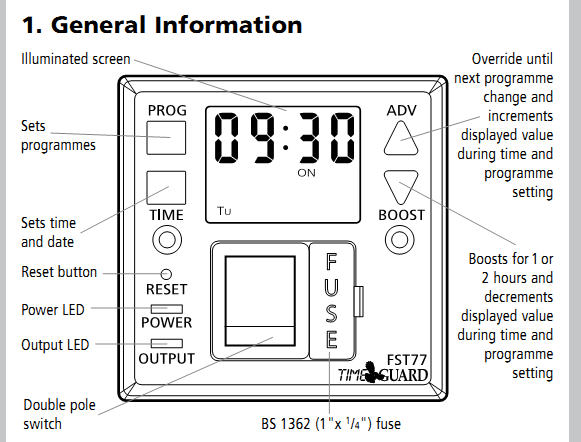
-
Suggestion: panel-heater by front door for comfort
Jeremy Harris replied to Dreadnaught's topic in Other Heating Systems
Strange, isn't it? IIRC, white LEDs use a blue LED that excites a phosphor that glows white, so it may be that there is a fair bit of blue, violet, or may be UV light emitted from them as well. I know that people with artificial lenses in their eyes can be sensitive to the "blue" light from some white LEDs. -
Pouring Concrete and Drinking Cava
Jeremy Harris commented on dnb's blog entry in Building in a woodland on the Isle of Wight
The reaction from my other half when the slab was poured was that the house looked very small. As soon as the frame and stud walls went up she commented that it was absolutely massive. No idea why houses seem to look small when they are just at foundation level. -
Heating controls in a bank branch
Jeremy Harris replied to Tennentslager's topic in Other Heating Systems
It looks like it has an air-to-air heat pump system, basically a split air conditioning system that works both to cool and heat the air coming out of the ceiling grilles. Daikin are a very well-known manufacturer, plus you have the manual. There look to be errors showing on the display, so the first thing to check might be to try and decode the errors, using the manual. Might be something as simple as the outdoor unit having been turned off, or it might be something more serious. Doing a search for the displayed error codes, together with the term Daikin, may help track down what they mean. -
Once set up then they are as simple to control as any other form of electric heating. All I have for our ASHP is a wall thermostat to set the temperature and a programmer to set when the heating comes on or turns off. It hasn't needed any fiddling or adjustment since I installed it.
-
I think you're either spot on with this observation, or that the work was, in reality, done by a professional.
-
Bathroom electrIc radiator
Jeremy Harris replied to Pocster's topic in Electrics - Kitchen & Bathroom
Some are, and some aren't. You need to pick one that specifically mentions that it has a flex outlet. I prefer the ones that have this flex outlet at the bottom edge, but you can get them with the flex outlet coming out the front, like this one: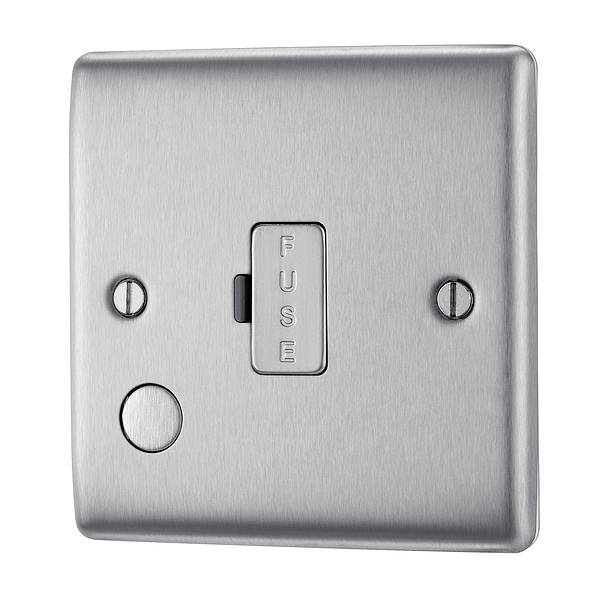
-
Bathroom electrIc radiator
Jeremy Harris replied to Pocster's topic in Electrics - Kitchen & Bathroom
There's a flex outlet under the lower edge, usually with a small plastic blanking plug that needs to be removed to feed the cable out, plus there is a cable grip at the rear to secure the flex. Here's a link to the full description: https://www.tlc-direct.co.uk/Products/CB4828slash3.html -
Bathroom electrIc radiator
Jeremy Harris replied to Pocster's topic in Electrics - Kitchen & Bathroom
No, you can get non-switched FCUs, with a flex outlet (it's hidden under the lower edge in this photo): That one has an indicator, handy for a heater as you can see when it's on.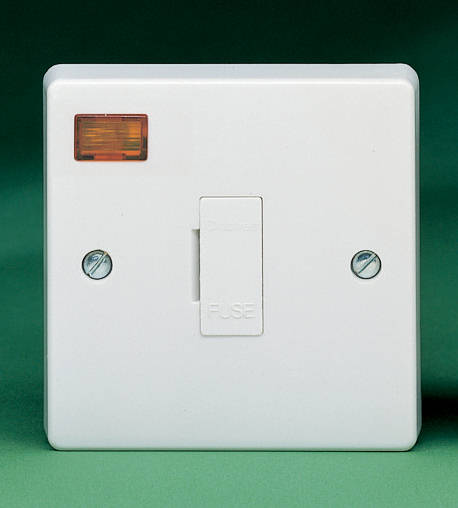
-
Bathroom electrIc radiator
Jeremy Harris replied to Pocster's topic in Electrics - Kitchen & Bathroom
Normal way to wire these would be via either a flex outlet plate (if the supplying circuit is suitably protected for the rating of the flex) or via a fused connection unit (FCU). The latter has the advantage that it can be fused to protect the flex that is supplying the heater. For example, we have heated towel rails that are both wired with FCUs, with the fuses being 3 A, as the heating elements are only around 150 W, and the flex to the towel rails is 0.75mm² heat resistant cable, rated at 6 A. The 3 A fuse in the FCU provides adequate protection for the 6 A rated flex. The FCUs are supplied from the upstairs ring final, via a wall mounted time switch outside the bathroom. The ring final is protected at 32 A, way more than the rating of the flex to the towel rails, hence the need for the additional protection offered by the fuse in the FCU. -
Suggestion: panel-heater by front door for comfort
Jeremy Harris replied to Dreadnaught's topic in Other Heating Systems
Could probably be done with some fairly modest radiant heat sources. I bought a couple of "UV" (really mainly blue/violet, at ~406nm) floodlights to post-cure resin 3D prints, and these are surprisingly good radiant heat sources. I need to dig around and find out why, as they don't heat most things, but they definitely feel warm if you place your hand in front of one. My guess is that the wavelength happens to be one that is absorbed by skin, so making it feel warm. -
Suggestion: panel-heater by front door for comfort
Jeremy Harris replied to Dreadnaught's topic in Other Heating Systems
Given that you only need this feeling as you walk in, and not all the time (as the house will be at a comfortable temperature) I wonder if there's a way of making a short burst long wavelength IR "illuminator", activated by your approach to the front door? That way it only needs to be powered for a short time.- 8 replies
-
- 1
-

-
- heating
- front door
- (and 1 more)
-
Does seem crazy to me. If I could install a heat pump in a few hours, with zero experience of installing one before, then any competent plumber/heating engineer/electrician could install one. They are less complex than installing and commissioning a boiler, and, unlike a boiler, they need no specialist equipment to install. The one area where heat pumps need a different approach is in sizing them, and the heating system, in order to give good performance. For most new builds this should be easy, and not something that would have been done by a heating engineer, anyway, in all probability.
-
New build - confused between timber & i-stud
Jeremy Harris replied to osmononame's topic in Timber Frame
Depends on the structural requirements. Our twin-stud walls are all on 400mm centres, with the 300mm cavity being filled with blown cellulose. The cellulose gives a pretty dense wall, that attenuates sound very well, as well as giving a reasonable U value, about 0.12 W/m².K. The decrement delay is also fairly long, long enough to help give the house a thermal time constant of significantly longer than a day. -
The Feed-in Tariff scheme stopped accepting new applications in April 2019: https://www.ofgem.gov.uk/environmental-programmes/fit/applicants with some exceptions. The RHI scheme is still extant for heating provided by heat pumps etc.
-
The Feed-in Tariff ended a couple of years ago, so there's now no subsidy for installing either PV, wind or small scale hydro generation. All that may be paid for is the metered export of excess generation back to the grid, at a rate of around 5.5p/kWh, I believe. To get this means having a smart meter installed (not an option at the moment for anything other than a single phase supply) and signing up to one of the companies offering the payment.
-
That is an MR16 downlight, that takes any lamp with an MR16 base.
-
We have an Economy 7 supply, and the tariff at the moment is 8.148p/kWh during the off-peak 7 hours (at the moment from 00:00 to 07:00) and 15.729p/kWh peak rate. The car tends to use roughly 250 Wh/mile, and I charge it mainly overnight at this time of the year, as our PV system is only now beginning to start generating appreciable amounts of energy again. 1 kWh gets me roughly 4 miles of range, hence the ~2/p/mile cost. From this month onwards there's a good chance that I'll be able to charge the car from excess PV generation, so the "fuel" element of the running cost will probably drop to close to zero for maybe the next 6 to 8 months or so.
-
Which ones, though? GU16 doesn't exist as a mechanical interface spec, as far as I know. MR16 does, as does GU10, but they are radically different in the design of the base part of the lamp. In general, the majority of 12 V downlighters use MR16 lamps, and the majority of 230 VAC downlights use GU10 lamps. Both have about the same front face size, but the lamp holder design is very different.
-
Do you mean MR16 lamps? These have two pins that poke out of the back and which push-fit into the lamp holder socket. Often MR16 lamp holders have a floating socket on a bit of cable, that is pushed on to the rear of the lamp, with the lamp then being secured by a bezel around the front. An alternative is the type of free-floating MR16 lamp holder, as used on twin catenary wire type installations, where the pin socket is the only part, and the lamp is just held by the friction of the pins in the socket at its base. GU10 is a bayonet style fitting, more commonly used for 230 VAC lamps (but can be used for 12 V lamps occasionally). A GU10 lamp holder will often use the bayonet fitting at the base to both make the electrical contact with the lamp and also provide the mechanical support to hold it in place. Neither the MR16 or GU10 specification defines the voltage of the lamp, they are only definitions that define the mechanical shape and size of the lamp and its interface to a lamp fitting. In general, most GU10 lamps tend to be 230 VAC and most MR16 lamps tend to be 12 V (either AC or DC), but this isn't always the case.
-
New build - confused between timber & i-stud
Jeremy Harris replied to osmononame's topic in Timber Frame
Just to be clear, I stud is a metal framing system for internal walls, whereas I beams are timber. -
Electric vehicle charging presents some hard limits on the power source, unfortunately. The lowest rate at which an EV can charge from AC is 6 A per phase, so about 1.4 kW from a single phase supply, or about 4.2 kW from a three phase supply. If less power than that is available the vehicle will stop charging. The highest rate that an EV can charge at from AC is usually about 32 A per phase, so about 7.4 kW from a single phase supply. Few cars have three phase onboard chargers that are capable of handing 32 A per phase, though, so often the three phase charging limit is significantly lower than 32 A per phase (my Tesla can only accept 16 A per phase from a three phase supply, for example). The other issue is that car onboard chargers need to have the available current signalled to them, so a variable power source, like a wind turbine, would need something to measure the available generated power at any instant and communicate that to the car via the signalling interface. The effectiveness of this depends on the response time of the car onboard charger (this can be tens of seconds) relative to the rate at which power generated by the wind turbine varies over time. It's very probable that the car onboard charger may not be able to respond fast enough to cope with gusts and lulls in the wind. Buffering the wind turbine output, by using it to charge a bank of batteries directly, then only generating 230 VAC from the battery supply, would be an option that may work OK, but it would need a fairly large battery bank, in order to be able to charge at a reasonable rate. The battery bank would iron out the peaks and troughs from the wind turbine, so as long as the mean power generated slightly exceeded the lowest vehicle charge rate then it should work. Whether it makes financial sense is debatable, though, as electricity is pretty cheap (costs me a bit over 2p/mile to run my car, charging with off-peak electricity).
