Jeremy Harris
-
Posts
26430 -
Joined
-
Last visited
-
Days Won
360
Everything posted by Jeremy Harris
-
You really don't get paint anywhere but where you want it if the person doing the spraying takes the time to set the pressure sprayer up properly. There's no air, so all that comes out of the gun is paint, and unless the pressure is too high (or the nozzle is badly worn) the spray pattern is really tight. I was really surprised at how little overspray there was, as it was nothing like using an air fed spray system at all.
-

Vaillant aerotherm
Jeremy Harris replied to jpinthehouse's topic in Mechanical Ventilation with Heat Recovery (MVHR)
I believe that this is another re-badged Carrier heat pump, certainly their previous model was. If the price is right, and the support from Valliant and the supplier is OK, then the heat pump itself will probably be fine. Carrier are a pretty big manufacturer; Willis Carrier invented the things around 100 years ago. The reason I believe this may well be a re-badged Carrier unit is because several of us have been doing detective work to find out who really makes a number of different heat pumps and several seem to be really made by Carrier. A couple of years ago @Alphonsox put together some of the manuals in one location in this post: -
Kingspan ASHP GMC board issue
Jeremy Harris replied to Gav_P's topic in Air Source Heat Pumps (ASHP)
Welcome. I'm inclined to think that your guess that you've shorted the 12 V supply may well be right. It might be possible to repair the board, but I suspect it might be hard, as there's no easy way to test any repair, and the chances are that there could be other damage, other than just the 12 V supply having blown. I can have a look at the board in my unit and see if there's an on-board fuse in the 12 V supply, as if there is that may be a quick and relatively easy fix, as long as that's the only damage. -
I sprayed the inside of my workshop. Dead easy, no need for masking if you get the settings right - as @Ferdinand says, the key is to keep the pressure down to give a good finish without paint bounce. I found I could easily spray to within a couple of inches of door frames, with no overspray on to the frame, with a bit of practice. I didn't backroll, but managed to get a pretty good finish with the gun. I was amazed at the speed with which you can apply paint - a 5 litre drum of paint seems to just disappear in no time. My pressure sprayer isn't an expensive one (in fact I may well sell it, as I'm not sure I'll use it again) but it still did an impressive job. I've used conventional air-driven spray systems a fair bit, both high pressure and an HVLP unit, and so knew enough to be able to handle the gun OK. The critical thing seemed to be getting the paint really, really well mixed. It's absolutely essential that the paint is power mixed for a lot longer than you might think necessary, as it only takes a small bit of thick stuff to clog the gun filter. I didn't mask anywhere, but used a big painters george, held in my free hand, as a portable mask, as shown in this US video:
-
Watching the the guys who connected our head up (from SSE), doing the job wearing kit that wouldn't have looked out of place on a rocket launch pad, I wonder how much variation there is from one area to another? Would they have been happy for you to pull the fuse on one of those old cast iron incomers, I wonder? They are still around, my late Mother's farm has a 3 phase board that looks like it's around 100 years old - I'd not pull one of those fuses, simply because I've no idea what's under the cast iron cover. I often get the feeling that much depends on the personality and experience of the person you talk to at the DNO. I had a wide range of pretty obstructive responses from different people at SSE over trying to get the cables relocated around our plot, but the guys who turned out to do the job (not the same guys that connected our supply up, on the same day, for some bizarre reason known only to SSE) were great, and did a really quick job, with no hassle at all (pity they couldn't run the local team - they could show their managers a thing or two).
-
I wouldn't be overly worried about what you did, frankly I'd probably have done the same. The thing is that you know what you're doing, having been in the building trade for decades and seen all this stuff, and I've no doubt the DNO guys had no problem with the circumstances of your relocation of their kit. It's the same problem as discussing removing the company fuse in order to change a consumer unit where there's no isolator, or meter with a built in one. A fair few qualified people will take the risk and break the seal and remove the fuse (with some exceptions, there are still some old company heads around that I doubt anyone but someone from the DNO would touch). Yes, it's breaking the law, but if there is no load on the circuit, you know what you're doing and have the right PPE then it's often the pragmatic solution to trying coordinate things and so get the supply back on as soon as possible. Few openly talk about it; it's fairly common to just read a reference to Amelie (the seal fairy) when someone's done this, for example. Everyone who understands the risks involved will understand the reference, without having to actually say it or write it somewhere. As @ProDave says, though, it is a lot easier and safer to just fit the meter box away from the house in the first place. It's what he and I both did, as it means only one visit from the DNO and supplier and your electrician can do any work needed, from running a temporary site supply to feeding power to the house, or temporary accommodation, without needing to trouble either the DNO or the supplier at all.
-
I hired a local labourer for a day to hand dig some additional trenches when we had to move the position of our borehole. Around here labourers are between £80 and £120/day. Worth paying more for a labourer who's good at digging trenches, as they will do a better job in less time. There's definitely an art to digging a nice clean service trench by hand.
-
Probably more than 600 to 700 A, but with luck there may be an 800 A fuse further back up the line, although I'd not rely on it - cables will burn back before that fuse blows, if it's there, I've seen it happen a couple of years ago when a pot joint on an LV supply pole failed and caught fire. Ze will be less than 0.35Ω on the incoming supply, assuming that the new supply will be TN-C-S with a PEN, and will most probably be around 0.2Ω or less, so with a nominal 230 VAC supply (which will probably be closer to 240 VAC) the PFC will almost certainly be over 1 kA, perhaps as much as 1.5 kA. I recently checked Ze and the PFC for our old house, it was 0.16Ω and the PFC was 1.43 kA, and that's in a rural village with the house some distance from the local substation. Not borderline illegal, either, it's an offence for for anyone other than the DNO to interfere with cables, the cable termination, or the fuse on the DNO side of the supply. I accept that people have got away with doing things like this, but that doesn't make it legal to do so. I'll freely admit I've had cause to illegally interfere with the DNO side of a supply before now, as, I would guess, have others who want to get a job done without the delay of waiting for the DNO to come out, but I did so knowing the risks and that I was doing something illegal. To help illustrate the risk, the PPE requirement for a trained DNO person to just remove/change the fuse in their head will be long heavy duty insulated gloves, a full face mask and a flash shield. Electrical explosions from a short on even a 230 VAC supply at over 1 kA are bloody terrifying.
-
The engine we ended up with was a total pig, took well over an hour, at around 11pm, after a day that started on set at around 7am, to get to start for the final build shots. Generally, there's at least enough stuff in the heap to build around 3 or 4 machines that will fulfil the brief, but whether or not the engineering team have checked anything out is doubtful. Worst production for hanging around getting wet, cold and bored, doing dozens of retakes, was Poldark in the 70's. It was all shot on film, too, which made things even slower, with all the delays for reloads. The Onedin line was really weird, as we did all the at sea sequences for the whole series in a week, sailing around a few miles offshore, with the damned stupid director not understanding that you can't just turn a square rigger*** around; it's a process that can easily take half an hour or so of hard work to wear ship (and you don't even want to think about how long it takes to tack, we'd have needed half as many crew again and it would still have been slower), and get her heading in the right direction for light or whatever. *** The Charlotte Rose wasn't, strictly speaking, a square rigger originally, she was a Baltic Trader modified to take a square rig, but with a damned great Gardner diesel to allow her to get in and out of the two harbours used, Charlestown and the main set up the river from Fowey.
-
Obtaining restrictive covenant insurance
Jeremy Harris replied to Moonshine's topic in Party Wall & Property Legal Issues
They should have, but the only process I can find to do this takes years and costs a lot of money. -
I was emailed by a researcher working for Boundless Productions within a week of us getting planning permission. Not sure how they got hold of my email address, but I do know that the majority of the people working for production companies are freelance. Around 80% of the people working on Scrapheap were freelancers, and most of them kept some form of "little black book" of useful contacts. I worked for four or five different production companies and each time it was one of the junior researchers who contacted me, from information that he/she had acquired from some other production. For example, having worked for BBC online on an aviation related series (which came via knowing Douglas Adams, who must have told his friend Richard Creasey, who was then a BBC producer, as well as having a famous author father, John Creasey), I was contacted out of the blue by RDF Media to advise on an aviation-related international production (which ended up with another friend, Bill Brooks, in a starring role). The next thing I knew I was contacted by another RDF researcher (also a freelancer) to give more advice, then eventually ended up on camera in production (something my wife absolutely hated - she still gets really embarrassed whenever a channel runs a repeat and her colleagues ask if it was me in the show). Doing TV stuff is a mix of massive amounts of boredom, loads of frustration when the arty-farty types deliberately screw things up to create tension and a little bit of fun. Forget making any money - it has to be one of the hardest and least well-paid jobs I know. The only real positive is that the food is usually great, and there's loads of it, available all the time your around on set. I was semi-interested in doing GD, but SWMBO absolutely hates Kevin McCloud, and put her foot down, very firmly, so there was no way our build was going to be on the show. Unsurprisingly, we were then contacted by two other self-build related TV production companies, who must have heard of our build via the jungle drums. We may well end up on an unrelated media production, though, everyone will just have to wait and see what happens. I can say, if it comes off, it may well involve someone I've worked with before (and not as far back as the original Poldark series, or the Onedin Line...). Finally, you have to accept the way that you're not in control of how you're portrayed. Scrapheap isn't scripted or rehearsed at all, it's shot live with masses of post-prod to bring something like 30 hours of audio and maybe 200 hours of video into a 45 minute show. If you want to see how bloody awful editing can be, here's a classic intro bit that's nothing like me at all:
-
Obtaining restrictive covenant insurance
Jeremy Harris replied to Moonshine's topic in Party Wall & Property Legal Issues
I'm certain you're right, it reads as if it is just a bit of boilerplate text to me, and is a bit odd in that it doesn't really seem to add anything useful to the beneficiary over and above the clauses that restrict anything being built on the land other than one, single storey, dwelling; what's on there now almost fills the entire width of the plot in the looking from the direction of the original vendor's house. There's no room for any extension on that axis, or at the rear, facing the original vendor's land, either, so the whole thing seems to be just a quirk that the purchaser will have to accept, I think. It can't be insured against anyway, I've just been told, because when the issue of the restrictive covenant came up with the previous purchaser, the one that I believe wanted to develop the site into something other than a dwelling, I discussed the covenant with my neighbour, so they are fully aware of it. -
You might be interested in the PV diverter I built some years ago (which is working fine, but now via a wireless link): https://picaxeforum.co.uk/threads/photo-voltaic-immersion-heater-power-diverter-safety-warning.24286/ (re-reading this old thread about the PV diverter I see that I mentioned your web site, @Ed Davies...)
-
I don't have a problem with buying electrical stuff direct from China, be it via AliExpress, eBay, Amazon or whoever, as I take the view that the stuff will most probably be non-compliant and may well be unsafe or dangerous, and I'm willing to strip, test and modify stuff to make it safe and fit for purpose if I can (some stuff is so dodgy that all you can really do is destroy it, though).
-
Obtaining restrictive covenant insurance
Jeremy Harris replied to Moonshine's topic in Party Wall & Property Legal Issues
The indemnity policy price seems variable by a large amount! I've found an online indemnity policy and had a quote for £125, including tax, which is around 1/3rd the price my solicitor is trying to charge (including a hefty fee from the solicitor for arranging the policy). If push comes to shove I'll just buy the £125 insurance, but on a point of principle I'm not going to pay through the nose for it with my own solicitor, as I'm convinced it's primarily a money making scam. As @Ferdinand wrote, enforcing covenants is so expensive that the likelihood of anyone trying to enforce this one, when other clauses in the covenant prevent the house being built taller, and so possibly causing a restriction of light, air etc to the bit of land involved, is effectively zero. The other restrictions have been accepted by the purchaser, and they include clauses that prevent anything over a single storey, or a single dwelling house, being built on the land. -
Obtaining restrictive covenant insurance
Jeremy Harris replied to Moonshine's topic in Party Wall & Property Legal Issues
Good point, but the "intrinsic evidence" has to be stronger than just knowing who the vendor was in 1981 and knowing the extent of their land at that time, it seems. In the case referred to this was the essence of the ruling at appeal: The sentences I've highlighted seems key, in that if the covenant is not properly registered as a land charge (and that is the case here - the land cannot be identified by the charge that remains on the registered title) then the covenant becomes, in effect, unenforceable. It bugs me that our solicitor failed to pick this up when we bought the house, as nothing has changed in the intervening years (except the popularity of indemnity insurance!). -
Obtaining restrictive covenant insurance
Jeremy Harris replied to Moonshine's topic in Party Wall & Property Legal Issues
Thanks, that's pretty much my take on it, and if our solicitor had taken the time to read the thing properly I'm damned certain that they should be advising me that it's unenforceable, not trying to sell me insurance (very expensive insurance - if I choose to buy insurance I can get it for less than 1/3rd of the total price I'd have to pay by using them). -
Obtaining restrictive covenant insurance
Jeremy Harris replied to Moonshine's topic in Party Wall & Property Legal Issues
Thanks, @Ferdinand, that's useful as there are two areas in the section on enforceability in that document that would seem to apply here, the ones I've highlighted: -
Obtaining restrictive covenant insurance
Jeremy Harris replied to Moonshine's topic in Party Wall & Property Legal Issues
That's my understanding from a previous debate we had, either here or on this forum's predecessor, where someone (almost certainly @Temp) found chapter and verse on the "right to light" legislation. Either way, I can't see how a house ~40m away from our boundary could possibly have a "right to light" with regard to land so far away, especially as there's a very big hedge on our boundary, on their side. -
FWIW, I've had a 25 A rated SSR switching our equivalent to an immersion heater on and off reliably for a couple of years or so. The heat sink needed is modest, and the alloy case it's screwed to does a good enough job. The big advantage is logic level control in my case, as I switch the SSR directly via a microcontroller pin. For a simple application like switching an immersion from an existing low power programmer/thermostat I'd just use a relay, though, as @dpmiller suggests. You can make a neat job of this by using a small DIN rail case and fitting a plug-in relay that fits a DIN mounting socket base. The most compact case with a DIN rail is probably one of the ones intended for use with a DP isolator. You used to be able to buy these on their own cheaply, but a quick web search has failed to come up with one. I've used the small Wylex ones for jobs like this, but can't for the life of me find the same ones now, which is a shame.
-
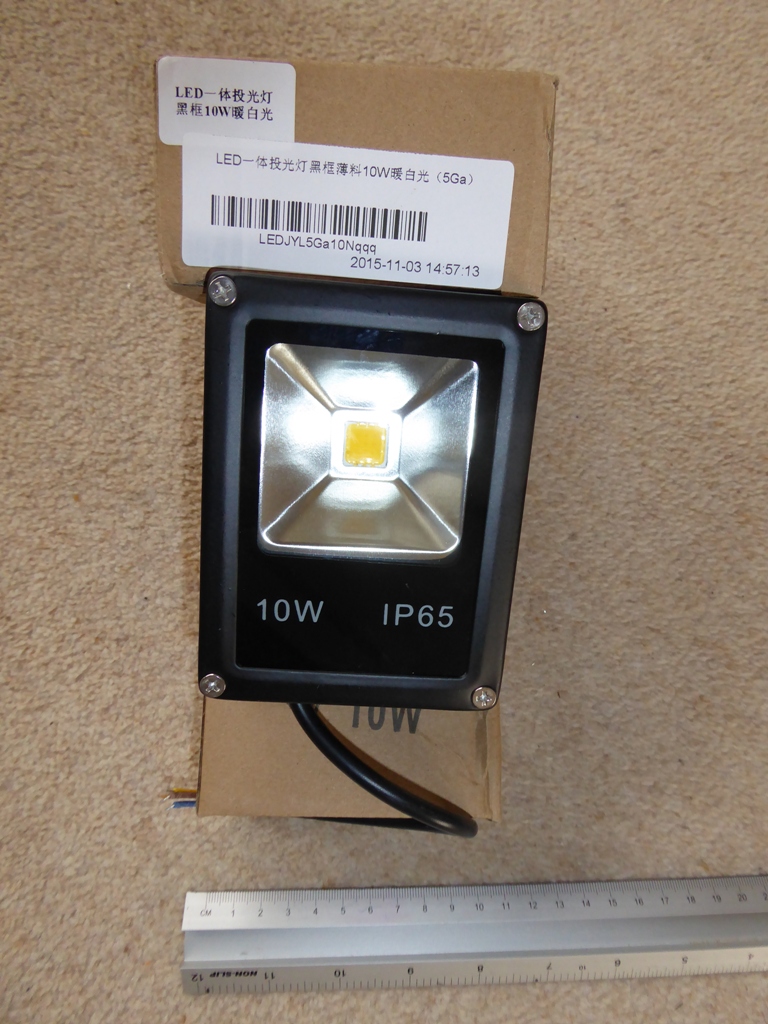
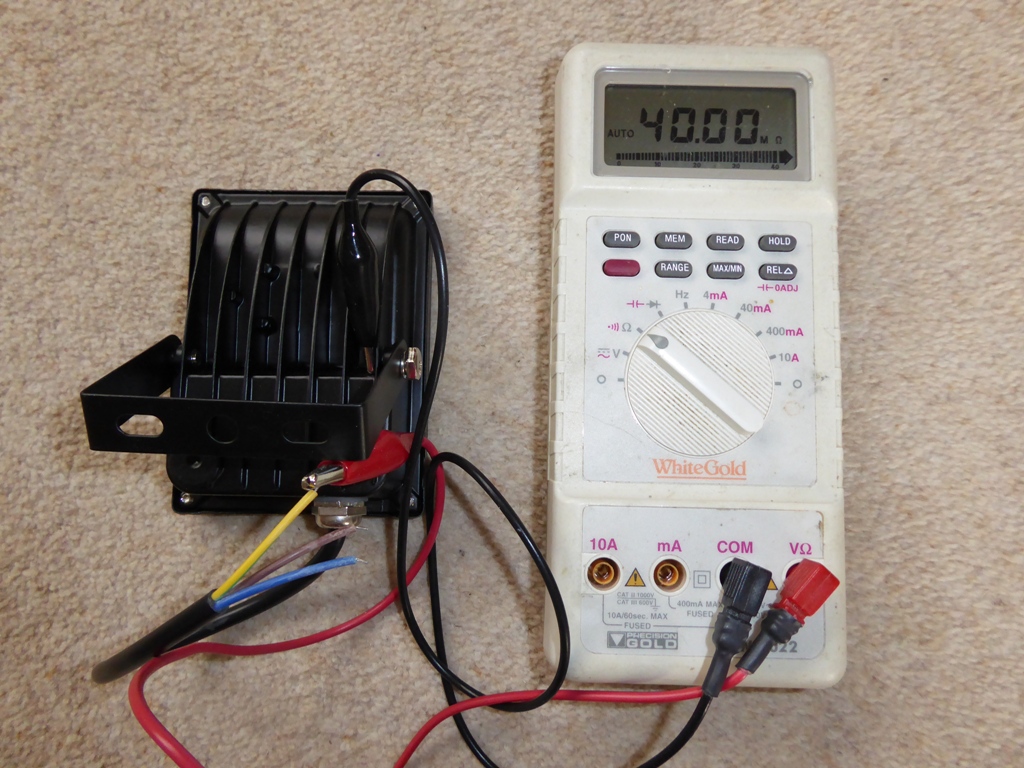
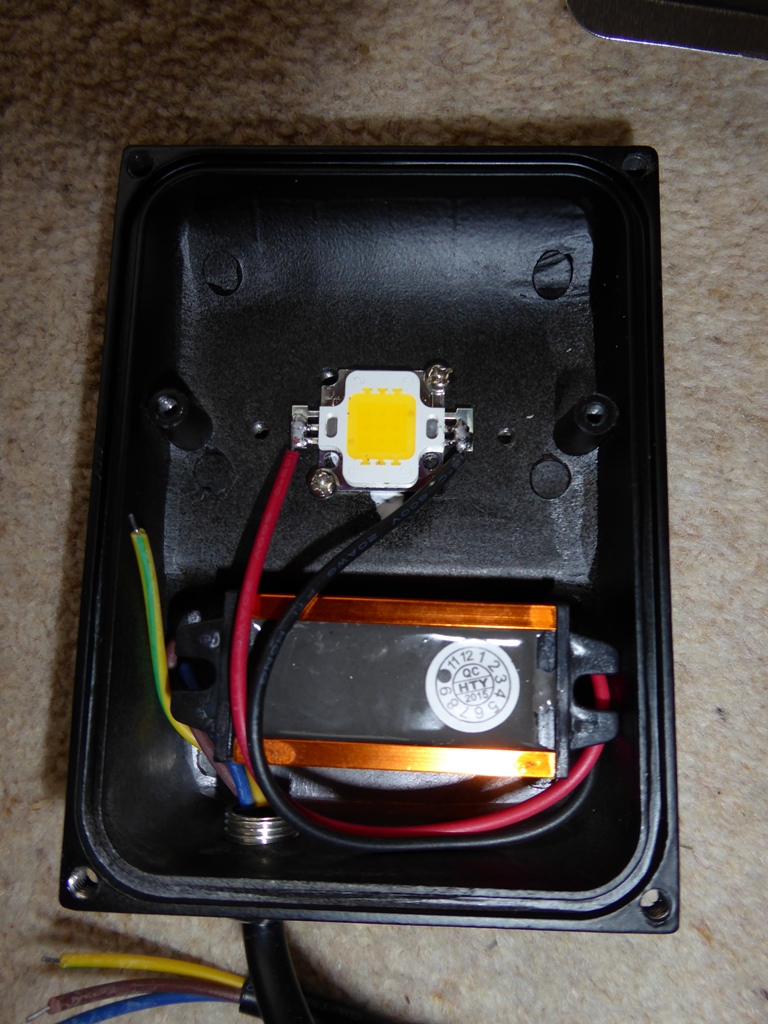
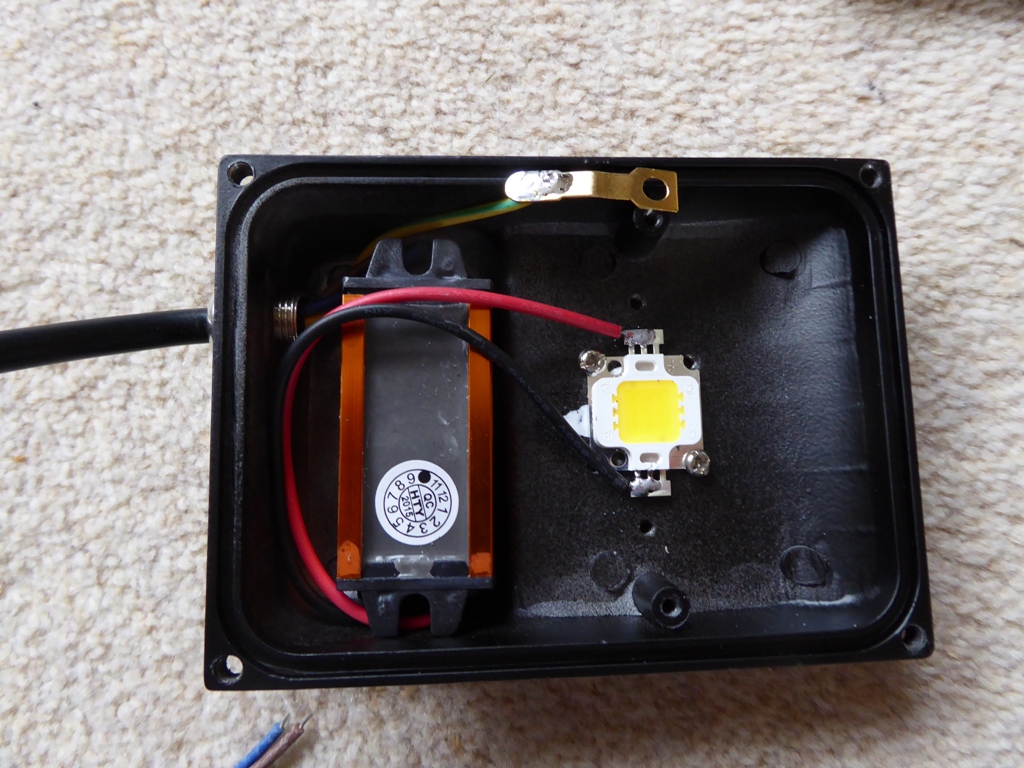
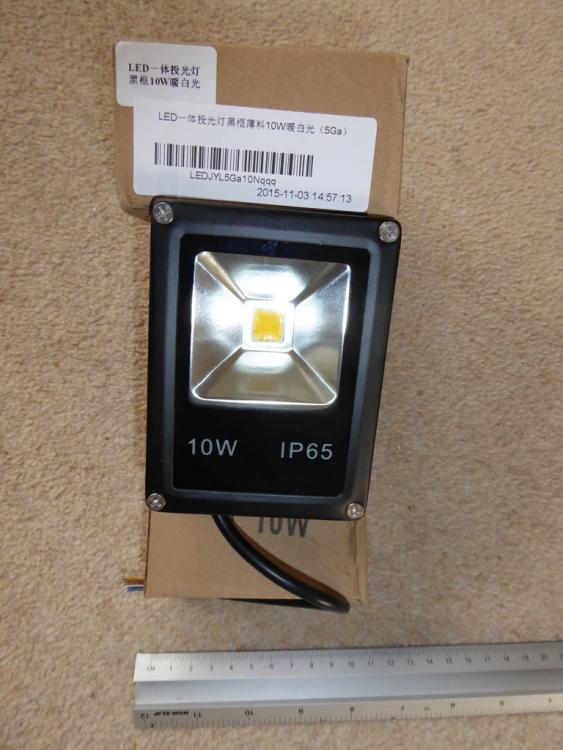
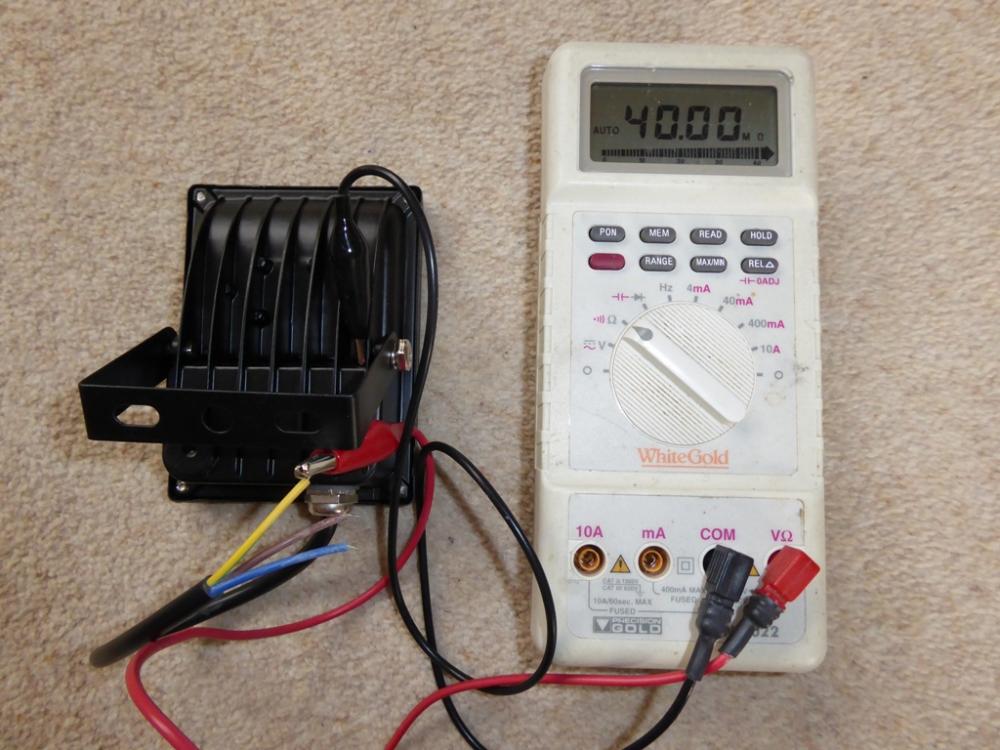
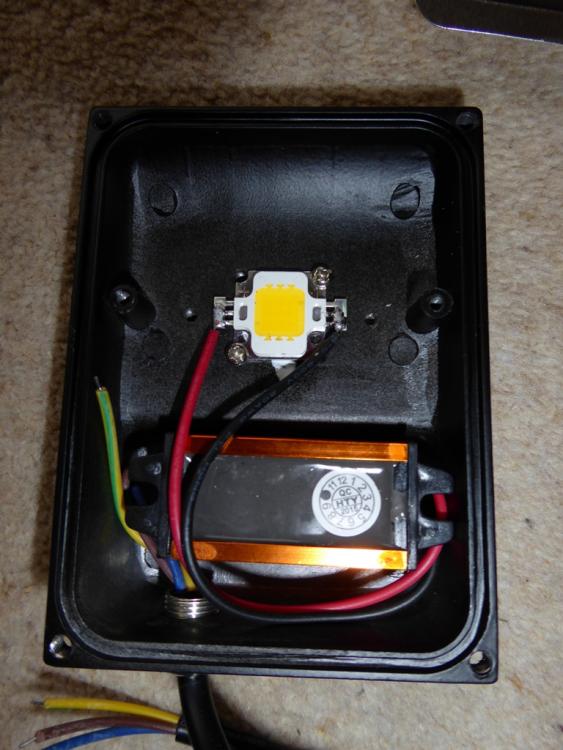
Here's an example of some outdoor LED floodlights that I purchased from China. They have a cast alloy case, are CE marked implying they are safe, which is a joke, as they definitely weren't safe, let alone compliant with the LV Directive. This is how one looked when I took the front glass off, because a quick continuity check revealed that the CPC in the flex wasn't connected to the metal case. First, this is the lights as delivered from China: This is a quick continuity check to see if the flex CPC is connected to the metal case, as it must be to be safe. As shown by the cheapo meter, the CPC to case is open circuit, meaning that an internal fault could easily make the case live: When I opened the light up, the reason for the open circuit was clear, the CPC was not connected to anything internally. I'm just bloody staggered that any manufacturer can be so penny-pinching as to not put an eyelet on that wire and do as I did to make the light safe: This was my fix, solder an eyelet to the CPC, clean up the alloy case where one of the internal reflector screws fitted and so make the light safe. I did take the LED driver unit out (it was hot glued in) and it wasn't a Class II one, at least it had no markings indicating it was and it was in an alloy case. With the LED -ve terminal electrically connected to the light case there was a clear risk that an internal insulation fault in the driver could make the case of the light live: This is the light back together with the CPC properly connected to the light case:
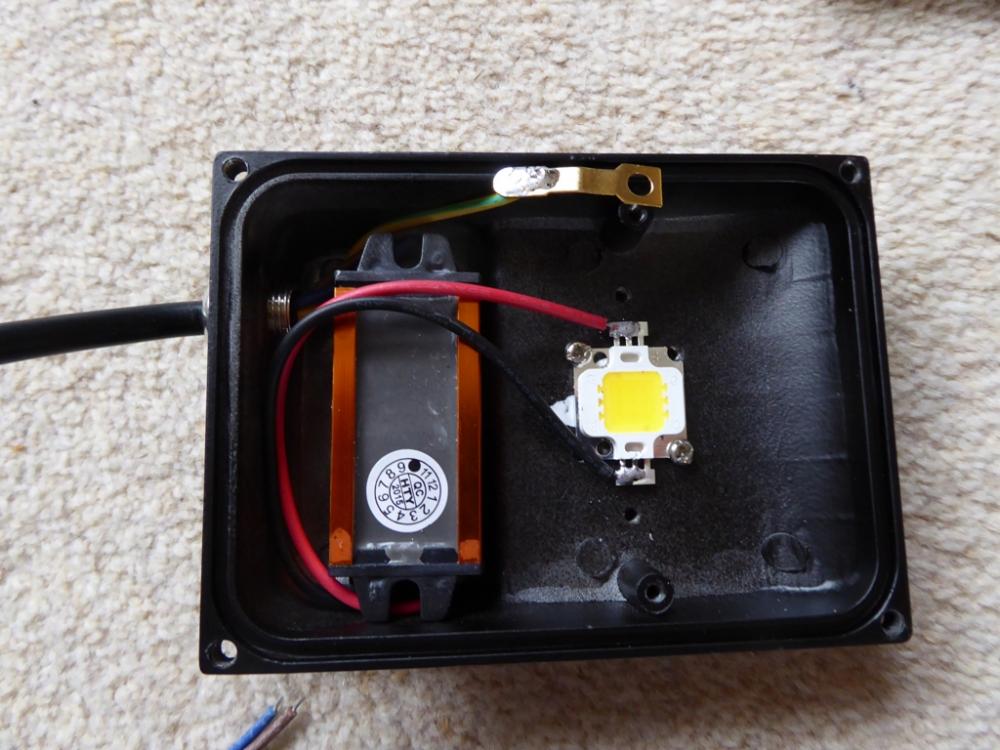
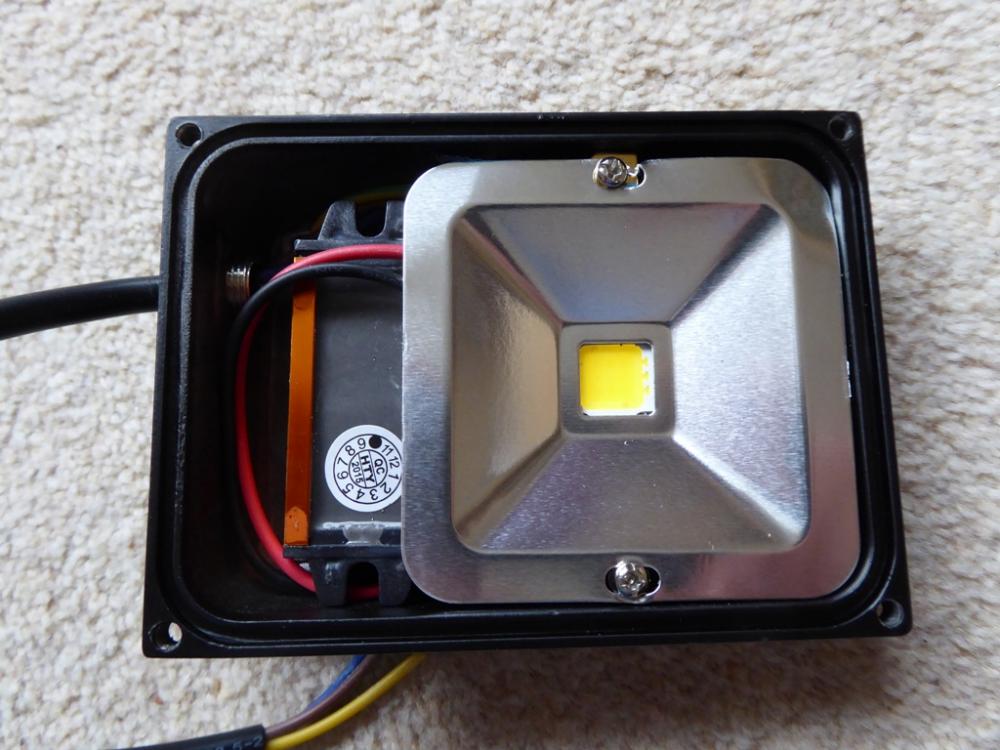
-
Obtaining restrictive covenant insurance
Jeremy Harris replied to Moonshine's topic in Party Wall & Property Legal Issues
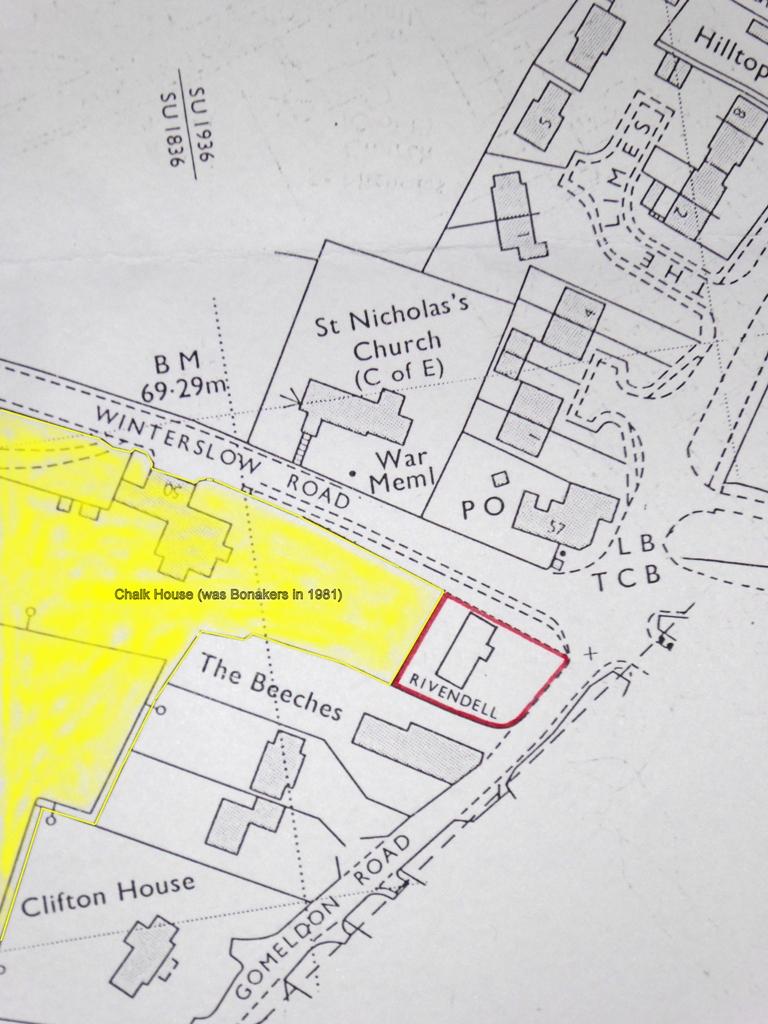
Thanks all. The wording of the part of the covenant that no longer defines the land to which it applies (the plan it refers to is missing, we don't have a copy, the Land Registry don't have a copy and the current owners of the house next door, which sold the land our house is on in 1981, don't have a copy) is: The vendors at that time were the owners of the house to the West, some ~40m away, and their beneficiaries in title are the current owners of that house. The house to the South of our house was built around 1930 and has been in private ownership since it was built, so cannot be the land referred to in the above clause. I know full well that the "land edged with green" can only be the 1981 vendor's land, as there is no other land adjoining our house that it could be (the local authority own the grass verge to the North, we own the grass verge to the East). I've shaded in the area in yellow that is the only land to which the above clause could apply to on this plan: From the link that @Temp gave, I note that in the section on enforceability there is this note: I find it very hard to see how a "right to light" could possibly apply given the distance between the 1981 vendors house to the West and our house. I'm certain that it would fail the "reasonably close together" test. AFAIK, the "right to light" cannot now be enforced for an area of garden, only a dwelling.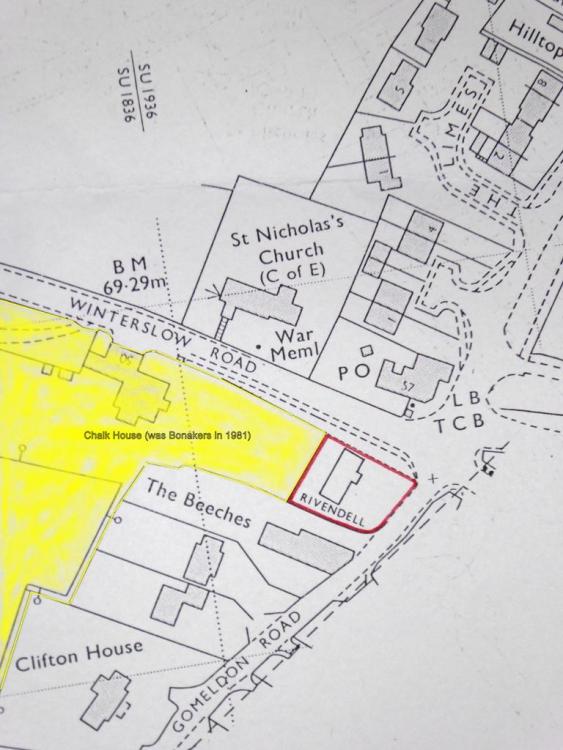
-
Make sure you get them VERY thoroughly checked and tested before you even think about connecting them. My experience with buying lights from China has been that none complied with UK electrical safety standards, some had no earth connection, despite having conducting cases, all had fake approval marks, none complied with the LV Directive and several LED drivers didn't comply with the EMC Directive. I've routinely had to replace cables on Chinese stuff bought directly, as even what looks at first glance to be ordinary flex has turned out to have conductors and insulation that were positively dangerous. The good news is that fixing these things so they are safe isn't usually hard, I've found that replacing the cable with properly certified UK spec cable is usually dead easy and sorting out missing earth connections isn't usually too hard. Most of my stuff like this either came via AliExpress or eBay, with no real indication that any of it was non-compliant and unsafe until I checked and tested it.
-
Obtaining restrictive covenant insurance
Jeremy Harris replied to Moonshine's topic in Party Wall & Property Legal Issues
Thanks, I'm going to push back on this, as I have a strong suspicion that it's our solicitor seeking to earn a fee from selling a pointless insurance policy, as I know the purchaser isn't bothered by the covenant at all - she has specifically told me this. I'm inclined to the view that these are primarily a scam, as they are effectively a zero-risk insurance policy if the covenant is unenforceable, as this one is. -
Obtaining restrictive covenant insurance
Jeremy Harris replied to Moonshine's topic in Party Wall & Property Legal Issues
Our buyer is a cash buyer who doesn't need a mortgage and definitely doesn't want to develop the house, she's buying it for an ageing parent and was fully informed of the covenant when she viewed the house. Having been caught out by the first sale falling through because the buyer pulled out when seeing the covenants I made sure I showed them to every person who viewed the second time around. What hacks me off is that it's our solicitor pushing for the insurance, and the fat fee they get for providing it (more than half the premium!). I know that neither of the neighbours know anything about this, as neither has anything in their deeds or Land Registry documents that mention any covenant regarding our house. Both have checked their deeds to be sure and have come back saying that they can't find anything at all referring to our house. One of the houses is 60m away anyway, so is well outside the "right to light" provisions, and the other is much higher than our house and our house is completely hidden from it by a 15ft high yew hedge.