Jeremy Harris
-
Posts
26430 -
Joined
-
Last visited
-
Days Won
360
Everything posted by Jeremy Harris
-
I've used it for years, it's pretty much the standard way of assembling aircraft fasteners, which are very often cad plated steel securing aluminium alloy components. I've also used it when fixing things to alloy masts and never seen a corrosion problem. The nice thing about chromate paste is that it coats every bit of the fastener, plus it tends to seal against moisture ingress, both of which make it more effective, IMHO, than just using an insulating washer.
-
Or just use a smear of chromate paste. Works fine for preventing electrolytic corrosion on aeroplanes and boats. A small tube of the stuff will do hundreds of fasteners.
-
It will be an older model, almost certainly the big brother of the Carrier-made, Glowworm-badged, ASHP that we have (we have the 7 kW model). Glowworm never manufactured these units, they just put their badge on them, so they are well-supported via spares from Carrier, probably one of the largest heat pump manufacturers in the world. The control systems for the 14 kW model are nearly identical to those for the 7 kW model we have, and now I've spent tens of hours reverse engineering the thing and its settings I can say that they are pretty versatile and easy to use units. The key thing is to make sure the ASHP comes with the Command Unit, as that's essential to be able to programme the unit and change the settings. You can buy the Command Unit from Carrier, but it's a bit pricey, IIRC. FWIW, Kingspan-badged ASHPs are also made by Carrier and are identical internally to the Glowworm units.
-

Heating system for an ICF house with UFH
Jeremy Harris replied to Nelliekins's topic in Other Heating Systems
I doubt there would be any significant beneficial impact at all, in reality. The heat would be largely absorbed by the surfaces in the room, then a bit of it would end up in one extract duct, which would then be diluted with cooler air from every other extract duct in the house. The net result is there might be a very tiny increase in the temperature of the air entering the heat exchanger, and around 80% or so of that tiny increase in sensible heat would be recovered and passed to the incoming fresh air. As MVHR only ventilates at a relatively slow rate (typically around 1 air change every two hours or so) there is loads of time for surfaces to absorb heat before the air in any room is changed. Normal passive MVHR always cools the house in cold weather, just not as much as conventional ventilation. -
I think that you could still use the same method to partially charge the PCM to a particular SoC, within a reasonable error margin, just by determining the difference between energy out, plus losses, and energy in. I use something similar to partially charge my motorcycle battery pack and yet still have the "fuel gauge" give a reasonably OK SoC indication. In that case, the BMS measures the charge energy, subtracts a notional charge inefficiency % and then using that, together with the known SoC from before charging started, displays the resulting SoC. It wouldn't be hard to adapt the same basic process for charging the PCM cell up to an approximate SoC, I think, as measuring the electrical input energy is pretty easy and with a flow meter and two temperature sensors it should be straightforward to measure the output energy. Losses over time would have to be taken into account, but they are small, so a simple linear approximation over time would probably be good enough, depends on how accurately you want to charge to a specified SoC. Getting to within 10% is probably realistic, and given the likely variability around any predicted energy requirement this may be good enough..
-
Heating system for an ICF house with UFH
Jeremy Harris replied to Nelliekins's topic in Other Heating Systems
Are you wishing to use the 140 litre cylinder as a thermal store solely to supply the heating? If so, then if charged to, say 65 deg C, with a UFH flow temperature of, say, 28 deg C, the cylinder would store around 6 kWh. This would run the UFH at 2.5 kW for around 2 hours 24 minutes before it would need to be recharged. -
Heating system for an ICF house with UFH
Jeremy Harris replied to Nelliekins's topic in Other Heating Systems
Why would you want a heat source for the MVHR? The fresh air that the MVHR feeds into the house will always be colder than the air in the house, no matter what you do in terms of adding a bit of local heat by one extract terminal. For example, right now my MVHR control panel is telling me that the extract air is at 23.1 deg C and the fresh supply air to the rooms is 19.2 deg C. The room temperature is currently 21.9 deg C and the outside air temperature is 8.6 deg C. -
No, IIRC it was also C rated, for the same reason as the current electrically heated versions are C rated. The heat losses from the Sunamp PV were a little higher, in proportion to the stored energy, around 600 Wh/24 hours for a nominal capacity of around 4.5 kWh. The difference in heat losses is probably partly down to the smaller size of the Sunamp PV and partly down to the small additional loss from the charge circuit plumbing in the top of the unit. I'm still toying with the idea of making a well insulated electrically powered hot water charging unit for a Sunamp UniQ. I think that it could be a bit simpler than the system used in the Sunamp PV, as a Willis heater would be the obvious off-the-shelf heating unit, and that has a greater volume than the tiny heater that was in the top of the Sunamp PV. The advantage of that is that I think that good enough charging temperature control could be achieved just by turning the pump on and off (rather than using a variable speed pump). Monitoring the return temperature should give a reliable indication as to when the PCM cell is charged, as when that rises above about 60 deg C or so then it's a reasonable bet that the PCM is close to being fully charged. Also dead easy to build in two fail safes that are outwith the main control system, using the Willis immersion thermostat to turn off power to the element at around 75 deg C and using the cut-out in the immersion as the final backstop over-heat prevention measure.
-
The interesting thing was that the Sunamp PV didn't appear to have this problem. It would just heat the charge circuit (a closed water loop) up to the target temperature whenever it detected that there was a supply, whether continuous, pulsed, phase angle controlled, or whatever, available. The water charge loop was both physically small and low in volume, so the heat losses from it were small. In many respects I prefer the way the Sunamp PV charge circuit worked. Not only did it reliably keep the PCM charged when power was available, but it also had other advantages. It was inherently safe, in terms of not allowing the PCM to overheat, plus all the working components could be replaced easily, as they were fairly standard parts and were easy to access. If the heating element failed, for example, then it was perhaps an hours work at most to replace it. The same goes for the charge circuit circulating pump, or the flow or temperature sensors - all could be pretty easily serviced/replaced.
-
AFAICS, the controller has no means of measuring energy in or out. The connection to the heating element is directly from the input cable, via the contactor, to the heating element, so it can't sense current (or energy). With my electric motorcycle battery management system I can measure energy in and energy out (as well as other parameters, such as cell voltage and temperature) and this is a useful guide as to SoC both when charging and discharging. The main reason for doing this was to give the bike a "fuel gauge", but it's equally useful when only partially charging the battery pack. When the pack is being fully charged it just shuts the charger down at the end of the cell balancing stage, and sets the SoC to 100%. With the addition of a flow rate sensor plus two temperature sensors, one each in the water inlet and outlet, it should be possible to measure the discharge energy, and combined with measuring the voltage, current and time for the heating element then it should be fairly straightforward to measure the charge energy. The losses are probably fairly predictable, so could be accounted for over time, so giving a reasonably accurate SoC status indication at any time. Combined with temperature measurement, primarily as a safety feature, to prevent the PCM from being over-heated, it should be possible to get fine control over the charging system. Whether that's worth it is debatable, though. My feeling at the moment is that the simple temperature measurement system, combined with a bit of logic that just does something like "IF contactor has been off for > x hours THEN turn contactor ON", with the existing "PCM fully charged" logic over-riding that to turn the contactor off, as it does now, would work well enough for pretty much any use case I can think of.
-
Heating system for an ICF house with UFH
Jeremy Harris replied to Nelliekins's topic in Other Heating Systems
Here's a link to the heat loss calculator spreadsheet, just download it, rename it to change the .txt suffix to .xls (the forum software has a problem with .xls files) and open it in Excel, LibreOffice Calc or something similar: Heat loss calculator - Master.txt If you also want to look at your UFH efficiency etc, then this spreadsheet might be useful, too: Floor heat loss and UFH calculator.txt -
They cannot reasonably refuse to discharge a condition if all reasonable measures have been taken to ensure that it was complied with, even if there was an error and some aspects had to be retrospectively corrected. Worth remembering that there is an assumed right to grant PP, unless there is a specific policy reason not to. I know it seems the other way around, but the reality is that planning officers don't have a great deal of power and that enforcement regarding non-compliance has to be on reasonable grounds. It's clear there's been a very minor cock-up here, and that wouldn't be grounds to take any action, or refuse to sign off the condition once you've done all that could reasonably be expected of you (which is as @PeterW suggested, although I think you might well get away with doing sod all and just arguing that no harm has been done).
-
That was exactly my thought when I first discovered we had a problem (as in the shower ran cold) and emailed Sunamp for clarification of the exact meaning of the Option 1 setting. Their reply was that the wording in the manual: means what it says - that 90% depleted, or 50% depleted, is really 10% SoC and 50% SoC. The email I received did say that the 50% figure is approximate, though, and my guess is that this may be because it's much harder to determine the SoC once the unit is not charging but being used to deliver DHW, often sporadically. The unit doesn't have any way of directly detecting when hot water is being drawn off, as all it measures is three temperatures inside the cell. The bottom line is that we ran out of hot water as a direct consequence of the Sunamp controller not switching the contactor on to allow an early morning boost. Since adopting the procedure of turning the unit off, then on again, every day, just after we've used the shower, we've had no further problems at all. The unit almost always switches to charge acceptance mode when this is done, allowing utilisation of any excess PV generation, and also allowing the timer-controlled early morning boost to work, if there hasn't been enough excess PV generation to charge the unit up.
-
Depends on your definition of "multiple". From the manual I have there are two settings. either Option 1 is set to ON, which means that the Sunamp won't accept a charge until it's 90% discharged, or Option 1 is set to OFF, which means the Sunamp won't accept a charge until it's 50% discharged. Neither setting is any damned use at all if you wish to utilise all your excess PV generation (unless you frig around resetting the controller every day by turning it off and then back on again to force it to accept a charge). If you use around 4 kWh worth of hot water a day, from a 9 kWh nominal capacity unit, then there's a fair chance that you will end up with no hot water part way through the second day, even with an early morning boost from a time switch (which wouldn't be accepted if the unit was just over 50% charged at that time), as we found out when the shower ran cold.
-
It was online, following on from a recommendation from Joiner. Normally I'd not risk buying timber without seeing it first, especially something that's going to be on show, but I have to say that these people were pretty good, with all the timber that arrived usable and most of it excellent. I bought random lengths, with, I think, a minimum of around 2.5m long, and found that most lengths were well over 3m long, which minimised the number of joints I needed to make in the skirting boards, and reduced wastage a fair bit.
-
The lining for an internal door does, though. It'd look a bit odd with a narrow lining set into a wider internal wall, with no architrave, although it may suit a fairly modern design look, perhaps. Personally I like a having simple architrave and the protection it gives to the corners of the door opening.
-
Best bet will be to buy cheaper narrow boards and hide the joint under the stops, as narrow boards are generally cheaper than wide ones. We bought all our oak from British Hardwoods, on the recommendation of Joiner (from Ebuild). I have to say they were very good, and all the oak we received from them was near-perfect. Their price was pretty good too, but I did buy a lot of oak from them, as all our skirtings, architraves, shelving as well as the doors and linings, are in a plain oiled oak finish. I still have some 120 x 20 and 70 x 20 boards left over, and have been using it for odd jobs, like the CNC machined house name sign we put up earlier this year (I laminated up two 20mm thick boards to make that thick enough). Biscuit jointing narrower oak boards should be easy enough, and the joints don't need to be tidy, as they will be hidden. Also worth placing all the screw fixings under the stops too. We did this and it worked a treat, hiding all the fastenings and saving me having to cut and glue plugs.
-
The misuse of language like this also sets off a similar reaction with me. Symbiotic has a specific and unrelated meaning ( the giveaway is the last part, "biotic", from the Greek, referring to living organisms or life itself), specifically the beneficial relationship two living organisms may have when living in close proximity to each other and sharing resources. To the best of my knowledge, there are no living organisms associated with either of these products/services (apart from the human users). I do wish that plain English would be used as the base standard for documents like this, as it would make understanding what on earth the writer was trying to convey to readers a great deal simpler. As for charging a Sunamp only from renewable energy, then frankly they need to fix the outstanding problem with their control system in order to make that a reality. Having to fudge the damn thing by turning it off, then on again, every day, just to allow it to perform its primary function in our application is not fit for purpose, in my view. I have now acquired a slim (17.5mm wide) DIN rail mount time switch, and will be fitting that inside the control box in the new year, to automate the reset procedure that I'm currently having to do manually every morning.
-
My only real experience with CSV is when I wrote the code for logging data to USB in our house monitoring system. I just made sure that the delimiting characters between fields were commas (no spaces) and used CR/LF as the EOL marker. The two spreadsheet programmes I've used with files from this (LibreOffice Calc and Excel) seem to be able to natively import CSV files in this format with no glitches, so I get columns of data, with headers, all in the right cells. I'd no idea that a tab delimited file could also be referred to as CSV, seems a bit counter-intuitive to me.
-
and so it begins........ design 11 so far
Jeremy Harris replied to Sue B's topic in New House & Self Build Design
I'm unlikely to forget having been bitten on my finger by a snake when working in the wilderness that is now our garden. That turned out to be a grass snake - until then I didn't know they could bite. Hurt like hell for a while, but no lasting consequences. It was my own fault for just putting my (ungloved) hands into the long grass, trying to pick up a half-buried bit of pipe. The poor snake was probably a hell of a lot more frightened at having his/her peace disturbed than I was by getting bitten on the finger. -
Spot on. In general powder coating is a real pain to re-coat, as you need to get back to bare metal in order to enable a good bond. Trying to powder coat on top of an existing finish will probably result in it just chipping or flaking off, plus the whole frame and door assembly would need to be stripped out and have all the glazing and fittings removed in order to be able to hang the bits up to charge them. We once had to re-powder coat a steel tube aircraft fuselage and ended up getting it bead blasted back to bare metal and starting again, after a couple of goes at just re-coating it. However, if the powder coat is polyester (which is most likely, I think) then you can often spray paint on top of it with a bit of careful surface prep. It would still mean stripping all the hinges, handles, glazing etc off, but the frame could be painted in situ I'd have thought. Might be a job for one of the mobile repair companies to have a go at, as they can usually match colours very well.
-
Nice to know, and a pity it's not more common, as I wouldn't mind betting that there are a fair few heat pump installations around that don't have strainers fitted. Handy being outside, too, as it makes it easier to get at I should think. Mine ended up being fitted low down inside the bottom of the airing cupboard, which is OK, but not ideal, given that there's always a bit of spillage when the strainer is removed. Worth checking, too, as when I first checked mine a few months after installation, the strainer had caught a fair bit of crap, all if it related to my poor workmanship on the plumbing, from the look of it (small bits of copper, plus some bits of pipe sealant).
-
I suspect the problem is closely related to the state of the thermostatic valves, and so may well appear on timed operation after some time of it having been running, when some valves have closed down and restricted the flow through the system a bit. I had to fit an automatic bypass valve to our ASHP system, and increase the circulating pump speed a bit, in order to overcome flow errors caused by valves that were a bit slow to operate. On a related note, our old central heating system with a gas boiler had the reverse problem. When first installed and fired up on a cold morning it would shut down. The reason was all the thermostatic valves were wide open and the boiler didn't see enough flow restriction to be able to detect the blip increase in pressure when the pump switched on. BTW, all ASHP systems need some form of strainer/filter in the return line to the ASHP itself. I've never heard of one of these being inside the ASHP, they are usually fitted where they can be easily and regularly maintained/cleaned. The installation instructions for our ASHP made it clear that a strainer had to be fitted in the return, just before the ASHP.
-
@ProDave, I see what you mean about PVGIS. I've just spent the morning doing battle with its non-CSV format .csv files. I seem to remember that the .csv files from PVGIS used to work OK, but now it seems they download minus the commas as delimiters, which makes them pretty awkward to use. I've also just been running some estimates of our energy usage through the year, subtracting the usable PV generation and trying to see whether or not it's worth opting for an E7 tariff or not. Not sure yet, but over the whole year it seems that we're probably going to be about 50/50 peak rate/off-peak rate, if I optimise winter loads for off-peak times. It all hinges on the standing charge I suspect, but I'll post the details of the sums in another thread, rather than clog this one up.
-
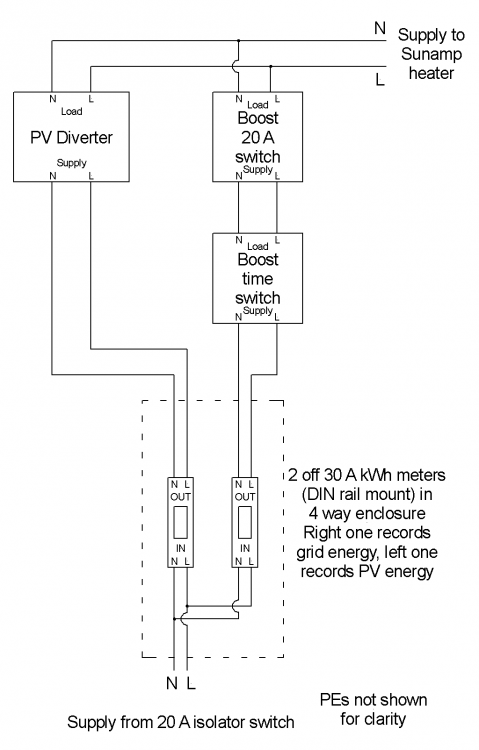
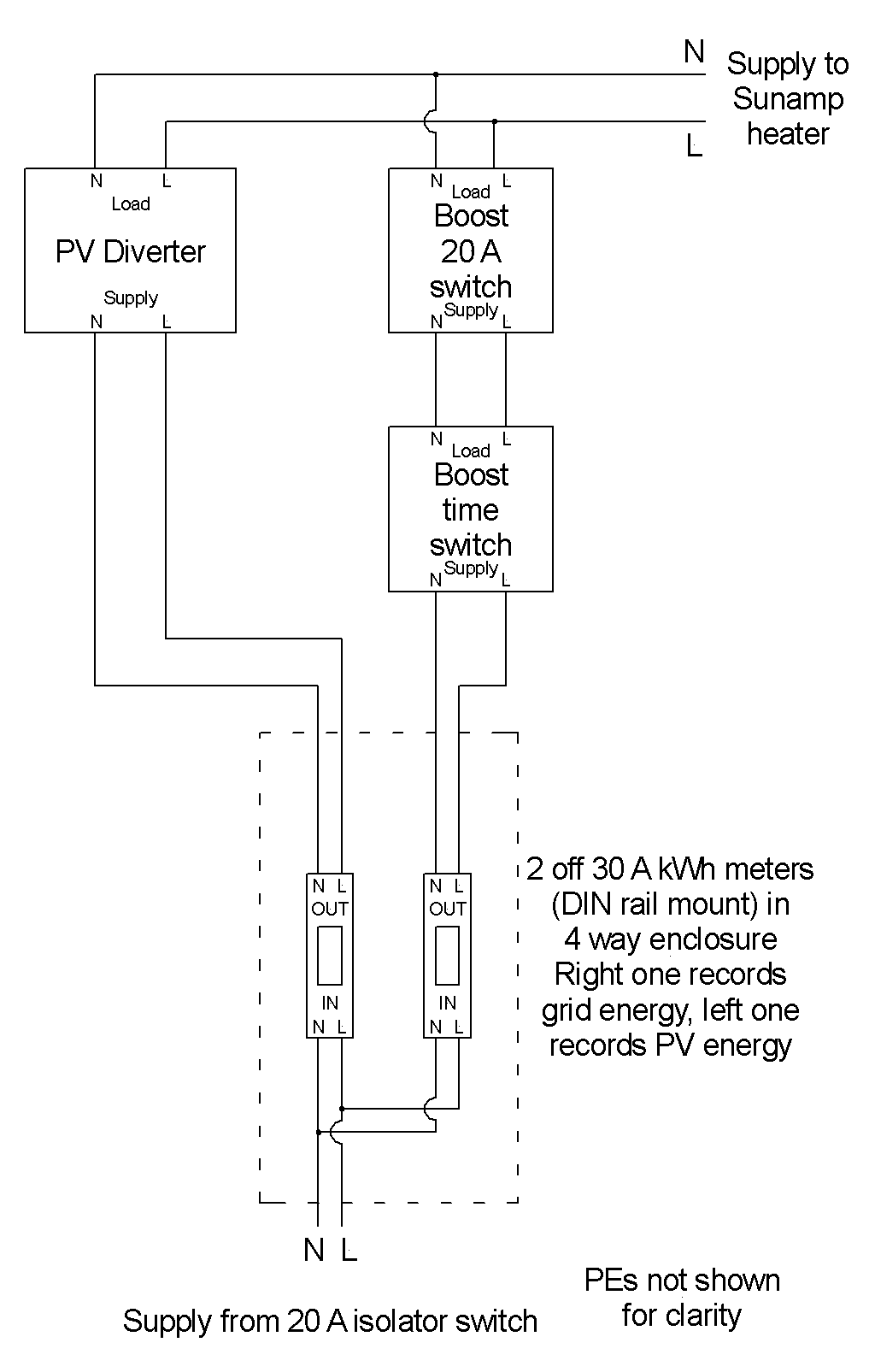
Here's a rough and ready diagram, with the PEs (earths) left off for clarity (all PEs need to be carried through each box): Some items, like the the time switch and the PV diverter, only switch the line, so the neutral is just passed through the box. The boost switch is a 20 A DP isolator with a neon indicator, that allows the timed boost to be turned off in summer, when it most probably won't be needed, as there should be enough excess PV generation. Using a DP switch with a neon on the load side is useful as it will light up as the PV diverter pulses power to the Sunamp, and will stay on continuously when the time switch is in boost mode. The boost time switch is a standard, cheap, immersion heater one. I have ours set to come on at 03:30 and off and 06:00, just to make sure that the Sunamp has enough charge for our morning showers. If the Sunamp is already charged from excess PV generation the day before it won't draw any power during the boost time, as it will just keep it's contactor closed.