


Jeremy Harris
-
Posts
26430 -
Joined
-
Last visited
-
Days Won
360
Everything posted by Jeremy Harris
-

Just been buzzed by a mosquito.
Jeremy Harris replied to epsilonGreedy's topic in General Self Build & DIY Discussion
Aquila Maris was on my charge too, as I was the OiC of that range. I've got some good photos of Aquila Maris somewhere, as well as ones of the Portpatrick Princess and all the other range aircraft we had. I left West Freugh about a year before it closed, and could see that the writing was on the wall then. The odd thing was that I'd gone up there when the range I worked at down in West Cornwall closed. After Portpatrick I went to run two ranges down on the South Coast, and when I arrived there my reputation for taking on ranges that were likely to close shortly preceded me. I was nicknamed Jonah before I arrived... -
If it works for you then that's OK, but it's worth bearing in mind why smart meters are being rolled out and why the energy companies are spending millions on promoting them. Smart meters won't save consumers money in the long term, that's not why they are being rolled out at all. The problem that smaller energy companies, in particular, and the government regulator, who wishes to promote a more level playing field for energy supply, has is that energy is sold wholesale on a 30 minute spot market, with the price varying widely from hour to hour. It can even go negative at off peak times, so generators have to pay suppliers in order to take their energy, as well as rising to close to, or above, the retail price, so suppliers lose money selling it to customers. At the moment, suppliers take that market risk. They try to guess what the wholesale spot market will do over the next 12 months or so and then set their tariffs so that they can make a profit. Unfortunately, with such a volatile market, and one that's been made more volatile with the increase in variable generation capacity (wind and PV) and the decrease in steady generation capacity (mainly nuclear), small suppliers often aren't able to stay in the market (plenty of evidence for small suppliers going bust, seven collapsed in the UK last year alone). The big suppliers may well have enough reserves to weather a bad spell in the market, hence the concern over unfairness. So, all the suppliers have been lobbying hard for years to try and get rid of the risk they carry in this volatile market and place that risk on consumers. Nothing particularly wrong with that, except the best way to do it is to introduce a means of being able to adjust tariffs every 30 minutes, so they track the wholesale price and then persuade consumers that this is being done for their benefit. The suppliers then carry no risk, and can just charge the wholesale price, plus their operating cost, plus their profit. It's a guaranteed profit scheme for suppliers. The problem comes when consumers want to try and compare prices. The only way to do that is to compare the average price, however, that's not very representative. For example, those who have electric storage heating and live in a cold part of the UK are pretty much fixed as to when they need energy, they can't just turn off their heating if the price rises for an hour to around 30p/ kWh (which it is predicted to peak at when the fully agile market is established). Most consumers won't have any way of being able to accurately predict their energy bill from one month to the next, as they will only know the price for any 30 minute slot after the event, or very shortly before. Tariffs like Agile and Go are really aimed to get users to fit smart meters, with the incentive of a tariff that, right now, may look attractive. However, once everyone is locked in to smart metering, then it will be near-impossible to make a judgement as to which provider gives best value, as that is bound to depend on trying to compare 30 minute prices against an exact pattern of energy use over a year. The suppliers know this; the pricing model will be more complex that that used by mobile phone providers, and that complexity isn't likely to result in best value for the customer. The other problem with smart meters is related to data security. The data standards used are far from robust, and there are clearly some privacy concerns over that. For example, think how useful it could be if a household's energy consumption pattern changes, such that someone with ill intent could be fairly confident that the house was empty. That's a pretty trivial example, but it illustrates just one potential vulnerability in the data handling system for smart metering.
-
Agile requires a Smart meter, and as long as you can deal with the high peak time tariff by load shifting then it can work OK. Octopus Go is similar, but offers a really low off-peak rate of around 5p/ kWh, but only for four hours in the middle of the night. Go also needs a Smart meter. We were with Octopus at the last house for a time, as they took over from Iresa. TBH, their hippy style of communication got up my nose, as I didn't appreciated being addressed by only my first name or having every communication from them signed off "Love and Peace".
-
With a wood burner and your predicted energy usage I doubt you will need much heat from electricity, will you? The smallest wood burner is going to chuck out at least 2 or 3 kW into the room, for maybe 5 or 6 hours on a burn, which gives you around 10 to 15 kWh of heat into the house. That leaves DHW, which for us is pretty much our greatest consumer of electricity, albeit from the excess PV generation for a lot of the year (even now excess PV seems to be delivering around 1/3rd of our DHW requirement). If you believe that your DHW energy requirement will be high enough to make E7 worthwhile then go for it. For us, it's really my car that swings the balance, being able to charge it at E7 rates during the winter makes a significant difference. SSE changed our meter in about 30 minutes, and didn't charge for the change, so it's not a major issue if you decide you can make good use of E7 once you have a better idea as to your pattern of electricity use. Originally I worked out that E7 wasn't worthwhile for us, and it's only really getting an electric car that made me reconsider. Once the balance had swung over to the point where E7 looked a better option, then I tried switching the heating over to run at the cheap rate, and found that it works OK for us. However, we are all-electric, with no other energy sources, plus our annual energy use is lower than yours, around 12 kWh/m². If I were in your position I'd just leave room for an E7 meter (they are a fair bit taller than a standard meter) and have a standard meter fitted for now, then keep an eye on your consumption when you've been in for a while and work out whether it makes sense to switch.
-
How long have you left it turned on for? Some PIR lights seem to stay on for a long time when first powered up, longer than the normal time setting. We have two like this, that come on and stay on for around 5 to 10 minutes after a power cut, then they settle down and work normally.
-
We had a similar restriction and definitely broke it a fair few times, especially when MBC were on site, as they tended to work from dawn to dusk (and beyond at times). We did try to keep the noise down as best we could, and in reality there's very little possibility of nuisance once the house shell is up and weathertight, and most of the work has shifted to inside, anyway. My guess is that if you were using a digger or mixer outside the allotted hours then someone might well complain, but with luck no one will bother too much if you're just doing other work on site. The exception to that would be if a neighbour objected to the planning proposal and remains opposed, as by working outside the permitted hours it would hand them ammunition for a legitimate complaint. Having said that, what's the worst that can happen? The first breach would just be a warning from the local authority, and it would probably only be repeated breaches that would cause them to take action.
-
I looked into this for a long time before opting for a passive slab, and frankly most of what you've written is complete tosh, with no evidence to support it. In fact the opposite is true; there is a lot of evidence that EPS in wet ground doesn't absorb any water after several decades. Apart from this, a passive slab has a drainage layer underneath, so that the EPS doesn't even sit in water at all, even on wet ground (bear in mind that the base of the EPS is close to ground level anyway). I don't know where you get the idea that countries like Germany (which have been using EPS raft systems for basement foundations for over 40 years now) have permafrost, or that even the populated areas of Scandinavian countries have permafrost (they don't). I'm wholly unaware of any controversy in Ireland either, and I have been following the use of passive slab foundation systems for around 7 or 8 years now. Finally, a passive slab isn't that costly when compared with a traditional foundation. The excavation requirement is a lot less (we excavated 200mm deep over 85m² for the sub-base) and the labour is less (two blokes laid ours from start to finish in four days). Add in that the UFH can be simply tied to the steel fabric before the pour (included in the four days it took to lay our complete foundation slab) and there can be significant overall cost savings. Like any foundation system, it does depend very much on the underlying ground as to whether it is cost-effective and efficient, but for us it was actually the cheapest foundation option, when everything was accounted for.
-
MVHR for single room studio
Jeremy Harris replied to Andrew's topic in Mechanical Ventilation with Heat Recovery (MVHR)
That was the system I looked at very closely, to the extent of going to see a unit and examining how it worked. The show stopper was it not being able to meet building regs, as the design was intended to use diffusion from one room to another to avoid the need for a unit in every room (when I looked at them they were the best part of £2k each). Building regs don't allow for diffusion ventilation from kitchens, bathrooms or WCs, so the advice from the Dutch manufacturer of the Fresh R unit was to install extractor fans in those rooms. For us that would have meant fitting 5 extractor fans, on top of 2 Fresh R units, and the impact on overall thermal efficiency (not to mention our budget) was way too high. -
The problem is that an MVHR has just two holes through the walls, and these are sealed in as much as the nature of distributed MVHR means that the chance of a net pressure differential between the fresh air intake and the stale air exhaust is small. Once you have holes all around the building you will definitely get differential pressure effects that tend to drive air in and out either assisting or impeding the flow at the various cycle times of the independent units. You also still have to meet building regs extract rates from the kitchen, bathrooms, WCs etc, which dramatically reduces the single unit efficiency. I was committed to using in-wall mounted room MVHR units, having been sold on the idea a long time ago. I couln't get the units to comply with building regs without having a massive imbalance in flow, plus the cost was astronomical, as even for our house I would have needed around 8 units. I did calculate the heat loss from these, and it ended up as high as having extractors and trickle vents. They may a good solution for retrofitting as a replacement for existing extractors, as at least they provide a degree of heat recovery, but for a new build I have to say I'm no longer convinced that they are a sensible solution, especially given the relatively high initial cost and the ongoing cost of replacing multiple filters through life, not to mention the very much higher electrical power consumption from having lots of small fans running, rather than just two, larger (and hence much more efficient) fans.
-
We have the 1.5 bowl version of that one from DIY Kitchens. Seems OK, although it came supplied with a pretty rubbish drain kit, that ended up in the skip, as I fitted a decent brand name one instead.
-
These single room units also dramatically lose efficiency when operated at building regs ventilation rates, so much so that they become little better than extractor fans and trickle vents.
-
MVHR for single room studio
Jeremy Harris replied to Andrew's topic in Mechanical Ventilation with Heat Recovery (MVHR)
There are several single room MVHR units available that might be worth considering, but care is needed to ensure that building regs can be complied with, especially with regard to the ventilation rate for the WC and shower room. The inability to comply with building regs was the thing that stopped me from exploring the use of a very neat wall-mounted MVHR solution. It may have been OK in other countries but couldn't be made to comply here. However, it should be fairly simple to install a small MVHR with extracts from the shower and WC and fresh air feeds into the working area without too much trouble. If you're going to be using this area for long periods every day then it makes sense to try and make the environment in there as pleasant as possible, plus there should be a useful saving in heating cost. -
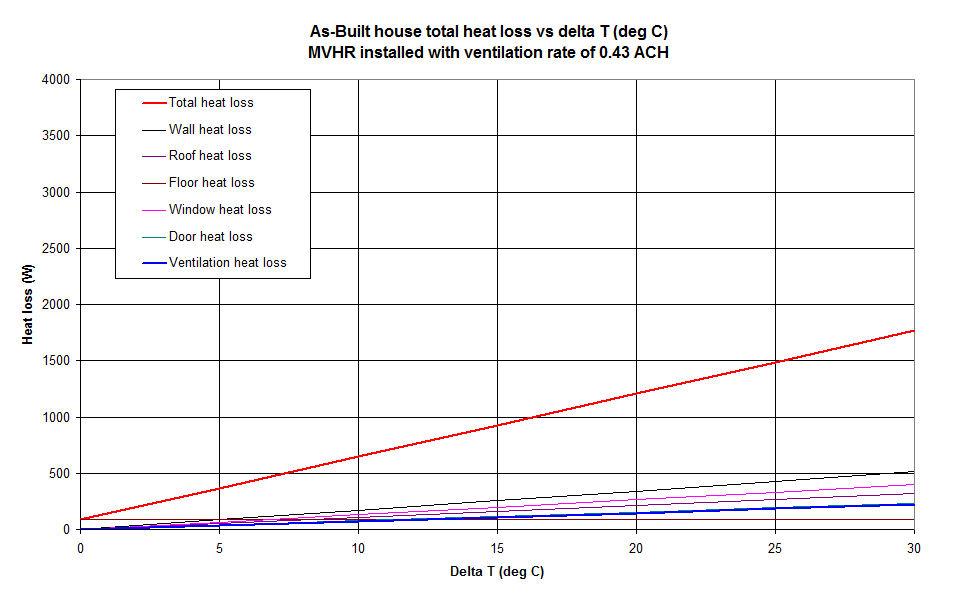
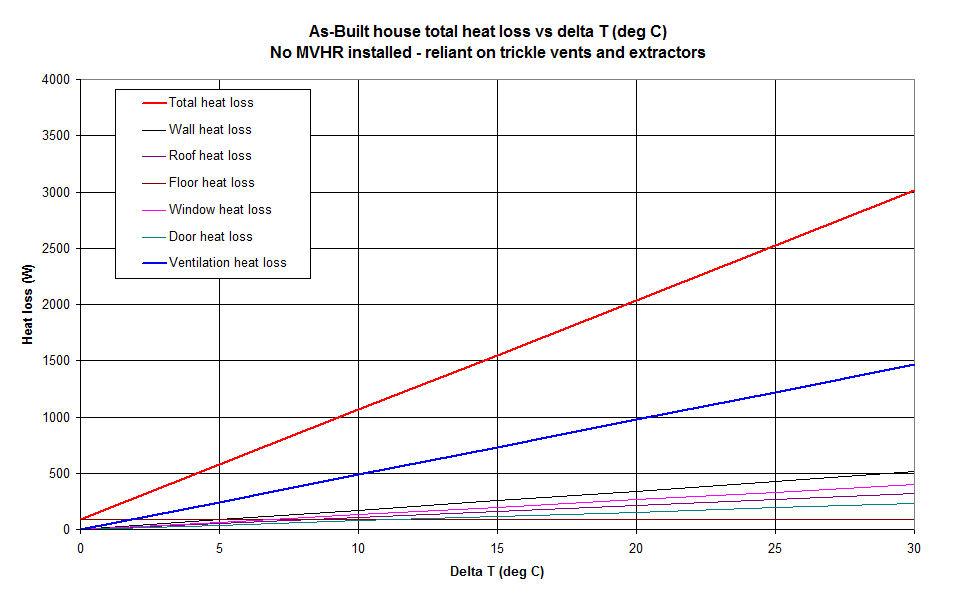
As an idea as to the benefit of MVHR, here are a couple of plots of the heat loss rate from our house, the first with MVHR, the second without: The plots show the heat loss from the house versus the difference in temperature between indoors and outdoors. With MVHR the total heat loss rate for 20 deg C indoors and 0 deg C outdoors is about 1,200 Watts. Without MVHR, and assuming the same level of ventilation with trickle vents and extractor fans, the total heat loss rate for the same conditions is just over 2,000 Watts. The MVHR reduces the heating requirement under these conditions by around 40%, a very worthwhile saving off the heating bill.
-
Depends very much on the UFH flow temperature and the surface temperature of the floor. For example, our UFH flow temperature is typically around 25 to 26 deg C and the floor surface temperature never goes over about 23 deg C, and those temperatures wouldn't be unusual for a non-UFH floor in warm weather in summer, so whether the UFH is on or not doesn't really matter at all as far as stuff like this goes. I'm pretty sure the manufacturers of flooring products in general are hyper-sensitive about UFH because of the way older systems in poorly insulated houses had to run at higher temperatures, but even then I'm far from convinced that UFH is a particular problem. We had an area of floor in our old house (which had radiators, not UFH) that used to get up to ~30 deg C or more when the sun was shining on it, which is a fair bit hotter than any UFH would heat the floor surface to (30 deg C is over 110 W/m² for a 21 deg C room temperature, way higher than UFH systems normally run at).
-
Just been buzzed by a mosquito.
Jeremy Harris replied to epsilonGreedy's topic in General Self Build & DIY Discussion
Not if the Nimrod experience is anything to go by. The main spar "spectacle frames" were always a fatigue concern, especially with the added fatigue factor from operating at relatively low level over the sea for long periods. All sorts of ways to try and extend airframe life were explored, when the MRA4 started to look dodgy and I'm pretty sure there wasn't a cost effective way to keep those old airframes flying. The decision to kill off the MPA role, as an end of the Cold War benefit, was as much to do with the high cost of keeping the Nimrod fleet operational as anything else. -
Just been buzzed by a mosquito.
Jeremy Harris replied to epsilonGreedy's topic in General Self Build & DIY Discussion
The venerable AX3 for one... -
Just been buzzed by a mosquito.
Jeremy Harris replied to epsilonGreedy's topic in General Self Build & DIY Discussion
Just had a quick check and even the two UK aircraft that are being restored to airworthy condition are both in New Zealand at the moment. There seem to be three flying in the US and one flying in Canada, so the sum total of airworthy Mosquitos in the world seems to be four. Given that nearly 8,000 were built, this seems a pretty sorry state of affairs, but probably reflects the way the airframe is constructed; it was never really intended to be a durable aeroplane, just light and fast. -
Just been buzzed by a mosquito.
Jeremy Harris replied to epsilonGreedy's topic in General Self Build & DIY Discussion
No idea. Mosquitos were scrapped en masse when they went out of service, with very few being kept and even fewer being stored in conditions that allowed them to be restored to flying condition. Only people with extremely deep pockets have been able to attempt to get one flying again, especially as many of the particular skills needed to restore one seem to have been lost over the years. There was a TV programme on a while ago following the restoration to flying condition of one in the USA, and it was essentially a complete rebuild from the ground up. It's a heck of a lot easier to do this sort of thing in the US, and the reason we chose to build our first kit aircraft prototype there, as they have their catch-all Experimental category, which removes about 90% of the airworthiness hassle we have to deal with here. The C-47 that BBMF have as their communications ship used to be on my charge years ago. Back then she carried the name "Portpatrick Princess". When we stopped using her for our trials work, (she was replaced by two Devon C Mk2s), she went back into the general Farnborough/Boscombe Down trials fleet and then ended up at BBMF. C-47s/DC-3s are pretty indestructible, one of the very few metal aircraft with an infinite fatigue life. -
We've found that the floor, towels, shower screen etc all dry very quickly with no UFH. MVHR is very effective at drying things in the house, so much so that I fitted one of those Victorian style hoist-up clothes dryers in our utility room, so that when hoisted up it's just under the MVHR extract terminal. Anything put on there dries very quickly, faster than putting it on an outside line very often.
-
Just been buzzed by a mosquito.
Jeremy Harris replied to epsilonGreedy's topic in General Self Build & DIY Discussion
There aren't any Mosquitos in airworthy condition in the UK. The only ones flying are a couple in the USA AFAIK, and they've only recently been restored to flying condition. There's at least one that's under restoration to an airworthy condition here in the UK, but AFAIK it's a fair way away from being test flown. -
C-R-L Structural Warranty - Issues
Jeremy Harris replied to jasper Becker's topic in Introduce Yourself
Might be worth reading this thread from last year about this same warranty company: -
The matting I fitted in our old house used a programmable thermostat that used a sensor that was embedded in the floor under the tiles, so it sensed the floor temperature, rather than the room temperature.
-
It might be, if you think that the bathroom floor could be a bit chilly in the non-heating season. The electric UFH mat isn't very expensive, so if you think you may want to take the chill off the bathroom floor when the main UFH isn't on then it may be worth fitting. My view of electric UFH is that it's mainly a comfort thing, than a way to heat the room. It is nice to have floor tiles warmed up a bit when you're using the bathroom, but if you're thinking of using flooring in the bathroom that isn't as cold to the touch as tiles then it may not be an issue. Our bedrooms have bamboo flooring, with no UFH, and they are fine when walking around with bare feet, it's just the travertine flooring in the bathrooms that can feel a bit chilly every now and again.
-
In our old house there used to be just a radiator in the bathroom, and I replaced that with a "dual fuel" towel rail (it was both electric and ran off the heating) plus UFH matting under the tiles. For the new house we just have an electric towel rail in each bathroom, so no UFH (we have no heating at all on the first floor), and we've had maybe three or four mornings when it would have been nice to have the floor in the bathroom slightly warmer. It's no big deal, just a comfort thing really, as the bathrooms are plenty warm enough without any heating.
-
I fitted electric UFH in the bathroom of our old house, just to take the chill off the tiles. IIRC it was only something like 350 W, but more than enough to warm the floor up enough to be comfortable. The only heating we have in our bathrooms in the new house is electric towel rails, run from a time switch so they only come on for an hour or two morning and evening. They work fine, but there are times when I wish I'd fitted electric UFH mat in them as well, as it is pretty cheap to install, if done before laying floor tiles, and doesn't cost a lot to run if on a programmable thermostat.

