Jeremy Harris
-
Posts
26430 -
Joined
-
Last visited
-
Days Won
360
Everything posted by Jeremy Harris
-
 A while ago I saw the same model of multitester as I have going on eBay for £70 or best offer. It's old, but perfectly OK, and will do just about every test needed. Not as easy to use as some of the newer models (the test button seems designed for someone with 8" long thumbs) but for occasional use it's fine (I'd not want to use it every day to earn a living, though). Mine's out of cal now, but I have a couple of big, known value, resistors that I can use to check the low resistance bit and the insulation resistance, plus I can cross check the voltage readings against a couple of other multimeters; it always seems to read the same from one year to the next. Errors are more likely to be from leads not being nulled out, anyway. Every time I've scratched my head over an odd reading it's been because I haven't nulled the leads properly (something made more awkward because the ergonomics of the tester are so dire - you really need three hands to use it at times).
 -
Why do internal doors have handles?
Jeremy Harris replied to ultramods's topic in Doors & Door Frames
Yes, at the Curie point. For a typical neodymium magnet this will be around 300 to 400°C, so fairly high. -
That's a posh version of my tatty home made one! Mine just has a single resistor that gives around 30 mA or so, as we've not lived anywhere with a TT installation for years now.
-
FWIW, my home made test plug (used to do "quick and dirty" checks when I can't be arsed to get the multitester out) just has a resistor to earth, switched via a push button, to create around 30 mA of leakage. It's a pretty foolproof way of testing a low current RCD, IMHO. Good enough for an "is it still working?" test, anyway. If it fails then it's time to do a proper test. Interesting to see that the chap from SSE who came around to change our meter "tested" the installation afterwards with what looked like one of the cheapo eBay test plugs, the ones with three LEDs on the front. I've often wondered what the failure rate is on RCDs and RCBOs now, as I've had two DP RCBOs fail within 5 years. Both failed the same way, leaving the circuit on with an earth fault present, which is the opposite to the way I remember older RCDs tending to fail (my experience of older TT installation RCCB/RCD failures was them often failing to latch back on after they'd tripped).
-
We were told in writing by SSE (our DNO) that both the diverted underground supply cables and the new supply to the house had to be in 100mm black cable duct. We laid this, only to be told by the guys that came out to lay the cables that they didn't want the ducting and would rather lay their cable directly in the trenches. Luckily we hadn't backfilled the trenches, so we just pulled the duct out and let them carry on. This was five years ago, and was in the contract with SSE then, so I don't think it's either a new rule or one that they adhere to.
-
We had Duct 56 and all the necessary bits to go with it, like cast iron boxes, hockey sticks, and a reel of cable to pull through the duct, provided free of charge by OpenReach. We just dropped the ducts into trenches where they were needed and pulled the cable through, leaving it looped up at either end, ready for connection.
-
Changing electricity supplier
Jeremy Harris replied to Crofter's topic in General Self Build & DIY Discussion
I reckon you can probably get a quick win by just changing suppliers. I recently switched from SSEs E7 tariff to the E7 tariff from Bulb and saved well over £100 a year, just from that. You do need to check carefully on your local tariff prices, though, as I found that there are wide regional variations, so a supplier that's good value in one region may not be in another. If you choose to switch to Bulb (something we've found pretty painless) then this referral code will save you £50 (and knock £50 off my bill!): bulb.co.uk/refer/jeremyh2413 Worth looking if you can make enough of a saving by switching time of use of stuff to make changing to E7 viable. The general rule of thumb seems to be that if you can move about 35% to 40% of your consumption to the E7 period then you'll start to save money. Shift more to the E7 period and the saving ramps up (currently we've managed to shift usage so that we at around 56% at the off-peak rate, a significant additional saving over just switching supplier). Reducing consumption tends to be a fairly long process of identifying where you may be wasting electricity and doing something about it. The biggest single saving I made by doing this was discovering that our old fridge freezer was using loads more electricity than it should be, and changing it for a new one that only used about 1/3rd as much. Getting the other loads down, especially the plethora of low, but often always on ones, was hard work, and even now our background load is higher than I'd like it to be. -
Nothing would ever induce me to have another Saniflo (or any other macerator pump, for that matter). The things have so many annoying and unpleasant features, from being incredibly noisy (and they will randomly switch on, even if the toilet isn't flushed) to being the most unpleasant bit of kit to strip and unblock when it jams (as it will). Far, far better to run a gravity soil pipe out to a pump station and then pump up from that. My experience of living with a pump station was that it was silent and very reliable, completely the opposite of a Saniflo.
-
Not sure if I have the hump.
Jeremy Harris replied to Russell griffiths's topic in General Self Build & DIY Discussion
I did indeed have the same thing happen to me, and I found that, despite the images being used fraudulently (i.e. they are being used to advertise a company that had sod all to do with our build) there was essentially nothing that I could reasonably do to get the images taken down. I did try, but have been told that in order to get the internet hosting company to take action (the web site owner refuses to do anything, and is not in the UK) I have to lodge a $50,000 deposit with them, which would not be refundable in the event that they didn't find the images to be in breach of my copyright (I have the original images, as I took them in the first place). I've been tempted to name the individual/company that's using images of our build to promote their own business on here, but frankly it's not worth the hassle it would cause. Many people who see those images know that the individual/company that's using them wasn't involved in our build, and so can draw their own conclusions as to whether or not to believe what's on that website or not. I have had a warning on my website about the misleading use of my images to promote a different product, for a fair time now, and that does name names. Several companies have asked if they could use images of our build in their promotional material and I've never said no to any of them. My problem is only with the use of my images to promote a company that I had nothing to do with. -
GSHP likely to be better choice...
Jeremy Harris replied to Digmixfill's topic in Air Source Heat Pumps (ASHP)
In practice I've found that the COP of our ASHP is always well over 3, often over 4 for a lot of the time. The lowest outside air temperature we've seen has been about -8°C, but that's irrelevant. as all you need to work out the overall running cost/energy use is the mean outside temperature (and, perhaps, humidity). From that, and from knowing the flow rate, operating time and temperature you can work out the mean COP, which is all that matters. The worst case we've found is when the air temperature is a few degrees above zero, but the air is very humid. That can create a situation where the ASHP needs to defrost, but only if it's heavily loaded. By making sure that ours never needs to deliver water at more than 40°C I've been able to stop it defrosting under any condition we get here, which makes a significant difference to its efficiency. I can sit down later this week and work out the mean COP, but at a guess I'd say it's well over 3.5. In worked out that the mean COP of a GSHP could be around 8% more efficient at best. -
Plasterboarding on yer lonesome ....
Jeremy Harris replied to ToughButterCup's topic in Plastering & Rendering
Cheeky sod... -
Plasterboarding on yer lonesome ....
Jeremy Harris replied to ToughButterCup's topic in Plastering & Rendering
Let's just say that I'd not have been able to lift boards the way those lads did. Not sure, but I suspect we're pretty close to being the same age, within a couple of years or so (hint: I was told that I was outside Buckingham Palace at the Coronation, albeit being carried in a carrycot). -
Plasterboarding on yer lonesome ....
Jeremy Harris replied to ToughButterCup's topic in Plastering & Rendering
The vaulted ceiling in our entrance hall is a bit over 6m high. The two chaps that boarded and plastered it didn't use a board lifter, just the scaffold tower I bought (which I ended up selling to them in the end). They were young and fit, though, but even so it looked to be a hell of a job, manhandling boards up the scaffold tower with just the two of them (they could have done with some help from the look of things at times). -
I don't think I'd like the idea of EPS in a loft space, primarily because it's both flammable and drips molten stuff down when it burns. PIR might be a better bet, although that might then create a condensation problem, as it's pretty vapour impermeable. I think I'd stick with just using the flooring spacers, and keep the existing fibreglass underneath.
-
The suicidal instinct that pheasants seem to have on roads never ceases to amaze me. What on earth makes them decide to run,at the last second, from a place of relative safety by the side of the road, right into the path of oncoming cars? As and aside, we seem to have a growing population of Silver pheasants around here. Interestingly they don't seem to be as suicidal as their more common, ring-necked cousins, might be why their numbers seem to be increasing, survival of the fittest and all that.
-
The main issue is really demand management and staying within the rating of the incomer. This is usually managed by diversity, but diversity cannot be applied to some loads, including EVSEs and electric showers, so some other way of protecting the main fuse is needed when there are multiple, long-duration heavy loads. Using a current-sensing relay to switch off non-priority loads is a reasonably good way to do it, as it doesn't rely on human control. At least one EVSE (the Zappi) has a built-in load sharing capability, but the simplicity of a current-sensing relay and priority-switching contactor appeals to me, as it's reasonably fail-safe.
-
Our buffer is always warm, has to be, as it preheats our hot water, via a PHE, hence the need for a means of isolating it.
-
As above, modelling with PHPP would be a very wise move, as that will give you a reasonable indication of overheating risk, and from your description of South facing glazing, and, in particular, the South facing bedroom, I think modelling would be extremely useful. When thinking of blinds, then it's worth remembering that external blinds are massively more effective than internal blinds at reducing solar gain. I'd go so far as to say that internal blinds are pretty ineffective with decent 3G glazing, based on our experience. Overheating was the single biggest problem we had initially, and I dearly wished that I'd been able to fit external blinds or shutters and that I'd made provision to fit an air-to-air heat pump (I'm still looking at ways to try and do this - not easy after the house has been built and decorated). MVHR with cooling is available from Genvex, Paul and probably one or two other companies, but it won't be powerful enough to overcome the effect of a lot of solar gain. Our Genvex can deliver around 1.5 kW of cooling, which is no where near enough to remove the heat we get from solar gain on a hot day; we need more like 3 or 4 kW to deal with it, and MVHR just doesn't shift enough air to be able to get close to that. I have modified our UFH to include cooling from our ASHP, and it works very well at keeping the house comfortable, but it's not a particularly standard set up, so if you're using an installer then the chances are you may find a bit of resistance to the idea, really just from a lack of familiarity more than anything else. The Tesla Powerwall 2 has a pretty comprehensive user interface, with loads of data available, and I doubt you'd need anything in addition, TBH. Be very wary of people trying to sell you stuff you may not need, or that may not do what you wish to do! There are other systems available from Sofar, Growatt, Lux and a few others. The Tesla Powerwall 2 is neat, but knowing what I do about lithium chemistry batteries (I've built several electric bikes, a boat and a motorcycle) there's no way on this earth that I'd have that size battery pack inside a house. My battery pack is going in a detached metal shed behind our house, so that if the worst happens the risk of the whole house going up is much reduced (I've had fire training on how to extinguish a lithium fire with graphite extinguishers and it's far from easy to extinguish). Fitting an EVSE from the start is a wise move, as sooner or later all homes with off street parking are going to need one (we have two, one at either end of the drive). If looking to fit more than one EVSE, then it's worth looking at total demand and how this can be managed. I use an Irish unit, that has a current-sensing relay and contactor and that switches power to just the priority load when demand rises above a certain threshold. The unit was designed to be used with electric showers on houses with a relatively low incoming supply capacity (a relatively common problem in parts of Ireland) but it happens to be ideal for managing the maximum load when two EVSEs are fitted (I don't know why Garo don't market it for this purpose:http://www.meteorelectrical.com/distribution-control/consumer-units-accessories-1/garo-priority-shower-board-choose-priority.html). When it comes to electricity suppliers the market changes almost by the day, but I've opted to refuse a smart meter (for a lot of good reasons) and stick with E7. So far that's working well, with around 2/3rds of our consumption being at the off-peak rate. I'm hoping that I can shift to close to 100% off-peak usage with the battery system, which I think should be achievable (although not with the Tesla Powerwall 2 as it is currently configured - it doesn't really seem to work that well at optimising off-peak consumption).
-
It's really just that cooling the UFH means having a custom designed UFH system, with valves to isolate the UFH from any hot buffer and an additional thermostat to control cooling. I've done it and it works well, but our system isn't exactly off-the-shelf. An air-to-air heat pump is a neat, fairly cheap, off-the-shelf system, that any competent person should be able to easily install and maintain.
-
Off the top of my head I can think of systems from Sofar, Lux and Growatt that all offer a UPS capability on a separate circuit. The Lux system offers 3.6 kW per inverter/charger, and also offers a parallel connection function, so output power on both the primary and always-on circuits can be increased by just parallel connecting inverter/charger units. Their system is "plug and play" with the Pylontech LiFePO4 rack mount battery packs, which makes for an installation that's pretty much as easy as the Tesla Powerwall 2, and which is modular, so allowing more flexible configuration. It's also cheaper than the Powerwall 2 and doesn't suffer from some of the automatic stuff that tends to cause the Powerwall 2 to under-charge from E7. Essentially the Powerwall 2 tries to limit battery cycling by estimating consumption for the following day and only charging the battery up to what it thinks that's going to be. If the usage pattern is fairly constant this works OK, but if there is a fair degree of day-to-day variability then it tends to fall over a bit.
-
GSHP likely to be better choice...
Jeremy Harris replied to Digmixfill's topic in Air Source Heat Pumps (ASHP)
ASHP COP is more affected by humidity than temperature in practice; changes in outside air temperature alone don't make a massive difference to performance, which is why places like Finland have so many ASHP installations (cold, dry air is pretty good, as it doesn't give much evaporator icing). The biggest single cause of a poor COP is asking any heat pump to operate with a higher temperature differential than it was designed for. This differential is more critical for an ASHP, as most single-stage heat pumps (whether ground, water or air source) won't operate efficiently with more than about a 60°C temperature differential. The impact of this is greater with an ASHP than a ground or water source heat pump just because a ground or water source heat pump will have a fairly steady input fluid temperature. Whether this is actually important or not depends on the desired output temperature. For example, I run our ASHP at 40°C flow temperature, which is more than enough for the heating and hot water pre-heat (we could drop this by another 5°C with no significant impact). This means that our ASHP carries on working fine down to about -20°C outside, when it starts to limit because of the working limitations of the refrigerant gas used (there's still plenty of heat available in air at -20°C). -
Most of the concerns you have about ventilation will be handled by any well-specced and installed MVHR. If you want comfort cooling, then an MVHR with built in air-to-air heat pump will provide a modest amount of cooling, but nowhere near enough to overcome a house with a fair bit of solar gain. If you think overheating may be an issue, then it's almost certainly likely to be cheaper and more effective to just fit an air-to-air heat pump. These are almost always reversible, so will also provide supplementary heating if needed. Tesla isn't the only player in the home storage market, and there are other products available that will provide uninterruptible power to a designated set of circuits. Personally I'm not at all convinced that the Powerwall 2 is good value, and neither am I convinced that it's user interface is that great, having looked at how it tries to automate stuff with hidden control functions that I think would be better made accessible to the user. Getting a house to run in winter without grid power is damned difficult. We have a 6.25 kWp PV array and there are plenty of days in winter where we don't generate enough to cover the house background load, let alone have any excess to store. It wouldn't matter what sized battery system we had we still wouldn't be able to charge it from PV for much of the time in winter. In winter we intend to just charge the battery from E7 off peak electricity (something that's a bit flaky with the "intelligence" built in to the Powerwall, it seems). The idea is that we hope to be able to power the whole house, 24h/day, from off-peak electricity. Being able to charge the battery from PV in summer will be a bonus. Our house is all-electric, and has a pretty low energy demand (the EPC is A107, with an energy "consumption" of -35kWh/m² per year)
-
GSHP likely to be better choice...
Jeremy Harris replied to Digmixfill's topic in Air Source Heat Pumps (ASHP)
Even DIY the installation costs for a GSHP will be a great deal higher, just because GSHPs tend to be more expensive, they a ground loop and also require pretty expensive antifreeze. I doubt that any GSHP will ever recover the higher initial cost through life (and, FWIW, I was going to self-install a GSHP, and my costings above were based on that). -
No, I was put off pheasant for life, having eaten it damned near every weekend as a child (my father was a keen shooter, so the house was always full of things he'd shot, and as children we had to eat them). Full marks to my mother, as she must have invented dozens of different ways to cook pheasant, just because we all used to do the "Oh no, not pheasant again..." thing most weekends in the season.
-
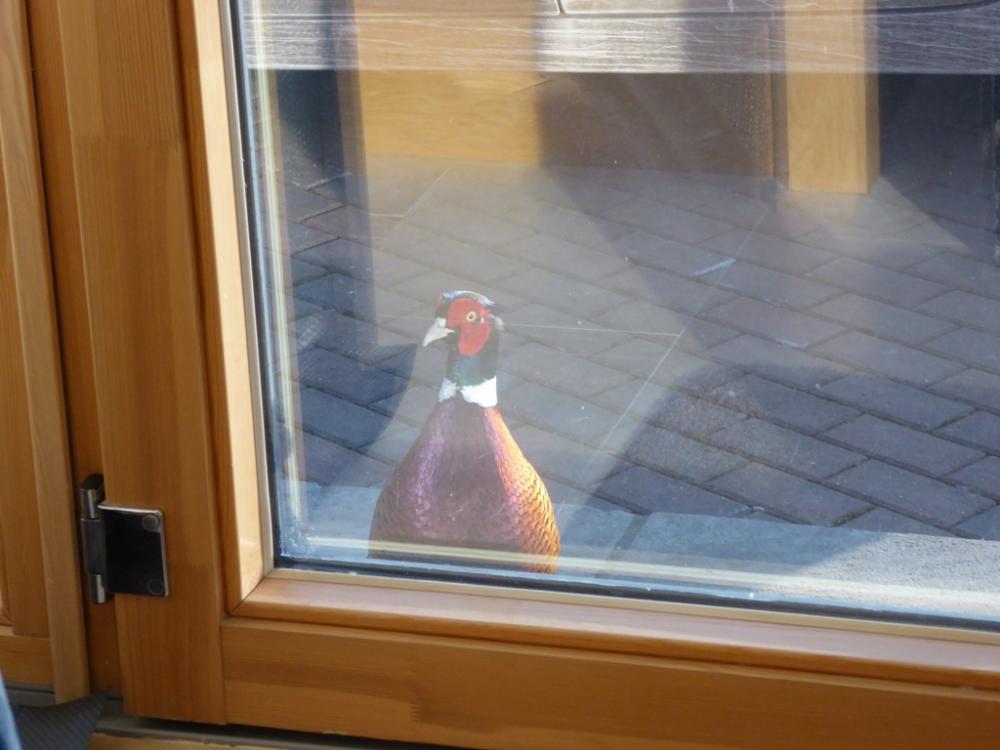
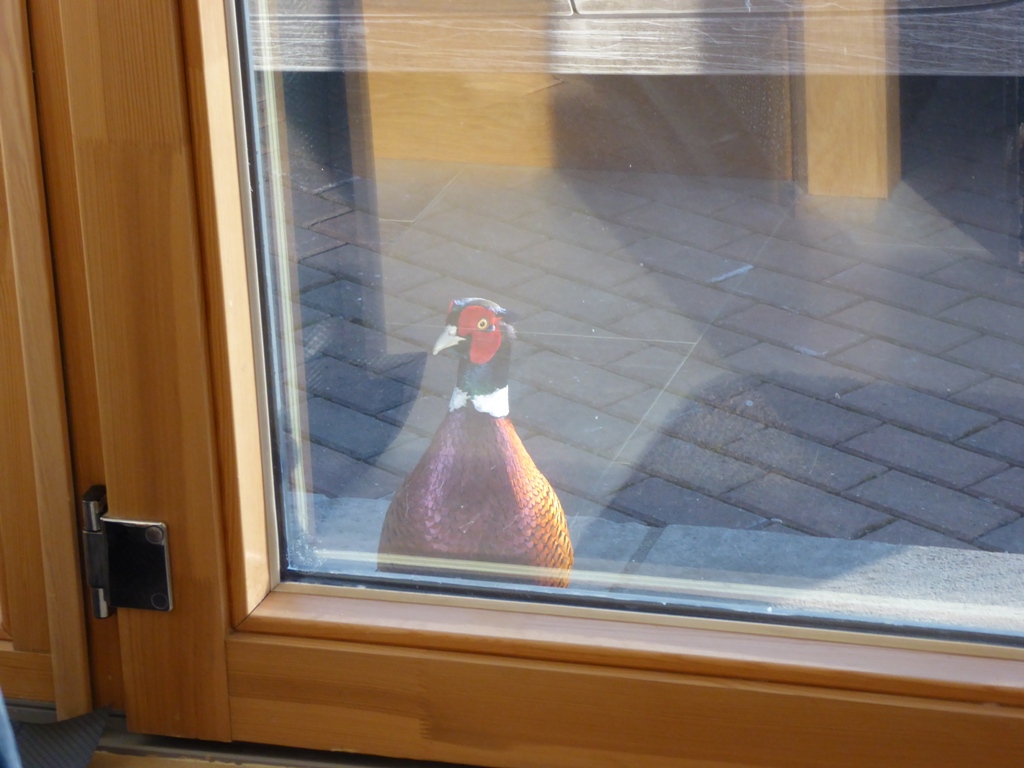
Don't get me started on pheasants... Some may recall that we had this cheeky sod banging his beak repeatedly at our front door last year: Well, he's back... I'm getting fed up with opening the door and chasing him away. It seems that he can see his own reflection, assumes it's a rival, and then sets about head butting the window. The bugger's far too dim to realise that he's not banging his head on another cock pheasant, so every time I shoo him away he comes back for another go ten minutes later. Not only that, but he's crapping all over our front steps.