Jeremy Harris
-
Posts
26430 -
Joined
-
Last visited
-
Days Won
360
Everything posted by Jeremy Harris
-
This is what I submitted to our planning officer, who accepted it: Landscaping Plan.pdf
-
As long as the planners are content with your choice of external finishes and the design, then that's fine, but it would be well worth looking at the local planning policy to determine what, if any, conditions might be imposed. Often it's also well worth looking at a few recent planning approvals in the area (they should all be available online) to see what conditions have been imposed. The landscaping plan had to be approved before we could start, and we were required to stick to it, but frankly no one has been to check, so my guess is that we could have deviated from it, although that could have posed a risk if someone chose to complain about it. There was nothing saying that the planners had to agree to our choice regarding the landscaping, and it was quite probable that they could have told us to do something different if they wished to. With regard to water, then I'd think hard about how you go about using rainwater. Modern washing machines run at cool temperatures, so aren't suitable for using untreated stored rainwater, as this will contain significant quantities of faecal bacteria from bird droppings. It's fine to use stored rainwater to flush toilets, but if you have a spring then why bother to harvest rainwater? We have a borehole for water, so use that for everything, as it means only having one pump, pressure vessel, filter and disinfection system, etc, and one set of plumbing. If we'd added rainwater harvesting we'd have had to install two systems, at a significant additional cost, and with zero environmental benefit (rainwater ends up in the aquifer that supplies our borehole, anyway, just as it ends up feeding your spring). Drainage depends on how forcefully the planners decide to impose SuDS (SuDS is a national requirement, supposedly). In general they may impose a standard condition requiring the control of surface water run off, or they may not. Have a look at local policy and recent planning applications in your area to get a feel for what they may choose to impose.
-

Retrospective PP for change to new build
Jeremy Harris replied to Bestsy Bungalow's topic in Planning Permission
This is a good idea, but needs some thought. In order to be able to claim back the VAT you will have to submit the planning drawings and decision notice to HMRC, and they will not refund VAT if the planning consent is for a rebuild, rather than a new build, so that means you will have to get the planning consent changed. -
Anything is possible with Openreach... I was sent a specification for installing Duct 56 on a new site, by the Openreach main office. That stipulated that a new installation had to have an external termination box, a BT66. There was no restriction on what I chose to do from the BT66 into the house, so I opted to just run Duct 56 under the slab and up where I wanted the cable to come in. I also provided a length of underground (gel filled) cable (to the Openreach spec) for the run from the house to the external BT66. I just left excess cable looped up at both ends, as the terminations have to be made by Openreach. It was only when the Openreach chap came around to connect us up that I was told that I'd wasted my time fitting the BT66 externally, as they would have been happy to run a single length of cable from the base of the pole, along a single length of duct and into the house. By that time this wasn't practical to do, as the trenches were filled and a path laid on top, so I just had two vertical hockey sticks poking up under the fence where the BT66 is fitted. It's quite possible that the chap wiring things up would have been happy to just ignore the spec that I was given by the Openreach office.
-
Lots. We had a condition requiring samples of all external materials and finishes to be approved by the planning office, with restrictions on what those materials and finishes could be (the originally specified stone finish from the planners would have added around £45k to our build cost, but I won the battle to have it changed). We had a condition requiring control of any run off from the site during building work, to prevent contamination of the stream alongside, which could have cost a lot if we'd had wet weather during the ground works (we were lucky, it remained hot and dry for that stage, and I wrote some deceptive weasel words in my request for discharge so I didn't need to do anything unless we observed a problem). We had a condition requiring the driveway surface to comply with the requirements set by the planning office, with prior approval of materials used by them (again costly, as they insisted on a specific type of permeable block paving). We had the standard condition that we needed to provide SuDS compliant surface water runoff control, which meant building a large underground surge attenuation tank, that soaked away gradually over a period of hours after storm levels of rainfall. We had a minimum finished floor level and parking area level, relative to the 1:100 year flood risk level, imposed by a planning condition from the Environment Agency. This determined how much spoil we needed to remove from the site (we shifted around 900 tonnes of stuff when levelling the site). We had a condition requiring that we submit a detailed landscaping scheme for approval prior to starting work, and a requirement that we landscaped the area in accordance with that approved scheme. We had the standard condition imposed that restricted all work on the site to being between 08:00 and 18:00, Monday to Friday, and between 08:00 and 13:00 on Saturdays, with no work allowed outside those times, on Sundays, or on Public Holidays (I broke this condition many times, but was lucky, no one reported me). There were a few other conditions, relating to local planning policy, the need to adhere to the approved plans etc, but none were very onerous.
-
I wholeheartedly agree, I just wish that we hadn't backfilled the trenches and laid a stone path over the top when I was told the damned box was no longer needed...
-
No, it's fine to run a Duct 56 hockey stick up through the slab, it's what I did. No problem at all as far as BT Openreach are concerned, although their rules have changed and that caught me out. They had changed the rules some time ago, so that any new build was supposed to have an external junction box (a BT66) to terminate the incoming cable, with another cable going from that inside the house to the master socket. I duly installed a BT66 on the fence where our meter box is, and ran Duct 56 in from the box at the base of the pole to that, then another run of Duct 56 from there under the slab and up into the house. When the chap came out to connect it all up he told me that they no longer required the external connection box, and it would have been better if I'd run the Duct 56 straight in from the base of the pole to the house. Sometimes you can't win as far as BT Openreach are concerned; I'm convinced that they make up rules as they go.
-
With respect, I don't think you can really get costs pinned down at all until you have got planning consent and costed the implications of any planning conditions that have been imposed. Depending on the local planning policy, your planners could impose conditions that may have a pretty massive impact on cost. In our case planning-related conditions probably added around £10k to £15k to the build cost, plus lots of time spent trying to work around some of the conditions that were imposed.
-
Septic Tank v Sewage Treatment Plant
Jeremy Harris replied to canalsiderenovation's topic in Waste & Sewerage
Discharge to a canal won't be allowed, I'm certain. There is an ongoing drive to clean up the water in the canal network, and the CRT will almost certainly strongly oppose any request to allow you to discharge, even if the bywash does flow all year around Discharge to a watercourse may be allowed if it has flowing water all year around, but the acceptability of this seems to vary a bit from region to region. I found the EA were fine about us discharging to the stream alongside our plot, but @ProDave had some difficulty getting SEPA to accept this, so it seems clear that SEPA and the EA work to a different set of rules. -
I'd never want to use a solicitor for any planning application, as it's way outside their skill set, plus they will almost certainly charge more than anyone who understands the planning process properly. The sequence you need to go though is this: Do some basic investigations as to ground conditions on the land, so you can determine if there are areas where it's going to be easier/cheaper to build. Draw up, or get someone to draw up, outline plans for planning consent. These do not need to be very detailed, take a look at this page of our blog: http://www.mayfly.eu/2013/04/part-two-the-joy-of-planning/ and also the planning drawings that I submitted, and that are still on the LA website, here: https://planning.wiltshire.gov.uk/Northgate/PlanningExplorer/Generic/StdDetails.aspx?PT=Planning Applications On-Line&TYPE=PL/PlanningPK.xml&PARAM0=500894&XSLT=/Northgate/PlanningExplorer/SiteFiles/Skins/Wiltshire/xslt/PL/PLDetails.xslt&FT=Planning Application Details&PUBLIC=Y&XMLSIDE=/Northgate/PlanningExplorer/SiteFiles/Skins/Wiltshire/Menus/PL.xml&DAURI=PLANNING to get an idea as to what's involved (your planners may have additional requirements, as they vary a bit from one region to another). Once you have planning permission, draw up, or get drawn up, detailed plans and apply for Building Regulations approval. Again, I did this myself, and the details are on this page of our blog: http://www.mayfly.eu/2013/09/part-fifteen-the-site-is-finally-ready/ Once you have planning permission, then you can look at going out to tender for the building work. I opted to tender for the major groundwork first, learned a lot from that process, and then tendered for the house and foundation build. Once the house was up, I separately tendered for the roofing, then used a mix of my own labour and tradespeople, often on a day rate, to complete the house. I did pretty much all the internal fit out, plumbing, heat recovery ventilation, heating and cooling system, some of the wiring, kitchen and bathroom fitting, internal joinery etc myself, to keep costs down. This was OK, but did extend the build time, especially when we ran out of money towards the end, so I ended up only being able to buy materials, or get a chap in to help with the landscaping, from anything I managed to save each month.
-
Grand Designs at Graven Hill starts tonight on Channel 4
Jeremy Harris replied to ProDave's topic in Property TV Programmes
So far this series seems to be bucking the trend as far as GD goes, as all the builds featured so far have been pretty damned impressive. Got to admire the way that chap managed to scrounge so much stuff, good stuff, too, from the look of it. About the only consistent feature with older GD programmes seems to be the failure to comply with building regs, especially with staircases. I can only assume that GD feel that stairs always look better without the mandatory balustrades, so film the programmes before these are fitted and the house has been signed off. -
That's not a valid reason from the DNO, as they are required to offer a connection if required, and they cannot dictate that a 3 phase supply has to be accepted. They can charge for reasonable costs associated with reinforcing their distribution network, but those costs have to be shown to be due to the specific connection request, and have to be shared if there are several requests from the same area.
-
I'd second what @Sue B has written, and add that, based on our experience, window and door suppliers were far and away the most difficult people to get a firm price from. We had a massive variation in price from one supplier to another, for pretty much the same specification. I also found them reluctant to quote until the house was up, and some initial quotes we had, based on just the approved plans, were way more than the price we ended up paying.
-
@Ferdinand's right. There's a preference order for sewage treatment that is: 1. If at all practical, connect to mains drainage, even if this means installing a pumped system. 2. If it's not practical to connect to mains drainage, then install an approved treatment plant, draining to land drains, a watercourse (needs separate consent) or drainage mound. 3. If fitting a septic tank, then tertiary aerobic treatment is required. There's some difference between different areas as to how to do this, but the general principle is that aerobic leach field treatment may not be adequate, because of it's relatively short operating life. 4. A cess pit may only be used if there is no other practical way to deal with effluent, and is not recommended. The cost of installing an approved treatment plant is pretty much the same as that for installing a septic tank and leach field, so overall there's no good reason to consider installing a septic tank now. I suspect it won't be long before pre-manufactured septic tanks stop being sold.
-
We had exactly this, with an inaccurate Land Registry Title Plan, when we bought our plot. The fence on the ground was in the right place, but for whatever reason the Land Registry had drawn their red line several metres away from where the fence line ran. Everyone involved agreed that the error was with the Land Registry red line, and it was just a matter of getting the fence line surveyed (cost me £450, inc VAT, but I got the surveyor to do a topo survey whilst he was on site, as well) and then getting the Land Registry to amend the two Title Plans involved (the one for our plot and the one for our neighbour). The cost of getting the plans amended was modest, and the only legal costs were for changing mortgage-related details, I believe. The Land Registry aren't very fast when handling stuff like this, though, and that may be a nuisance.
-
Accumulator or Pump to boost water supply?
Jeremy Harris replied to Ferdinand's topic in General Plumbing
The easy way to check is to look at whether or not a pump set has WRAS approval for direct connection to the water main. That will be readily available from the manufacturer on request. As above, the flow rate is neither here nor there, as it's the pressure in the main that is the critical factor. Because all water mains have leaks somewhere in the system, it's very important that the pressure in them is never allowed to reduce to the point where contamination could be drawn in, hence the reason for not allowing direct connection of a pump set. In theory it should be possible to get a pump set WRAS approved with some sort of clever control system on the suction side, so as to ensure that the pressure cannot drop below the lower allowed threshold, but I'm not aware of any pump set that has such a feature (and I've looked at the specs of lots of pump sets, as we have a pumped water system). -
Accumulator or Pump to boost water supply?
Jeremy Harris replied to Ferdinand's topic in General Plumbing
I'm not at all wrong, check the regs. You must not allow suction to occur on the main at any time, and you have no way of knowing, with a directly connected pump set, what the mains pressure is when the pump is running. The flow rate is neither here nor there; it's the dynamic pressure in the main that's critical. If the water company have advised you that direct connection of a pump set to their main is legal, without some form of positive control measure to guarantee that the pressure at the main connection cannot drop below the minimum positive pressure required to ensure that contamination is never drawn into the main, then they are wrong. -
Accumulator or Pump to boost water supply?
Jeremy Harris replied to Ferdinand's topic in General Plumbing
You're aren't, it's a breach of the water regs if you create suction at the main, a big no-no, as it risks contamination being sucked into the mains water supply through any leaks (and all water mains have leaks). If you need to add a pump set, then it needs a break tank, to remove all possibility of creating suction on the main. The alternative is to fit an accumulator, fed from the main via a NRV, which will store water at the peak pressure from the main under low demand conditions, so allowing water to be drawn off later at high pressure and flow. -
Our planning officer accepted that the CfSH condition wasn't valid straight away, by an exchange of email, but you may need to mount a more vigorous challenge, given that your 3 phase condition seems to be worded more emphatically. I'm not sure of the appeal procedure for unreasonable planning conditions, but would guess that @Temp may be able to help, as he knows far more about the detail of these things. Your house is about twice the size of ours, but energy use doesn't scale linearly with house size. Smaller houses tend to need more heating per m² of floor area than larger houses (the elephant versus mouse analogy), and hot water use scales with the number and age of occupants. Cooking requirements tend to not vary very much with the number of occupants (running the cooker for an hour to cook a meal for two is much the same as running a cooker for an hour to cook a meal for six). The PV requirement is export power related, not import power related, so unless the PV system is pretty big then the dominant factor will be the supply capability, and a "standard" 100 A single phase supply (which is what we have) can (in theory) deliver about 23 kVA (near enough kW for most intents and purposes). We have a heat pump that's around 3 times larger than we need (it was available at the right price), so would probably meet your heating requirement OK, but a larger one would be needed to meet your hot water needs. At a very rough guess you might need a 12 kW heat pump, which would require around 4 kW from the supply, worst case (much of the time it would probably be using around 1.5 kW or so). The treatment plant is trivial, around 50 W or so, so down in the noise. The same goes for the pump for the rainwater harvesting (please check if rainwater harvesting makes sense - often it doesn't, and may be more trouble than it's worth, for toilet flushing, which is all you can really safely use it for). The cooker and other house loads might need around another 4 kW to 5 kW or so, so heating, hot water and the normal house loads might add up to around 9 kW. That leaves around 14 kW or so of "spare" capacity from a single phase supply. That's enough to run two 7 kW car charge points. 7 kW is the maximum size standard domestic charge point, and all that's needed really, as a 7 kW charge point will charge my BMW i3 up from completely discharged to full in about 4.5 hours, and we have E7, so have 7 hours of overnight cheap rate charge time available. The PV limit will be determined by whatever your DNO will allow as a maximum export. I applied for an "unlimited" G59 (now G99) consent and was told that anything up to 10 kWp was acceptable, although in the end we could only fit 6.25 kWp on the available roof area. I'd estimate that the house, plus a single electric car charge point, wouldn't even need the full capacity of a normal domestic single phase supply, and most probably the PV system wouldn't either (although this depends very much on the nature of your local distribution network).
-
Do people really not realise this?
Jeremy Harris replied to Jeremy Harris's topic in Networks, AV, Security & Automation
TBH, I'd pretty much guessed as much, as I was pretty astounded by the terms and conditions that everyone (except Enterprise users) have to agree to in order to use Windows 10. For those unaware, then this is what Windows 10 users have agreed Microsoft can have free access to on your PC: Worth noting that, by installing Windows 10, you agree that Microsoft can read all your emails, hear and see any audio or video from your PC, and look at the contents of all the files on your PC (so documents, letters etc, basically anything you do on the machine). -
Yes, I did, although we were only required to meet CfSH Level 5. As CfSh was scrapped between the time I put in our planning application and the time we started the build, I requested that the condition be removed, as there was now no underpinning legislation. This turned out to be a formality, although the CfSH requirement remained a local planning policy for years afterwards, as the LA were really slow in getting it changed. With regard to the condition requiring a 3 phase supply, I'd suggest that isn't technically sound at all. A low energy home won't consume much power, and hence won't need a lot of renewable microgeneration in order to be zero carbon. There's an underpinning requirement that all local policies have to be realistic, and that one is clearly pretty misguided and not supported by an adequate level of evidence. I'm pretty sure it could be challenged pretty easily, as all it would take is to take the data from the SAP worksheet and use it to show that the "zero carbon" requirement can be met easily whilst staying well within the limit for a standard single phase domestic supply. I manage to remain well within the single phase supply limit in a house that is all-electric, has a heat pump, 6.25 kWp of PV and two electric car charge points.
-
Do people really not realise this?
Jeremy Harris replied to Jeremy Harris's topic in Networks, AV, Security & Automation
Very true. I had a conversation recently with someone who was concerned about the privacy of email. I mentioned that email was inherently insecure and not private (unless encrypted) and that all the "free" email services had to generate a revenue stream, so where did she think that came from? Same goes for social media, where companies like Facebook only provide the service as a way of capturing large amounts of personal data that they can earn revenue from. You're OK, we don't pass data on to anyone, and fund this site from donations, so we're not in anyone's pocket. This place is run by volunteers who are a not-for-profit member's association, with regular meetings, an AGM and all the other stuff that a member's association has by way of governance. -
Do people really not realise this?
Jeremy Harris replied to Jeremy Harris's topic in Networks, AV, Security & Automation
I'm old enough to remember when we still had telephone operators (before we had STD) that everyone knew had a tendency to listen in on conversations! The first house we had that had a telephone, back when I was growing up, was on a party line, so you'd often pick up the receiver and hear the neighbour on the phone, and had to wait until they finished their call so that you could use the thing. -
https://www.bbc.co.uk/news/technology-47893082 I'd assumed that anyone who bought one of these things must have read the terms and conditions and realised that they were transmitting voice data from inside their homes back to Amazon, Apple, Google or whoever, but it seems not. How on earth do people think these things work? It has to be blindingly obvious that there isn't enough smart stuff in a really cheap box to do the voice recognition stuff, and that this is done by remote systems. I seem to recall that there was a court case not long ago where voice recordings from one of these manufacturer's servers was used as evidence, too, so it's not exactly a secret that they transmit everything they hear back to base. Given that these companies need to continue to improve their voice recognition algorithms, it also seems pretty damned obvious that they must use people to compare recorded audio data with the interpreted data from time to time, too.
-
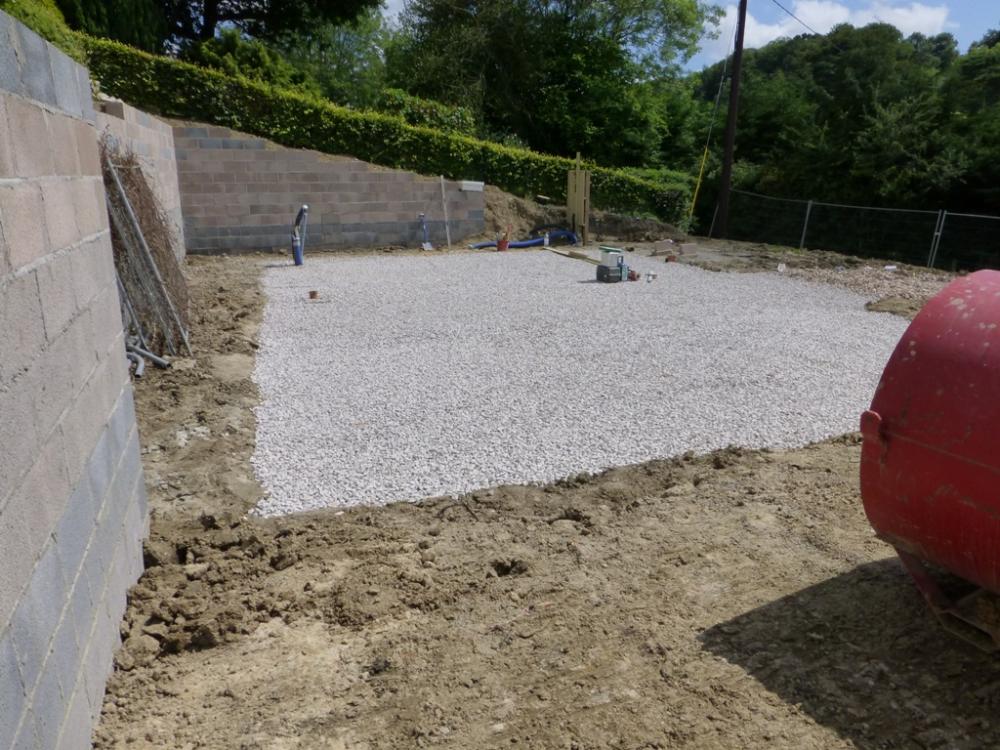
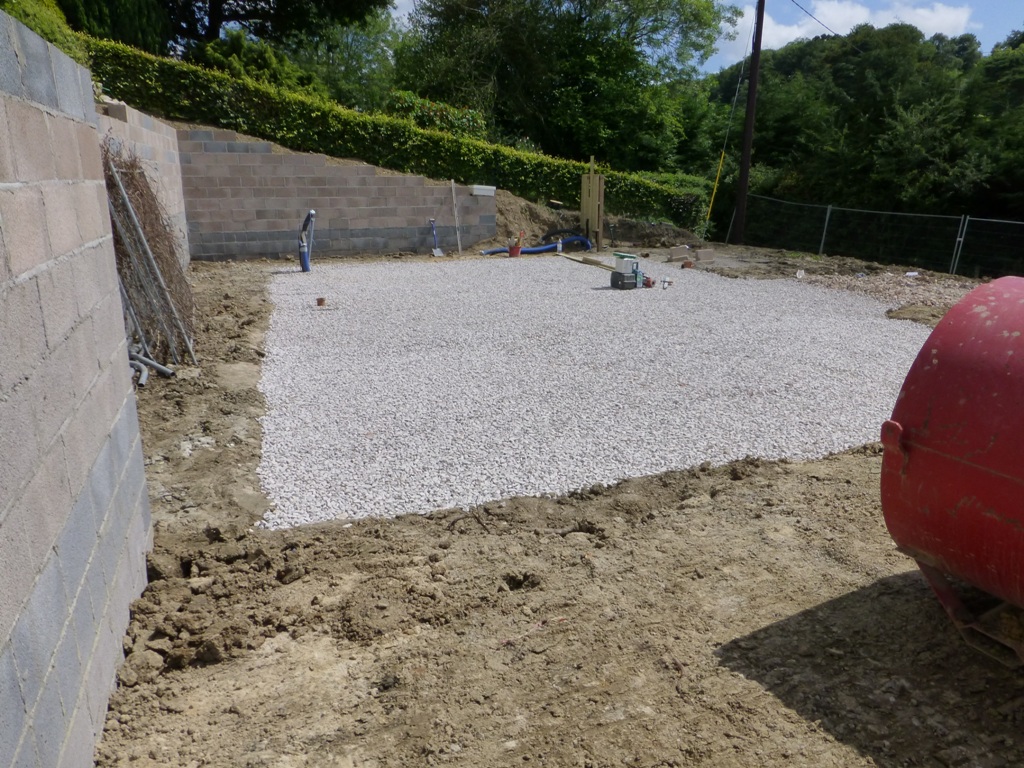
I was referring to the pretty much standard, EPS on drainage layer, passive slab arrangement. Both @PeterStarck's slab and ours (plus several others here) are built on a layer of well-drained ballast, so, as I said, there is no hydrostatic pressure to push water into the EPS. In our case, we have 200mm of Type 3, blinded with ~50mm of coarse grit, under the EPS, and 100mm land drains around the periphery, under the edge of the ballast, to ensure that it's well drained. In addition, the base of the EPS is at ground level anyway, the photo below shows the layer of Type 3 before it was blinded and the EPS was laid. It's really hard to see how water could be pushed upwards into the EPS.