Jeremy Harris
-
Posts
26430 -
Joined
-
Last visited
-
Days Won
360
Everything posted by Jeremy Harris
-
In England and Wales (not sure about Scotland or NI) then the set of building regulations that apply will be those that applied when the house building regs submission was initially approved. This assumes that there was a building regs submission and that the foundations and B&B floor do have building regs sign off. However, it would make no sense to build a house now to 10 year old building regs, as quite apart from anything else it would be even less energy efficient, and cost more to run, than a house built to the pretty poor building regs we have now.
-
Octopus seem to be offering the "Go" tariff as a bit of a loss leader at the moment, as they have a strong vested interest in getting as many of their customers to have "smart" meters installed as possible. Whether "Go" (or "Agile") remain so competitive once there is a critical mass of customers locked in with "smart" meters remains open for debate. If I had to guess then I would say that these "smart" meter only tariffs may well stay competitive for 2 to 3 years, but are then likely to either rise, either because they aren't sustainable in the long term (they seem to be working with virtually no margin for profit at all right now) or because comparing prices with these variable tariffs will be very much harder. The end result (which is probably what the suppliers want) is that customers will be less reluctant to change supplier in future, I suspect.
-

Anyone fitted a pre-charged aircon unit?
Jeremy Harris replied to Jeremy Harris's topic in Air Source Heat Pumps (ASHP)
I'm sure you're right. Looking at videos of installing these units, it seems that it's pretty important to leak test the joints. Just spraying them with soapy water seems a reasonable way to check, but, as you mentioned earlier, even paying for someone to come out and regass and seal the system after a year or two is still cheaper than paying for a full professional installation. -
There's an old adage: "Follow the money...." Review sites are funded by advertising in the main, and their advertisers are the very companies that are being reviewed. Are they likely to be impartial? As heck as like! It's a bit like trying to discuss the negative health impact of burning stuff in stoves to heat homes on a certain "green" (what a joke that is) forum that is sponsored by wood burning stove manufacturers... There's a very good reason that the founding members of this forum have a pretty rigid stance when it comes to remaining free from commercial influence, and relying on volunteers to run the forum and donations from forum members to keep things running. It's to try and ensure that views expressed here are a fair representation of the views of members, free from any commercial influence or bias.
-
Anyone fitted a pre-charged aircon unit?
Jeremy Harris replied to Jeremy Harris's topic in Air Source Heat Pumps (ASHP)
Many thanks, @Temp, that's perfect, exactly what I was after! I fitted a second MVHR air feed through the wardrobe and up to a terminal on the wall, right where I now want to fit the indoor unit. To get a neat looking duct run inside the wardrobe I used 110 x 54 PVC rectangular duct, so with luck the pipes will all be able to run inside this. -
It would be interesting to have a guinea pig to test their pricing etc, but you'd probably need a strong constitution, and be prepared to waste a few hours of your life, to tolerate it, I expect. If I had to guess, then I'd say they most probably use the double glazing sales approach, with pushy sales people who refuse to leave until they've got your signature on an order.
-
I couldn't agree more. The positive side of this deal would seem to be that the badge-engineered units that Fischer/Premier are marketing won't have any Sunamp labels on them, so most people buying from them won't know who the OEM is. That, together with the volume of sales that Sunamp will gain from this marketing route, will be good for Sunamp. The snag is that it probably won't take long for those who feel that they've not had good value or service from Fischer/Premier to find out who the OEM is, and also find out the price of the Sunamp badged units. If Fischer/Premier market these as they have other products they've badge-engineered then the chances are that they will put a pretty hefty mark-up on them.
-
Anyone fitted a pre-charged aircon unit?
Jeremy Harris replied to Jeremy Harris's topic in Air Source Heat Pumps (ASHP)
One advantage of buying a non-precharged unit may be that I can get away with a smaller duct through the wall for the pipes. I may hunt around and see how much an F gas person would charge to just connect the pipes, pump the unit out, and fill and test it. Might be worth going down that route if it means a neater installation with a smaller hole through the wall. -
Anyone fitted a pre-charged aircon unit?
Jeremy Harris replied to Jeremy Harris's topic in Air Source Heat Pumps (ASHP)
@Temp, do you recall how big the pipe end fittings were by any chance? It doesn't seem to be something that's included in the spec for any of the units I've looked at, yet it's fairly significant, as I need to get the pipes out through a duct fitted through the wall, and would much rather have as small a hole as possible. -
In the recent hot weather the house has been plenty cool enough downstairs (between 21°C and 22°C) but it's been getting a bit warm upstairs (typically around 24°C to 25°C in the bedroom). This is with the MVHR running continuously in cooling mode, as that can only provide about 1.4 kW of cooling capacity, split across all the rooms in the house. I've been kicking myself since the house was first built that I didn't allow provision for installing a split aircon unit high up in the central hall, but have now worked out that I can fit one high on our bedroom wall, with the pipes leading through the walk-in wardrobe and out to the service area, from where I can get them out through the wall OK. I've been looking at fitting one of the pre-charged, DIY fit units, as we only need something fairly small (a couple of kW, around 7,000BTU, would be ample). These are pretty cheap, typically around £500 to £700, so the chances are that professional installation would probably double the cost, which makes me think that a DIY installation might be a better option. A DIY installation also means that I can make sure the pipes are sealed properly where they go through the wall (I'll probably stick a rigid duct through the wall for them, I think). Has anyone fitted one of these? Looks easy enough, but I wonder if the fittings on the end of the pre-gassed pipes mean that they need a big hole in the wall to pass through.
-
There's also the question as to whether the existing beam and block, plus foundations will meet building regs or not. There's no way of really being able to tell now, so unless there is a record of building control sign off, together with the original foundation drawings, then it's all a bit of an unknown. Far better to just rip it out and start again, as apart from giving more design freedom it also removes any doubts, and possible hassle with building control, over what's there. Building regs have moved on a fair bit in ten years, too, so what was OK in terms of floor insulation then most probably wouldn't be OK now.
-
If you want to stop labels coming off, then you can stick clear heatshrink sleeving over them: https://cpc.farnell.com/search?st=clear heat shrink This works to protect hand written labelling with a felt pen, too.
-
Yes, softened water does leave some slight marks on the glass if not squeegeed off well, but not as bad as hard water. I just wash ours with softened water, squeegee them off then give them a squirt of Screwfix own brand window cleaner, polished off with the cheap Screwfix microfibre cloths. Seems to work OK, and a bottle of the cleaner easily lasts a year or so.
-
I've always used a standard label printing machine. Easy to use, pretty cheap and the labels stay put if wrapped right around a cable and back on themselves.
-
The main problem with horseboxes is that the floors rot out. The rubber flooring is rarely watertight (often it's just loose laid thick rubber anti shock mats) and as a consequence the timber underneath just tends to sit saturated with horse pee for long periods of time. Having slept in the hay loft space of a horsebox a few times at shows (where the horses had the luxury of being in loose boxes) I can say that there is a unique smell that permeates everything inside them.
-
DIY Arduino based solar PV dump controller
Jeremy Harris replied to ProDave's topic in Photovoltaics (PV)
I thought of doing this, but the need for compliance testing (as @ProDave has mentioned above) and the consequent potential liability from selling stuff to build one put me off. I did publish my original design and code over on the Picaxe forum years ago, but even then added a caution, because of the risk of somebody getting things wrong. The version I'm using now is basically the same, in terms of the measurement system and energy bucket principle, but uses a 868 MHz link between the measurement and sensing unit and the 20 A SSR unit that switches power to the Sunamp. -
Which unit
Jeremy Harris replied to Pocster's topic in Mechanical Ventilation with Heat Recovery (MVHR)
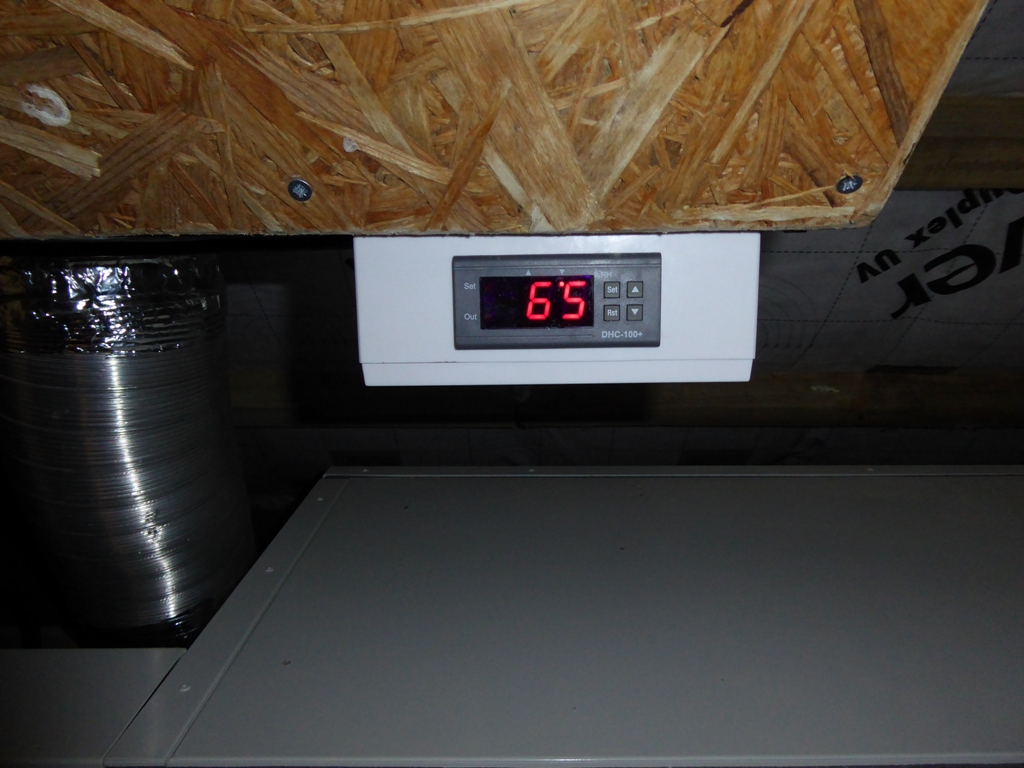
The programmable humidity sensor and switch I used was this unit from Poland: https://www.ebay.co.uk/itm/DHC-100-Feuchtigkeitsregler-Hygrostat-Humidity-Control-Sensor-Fuhler-2-meter/182951476628?hash=item2a98c1fd94:g:hAgAAOSwFSxaKeA~ I put the remote sensor inside the extract plenum chamber and it seems to work well. Boost turns on within a few seconds of a shower starting, or even just from the steam from making a cup of tea, and the unit can be programmed with a variable turn off delay and RH hysteresis. I fitted the controller inside a surface mount box, in the services room, just above the MVHR: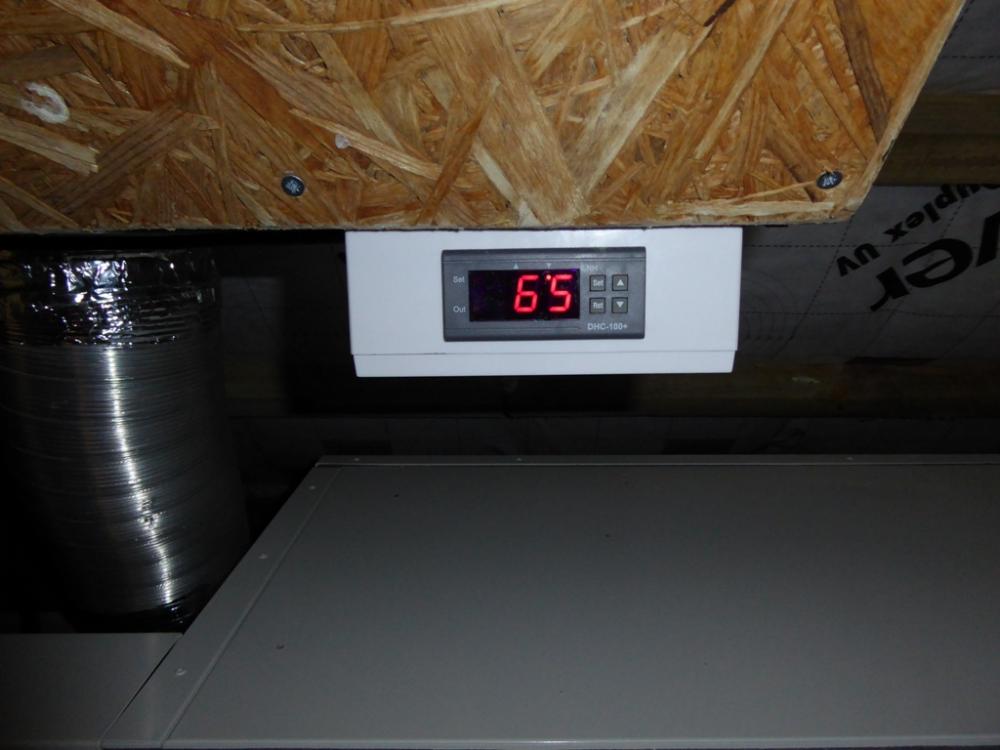
-
Harvey Water Softener -- Annual maintenance
Jeremy Harris replied to TerryE's topic in General Plumbing
Sounds very like ours, the left block always gets used faster than the right block. We also get a little bit of salt crusting around the lower edge of the lid, often after we've been away and there hasn't been any water use. I've not done anything other than changed the salt blocks on ours. -
Pity about the timing, as we're heading over to Sark for a few days from tomorrow. Could have brought a roll or too over with me and had it forwarded on from Guernsey to save a bit of postage.
-
Save the world, install an LPG tank.
Jeremy Harris replied to epsilonGreedy's topic in Environmental Building Politics
Precisely linking cause with effect is pretty difficult with climate science, as I understand it. A more accurate way of referring to what we observe would be to say that there is a clear correlation between various factors, and the predictions made are based a fair bit on the strength of those correlations. Some will point out the golden rule of science, perhaps, that correlation doesn't equal causation, but then the same is true of many things that we cannot prove beyond doubt, yet can be pretty sure are true, nevertheless. There are also some factors that aren't fully understood, and some that have only come to light relatively recently. A good example would be the impact of ocean CO2 absorption. A few decades ago the thinking was that the oceans would just continue to absorb atmospheric CO2 as the concentration increased, so balancing out the effect of increased CO2 emissions as a consequence of human activity. That proved to be a false assumption, in that the way the oceans absorb CO2 isn't as straightforward as initially thought, and changes a fair bit, dependent on a host of factors that are separate from atmospheric CO2 concentration. Things are made more complex by the way that upper ocean CO2 absorption is partly driven by ocean turbulence and significantly affected by temperature, so as the oceans warm, weather becomes more variable and upper ocean CO2 absorption rates change, which then tends to drive temperature change, and so feedback to produce greater variability. The whole system is exceptionally complex and difficult to model with any degree of accuracy, which explains why practically all global warming predictions have such wide error bands. If things were as simple as saying changing the value of X will have this effect on Y, then it would be a lot easier to understand. Sadly it isn't, but what we are seeing are global changes that map consistently to human activity. -
I didn't manage to find a supplier who would just sell the external film when I was looking around. I got the impression that the manufacturers had pretty much stitched things up so that they would only sell to authorised installers. Installing the stuff seems to need a fair bit of expertise, together with some equipment. The people that did ours had dispensers for the rols, a large guillotine to slice the film off, and some thin stainless steel shields that they used to protect the edges of the window frames when they sliced the film to size when partially bonded to the glass. Fitting the stuff seemed pretty straightforward, they just thoroughly cleaned the glass and polished the surface, checking for anything that might be stuck to the surface, no matter how small (they ran wide blades over the glass). They then sprayed water onto the glass and applied the film, using a squeegee to smooth it down and get the air bubbles out. The film is self-adhesive, so not easy to handle once the backing has been removed, it took two people to apply most of the film to our windows.
-
Electric Vehicle Tariffs
Jeremy Harris replied to Triassic's topic in General Alternative Energy Issues
I can vouch for the BBC taxi bill probably being extortionate. When I was a guest on Kilroy they sent a chauffeur driven Mercedes to pick me up from home (just outside Salisbury) and drive me to Teddington Lock studio and back. All for five minutes on daytime TV. -
Reading measurements from a DWG file?
Jeremy Harris replied to Dreadnaught's topic in General Self Build & DIY Discussion
Units are never included in the data set, other than as a header to tell the CAD package what they are. All entities are just expressed numerically. Back when we first got CAD at work (AutoCad, running on a DOS PC, pre-Windows by a few years) we used the new CAD/CAM system in the workshop at our parent establishment for manufacture. Our drawing office designed a new form of Mk46 torpedo tail nut (which includes the motor exhaust valve) using the new CAD system. They were really proud of the thing, which was to be machined from stainless steel. It's dimensions were such that it should have comfortably fit in the palm of the hand. A few weeks later we had a phone call, saying that there was a truck with a delivery for us, and did we have a forklift available to unload it. Lots of scratching of heads, wondering what the thing was, until the pallet was unloaded. There, in all it's glory, was a beautifully machined tail nut around 3ft in diameter, weighing around 1/4 of a ton. The CAD file had been transmitted to the workshop minus the unit header, so mm had turned into the AutoCad default of inches, making every dimension 25.4 times too large... -
Electric Vehicle Tariffs
Jeremy Harris replied to Triassic's topic in General Alternative Energy Issues
I thought that energy figure was just the total primary energy used by the UK divided by the population, wasn't it? If it is, then it seems to not be a million miles away from the only data I can find quickly, which suggests that the per capita energy consumption in 2014 (the latest year I can find data for) was about 95.4 kWh/day. MacKay was probably using older data, which may have given a higher energy use, plus the population may well have increased as well. -
lowering a 1600x900mm stone resin tray
Jeremy Harris replied to 8ball's topic in Bathrooms, Ensuites & Wetrooms
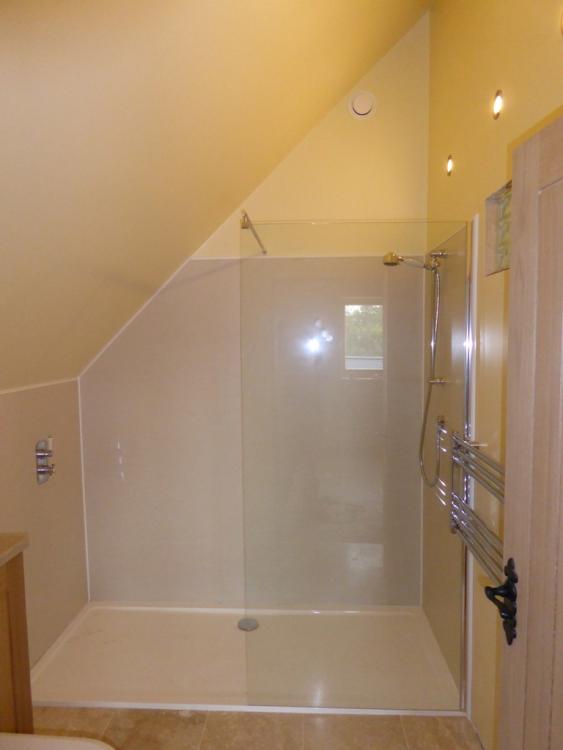
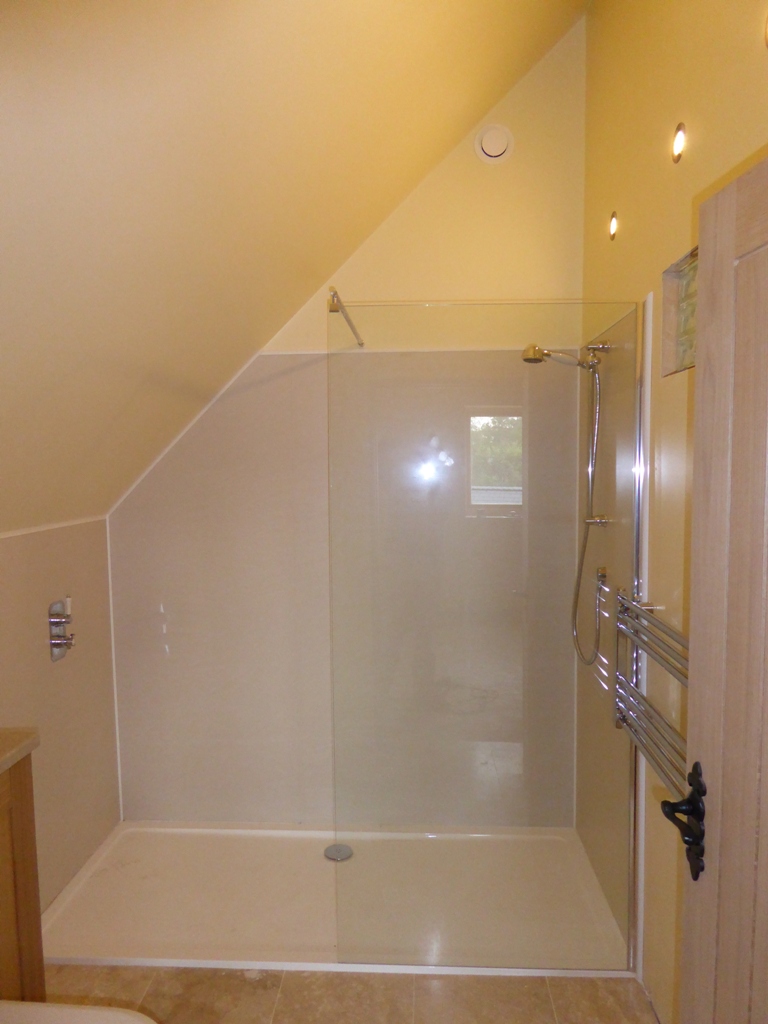
Don't do what I did. This is our's in place (it's 2000 x 900 and weighs about 70kg): The stupid way I chose to fit this (it's a tight fit between the walls from left to right in that photo) was to slide the tray in place, spaced up on battens, then lift the right hand side up, propping it in place with a bit of 2 x 2. I then mixed up some mortar, spread it on the floor (being exceptionally careful to not nudge the prop), then I took the weight of the thing and pulled out the prop. I'd intended to lower it carefully on to the mortar bed, but this was not to be. I got it within about six inches of the floor then dropped it. By pure good fortune it happened to end up dead level in both directions, so I just left it and went home, thankful that it hadn't fallen on my head...