


Redbeard
-
Posts
1532 -
Joined
-
Last visited
Everything posted by Redbeard
-
Care to share the maker?
-
+1. Can you post pictures so we can see the roof oversail (or not) etc? If you decide EWI is a no-go: I do wonder if trying to get a solution for the *whole house* using your existing plasterboard and frames might be blocking you from doing a high-quality wood-fibre or cork and lime plaster IWI solution to, say, 2 key rooms as part of an x-year 'rolling programme'.
-
skylight - roof alterations / building control submission
Redbeard replied to Moonshine's topic in Skylights & Roof Windows
Usually double-up the rafters either side and trim across as required, but don't take my word for it! Ask your BCO. I have seen 'standard requirements' vary from place to place. -
Re sourcing the board, short answer is I don't know either, but a search yields https://www.builderdepot.co.uk/12mm-fibreboard-sheet-2200mm-x-1220mm I used to use a lot of thicker wood-fibre boards, and the pallets often came with 'spacers' of 8-10mm board, but the merchants in UK did not sell it! That's a pity, as it was really useful for the occasional really tight reveal.
-
EWI? - Supasoft? Superfoil? Can they be used for EWI? Why would you? I cannot see the logic in using a floppy insulant for EWI, necessitating studs and render-board. Wood-fibre is good. Cork board is good, but IME a bit more expensive. Diathonite I have not used, but EBS say it can be used for EWI as well as IWI. See 'luneretrofit' for details of it sprayed on. Lune Retrofit https://luneretrofit.com Don't know Cork Sol. Hope that helps a bit.
-
Can you draw that? Are thinking to install them 'in check', where the win frame is tucked partly behind the outer skin of brickwork, so the timber lining in line with the inner skin? Is it solid walled?
-
New Welsh would be the 'go to', but at a premium. If I had the choice of fibre-cement or second-hand I'd go for second-hand Welsh, but I'd want to choose them. That's a bit rare nowadays!
-
Cross-posted with @markc. Yes, they can be very dirty, but I have been quite happy with 2nd hand slates; it's just all the sorting - not only into good and cr*p but also into thicknesses. I don't think I would have won my 'junior roofer of the year' award, but 'not too bad' would be a fair accolade!
-
I have seen suggestions that you should allow at least 30% wastage. I was kindly given the slates from a friend's house (OK some which had suffered 'Turnerising' or hessian and bitumen) but even of those that hadn't I reckon I had about 50% wastage.
-
How to repair crack in thin coat render on EWI
Redbeard replied to SimonD's topic in Plastering & Rendering
Do you have pics? Is this on the reveal? If so my suggestion of scraping back 150mm might not work as there may not be 150mm of reveal! But if you have the space, chop back (say around 150) till you find the mesh (and then you'll also see where it isn't), thin toothed coat of base-coat, mesh in, thin coat over, and try to recess about 1-2mm (depending on top-coat grain size (if indeed you have top-coated with 'from-a-bucket' stuff). This is what I have done. You *will* see the join at least a bit unless you are very lucky, but after a while you will have other things to look at. -
Lead, done right, will last 100 years. GRP can last well (and ST will have a better idea than I about GRP longevity, but still a lot of old GRP boats around) but I would have thought a lot less than 100 years. Lead gets my vote.
-
Pic does not open for me, save as a microscopic 'box'. Clicked on the box and got 'Gone! Error 410' (or 4 hundred and something anyway).
-
Similar issue to when you are installing PIR below rafters with timber cross-battens over the PIR. One schoolof thought says that a hoile with a screw in it is not really a hole, and another says 'yes it is' and guns silicone into a pre-drilled hole to give each screw a 'silicone VCL grommet'. I have never used phenolic in a floor before but I have used PIR with T & G OSB overlaid with a VCL (well, thick DPM, in fact, but acting as a VCL) between, as a floating floor. No weakness detected in several years' use. Reason for the thick DPM is so that your big work-boots don't kick holes in rather wimpy thin VCL.
-
Cutting into a brick retaining wall to build steps
Redbeard replied to Coral_M's topic in Landscaping, Decking & Patios
Depends whether you want to cut the steps fully into the retaining wall (with the bottom step in line with the wall) or whether you want to 'lean against' the wall, with, say, only the next-to-top step cutting in. In the latter case, provided the flank walls had adequate footings they would in fact add, rather than remove, buttressing to the existing wall. -
Limiting U values are not targets, though, so as others have said the values achieved look pretty disappointing. The way of calculating compliance with B Regs for new-build is based on a sort of 'pick and mix' insofar as you could get away with higher-than-ideal air leakage if you had better fabric U values and vice versa. The limiting u values are simply 'it cannot be higher (worse) than this'. Is there a membrane behind the plasterboard? What's the insulation? If foil-faced is it taped?
-
I don't quite get the maths here. If we assume the very beginning of Oct I think that's 16 weeks to date, with a 2-wk extension taking it to 18. Have I misunderstood?
-
Survey inputs to the planning process
Redbeard replied to Post and beam's topic in Planning Permission
I don't know, but if your username is indicative of your build-style maybe you have individual founds for each post (a la Segal Method) and therefore minimal threat to trees and roots and the LA recognised this. Or maybe not! -
Soffited. Was that the sort of (very short!) answer you wanted? Please give more detail if you want more.
-
I have, in the past, done a 'downstand' of PIR/plasterboard internally to cloak the thermal bridge caused by lack of CWI behind the fascias. Oversail on the inside by about 300mm compared with the est'd position of the top of the insulation outside.
-
On the upper left you can see 25mm of PIR between the (75mm) rafters, leaving a 50mm ventilation path behind. Below the purlin a further 100mm has been added to the initial 25mm, and all the joints and perimeters of the boards are about to be taped as the vapour control layer. On the right-hand side is the final stage before fitting the plasterboard. After taping of the joints in the 100mm board 50 x 25mm timber battens are fitted horizontally, screwed through the ‘insulation sandwich’ to the rafters, and a final sheet of 25mm PIR is fitted between the battens, giving a U value of around 0.16W/m2K.
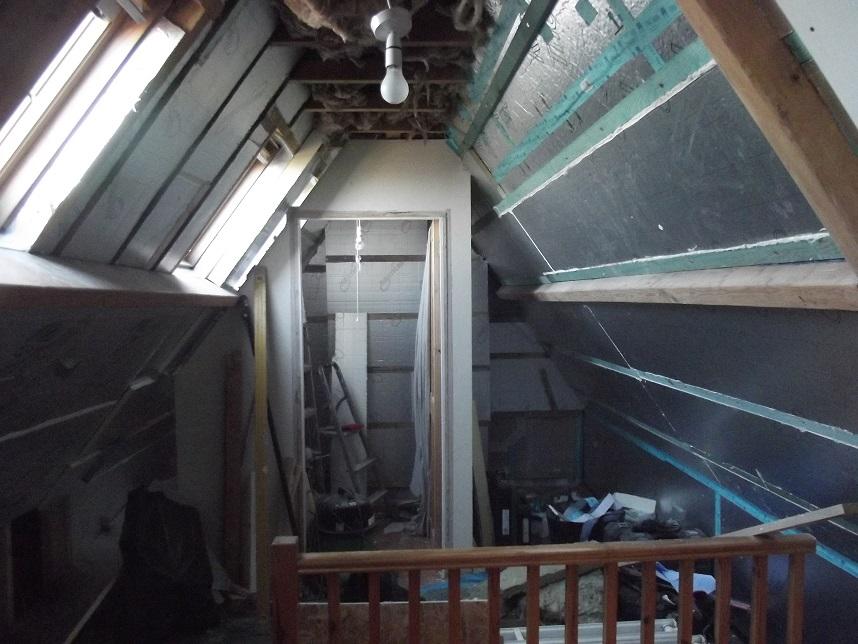
-
If you want smooth (-ISH!) use a bagged product with mesh and do the first coat with a toothed trowel. The 'tramlines' of the toothed coat act as a depth gauge. Do a small (1m2?) test 'panel' first and you can mess with it and refine it till you feel confident.
-
OK. Will get to that later.
-
Ventilation is a potential issue. You need a 'dropped section' (small area of flat ceiling) at the top to form a 'plenum chamber' otherwise the only things getting ventilated would be the spaces between 2 rafter pairs. Look at manufacturer's bumf and see whether 2 vents is enough. And is there 'supply ventilation' at the bottom of the roof structure? (You need 'ins' and 'outs'). Apologies if I'm teaching egg-sucking! Common practice since 2010 (when insulation became a requirement of re-roofing) has been to leave a 25mm gap between insulation and the top of the rafters, and this (https://assets.publishing.service.gov.uk/media/61d727d18fa8f50594b59305/retrofit-room-in-roof-insulation-best-practice.pdf) - gov't Best Practice guidance which seems to have sneaked in without many people knowing - says 50mm. Having 'trouble-shot' a number of moisture-ridden room-in-roof retrofits I favour 50mm, but no void of any size is much good if it does not have the 'feed' and 'exhaust' - the 'ins and the outs'. I prefer 'raw' PIR, finished with battens and pl'bd, to insulated plasterboard, as it allows you to tape the life out of the VCL. Plenty of example in BH pic history, I think, but pics from me if anyone needs them.
-
To me thermal wallpapers are an illustration of the fact that a thin thing has all the insulation value of a thin thing. They have their place where other measures are not going to be done (perhaps in some rented properties) insofar as the slight increase in surface temp may hinder mould growth. Don't expect huge comfort increases or fuel cost reductions, though.
-
Is this it? https://www.ukseptictanks.co.uk/ecoflo-nonelectric-sewage-treatment-6

