Redbeard
-
Posts
1560 -
Joined
-
Last visited
Everything posted by Redbeard
-
1st floor extension - SIPs vs builder
Redbeard replied to Adam_R's topic in House Extensions & Conservatories
...and if you want to go for 'woody', I find it a bit hard to see how SIPs (with some inherent thermal bridging AIUI) is much better than a TF and fill of your choice. Do you mean you would DIY if you did SIPs? You could also DIY a TF. I did my 'design', got SE to 'prove' it and off we went. -
Joist depth Notch depth 150mm 18mm 175mm 21mm 200mm 25mm 225mm 28mm 1 more row • 5 Oct 2022 Notches and holes - Eden District Council
-
Still bothered about the tanking. It seems to be an impermeable barrier at the very wrong point in the thermal 'sandwich'.
-
Yes, @joe90 exactly what I meant. That way you can get the joints good and full, even if you can't get in to 'tickle up' the pointing. If it is so close, and thus so sheltered, I should have thought just striking them off flush would suffice.
-
Sounds like a potential recipe for interstitial condensation, whatever the Glaser Method (BS condensation risk analysis tool) says. Glaser method will only spit out results according to the gist of what you tell it. If you say it's got a VCL it will assume *perfect* VCL. I'd get it modelled at least, if you have not already done so, preferably in a dynamic model such as WUFI, but practitioners are hard to come by, in my experience. The Glaser method, if I remember rightly, covers itself in saying that the outside of the 'sandwich' should be permeable in case water vapour *does* get through. Your tanking slurry would/could mean that the wall is no longer permeable. Why do you, or your advisor, think you will not be able to achieve waterproof-ness building 'blind' anyway? If it's 50mm from its neighbour you'd be pretty unlucky if it was classed as exposed. With careful use of a pull-up batten I would think you could get the joints pretty good, just not pointed.
-
Hmmm, The membrane I think you are describing has a good role to play in basement waterproofing. I would rarely suggest its use elsewhere. It appears to be used in a number of situations where good drying-out would/could have solved the issue. You seem to describe thicknesses of insulation which would not, on their own, meet the target U values set put in the Bldg Regs. Added together they might, but like you I do not like the idea of possibly having made each side of the 'sandwich' impermeable.
-
A2A Heat Pump minimum working temperature?
Redbeard replied to Ferdinand's topic in Air Source Heat Pumps (ASHP)
@Ferdinand, I was wondering about one of those. Presumably you have to get the optional hose kit and either dangle it out of a window or drill a hole of the requisite size? Any 'learning from experience' gratefully received. Thanks. -
Damp? humidity?
Redbeard replied to Tommy91's topic in Mechanical Ventilation with Heat Recovery (MVHR)
Tell us about the current heating system, temperatures maintained and relative humidity. What does your ventilation 'system' currently consist of? -
Self-levelling compound as finished floor?
Redbeard replied to Ben Weston's topic in General Flooring
Absolutely. It was plainly not a recommended application, but given that, as a bodge, it was remarkably successful. -
Yes. I would recommend never leaving thermal bridges un-'cloaked' if you can help it. Take care if you are doing any IWI inside CWI. Get a condensation risk ass't done.
-
Self-levelling compound as finished floor?
Redbeard replied to Ben Weston's topic in General Flooring
Oddly enough (luck, not good judgement!) I never had difficulty getting SLC well, level, but it did not last well as a final finish. I used it on my Damp) cellar steps, with sanded bitumen below. It lasted a fair few years but cracked a bit as it went on. -
Is the party wall surveyor asking too much?
Redbeard replied to Ernie's topic in Party Wall & Property Legal Issues
Pictures and list, please, so we can see what the issues are. 'Outrigger party wall'- is that what we'd call an offshot in the North, and if so where does that come into the loft conversion? Pics would be really good, as I am visualising a 'typical Yorkshire' 2-storey offshot which would not have enough headroom to be part of a room-in-the-roof. -
What sort of contract did you have with your builder? Is there wording to the effect of 'fit for purpose'? Could you show 'objective' evidence that it is not? Can I suggest that you consider making a DIY air-testing fan? I think there are threads on here. Some use a van radiator fan mounted on a board with a hole (and guarding!!) and others an office fan. Extremely useful. This could contribute to your 'objective' (see why I used the inverted commas?!) evidence if you can show pictures/videos of smoke being blown away via incoming draughts from, say, sockets, skirtings, reveals when the fan is running.
-
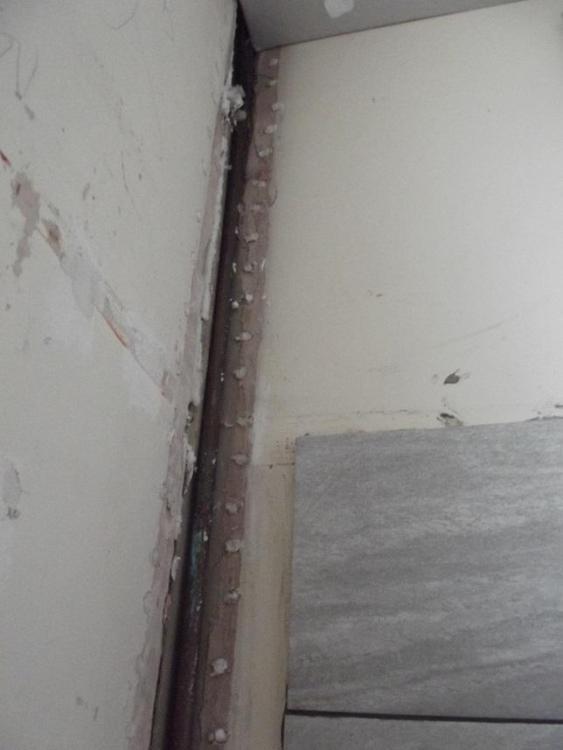
The silicone at skirting level will stop draughts from the plasterboard/block (mini-)'cavity' coming into, and cooling, the room, but it will not stop air-movement behind the boards cooling the board surface, unless full perimeter beads (and preferably cross-hatches) have been used. Where I *know* that boards have been on 'pure dabs' I have injected air-tight foam at approx 50mm centres. N.B, OP, this is *not* to try to get full foam fill behind the boards, it is to close off the perimeters.
-
Roof + chimney issues - advice appreciated!
Redbeard replied to andrewd8323's topic in Roofing, Tiling & Slating
So there are no soakers below the flashing on that chimney? I am not a roofer but surely you always have soakers on abutments? I do. I don't fully 'buy' the condensation reduction argument. Increasing insulation will not reduce condensation - it could increase it (because you are making the void even colder) unless something is done at the same time to effectively incorporate a VCL in the entire 1st floor ceiling(s). -
I am not an expert in the crushing strength of clay, but I think if you ram the disconnected part of the pipe full of concrete then it will do a very good impression of being part of a concrete foundation...
-
@iant63, are you most concerned about potentially blocking (and restricting future access to) the drain, or weakening the footing? If you want 100% peace of mind can you dig down, re-route the drain on that corner with swept bends to sit outside the line of the footing, and ram the old drain full of concrete? Of course I know nothing else of the job but that would seem to perhaps to sort things, even if leaving you with a slightly 'bendy' drain run.
-
Hessian wrap. Others may correct me but I am not aware of asbestos ever being 'implicated' in connection with this. It's not just anti-squeak - it is thermal insulation, and I sometimes use it as a wrap when I cannot get plastic sleeve on the pipe(s).
-
Ah! You added the otters and 'now that the roof is covered' after I'd read your first post, I think. Obviously if the tiles/slates are on you won't be taking up my suggestion. Am I right in thinking those are 150 (perhaps 200 at a stretch) rafters? What's the proposed lay-up in terms of ventilation gap on the cold side, and depth of insulation? I assume you will have insulation both between and under the rafters or (it would appear) you will have difficulty meeting the Part L U value target. (I think... probably) If the OP takes @Alan Ambrose's suggestion perhaps with collars and insulation above the collars, he could maybe solve both issues.
-
Does your architect have any site supervision responsibility? If so arguably he/she could instruct the builder to remedy and build as per the dwgs. Those rafters appear to bear on a timber plate on top of the steel, and are presumably tightly butted to the ridge board, so the archo could arguably instruct the contractor to cut out between each rafter pair. They will probably meet as tightly on the bits of ridge board as they would have done on each other. Can't see how they are fixed so far anyway. Plainly the suggestions made so far would be simpler. Just depends whether OP wants it built to the plans.
-
Not a problem if the alu foil is intended to work as a VCL. DPM was just an example of something stronger than 'ordinary' VCL
-
The insulation status of the rest may not help you, but 'practicalities' probably will. Different BCOs have different views, but the 'ideal'being entirely impracticable (or in some cases 'looking stupid' - although that's subjective) should get you some sort of acceptance and a waiver. Alternatively you may not even be asked how much insulation you are installing. I always insist on telling them - and usually showing, too, via a 'step-back' in the work, even if the rest is near-complete - even if they don't want me to! There are a few 'get-out clauses' with part L for refurb. One is that your proposals (for internal insulation of solid walls, for example) might cause moisture issues in a building originally built to allow the beneficial 2-way passage of water vapour, another involves pay-back time (but try to make that stick - it is hard to make it work), another relates to unacceptable loss of floor area. 'Practicability' and 'not looking stupid' are, unsurprisingly, not actually written that way in the Regs, but (if you actually get to see and talk to a BCO) you should be able to reach an agreement. You also asked: Q2: is the VCL necessary and can anyone recommend what type to go for? It is advisable. In reality your average apex void probably has a bog standard ceiling below it with no VCL, so water vapour can enter the void. Hopefully, though, there is a Howling Gale in the void, which blows away the moisture-laden air before it can condense out. I think in your case, you have the opportunity, so take it, and 'fit a VCL'. This could simply be the foil on the PIR, taped at all joints and perimeters. Or you could use a plastic sheet. When I do, I tend not to use the thin (often green) VCL, but heavy-grade DPM, as it's more difficult to make accidental holes in. Q3: should I use double sided butyl tape on the face of the 25mm PIR in line with the rafters to avoid any holes in the VCL? Well.... The optimist's view is that a hole (in a VCL) with a screw in it is not a hole at all. The pessimist's view is that it might still be a bit of one! Your idea is not unreasonable. I used to use 25 x 50 battens over (under!) the over-the-rafters layer. If I was feeling obsessive I would pre-drill the holes, gun in silicone mastic, then drive the screw through the silicone, so each screw gets its own air-tight and vapour-tight (??) grommet. Not fully proven, but pragmatic! Clean up the silicone carefully or your joint-filler will fall off!
-
Don't know which part of the UK you are in (assuming you are in UK), but the 75mm you propose would not comply with Building Regs. 125 or 150 is commonly required, depending on the 'timber fraction' (how much of the 'insulation' is actually rafter or joist). The Regs (Part L) refer to Thermal Elements and, when doing work from the inside, refer to the room you are in, not to the whole house, so when they say that if you 'treat' more than 50% of a thermal element you either have to comply with Part L or show why you cannot (and pay for a Building Notice, it is no good to say 'well, it's only one of 3 rooms, so it's not even 35%'. If you are insulating more than 50% of the roof in that room, you have 'triggered' Part L. My comments refer to England. I think Wales is probably the same or similar, and I understand Scotland is significantly different.
-
According to the text it's a '10-story building'. Can't wait to hear the other 9.
-
Recommendations for solar thermal suppliers
Redbeard replied to ChrisSig's topic in Solar Thermal (ST)
I understand 'through-flow' tubes are pretty rare now. We had a 'through-flow' array at S. Yorks Energy Centre and the vandals discovered that you can drain the system down via the 'alternative method' of smashing a tube!! I have not looked at Navitron for years but they used to be among the cheapest. I share your fondness for SWH - it's so crazily simple! - , but more and more find myself recommending PV/diverter. That would have been somewhere between counter-intuitive and madness in 2009, before the 'Feed-in' Tariff.