
Nickfromwales
-
Posts
30328 -
Joined
-
Last visited
-
Days Won
296
Everything posted by Nickfromwales
-
 +1
+1 -
50 year old timber frame building survey
Nickfromwales replied to Triassic's topic in General Structural Issues
Any decent carpenter/joiner should be able to assess this for you, and declare whether it can be saved or is too far gone? Specialist will prob look to make a meal out of it. -
Erm, so basically zero comparison lol Did you fit normal extractor fans though?
-
Ok, thanks. Have you heard of AeroBarrier UK? Probably ideal for you to get <1 ACH. This is a bit of a cop-out afaic..... <1 should be achievable if you know where to focus your attention during the early part of the construction phase. I've done builds down as far as 0.27 ACH, and with not a huge amount of additional time/money etc, just attention to detail and a bit of experience/tenacity. Most of my M&E projects have been new builds, ICF and TF, but there are a few on here who have gone down the traditional masonry route and done very well.
-
Has anyone mentioned mechanical ventilation or trickle vents to you, or the ideal which is installing MVHR, or do you already have this planned? You're building to (N)ZEB?
-
Criteria will be that the chamber and rodding point must be in a straight line of sight. If not, they can ask for you to have rodding access from either side (up and down stream) of it.
-
You can spray this with a closed cell foam, and it'll do a better job than trying the PITA and knuckle-scraping with membrane and tape. https://insulation-more.co.uk/products/soudal-soudafoam-maxtwo-polyurethane-spray-foam-insulation-kits-complete-sets
-
A diagram with some idea of layout etc would really help folk to comment further. Just pen and paper is fine.
-
Ok, thanks. One option is to remove the alarm box and have somebody blow bonded EPS beads into the cavity to finish it off. Gives better draught prevention, and will push down into any gaps in the existing insulation. Once done, alarm box goes back on to cover the hole required to inject.
-
Stud partitions sequence of build question.
Nickfromwales replied to Brian Ireland's topic in New House & Self Build Design
A is best IMHO. What is your plan for AT everywhere else? What is the house (brick and block?) as you may be better off going straight to AeroBarrier after you've done the membrane at the ceiling and you've foamed around windows etc. Next question would be about AT at the ground floor... -
thinner alternative to flowing liquid screed - views?
Nickfromwales replied to mikeysoft's topic in Underfloor Heating
Cemfloor (cementitious) screed is good, or a dry sand/cement if going thicker (65mm minimum for dry is advisable). Cemfloor is happy being laid as thin as 50mm, and is quick to go down; levels very well if you have a good installer, but doesn't just flow and level 'by itself'. -
Shower over bath next to window
Nickfromwales replied to JLAB's topic in Bathrooms, Ensuites & Wetrooms
Is that room really 1700mm wide? -
We've done solar reflective glazing for a few clients builds, works far better than I first thought it would. Part O compliance will be a big thing for this design, if you want to keep all the glazing for the views/personal preference etc, but it is a LOT of glass tbh. Defo look at installing an ASHP so you can get cooling via chilled water > UFH and air handling. Either that or you're likely to need air conditioning in the upstairs rooms to make them tolerable during the peak of summer. Heating a well insulated, airtight house is a doddle in comparison to keeping it cool
-
If you 'can' PM it, that is
-
Hi. What type of insulation is in there? Topping up the cavity is defo the best option, so you can keep the 'cold' as far outboard as is possible. What insulation is in the attic room (or that you hope is in there)?
-
You'll be able to set the Wedi boards down with flexible tile adhesive, as these need to be fixed in this scenario. There are cheaper equivalent boards available online btw. You can do the 10mm SLC (Mapei builders screed with fibres prob best here), and you're off to the races. For belt and braces I'd add a mesh (this type of thing LINK ) into the pour, and then your LVT. Also, consider adding an electric UFH mat whilst you're there, and maybe just for winter set that to the minimum cold temp you want the floor to be in the mornings, set to say 17-18oC and timed to turn on at 07:00 and off at 09:00; on and off with UFH controllers are actually times and temps, so you can choose comfort and economy temps for different times of the day.
-
Mvhr Airflow
Nickfromwales replied to Fadec's topic in Mechanical Ventilation with Heat Recovery (MVHR)
If hot air rises and accumulates at the head of the stairs, it’ll be less than fresh air there, plus it has been stated that the concern is it’ll be ‘hot’, so not air I’d choose to transfer to the en-suite with the bedroom being used as transfer. Areas do stagnate, as airflow in vaulted areas and thoroughfares aren’t usually addressed in MVHR designs, hence why for a next potential project with 2 storey gallery aspects I’ll be looking at push/pull in the high (and vaulted) aspects; this will be to shift the air and recover as much of the heat that has risen there as is practicable. There’s no reason to cascade here, when putting fresh air into habitable rooms is (afaic) such a far better solution, and the opportunity exists to do so. Retrofit or get-out-of-jail solutions shouldn’t be used if it’s a new project, and where a full MVHR system can be designed and installed to achieve the absolute best outcome. There’s no ‘could’ you need to do the undercuts if you want the system to function properly. The airflow is dictated by the rates set during commissioning, and they won’t be set up so the input to the bedrooms are equal to the extracts in the respective en-suites. The idea would be for airflow to make its way to / from spaces via the path of least resistance, so it can function as per design. -
Do I need a HP specific cylinder?
Nickfromwales replied to Beelbeebub's topic in Air Source Heat Pumps (ASHP)
You’d do this in the winter to prevent freezing when already doing space heating, but surely during the remaining months you’d use the HP at night to double or treble the saving, even at the 60/65°c you’d not freeze it up. -
Mvhr Airflow
Nickfromwales replied to Fadec's topic in Mechanical Ventilation with Heat Recovery (MVHR)
I’d never design for that amount of stale humid air being pulled through a bedroom into its respective en-suite. Bedrooms get a fresh air supply, and need to be able to have that air flow across the room, divisible here by some being extracted at the gallery at the top of the landing, and some by the en-suite. @Fadec, the 3x plenums in the dining is OTT, but if you are at peace with 3 crying warts then technically it’s the better solution as when on boost this will give the lowest level of audibility by far. Why not go for a linear plaster-in unit with all 3 ducts going to it? Me personally, I’m not a fan of how utilitarian these basic air valves look, in a domestic setting, but that may bother me more than it bothers you. Que sera. Utility and living, please just do 2 ducts > 1 plenum, and reduce the ceiling clutter; if only to help my ocd. -
Why 5 core? You usually have to run a separate 16mm2 or 10mm2 PVC earth along side this size of cable, or earth locally if too far/wrong supply type to export the earth connection. What’s it for/doing?
-
Multipipe Maxima FM 16-port manifold (..and 13, 14, & 15)
Nickfromwales replied to mikeysoft's topic in Underfloor Heating
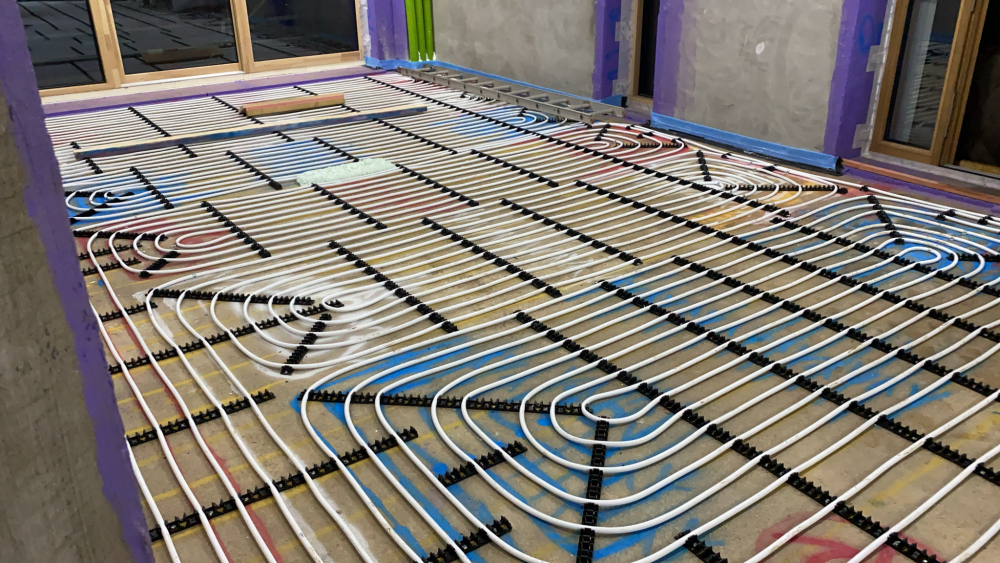
I’ve scanned back through, and can’t find any mention of this. Have I missed you conveying this elsewhere? If this is the case, then any other input is a waste of time, on floor build up etc, as you’re locked in to a solution you’re being told is weak/can be improved upon. Is it a case of us remembering that, or that you’ve neglected to share the info? Happy to be corrected btw, happens more than once or twice as I’m just a human being, but being told the horse has bolted is frustrating tbh. 👆 Previous comments have clearly stated to NOT decouple the heating from the slab, as the thin layer of insulation is pointless. Same here, where I gas nailed the UFH pipes to a constructional slab, and then 65mm of liquid screed got pumped over it. During the heating season this just sits there like a giant storage heater. Flow temp is about 3°C higher than target room temp. The only thing that’s left to manipulate here is the pipe centres, and how many manifolds service the total area. You mention 1st and 2nd floor heating is on the menu, perhaps we can stay ahead of that curve. My 2 cents would be to put the loops in at 100mm centres to get as much water volume into the GF screed as is possible, and then dial back zones / loops after you’ve commissioned, according to the heat needed for each space.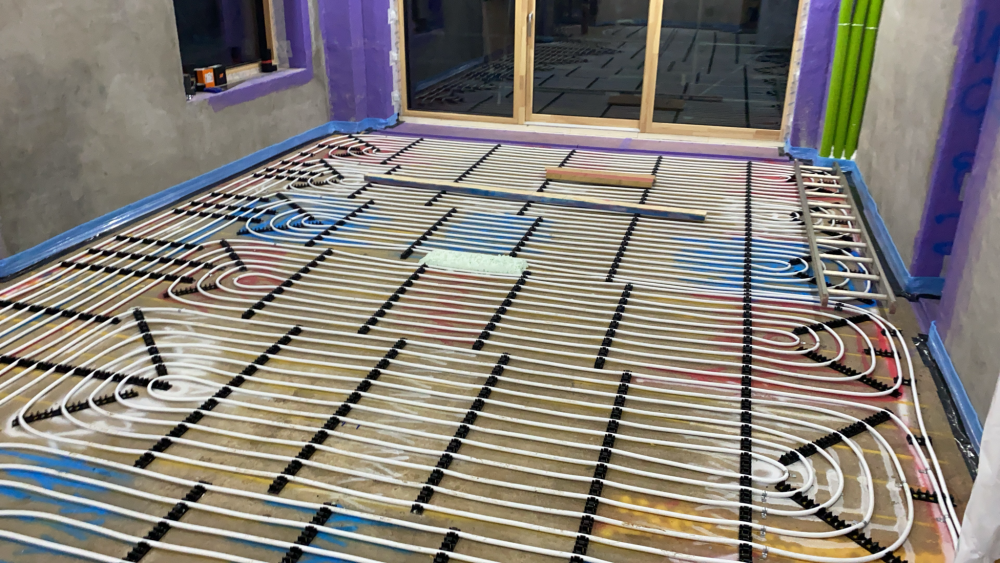
-
Most need at least 1-2 courses above, to meet the ridge. This is where wind driven rain will want to get in. I guess the deciding factor is the dimension of the flashing on the tray system of choice? Images I’ve seen where the solar is 100% the size of the roof, have been on-roof systems eg fitted over a weathertight and functioning rain screen.
-
Percussion piles indeed, not sure why I put screw piles in my text, I meant piled founds in general. We’re looking at an extension project for a client in Ruislip, and the geotechnical survey shows exactly the same as above, minimum 1.2-1.5m deep to pour founds, so one grounds company now re-quoting with piled founds; to save costs we’re looking to avoid the excavation and muck away. Have switched to looking at TimberFrame internal and brick external vs block & brick to reduce weight too. Just slow getting people to quote…..
-
Then you need to use the brain and the calculator. DO NOT piss money away making the outbuilding way more than it needs to be, and also (please) listen and learn here. The extension can be done the same way!!!!
-
FYI, my 6m x 3.6m garden shed/office/mancave is sitting on 100mm x 100mm posts sat on top of paving slabs. In a few years, the frame has moved about 6mm, and I have had to shave the bottom of the entrance door where it began to scuff the threshold. Other than that, rock solid. If I had gone for screw piles, it wouldn't have moved the 6mm, but I always knew this was a semi-temporary structure so didn't want to waste money.