
Nickfromwales
-
Posts
30347 -
Joined
-
Last visited
-
Days Won
297
Everything posted by Nickfromwales
-
I could always take them hostage, then you could sneak in and repair it in stealth mode. ?
-
Good girl ?
-
Should be a relatively easy fix though.
-
Yup. I wonder how long the chrome plated plastic will last ?
-
If the room is toasty at 5am then the flap is not shutting or the boost is not set to minimum. No, it would have wasted all the heat instead of storing it, and then left you with nothing to use during the day.
-
A pic of what you've got I meant
-
Get the screwfix one, I can't wait that long
-
Q1 Do you have two switches on the wall / skirting board ( next to the heater ) or one ?
-
100%. Fit a new mixer and start from there. I think all the problems will go with a working unit. Flow restriction on startup will be minimised then too, so should negate the holding down of the handset to get things flowing. Or change it to a tank-fed electric unit.
-
Erm.....by the auxiliary switch I kept mentioning? That'll bring it on on demand. Other than that it is already turned on, as the primary switch is turned on is it not? I think we're banging our heads against a brick wall without pics as if you're setup is not generic then we're pissing in the wind here Also it's a convector heater not a radiator.
-
If you went fishing for 4 hours and drank 1 cup of coffee an hour then you'd need 4 cups worth stored in the flask. If you need a lot of heat the following day you need to store the max amount of heat in the 7 hour window between 00:00 and 07:00 so you don't run out of stored heat. That's simple. "FOCUS!" Heat rises, so the the flap that were on about is not the flap on the controls. It's a full length metal flap at the underside of the heater that stops air getting in thus massively restricting convention heat flow ( hot air out ) eg keeping it stored in the heater until you actually want to let it out ( by opening the flap via the boost control ). Once you open the flap, cold air gets sucked in the bottom of the heater and gets heated by the bricks. That is where the hot air flow out of the top comes from. What comes out must be able to get in, so the wider your flaps open ( ? ) the more heat ( warm air flow ) you'll get out. The more you get out, the faster it'll run out of stored heat energy. Disclaimer : Thats the most number of times I've used the word flaps without my alter ego Finbarr Saunders making it onto the stage.
-
Change to E10 and then you'll be able to use offpeak rate between 1pm and 4pm to warm you again in the afternoon. Order of events, as is, on E7; cold heater from previous days use 00:00, Off peak kicks in and starts 'recharging' the heat bricks until 07:00 slight heat output as the heater heats, so the room should not be 'freezing', but that can be incrementally increased by setting the boost to 2 instead of 1 ( minimum ) you accept the fact that storage heaters are utter shite and wear a jumper all day at 17:00-18:00 you select 3 or 4 on boost dial and release more heat into the room for the evening until the aforementioned box of shite runs out of stored heat you freeze at night waiting for ABOS to reheat enough to start giving off incidental heat again from ~01:00 Or you use peak electricity to boost in the daytime. There should be an auxiliary switch at the side of the heater which is connected to the peak rate meter. When that's switche on you can get electricity ( heat ) whenever you want it, but use it at your peril as it'll cost ya! Oh, and forgetting to switch it off will be equally painful when you get your electricity bill. Or..... you get E10 and enjoy the 1pm to 4pm on cheap rate e.g. No need to boost with the auxiliary switch and no use of peak juice. Poost a pic of your heater thing at yours as I've no clue what it is or how it works without something to go on
-
Did you think this thread would be either a) simple or b) straightforward ? "sucker!"
-
Can't you just feel which pipe gets hot ?
-
Moving the mixer down is pointless. You can move it downstairs and there's will be zero difference. It's already been said, it's the height of the outlet that dictates flow. Pic seems to be pipe for pipe to me unless I'm missing something And go buy on of these for £50. ?
-

First self build - a southerner in Lancashire
Nickfromwales replied to Nelliekins's topic in Introduce Yourself
A problem shared Welcome, and please do a blog. We can start with a picture of your giant brass balls maybe? ( you self building, basement digging lunatic ) Youll fit in nicely. Grab a chair. -
If it's a gas boiler then you could manage with a single ( Sunamp ) 12 with ease. I'd say a 9 would probably cut it, but that would be borderline for your house at 212L uvc equivalent capacity. A 12 will walk it, as long as the gas boiler isn't allowed to service DHW according to demand. How about putting the manifold(s) in the airing cupboard and just having the SA in the garage? Less pipe work, less losses and any waste heat off the manifold / connective pipework will keep your trollies warm. Typically you'd only go for a manifold arrangement throughout, and not leave a room out. The idea is not to have any series plumbed outlets thus negating starting off with big dead legs. A HRC with a series plumbed house is quite indiscriminate so you won't be able to discount any outlets like you can with radial + manifold. Get back to the drawing board and see which setup will have the biggest benefit me thinks
-
Sounds like a negative.
-
Not all about the size of the house chief, it's about how much water you're going to use . Remind me of how you intend to heat the water please? I'm a veritable feast of random crap like that ? Just make them up as required. Simples. Run that by me again ? Turkey-induced coma at the mo. When you say room, do you mean to all the outlets in the one room? Yup. I believe my next couple of victims are going down the same route. Please don't kick yourself over this........allow me, as the wife says I need to start exercising more. Win, win.
-
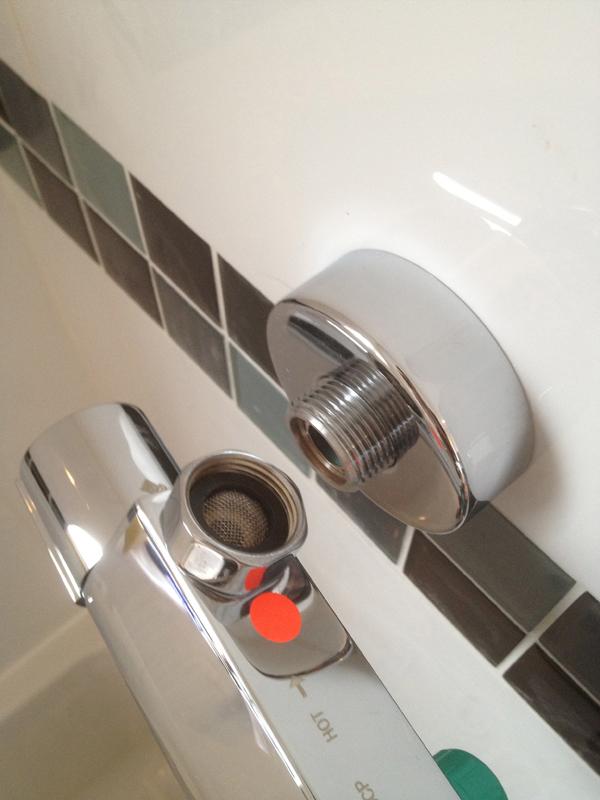
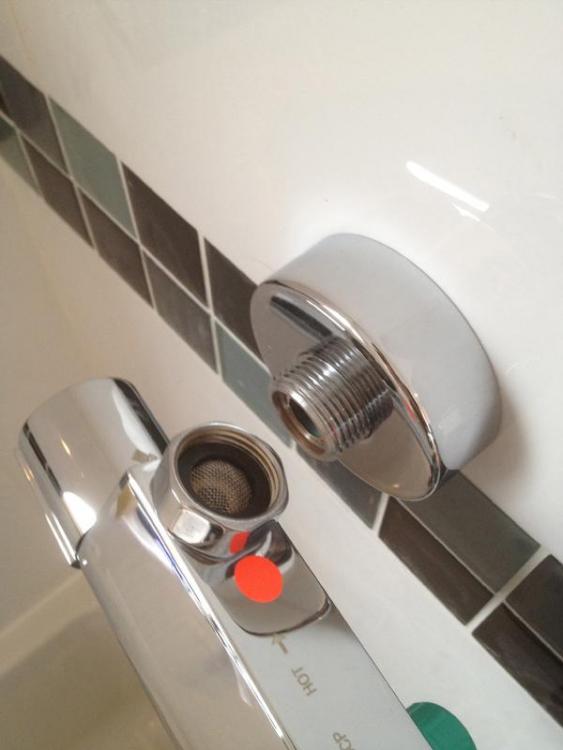
Can you get mole grips / other on the rear whilst you undo the front nut?
-
-
Yup. Nope. It's normally denoted by a little red dot ( removable sticker ) on the rear of the valve body. Back to the xmas ale you go ?
-
Change of £2.3k for the 12. Change of £2k for the 9, and ~£1000 saved every 10years vs owning ( and having to service / inspect ) an UVC. Couple that with no requirement for pressure reduction / relief controls / valves etc and the benefits soon outweigh the uplift in capital cost. Much simpler ( cheaper ) installation too, just cold in and hot out. I have just completed one, and am in the middle of another, spacious 3 bedroom property, ( for plumbing etc ), and both feature a HRC ( hot return circuit ). For the first one there are 10mm pipes to all the basins ( qty 3 ), and they have all been left without HRC, however the HRC has been awarded to the kitchen sink as its at the opposite end of the building to the plant room. The way that one is set up is so that the kitchen sink is the last outlet of the DHW manifold, thus heating the primary DHW 22mm pipework / manifolds etc and killing the dead leg of water off between the water heater and the manifold. As that is all larger bore, it creates a problem without a HRC as it increases the amount of dead ( cold ) water that needs to be drawn off by a sink / basin before getting premium temp DHW out of that particular outlet. As the kitchen sink HRC operates with occupancy, the manifold is always preheated therefore massively reducing the wait for DHW to the basins ( hence now not needing HRC loops to them ). The wait for premium temp water at the kitchen sink is sub 2 seconds, and the wait to any other sink / basin is sub 5 seconds. This house is often unoccupied so works well ( efficiency ) for 'stop / start' living. A side effect of heating the manifold is that all other non HRC outlets benefit from a much improved Dhw 'arrival' time. On my current project, I have gone a bit more complex as the house will be used almost immediately for a 'retired lifestyle'. First, some basics; With any HRC arrangement you need to bring all of the HRC return runs back to the point of origin and terminate them in an additional manifold. The reason is, that to be able isolate an individual hot feed to a particular outlet you'll need to do so simultaneously at both the DHW manifold AND also at the HRC 'return' manifold, in order to stop back-flow from the other HRC linked outlets. Because of this, I would recommend a single centralised manifold system and only distributing from there @Rich, if you do the manifolds as you've suggested you'll acually be worse off not better off as you'll have taken larger bore 22mm pipework all the way through the building and will have increased the amount of dead leg water volume significantly throughout. Running a basin from the upper floor manifold would be painful in terms of wasted water and time lapsed trying to get hot water there to wash your hands after a pee. Don't do the upper manifold. . For you, I'd recommend the single manifold and HRC with the UVC in the garage ( as we both know that's where it's going to end up ). Losses from an HRC are really pennies in the grand scheme so don't be put off by eco-warriors telling you the running cost will be high, it won't. Simply manage it with a timeclock so it's sleeps whilst you do, and it shuts off when you leave for the day. Insulate the hot and HRC grouped runs accordingly. See my next for a neat solution. Now, to clarify on HRC awarded outlets, you do not want to include any baths, showers, or other infrequent / high volume drawn outlets. If you run a shower then the longest you'll have to wait for premium temp DHW will be around 10 seconds or less, same or less with a bath. Reason for discounting those is that they're infrequent use / high flow rate outlets, and waiting a short while to get them up to temp is of little or zero consequence given how long you use them and the ratio of dead / lost water compared to the total amount drawn. A HRC is a great thing to have too IMO, when implemented correctly, as not having to wait for hot water eg to wash your hands quickly after using the loo / wanting to quickly swill something in the sink is something you'll soon get fond of. FYI my combi is about 2.5 and 4m away from both my basins ( all ground floor rear ) and less than 2m from my kitchen sink but I still get annoyed waiting for the 4-5 seconds to wash my hands after using the loo. Ok. On the current one we've gone for a full on, both barrels smoking HRC setup for instant DHW output ( at each HRC awarded outlet ) and I came up with a good idea ( IMO anyway, tin hat at the ready ) for managing the HRC to minimise these 'end of days' losses ?. As most folk will be installing an burglar alarm ( most, so no need to shout at me if you don't have one ? ) I decided to contact the alarm installer and ask for him to supply a couple of relay boards so I could activate the HRC from the alarm panel status; So :- alarm off = occupied = full HRC operation alarm full on = unoccupied = HRC off drumroll please........... alarm part-armed = no ground floor activity at night = HRC set to part coverage. In the part-armed state the ground floor HRC circuits ( kitchen sink / utility sink / cloakroom WC basin ) are shut off by some ball valves, and only the 1st floor master and ensuite basins have circulation to them. That's going to be achieved by separating the HRC return manifolds into 2 'groups' so they can be; "all off", "on group 1", or "all on", respective to the state the alarm panel dictates. Couldn't be easier. This dwelling has a reasonably sized multi directional Pv array with Sunamp ( x3 ) heat battery storage, so in actual fact running the HRC will likely never actually see a running cost. Battery storage ( AC ) is set to feature too, so not even running the HRC pump should have an impact. Re insulation of the pipes, simply do as I'm currently doing and run both the 10mm HRC and a the 15mm DHW pipe together and insulate them both with one piece of thick walled 22mm insulation. They fit perfectly. Terminate each dual run at the outlet with the 15mm terminating into a 15mm x 10mm 'centre' tee, the 10mm terminating in a street elbow, and the 10mm then fits in to the side ( centre ) of the vertically rising tee and you get the 15mm top of the tee left for the final outlet connection. @Rich, are you having Pv ?
-
Isn’t the majority of this problem solved by creating a ‘drip’ directly onto the underside of the door / window frame ? Eg if rain can’t get in high enough it will be inconsequential therefore negating a lot of extra detailing where the frame and EPS / frame and slab meet. For @vivienz I suggested bonding a ( RAL grey matching ) upvc ‘bib’ directly to the underside of the thresholds as a rain deflector. A mix of short and tall detail exists between the upper and lower floors, so simply buying 30mm and 100mm size D-section will suffice. A lot of people think that ‘pumping a load of sealant in’ is a good idea, but it can make things a LOT worse if misplaced. Can you post some pics?
-
One step closer to funding my plans for worlds domination. ‘Watch your backs, my future minions”.