

Nickfromwales
-
Posts
31390 -
Joined
-
Last visited
-
Days Won
346
Everything posted by Nickfromwales
-
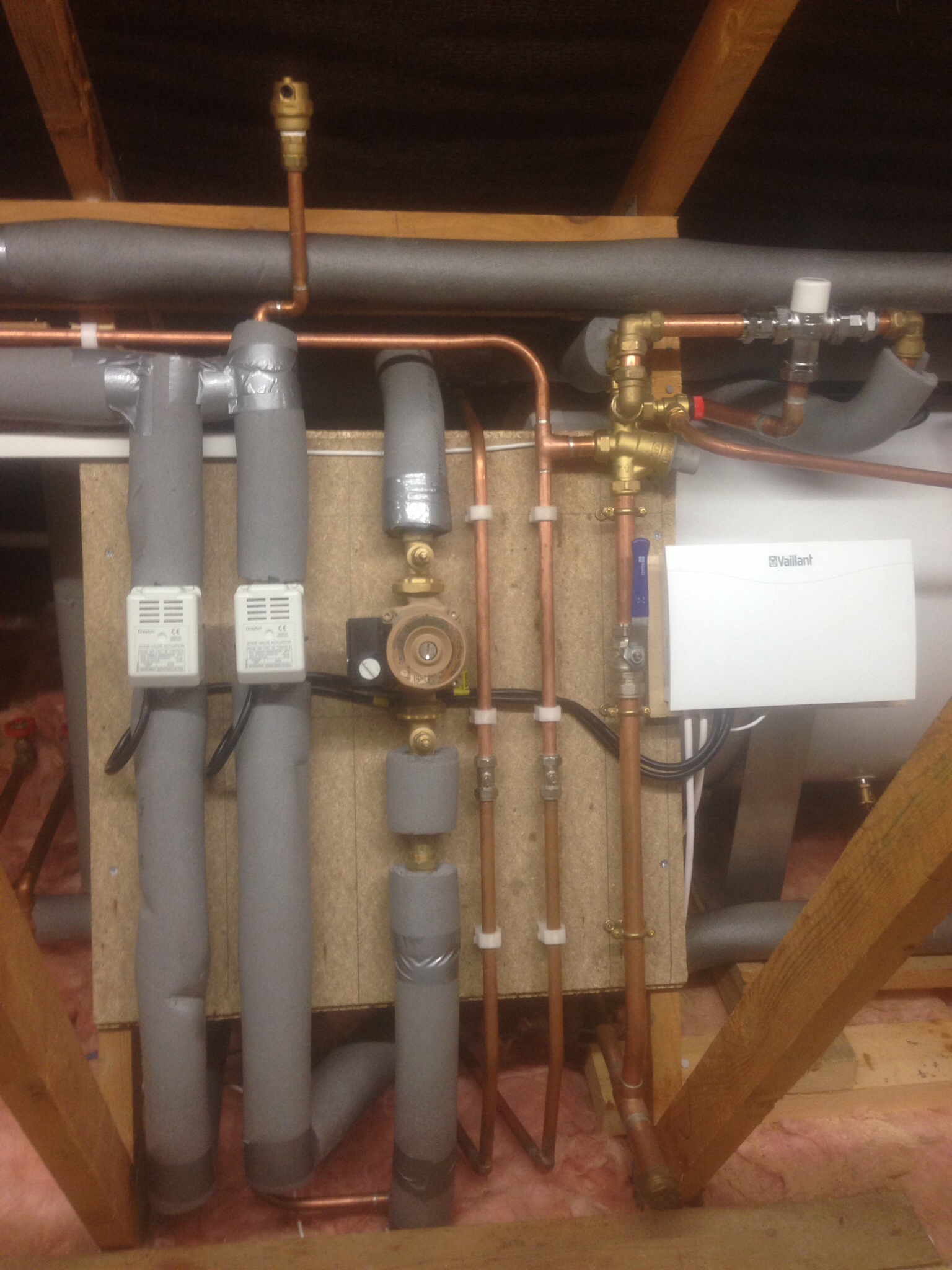
 Yup. Quite easy to implement. A 50L energy buffer in-line with flow might be advantageous, dependant on the minimum loads that the house may call for vs the manufacturers installation guide.
 -
Pretty healthy rate ?
-
Underfloor heating manifold how it works?
Nickfromwales replied to Martysmarty's topic in Underfloor Heating
Do you plan to routinely run the single UFH loop off the boiler, independently? -
Simple. You just add another small manifold, run individual hot returns ( HRC ) pipes back for each outlet, and connect the hot return pump to the manifold. I do this on nearly every job. Series plumbing will see a lot of waste of potential and much larger bore primary pipework, plus you would then have to have the HRC on all the time ( in lie with occupancy / demand ) or serving all of the house. With radial hot and HRC you can pick and choose as to where to implement HRC. I run a 15mm hot and a 10mm HRC together in one piece of 25mm wall pipe insulation to minimise losses. Virtually nothing escapes from those runs in terms of heat loss. You just split those immediately as they arrive at the plant room and then insulate them separately to the manifold. Box clever and take the HRC outlets from the end of the hot manifold and then the entire manifold gets 'pre-heated' thus reducing wait times on the non HRC outlets.
-
I regularly run 15mm hep2o across new builds, many runs often in excess of 15-20m, and showers work perfectly well, very well in fact. That's running to large rainfall heads etc so I wouldn't panic about running 15mm Hepworth to baths and showers. I've many many live installs under my belt and all customers super happy with the flow rates. I always run all the hot and cold supply in a radial arrangement from large bore primary feeds, 22mm or even 28mm at the hot and cold manifolds depending on system spec etc, so the results from series plumbing would be worse if you were considering that?
-
Yup. 100% spot on solution, and the only sensible one for this situation. You could fit a large split ASHP ( high temp ) here, and then get up around 80oC, but it would be bulky and very noisy. Heating would simply be toggled in / out between the TS or the ASHP by a diverter valve which changes state with the temp of the store. Pretty easy to achieve.
-
Anyone know a good large format tile cutting company?
Nickfromwales replied to hendriQ's topic in Wall Tiles & Tiling
I’m trying to work out what exactly are the required number of cuts? -
Viessmann Vitodens 200-w - initial impressions
Nickfromwales replied to larry's topic in Boilers & Hot Water Tanks
I had exactly the same issue(s) with a Worcester Bosch boiler serviced via a British Gas ‘insurance plan’. BG came out, 5 engineers over 4 visits, fault not cured, and basically rebuilt the boiler in situ from bottom to top. Left the box of spares in the utility room as a trophy, to demonstrate how they’d done “everything possible” and they then left with the client having no heating or DHW. Told him he needed a new boiler and said they’d post a quote. I went there, and 45 mins later I had the boiler working perfectly. Client was sooooo pissed off he rang the area manager ( the 5th chap you accompanied the final service engineer ) and gave the phone to me. The guy asked me what I did to fix it and I told him to keep guessing. So fed up of visiting customers ( pensioners mainly ) who have been a victim of this tactic from BG. I had to threaten them as a company to come and rectify a list of faults, one which was lethal, and gave them an hour to respond before I called the GSR to report them. After a load of condescending threatening waffle, 40 mins or so later 2 BG vans materialised. They told these pensioners that they needed new controls and the £5k glow worm boiler ( £600 in my plumbers merchant btw ) they just fitted ( in a day ) had to be left off indefinitely. I was contacted by the electrical firm that BG eventually appointed to try and fix it, 3 days after leaving an immediately unsafe installation and an 82 & 83 year old without heating or hot water, and I couldn’t believe how bad a job they’d done. All they had to do was wire a modern system boiler to a standard S plan system. Ffs. All these “heating engineers” these days are just plug n play laptop jockeys who cannot think outside the box. Get them back into proper apprenticeships!!!! -
Viessmann Vitodens 200-w - initial impressions
Nickfromwales replied to larry's topic in Boilers & Hot Water Tanks
That means the diverter valve is not parking in the fully closed position. Most diverters park in the heating position, and then move to DHW position swapping duties 100%. The diverters park in the heating position to do pump overrun, the heat dump cycle after each burner ignition event. Yours is not getting 100% of the way closed aka diverted, therefore you have the heat leak to the rads. I have to be honest, you need to remove this and get a full refund. Go grab yourself a Vaillant and get on with your life. Intergas and Veissmann do some strange choppy-changy is it a system boiler or is it now a combi nonsense and I’m not a fan at all. You’ve done the polite customer to the extreme, now you just need to contact them in their UK offices and ask for the unit to be removed and draw a line under it. Can you imagine sorting this and then going to the same bunch of clueless halfwits for the next problem ?!? Time to call it a day I think, before winter when you really need it to work reliably. -
A lot of UFH gets installed badly, so the comments from your plumbers don’t reflect well on them I’m afraid They should have told you what you need to do to have a successful UFH installation, not just spout negatives! Have you bought the combi yet? If not, buy a system boiler instead and run a thermal store ( 180-210L ) and get bags of hot water from that, way more than from a combi too. The TS will also provide a pair(s) of tappings for the lower grade heat you need to feed the UFH with. The mention of a store is because of the oil boiler, because oil burners cannot modulate ( go to a small flame for low output like a gas boiler can ) so you get 0-100-0% “all or nothing” output which needs to be captured over a long ( economical ) burn, and then drawn down via the store. The downside of the TS is it needs to be hot pretty much 24/7 to provide hot water on demand, but the difference in hot water supply will be huge vs a combi. Bottom line is, you’ll need a buffer tank or TS, particularly with retrofit UFH. Draught proofing the house, 3G doors and windows, and insulating as well as you can will reduce the amount of heat you need for the house to stay at 21oC, so UFH can and will work we’ll if you don’t fail to prepare. Get new plumbers too. ?
-
Chipping away at that clay pipe will likely just see it disintegrate, so you’ll probably need to dig it out, cut it clean with a grinder, and reconnect with a rubber clay > PVC union. You then take new PVC pipe into the chamber and connect with an offset 15 or 30 degree bend going into a long radius bend if you have room for it.
-
Viessmann Vitodens 200-w - initial impressions
Nickfromwales replied to larry's topic in Boilers & Hot Water Tanks
?. Bypass normally only allows the pump to recirculate back to itself via the return, so the pump needs to be going before the bypass could ever be an issue. The pump should not be running if there’s no call for heat, so I am dubious about that being a solution tbh. Stunk of diverted valve issues, but you say that’s been replaced? Most combi boilets go into pump overrun after DHW has been drawn, to get rid of the nuisance heat, the high temp heat left in the primary heat exchanger, and that goes to the heating circuit but without a flame. Eg the boiler sucks cool or cold water from the central heating into the HEx to cool itself down for between 1 and 2 mins typically. Then the pump should shut off. Ok; PS. Wow! You are the most patient person I’ve ever heard of. By now it would have been off the wall and dropped off at the point of purchase with “return to sender” written on it in permanent marker. -
ICF - Nudura vs ???
Nickfromwales replied to Mulberry View's topic in General Self Build & DIY Discussion
As ever, we digress. ? On a recent Velox ICF build I recommended a full internal cementitious parge coat, to turn PP the reveals, and to then tape between the PP and the window / door frames. -
ICF - Nudura vs ???
Nickfromwales replied to Mulberry View's topic in General Self Build & DIY Discussion
That depends upon what you’re sticking the membrane to and where that next stops. The MBC ph PIR + rockwool system does exactly that, but the entire dwelling interior is an airtight membrane so kind of cheats out the question of windows / door junctions. Traditional membranes need mechanical fixing, liquid membranes ( like the green paint on AT OSB ) need a substantial substrate to be applied to. All changes with whichever differing construction method is used tbh. -
ICF - Nudura vs ???
Nickfromwales replied to Mulberry View's topic in General Self Build & DIY Discussion
Incorrect. Smart ply on a TF gives you window > AT junction. Just needs tape to finish. -
ICF - Nudura vs ???
Nickfromwales replied to Mulberry View's topic in General Self Build & DIY Discussion
It is with Velox I’m afraid, as the window and door reveals are bridges to outside atmosphere so need a fair amount of detailing to mitigate, also. To be clear, airtightness is paramount with ph levels of build fabrics, and some systems offer ‘reasonably good’ AT standards without adding to the mix. 0.26, 0.27 and 0.28 on builds over recently been involved in are exceptional scores, but beating ( halving ) the shitty standards set out by IK BRegs is still easily achievable with these off the shelf ICF systems. Knowledge is important, as some minor tweaks and a few quid spent strategically can see you get much better results, if that’s what you wish to attain. -
Depends on whether we have one leaky gas joint or a few........ Neighbour called me to say they couldn't light the gas fire any more. I went into the alleyway dividing the two terraced houses and removed the soot plate to find that rainwater had been dripping onto the copper sleeve of the 8mm gas pipe for years, and it had eventually got through the sleeve and had made a hole in the 8mm pipe, worsening year by year. When I got to it, the gas was following the convection airflow from the living room, up the chimney to atmosphere at a rate of knots. As they were pensioners on a fixed costs tariff, they never got alerted to the huge amount of gas leaving the pipe and whooshing up the chimney for what must have been years!! Christ only knows how they never smelt the gas when the wind changed direction, but the house was at a constant 25oC, as they were freezers, and the convection out of the living room up the chimney was like a hurricane.
-
Agreed. It can be mummified in dense rockwool and the losses nigh-on lost. Or a PIR box etc.
-
Not me guv'. Remember I am a fan of boilers in attics, where space is constrained, and I've put many an UVC in an attic, again for the same reasons. If I was asked ""is that the best place?", I would have always replied "nope" followed by "it is what it is".... If there is somewhere within the heated envelope for this stuff, then that is where it always goes.
-
As the attic cools down the delta will rise and the losses will increase. 50L can suffice if the system is not too small. Remember that the buffer can be installed as an energy buffer rather than an intermediate heat bank, so basically it becomes an energy balloon, inflated an deflated in line with downstream heat demand fluctuations. When the call for heat goes off, the buffer no longer gets serviced ( heated ). Use of single check ( swing check ) non return aka anti-gravity valves will ( can ) reduce heat convection away from the buffer during the 'cool' cycles of any heating cycle.
-
Plus all the interconnecting pipework / connections etc. Any waste into a cold attic is bonkers. No constructive maths will change that.
-
As always, it's down to the OP to give advice on mileage / frequency etc. I'm pre-programmed for the larger mileage I suppose, as I do over 40k a year between the car and the van
-
Eh? Octopus Go! gives 5p/kWh between 00:30 and 04:30 so I can definitely see why you'd want to charge both cars at the same time on rapid charge thus maxing out one whole phase pretty much. That's great for general charging if you don't have PV, or for giving the home priority if you do, but don't have a 'huge' array. Cars are a good place to store excess PV but it's far too much to expect PV to charge 2 vehicles fully all week long for on-demand driving.
-
The most important and most difficult to detail area is at the lower outer edge of the roof where it forms the eave / soffit. On garage conversions where we typically have to retro insulate, just as you need to there, I found it SO much easier to get a sheet of 200mm rigid PIR ( kingspan / cellotex etc ) and make ~600mm x400mm blocks which I then cut in half diagonally ( to form wedges which match the pitch of the roof ) and to push fit them into those awkward spaces and foam for rigidity to keep the minimum 25mm air gap. Remember to cut them short, eg lose the thin tapered bit of the wedge by cutting it off, so they only project as far as the ventilated cavity. That ensures good airflow is still free flowing up the cavity and into the space above the soffit and up to the ventilated ( cold ) roof space. Worked a treat and completely mitigated against the risks of rock wool touching the roof / felt and causing condensation / bridging damp etc. A pig of an area to detail with wool. I then fit 2-300mm of rock wool up tight to the PIR where it has a nice uniform edge to abut with. running horizontally across the ceiling to meet the same detail the other side. The PIR on the walls can be taped to the PIR at the eave junction also then, giving a very robust joint detail where the wall meets the ceiling
-
That can cause huge problems with balancing a larger system. All of the pump potential looks to escape through the towel rads before servicing the furthest away / most difficult to ‘get to’ rads. It would also slow down the rate of recovery ( how long it takes to reheat a tank full of hot water ) significantly. I would not recommend doing that at all if it’s a larger system / family home.
