
Nickfromwales
-
Posts
30353 -
Joined
-
Last visited
-
Days Won
297
Everything posted by Nickfromwales
-

UFH 8 zone Heatmiser System Under Floorboards
Nickfromwales replied to AshleyH's topic in Underfloor Heating
You need to know if the ones you have operate at the same voltage as the Salus. Wunda tech support are pretty helpful. If you have the MI’s for the system you have them it’ll tell you there if the actuators are low voltage or 230v. The Salus are 230v IIRC. -
UFH 8 zone Heatmiser System Under Floorboards
Nickfromwales replied to AshleyH's topic in Underfloor Heating
If you get no luck with balancing what you have, you could change to Salus auto-balancing actuators. Link These recognise when warm water returns to the manifold, from each loop, and arrests the flow allowing the others to get more pump potential. So if you have a small loop immediately adjacent to the manifold, that will act like an unwanted bypass ( until the stat in that rooms sees the uplift and signals that’s been satisfied / closes the actuator ), but that’s already going to be too long a wait for the problematic zones to improve significantly. Balancing is great if all zones are open simultaneously. If not that goes out the window as the flow dynamics will change with the differing combination of zones open at any one particular time. Salus = fit and forget. -
Why would you want a concrete core to absorb heat from the house, and then have to try to stop it then conveying that to atmosphere by piling more insulation externally? Keep the heated element in the house and wrap it with insulation Adding the concrete core is a downside IMO which creates a path for the heat to be exchanged. You can mitigate with said extra insulation, but even though the U value is good on paper the decrement delay differs from blown cellulose, which is where my money would be. TF feels as solid as most traditional builds, plus you don’t need to large coat before installing the floors to get you airtight. Lots of gotchas with ICF. As for the opinion on Dirisol, I just speak as I find. Velox and Isotex both have bigger blocks and very excellent uniformity, so less junctions to deal with and less making good before internal finishes get applied. TF still remains the easiest for getting very close to airtight. A couple have seen 0.25 and 0.26 ACH which is exceptionally good.
-
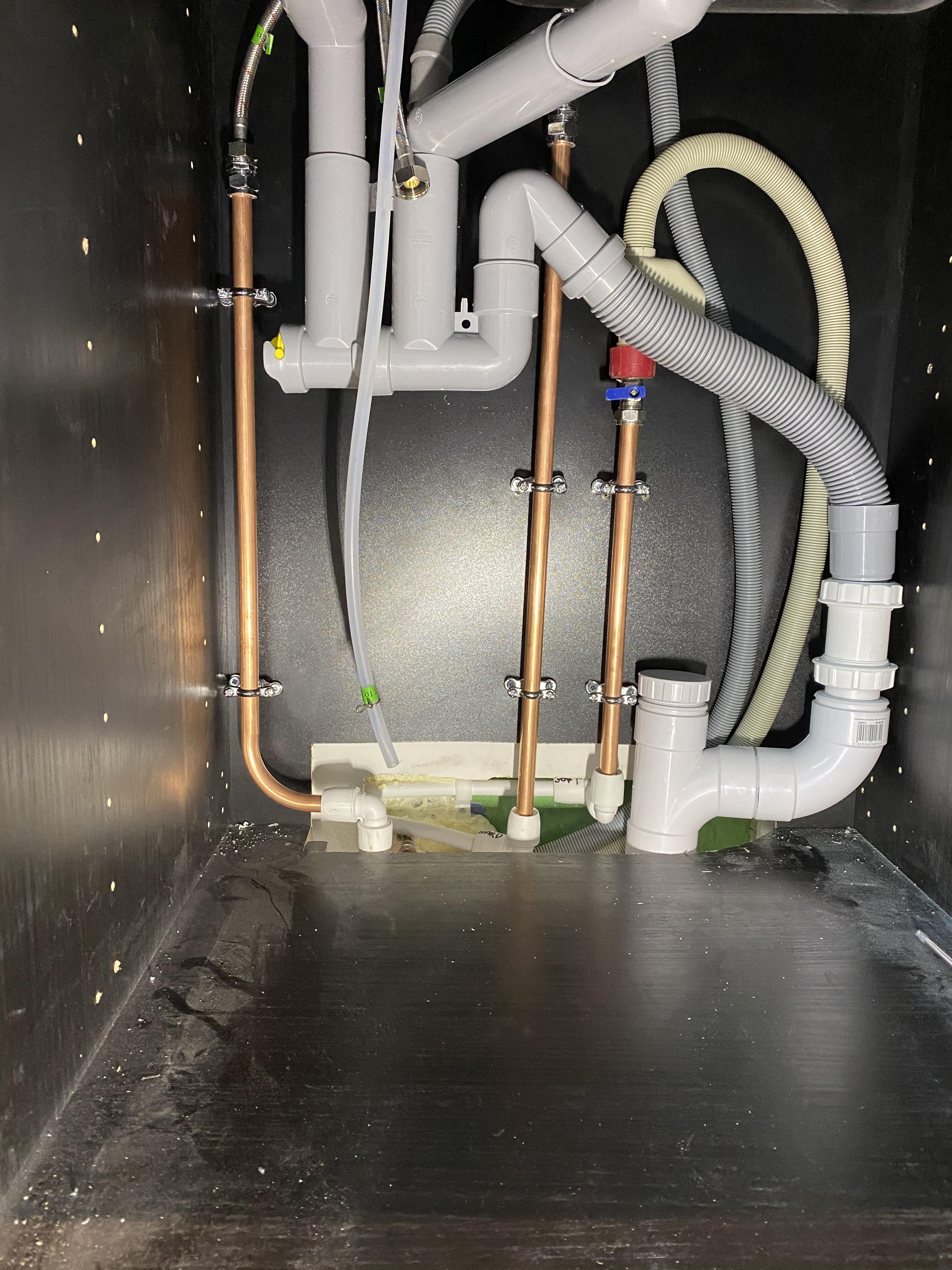
If doing wastes from scratch and not using g the supplied generic stuff I always put a washing machine upstand for the appliances so you don’t get the factory / obligatory gurgle which comes with putting the appliance on the inbuilt appliance waste connector ( as that is before the trap so the noise comes up though the waste / plug hole ? and into the room ).
-
This is what I do. 50mm waste rising vertically from 110mm fW directly underneath, with 110x50mm bung. 50mm T with an access cap on the top to rod the lot, and then the side of the T picks up the duties. If the FW run isn’t direct to an external inspection chamber or is T’d into by another 110mm, eg underground, then the second ( internal ) means of rodding access will be a B-Regs requirement
-
Meaning of "dry fit" - taps included?
Nickfromwales replied to lek28's topic in Kitchen Units & Worktops
I always asked the kitchen fitters to NOT fit ANYTHING plumbing related, and only to drill holes to get appliance hoses into the sink unit, and to put them up as high as practicable. One carpenter drilled holes for the electrical sockets at the very bottom of the unit ?. I asked him which way water drips if there’s a a leak, he remained silent. Great carpenter & kitchen fitter, shit at everything else. Fitted ballofix isolation valves behind the false backs and drilled ( very neat ) holes to put the screwdriver through to operate them. ?. -
Manifold system versus hot return system
Nickfromwales replied to Russell griffiths's topic in General Plumbing
I now do the basins and kitchen / utility sinks in 10mm, routinely, but will do 15mm if they’re close enough to the hot water device not to need an HRC. That helps the flow rate so gets the slug of dead cold water out a little quicker when ‘unassisted’. As always, no 2 instances are exactly the same so you need to review and execute to suit your own dwelling. 10mm copper ( plastic coated ) is what I’m using, so you don’t have the issues of the copper contacting other dissimilar metals ( pozi webs etc ) and also you then get the fullest bore pipe internal available. -
Manifold system versus hot return system
Nickfromwales replied to Russell griffiths's topic in General Plumbing
Just to clarify; The HRC is added to the manifold system, it doesn’t ‘replace’ it. I still would steer well clear of series plumbing with T-offs for each room and go with radial ( off manifolds ) for the best results. FYI, you simply add a 3rd manifold which accepts the hot return pipe runs. That is required for when you need to isolate a hot supply to a particular outlet, as if you didn’t have that then the outlet would get back-fed from the other hot return outlet connections ( as they would still connected via the common HRC connection at / before the HRC pump so at full hot pressure ). Remember that if you go away from manifolds then you have to increase the size of the hot water pipe work, significantly, at the start of the DHW pipe run to cope with multiple outlets drawling from the same common connection. Thread title says VS but it should read “hot return or not?” -
Manifold system versus hot return system
Nickfromwales replied to Russell griffiths's topic in General Plumbing
https://www.bes.co.uk/1in-bsp-female-outlet-brass-essex-cylinder-flange-12266/ -
Manifold system versus hot return system
Nickfromwales replied to Russell griffiths's topic in General Plumbing
You should get the retro-fit side entry flange and cut it in about 2/3 of the way up the tank tbh. Teeing into the good feed will work just means the system will work a little harder to keep more water at a higher temp. -
Blade cutting depth for track/plunge/circular saws?
Nickfromwales replied to MJNewton's topic in Tools & Equipment
The 24T cut great for the first few cuts, but agreed, they should not be used for chafing out the screed to get power to your island ?. Been there, done that ( with others using my tools that is!?! ). -
Blade cutting depth for track/plunge/circular saws?
Nickfromwales replied to MJNewton's topic in Tools & Equipment
My 36v Makita has a factory depth stop up by the trigger set so that when engaged it allows a 2mm cut into the face material. You then slide back, disengage the stop, and complete the cut. DEFFO do NOT have the saw blade finishing on or just below the underside of the cut material. You need to have at least 10mm clearance to allow the teeth to cut upwards rather than cut forward, as the latter tears through and the former cuts clean through. The blade being 40t minimum and new is beyond critical criteria for a good finish. -
Manifold system versus hot return system
Nickfromwales replied to Russell griffiths's topic in General Plumbing
Return can be a 15mm or a 10mm pipe. 10mm is my weapon of choice. Less cross-sectional area = less losses. Yes. Cold water ( ambient of the house temp by that stage so not fully ‘cold’ ) returns to the tank. It’s a continuous, recirculating loop. If you T it into an open vented system and come in at the cold inlet you’ll increase turbulence and the stored hot water capacity a bit as the bottom ‘cool’ section would be uplifted by the ( eventual ) return of hot water. -
Welcome aboard !
-
Manifold system versus hot return system
Nickfromwales replied to Russell griffiths's topic in General Plumbing
Agree, and I’m trying to promote that too. Just costs get a bit scary for the decent ( eg Quooker ) full combi units. Uplift to go the full hog with the kitchen sink tap would cover the majority of the cost of the HRC components for a full house, so only really a consideration in a dwelling where the other remaining outlets aren’t problematic ( otherwise you may as well invest in the extra lolly on the HRC instead ( IMHO )). -
All depends on what boxes you need ticked. I’ve not liked what I’ve seen of Durisol up to now, but quite impressed with both Velox and Isotex. When the time comes, it’ll be a warm cell blown TF for me without a second thought. Good thing with Isotex is the UK company offers turnkey packages including foundations, so much easier to get a frame up ( for eg for novice self builders ).
-
Manifold system versus hot return system
Nickfromwales replied to Russell griffiths's topic in General Plumbing
And for the Uber conscious; https://www.grundfos.com/products/find-product/comfort.html As little as 5-7W power needed. -
Manifold system versus hot return system
Nickfromwales replied to Russell griffiths's topic in General Plumbing
Makes me chuckle to myself when folk build high 6-figure+ luxury homes and worry about running a 60W pump. ? On a current project I’ve agreed with the client that we will go for hidden micro PIR’s under each of the floating / wall hung vanity units in each of the upstairs ( master and en-suite ) bathrooms, as the means of triggering the hot return pump. That HRC pump will be servicing those 2 basin taps only as the other high frequency / low volume outlets are close enough to the hot water device to not be deemed problematic, and running HRC’s to showers and baths is just pointless. All hot and hot return pipe work has been robustly insulated and the pairs of pipes servicing individual HRC “flow and return” hot feeds are paired up inside the same piece of insulation; eg so the heated water in both pipes can remain warm as long as possible after the HRC pump has switched off ( 5 mins run time on the HRC pump will be trialled upon final commissioning the system ). Annual running costs will be tiny, plus the property incorporates micro generation and storage, so, can be considered to actually cost less again. A holistic view will help so your property can employ such a system, successfully. It should be simple to arrive at, and seasonal efficiency will be dictated by the chosen means of control and of course the detail of how the installation is executed. The worst things I’ve seen so far are HRC’s done with heat trace tape; zip tied loosely to the hot feed and wrapped in insulation! Running costs / waste heat / inefficiencies of such a poor choice and execution often get used to gauge whether such a system is ‘economical’ which is wrong. Also poorly insulted standard HRC’s cannot be used as a yardstick either. Give it some thought, do it properly, choose how you control it and enjoy some basic convenience. -
Manifold system versus hot return system
Nickfromwales replied to Russell griffiths's topic in General Plumbing
It’s just an extra pipe or two, a pump, and some basic controls. -
Manifold system versus hot return system
Nickfromwales replied to Russell griffiths's topic in General Plumbing
It costs a few quid to service the essentials, kitchen / utility / wash basins in each bathroom ( and nothing else ) and costs pennies to run if insulated / installed properly ( and even less in a house with PV ). It’s nice for the low volume / high frequency outlets and not fitting a HRC is nuts imho. Why not give yourself a bit of convenience and “luxury” ?!? Think about how much you spent on an architect and how much the doors and windows cost, and then get a reality check on the penny pinching -
Your builder is tiling? Good stuff. Just switch the heating on for 48 hours and run it at around 30oC. What will be will be. ?
-
Doing that cycle is referred to as a “thermal shock” of the slab. I wouldn’t be worried about that. The fact it’s Anhydrite is the worry. Has it been mechanically abraded after curing? There will be a scum layer that will stop anything sticking to the screed that needs to be dealt with, as nothing, and I mean nothing, will stick to it. Ditra, tile adhesive, primer, nowt. I’ve been on jobs where 80+m2 of floor tiles are able to be lifted up with just the grout holding them together. Ask questions, get answers
-
Set 4 M12 threaded bars into the basement slab where you intend to mount the internal unit. Sleeve the bars with self adhesive neoprene insulation tape to minimise cold bridging, and then finish laying the floor as per above. Then fit uni-strut to the bars and anti vibration mounts to that, then the unit.
-
Got to be a crap install to half the CoP. The low loss pre-insulated pipe is very good, as long as it’s integrity isn’t compromised ( outer sheath punctured and then the internal pipes get water logged / poor detail at terminations etc.
-
Pressure testing new plumbing with air
Nickfromwales replied to islandboy's topic in General Plumbing
And water is obvious in seconds. Shows itself vs you having to go around every inch of pipework with a leak detection fluid. PITA vs water. ?. FYI Water testing shows a leak WAY before you get to even 0.5 bar so doesn’t need to be spraying everywhere and causing ‘mass devastation’ so don’t fear that. A bit of blue roll and some mopping up is the worst that’ll happen. I’d rather see the problem there and then and get it identified and dealt with, and that’s been the method I’ve used for the last 25 years. Commissioned a system last week and pinched 2 drips up whilst pressurising. Drama = zero.