
Nickfromwales
-
Posts
30353 -
Joined
-
Last visited
-
Days Won
297
Everything posted by Nickfromwales
-
https://www.ebay.co.uk/itm/Generation-6-Samsung-Air-Source-Heat-Pump-16kW-Capable-of-65-C/223765085822?epid=1960183766&hash=item3419703e7e:g:5nkAAOSwzDFb4ddf
-

Floor bounce - PosiJoist Floor Vibration checks
Nickfromwales replied to readiescards's topic in Floor Structures
Static mains pressure needs taking over 24 hours. Put a non return valve on the pressure gauge so the peak value is preserved. Then the dynamic flow rate in L/p/m with the outside tap for eg open fully. Zimlet via Anchor Pumps Ltd are robust and competitively priced. 2-300L is pretty much every level for a domestic dwelling as these only hold 50% or less of their volume as usable energy. -
Floor bounce - PosiJoist Floor Vibration checks
Nickfromwales replied to readiescards's topic in Floor Structures
The bottom line is, the UVC is cold mains dependant, so hot water flow would reduce if even just the washing machine was filling. Ive installed a number of cold mains accumulators in dwellings where I expected this to be overly problematic, to combat this very issue. If you’ve not hit a very good cold mains then perhaps you may want to consider inclusion of one of those to bolster the cold mains supply, post stopcock. -
Floor bounce - PosiJoist Floor Vibration checks
Nickfromwales replied to readiescards's topic in Floor Structures
Most if not every boiler manufacturer stated not to connect push fit within 800-1000mm of the boiler. So you get a free sprinkler system Not really a problem in a modern sealed system. Only a problem really if you go for a lesser known manufacturer. Copper is on its way out, so the market lead will end up plastic / other synthetic in the long run. Pipe clip centres need to be observed, but agree where on show, or where repeated light impacts may occur, copper is best. Lol. Agree 100%. -
Floor bounce - PosiJoist Floor Vibration checks
Nickfromwales replied to readiescards's topic in Floor Structures
Just all the controls / valves etc need something ‘fixed’ and copper / brass offers that. Push-fit also tends to allow the pipe to rotate ( deadly with JG Speedfit as it can simply undo itself. I try to do all my plant rooms with copper and a mix of soldered and strategic compression joints, eg to allow a ‘spanner only’ removal of any and all valves etc, ( so no cutting and soldering to replace anything U/S is the end goal ). @PeterStarck’s install with JG remains a thing of beauty, but a labour of love. -
Combi Boiler Replacement @ £2300??
Nickfromwales replied to Angel1403's topic in Boilers & Hot Water Tanks
Should be less than a days work if he brings a +1 to help with draining and refilling the system. My personal best is 3 hours on my own, with a bunch of students around me moaning that their monthly showers were overdue ? -
Floor bounce - PosiJoist Floor Vibration checks
Nickfromwales replied to readiescards's topic in Floor Structures
In a one bathroom house it would be difficult to make it add up, and at that stage you’d consider not steering away from the vernacular. Manifolds can be cheap ( DIY ) with these or a few £ with Hep2o brass ones ( my weapon of choice ). Ultimately they’re not going to be turned off very often. Main advantages are maintaining pressure ( flow ) to multiple outlets simultaneously, but only a notable benefit if there are a at least a couple of bathrooms that you’d want to be showering in at the same time. How good your cold mains is and the max flow rate of the hot water device will dictate what can be delivered of course. If you’ve a combi, for eg, then little point in radial plumbing of course. -
Combi Boiler Replacement @ £2300??
Nickfromwales replied to Angel1403's topic in Boilers & Hot Water Tanks
That quote is about right if it requires a new gas run ( upsize ) condensate connection etc, but is a bit pricey if it’s ‘one off-one on’ on existing pipework. Get 2 more quotes to give you a yardstick. -
Floor bounce - PosiJoist Floor Vibration checks
Nickfromwales replied to readiescards's topic in Floor Structures
Once the uninterrupted Hep has traversed the entire build from A to B then there are joints to covert the Hep to copper / brass. It is accepted as you’d have the same connections if going from copper to brass, just this introduces just one more joint. You can get Hep to brass in a single fitting, so check out the full range at Hep (Link ) website to see what they offer to get you up and running. Hep also do flexi tap connectors to go from Hep to 1/2” and 3/4” taps in one item. For clarity, a lot of folk on here are installing radial plumbing runs to each outlet so no T connections are required ‘behind the scenes’. If you want to do series ( regular ) plumbing then you will likely end up with some additional joints. -
Use a cheap ASHP to provide the bulk of your heating, with oversized radiators if UFH is a no-go. You can fortify this with an in-line electric boiler to boost the flow temps in December/ January and mothball it when not needed. Similar running costs to LPG when you compare holistically, and zero pita to install / own / service / maintain ( plus no dragging big bottles around ). If you have 150mm to play with, then an overlay system Link over 100mm of insulation may just get you through, but the more insulation the better of course. These retrofit UFH systems typically utilise a higher than preferable flow temperature, when using an ASHP, so a design heat calculation to work to will be paramount before being ‘advised’ any further.
-
shower drain position in new raft foundation
Nickfromwales replied to gravelrash's topic in General Plumbing
You need to say what type of shower tray / wet room former is going in If it’s a pre-cast above floor tray it’s minimal effort, but you need to shutter out for a wet room type former etc. Impey and Diamond are a couple I’ve fitted, and only need 22-25mm installation depth. Stick to your guns, it’s a great idea and makes a room look a million dollars. He’s secretly enjoying -
Floor bounce - PosiJoist Floor Vibration checks
Nickfromwales replied to readiescards's topic in Floor Structures
Yup. In the plant rooms / exposed areas ( like one of my previous installs above ) I always change to something solid, but behind the scenes I run Hep everywhere else. The benefit of not having hidden joints in the fabric of the dwelling is good enough reason for me to mix the disciplines accordingly.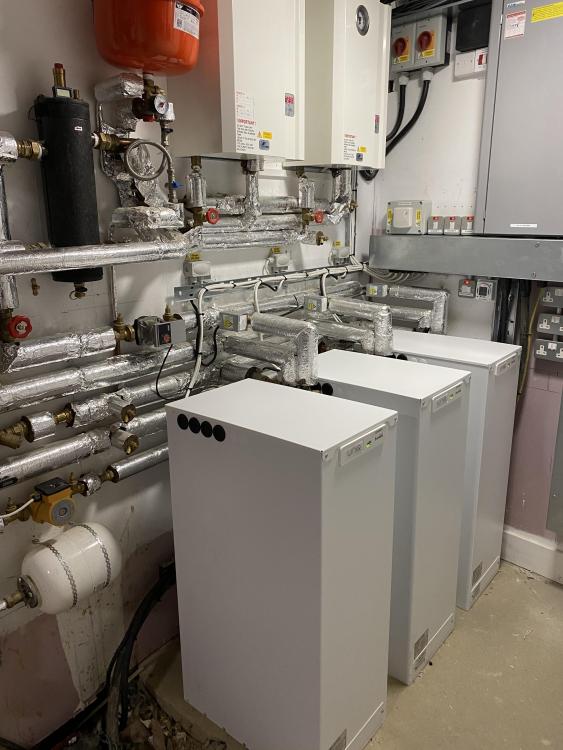
-
Getting Wi-fi in remote location
Nickfromwales replied to Russell griffiths's topic in Networks, AV, Security & Automation
As ( iirc ) the cabins will eventually need a rock solid internet connection / WiFi signal ( and possibly TV set top boxes ) I’d just extend the armoured BT cable and get subscribed connection(s) with stand alone router(s) ( c/w WiFi ) installed permanently at each of the cabins. If you do extend your BB connection to lend it to the cabins then your bandwidth will be gone when you try to ‘share’ the connection. You could probably service both cabins with a single subscription for the get - go ( multi-room option with 2x set top boxes ) and take a PoE WAP to the other cabin. Limit will be how much stuff can ‘be online’ at any one time so all depends on how good a service connection you get to start with. -
Salus Auto Balancing Actuators - Problems!.
Nickfromwales replied to Miller3857's topic in Underfloor Heating
Were these actuators done up hand tight, or with a grips? I recently fitted 9 and found they worked much better a little over hand tight, almost 'loose'. Just using the body of the actuator to turn a bit of extra tightness with the nut was enough to stop the actuator in its tracks. -
UFH Design Layout & Low temperature Underfloor heating
Nickfromwales replied to revelation's topic in Underfloor Heating
Some do give good service, and some just want the sale..... -
Silicone will do the same job if it's a very thin gap but it's not a bonding agent at all, just a sealant, so if it fails you can have expected nothing more from it. Silicone is a finish product, and has very little integrity vs a non-silicone product like CT1. Also, it attracts mould aka black death, so I very much like using it to create a top 'cosmetic layer' which can be easily removed and refreshed when the bathroom gets a freshen up / new lick of paint. 5 years is about right for silicone, after that it seems to start to show its age with any kind of regular manual / direct cleaning.
-
Water supply manifold - dead leg a concern?
Nickfromwales replied to Kilt's topic in General Plumbing
Sitting down from the upper moving rail of water, that is a very dead leg. As it's not true potable water, I think I'd want that gone. -
UFH Design Layout & Low temperature Underfloor heating
Nickfromwales replied to revelation's topic in Underfloor Heating
If an open area has a stat in it, and the heating pipes to that zone traverse smaller enclosed rooms, then the likelihood is that the stat will call for heat way beyond the smaller rooms requisite for more het input, ergo that small room would overheat. That may help out a lot, vs timed heating. Don't think for one minute that slowing down a loop at the manifold ( balancing ) will give temperature control, it won't. You'd probably be down to 25mm flexible conduit as 9mm wall on 16mm pipes would give you 34mm total. You'd only really have to insulate the flows, and group them at the absolute perimeter of any room they traverse. You only need 30-40mm between pipes where they congregate. If the manifold is bought then yes. Just remember now is the time to get it right, not after it's too late. If it's new, they should accept returns. IMO, yes. An old plumbing saying is, "enough 180o bends is a dead end", and inverted layout offers only 90o bends. Serpentine also puts all the heat at one end of the room and all the cool return flow at the other, so flow and return need strategic planning by design. Not important in a thicker, heavily insulated slab, but it will be notable with thinner insulation and a wafer thin emitter. I install UFH for others, so I have to be sure it all works A1 every time, and I would never do serpentine. As far as serpentine being easier? Not imo, but I am a 'seasoned' installer.... -
UFH pipes protection/testing/fluid in slab.
Nickfromwales replied to SuperJohnG's topic in Underfloor Heating
Good idea. Only downfall is you have to have a bit more waste as you need a factory capped coil for every run. Having them 'gas' pressurised during installation and then pressurising with a gauge on the manifold prior to / during / after the concrete pour is the gold standard. You'll know if you had issues during installation as a damaged loop wouldn't give you the steam-train whooooosh when you cut each loop to fit the manifold. -
Yup. That’s why they have very fine pitched threads, so lots of bite for very little torque.
-
Water supply manifold - dead leg a concern?
Nickfromwales replied to Kilt's topic in General Plumbing
Over what distance? This is just a short branch. -
"We'd just like to thank everyone for watching tonight's show, and please remember to tune in....same time next week. Goodnight!". ?
-
Water supply manifold - dead leg a concern?
Nickfromwales replied to Kilt's topic in General Plumbing
Fresh disinfected water will be passing this, so I would not worry. The metabolism says the risk is minute. -
I always CT1 here as the casting of porcelain is often imperfect, as is often the tile ( especially where the pan traverses a grout line and there is a distinct wobble ). Cutting through CT1 in the event of a doomsday issue is a few minutes work. CT1 Multisolve can be used to break down and remove residual product, and clean up before re-installing. Hearing a 'dry' pan grating against a tile whilst you tighten, and then do the first test arse-fit, is bloody daunting to say the least. And the gasket should be banned from existence !!!!!! Do not fit, it's like a bloody slip membrane and stands the pan off an extra few mm's which means more silicone on the upper rear edge of the pan.?
-
Tell him to say "no" to drugs An UVC will have 22mm pipework and will happily connect to a 15mm cold mains. The discipline you need to observe is taking the 22mm cold supply all the way from the UVC multi-block ALL the way back to the 15mm cold stopcock. Reducing the resistance that the cold mains has to suffer before getting to your outlets is the critical thing to observe. You really need a plumber who has done a few ( lots ) of UVC installs, as the difference between plumber 1 and plumber 2 can be night and day. If you wish to retain the existing combi for money saving measures ( as long as it is in A1 serviceable condition ) then just have the hot outlet connected to the kitchen sink, and then use the heating circuit for heating CH and the UVC. That will work just fine. Do NOT connect the combi hot output to a shower, as whilst the shower is running ( the combi is in DHW priority mode ) zero heat will go to either CH or UVC. Flow rate and static pressure of cold mains needs reporting here before ANY advice can be given. You could get away with a Vaillant 938 and an accumulator, but we also need to know how many people living there, when they shower / bath / how often and more. INFO PLEASE!