
Nickfromwales
-
Posts
30353 -
Joined
-
Last visited
-
Days Won
297
Everything posted by Nickfromwales
-

Solid conductor wire to 2 stranded circuits
Nickfromwales replied to NeilScotland's topic in Power Circuits
Look for a fused spur inside the house maybe on the outside wall near / next to a socket. That’s a popular way to glean power for out buildings. -
Solid conductor wire to 2 stranded circuits
Nickfromwales replied to NeilScotland's topic in Power Circuits
Ok, one issue at a time First off, you cannot connect the lights directly to the 2.5mm cable if that is fed by a breaker bigger than 6a ( or 10a ) which a 2.5mm cable normally is fed by. So, the supply cable needs to be identified, as does the size of the circuit breaker servicing it before any comprehensive advice can be given here. If it turns out to be from a 6a circuit breaker then great, carry on as advised, but if not then you'll have to install a DP switched fused spur and fit that with a 3a or a 5a fuse accordingly to de-rate the incoming supply. Can you add that info first, please ? -
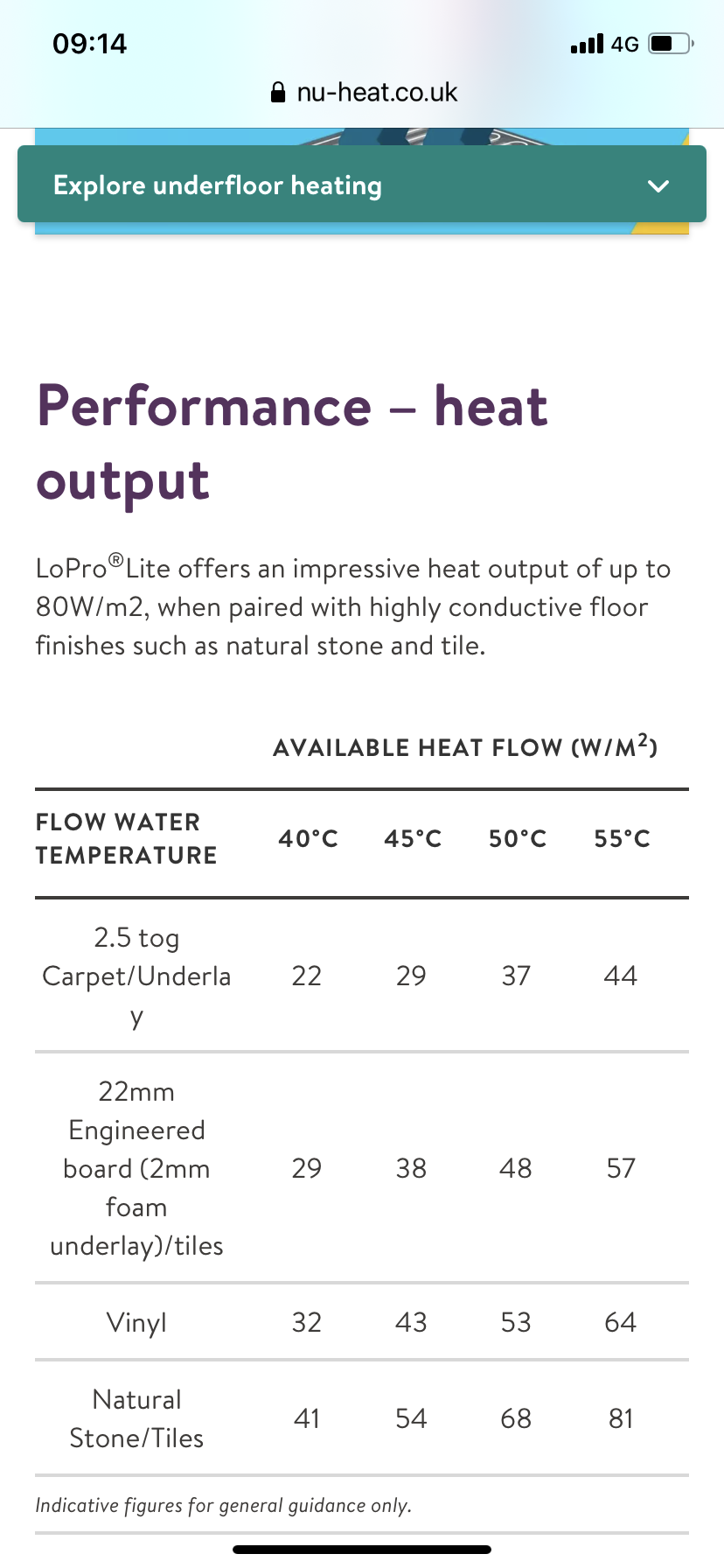
You need to know what the room requires in terms of heat input ( to maintain 20oC internal at 0oC outside temp ) before deciding on UFH, especially retro-fit options. There are a few online room heat calculators out there, so I'd say use 2 or 3 different models to get an average, and then work out total useful floor area / w/m2 and you'll have your answer. LVT is a good option because it makes the floor feel naturally comfortable under bear feet / in socks vs tiles, but it is a very poor diffuser / emitter and will allow the floor to have 'hot-spots', eg areas where you will actually be able to tell where the pipes are laying due to the elevated flow temperatures that you will require vs tiles. Are you dead set on LVT? That will work but tiles would help out quite a bit here and be far better at diffusing and emitting the heat evenly and allow for a slightly lower flow temp.
-
I’ve not seen much great about Nu-heat and have had to sort a few ( too many ) of their poor designs out. I’d look at Wunda Overlay as an alternative. Not great heat transfer characteristics with vinyl flooring either. With the Nu-heat system, do the panels get over boarded before laying LVT? Make sure you cost in for the spray adhesive that is required to bond the boards to the substrate, and the required prep work for the substrate too.

-
Aye, Dennis is a top guy. Just tell him I said to lay off the custard donuts and watch him go!!
-
Depends if the substrates are nice and flat? Whichever you lay the notched bed onto, the opposing face should be buttered, eg to have a thin wet skim of adhesive applied immediately prior to affixing the tile. Powder adhesive in a shower area is a no brainer, and most tub adhesive is shite on a good day, especially with zero-porosity porcelain. Get the standard or extended set adhesive and NOT rapid set. That way you'll have at least an hour open time with a bucket of goop before having to clean down and do a fresh mix.
-
Words are like weapons...they wound some times.
-
Facebook marketplace and Gumtree, under "grab what you want, it's free" and hope for the best. Usually causes delays, costs and inconvenience. Put the staircase on market place here on BH and see if anyone is building near you and could do with a temporary 'site' set
-
So, can I have 50% off my first order of N'evian?
-
And what can reassure you is, the FACT that I have done many like this, and its all good. Same with anything, the job will be as good as the execution and attention to detail. If that slides, so will the things you put on the floor. Very much relies on the builder having more brain cells than a house plant.
-
"Peckham spring" ? LOL.
-
Crazy. You don't need more than 32mm with a cuffing sprinkler system !! The last time I specified 50mm was where there were 3x 400L cold mains accumulators and a pump in a garage, and we needed to feed the house, and I needed a bigger pipe to retain the stored energy potential from the accumulators without hinderance. That's 'hooj'.....
-
An academic approach is fine, but my approach is of being on sites over the last 25 years and seeing these in, working, still working today, and all the ones that failed, and why. That comment of your suspicions is loosely scaremongering and without evidence also, ( IMPO ). PIR does not crush with a raft of screed over the top, as there is virtually zero distinguishable point loading. Order of events is usually; whack and blind ( with sharp stone ) the sub floor until compacted and level fit a secondary DPM atop the blinding layer install 25mm EPS as a sacrificial layer, employed to absorb any remaining points / adverse undulations / cheeky bit of hardcore that sneaked through when you were having tea and biscuits fit the primary DPM atop the 25mm of EPS, ergo it is safe from being penetrated from said foreign items in the subfloor carry on building the EPS layer up to 100mm or whatever in thin layers so it conforms fit final PIR layer(s) as required fit perimeter expansion skirting / insulation install screed / concrete / other to suit The weight of the screed going down will hold all the insulation layers against each other, and is essentially the worst case for compression in the lifespan of the floor. It will sit there quite happily...........................unless someone buys a grand piano, sticks it in the corner of the room, and then invites the Tomi-Tukamoto Sumo-wrestling team, and their family, from both sides, to sit on it.
-
Room Sensor? /White wall box identification?
Nickfromwales replied to MAB's topic in Electrics - Other
Looks like the type of junction boxes associated with a burglar alarm. Maybe where PIR's have been removed because previous occupants had pets etc. Is there an alarm there now? -
Probably the same price as a clip rail system to hold the UFH pipes, so that box ticked plus a lot of insurance. As prescribed. Also, from my limited knowledge of slabs and concrete, IIRC you need a minimum of 40mm cementitious coverage over bright steel to stop atmospheric moisture from penetrating the screed / slab and allowing the steel to start corroding. Maybe galv or stainless is employed in those circumstances, but i'm not 100% sure. Got a load of floors made up this way that have been in for north of a decade, and I've had the same phone number for longer Not a dicky bird
-
Experience you mean?
-
Doesn't matter, as it will make an excellent raft to sit the rest of the floor on. It's been in long enough to have settled, and will be fine to take the non point-load of a new upper deck. What's it like when you walk slowly over it? Any movement in the corners?
-
Cool.
-
Power wall will want to charge off grid electricity in the winter, DC won’t. There are a few existing threads there for continuation of relative dialogue, so please try and resurrect one of those to keep things current
-
Why not batteries on the DC side? AC coupled is such a waste. DC also means you use a 3-phase inverter and lose nothing plus you size to what you want instead of the PW ‘one size fits all ( which it doesn’t ). Plus no limited throughput with SolarWatt batteries either. DC is a no brainer afaik. No DNO permissions needed either. I’d be surprised if the DNO let you put a PW on each phase!! plus your PV?!?
-
No, but another danger which is derating of the cables if they are not sheathed ( or protected by other such means of containment ). Conduit or other such containment is advised at that point.
-
Using an UVC as a buffer for ASHP & PV heating
Nickfromwales replied to Brian Paul's topic in Boilers & Hot Water Tanks
That will be a decision the DNO will make based on the local infrastructure, and may be refused. Eg they may say 5kWp and export limitation at 3.96 etc, instead of limit at 3.96 and you can have the full 8kWp. Don't assume they will give you this, and then go and base all your assumptions on that for the synergy of the M&E side. Also, if you box clever and plan for the retrospective addition of a DC battery, then the DNO application will ignore your batteries altogether. If you go for an AC battery system you will need DNO approval and the two figures ( PV + Batteries ( total kW size combined )), will be the number they use. DC batteries are designed to mothball themselves and hibernate when there is no current / no long term excess PV available to store, and are warrantied to operate that way too vs AC which need babysitting and constant topping up to stay within acceptable state of charge. -
Chemical. The cause of a number of house fires. The plasticisers get absorbed and the cable insulation degrades to a point where it crumbles and falls away from the copper cores. Then ?
-
Ok, just for clarity, that concrete subfloor is staying yes? Be advised that EPS insulation CANNOT come into contact with the electrical cables.
-
Doesn’t need to be compacted hardcore. Needs to be sound and stable, and we obviously need a bit of feedback before saying more. Ive done loads without, just a quick blinding and a whack and job done. What I do, ( if at all unsure of the subfloor ), is build up the 1st 50 / 75 / 100 with individual sheets of 25mm EPS so they can easily conform to the subfloor. DIY not here tbh, so one assumption is a builder with at least 3 brain cells will be employed and able to govern. But then again, you’d probably then end up with a 150mm slab, 50mm of insulation and 50mm liquid screed