
Nickfromwales
-
Posts
30353 -
Joined
-
Last visited
-
Days Won
297
Everything posted by Nickfromwales
-
They seem spot on for a temporary / relocatable ‘hit’ of a little additional heat. Thermostatic too with timer by the looks of it. ?.
-
All the way to each outlet that you wish to have serviced by the HRC circuit . Not to every outlet afaic as I never really bother with baths / showers ( unless the shower is the far side of the building ) or any outlets in the immediate vicinity of the hot water device. Baths and showers typically get opened up immediately to 100% flow rate, so discharge the dead leg quick enough to not waste the heat / energy from running the HRC to such an infrequently used outlet. Bottom line…..just wait, as it’ll be 10 seconds or so max, typically, before premium temp DHW gets to that outlet so not life or death imho. Typically a basin with a 10mm feed, which runs for no longer than ~10m, will not attract the HRC. Reason being is that most HRC set-ups will have a recently used outlet or an HRC pump on for the daytime / periods of occupancy ( which will ‘pre-heat’ the larger bore pipework and the hot manifold, by design ) so the non-HRC outlets will therefore not have any discernible dead leg to shift, other than the tiny volume of cool / cold water in the 10mm delivery pipe. Works a charm.
-
I've just installed and commissioned a full house system for a client, with UVC in upstairs plant room, and I fitted 10mm runs to the downstairs en-suite and cloak WC plus upstairs master are all 10mm hot and cold runs where the water pressure is 'not excellent', and the flow is more than adequate ( given modern basin taps are restricted / air blended for low flow rates anyhoo ). I ran a HRC to the utility and kitchen ( 15mm flow and 10mm return ) for instant premium hot water to both of those outlets. I don't ever do the above series HRC as it just doesn't rid you of every drop of the dead legs, the whole point of installing one in the first place! Also, if you do a manifold / radial setup then you need individual HRC returns back to a third manifold so you can isolate every hot outlet individually ( hot and HRC both need to be shut off to isolate a HRC serviced hot outlet ). Also series HRC means several outlets can be pulling down one run of pipe, so the flow rates will suffer quite a bit too, especially with Buteline as the fittings have a lot of resistance. My preferred installation methods see just one fitting at the end of each continuous pipe run so flow rates are very very good indeed, even more so when preserving what flow you have where the cold mains is not as good as you'd have liked. Any multi-occupant dwelling would deffo benefit from a 200-300L cold mains accumulator too, which are cheap enough these days, which will stave off pressure drops when things like WC's are flushed or an appliance is filling whilst someone is showering. Makes a huge difference.
-
Don’t fill with water then, simples! Buy the pipes in the correct length coils from Wunda and they’ll come sealed and pre-pressurised to a good few bar. Cutting into it gets quite a notable rush of air and associated hissing noise. Either that or complete a regular installation with manifold rails and pressurise yourself / installer with air. A pressure gauge will show you that things haven’t gone tits-up during screeding
-
Only with an ASHP install.
-
You should be fine minus the AAV then Guessy-McGuess-Bob
-
Why the need for antifreeze? Are you winter prepping? Just dry test with air if you’re just needing to prove the pipes before install. If you’re just looking to treat the system at the point of commissioning then you just do that via the upper manifold vent / drain point with a 3/4” or 1/2” flexible hose and a funnel. Make sure the lower manifold air vent / drain are completely removed otherwise it’ll be ridiculously slow going.
-
As much use as a waterproof teabag. ?. Give me a measurement from the top of the muncher to the point the discharge pipe opens up at the PStn. Run there, gallop back ?
-

The research evidence on security alarms
Nickfromwales replied to Adsibob's topic in Networks, AV, Security & Automation
Problem is, they know where the key for the steering lock will be, on your car keys , so they get those by burglary anyhoo. Therefore only a deterrent to the opportunistic thief. Bollards are a good choice, as long as they’re not cheap bits of crap that they’ll know they can simply knock over with your car. Thieves can readily identify popular security products and gauge their resilience / robustness etc in the wink of an eye. Good ( well placed and very bright ) security lighting, and some basic disciplines re where keys are kept at night / choice of door locks / don’t have a letterbox in the house door etc are all little 5 and 10%’s of additional obstacles which may make the scrotes move on. -
Is there anything in the pipes atm?
-
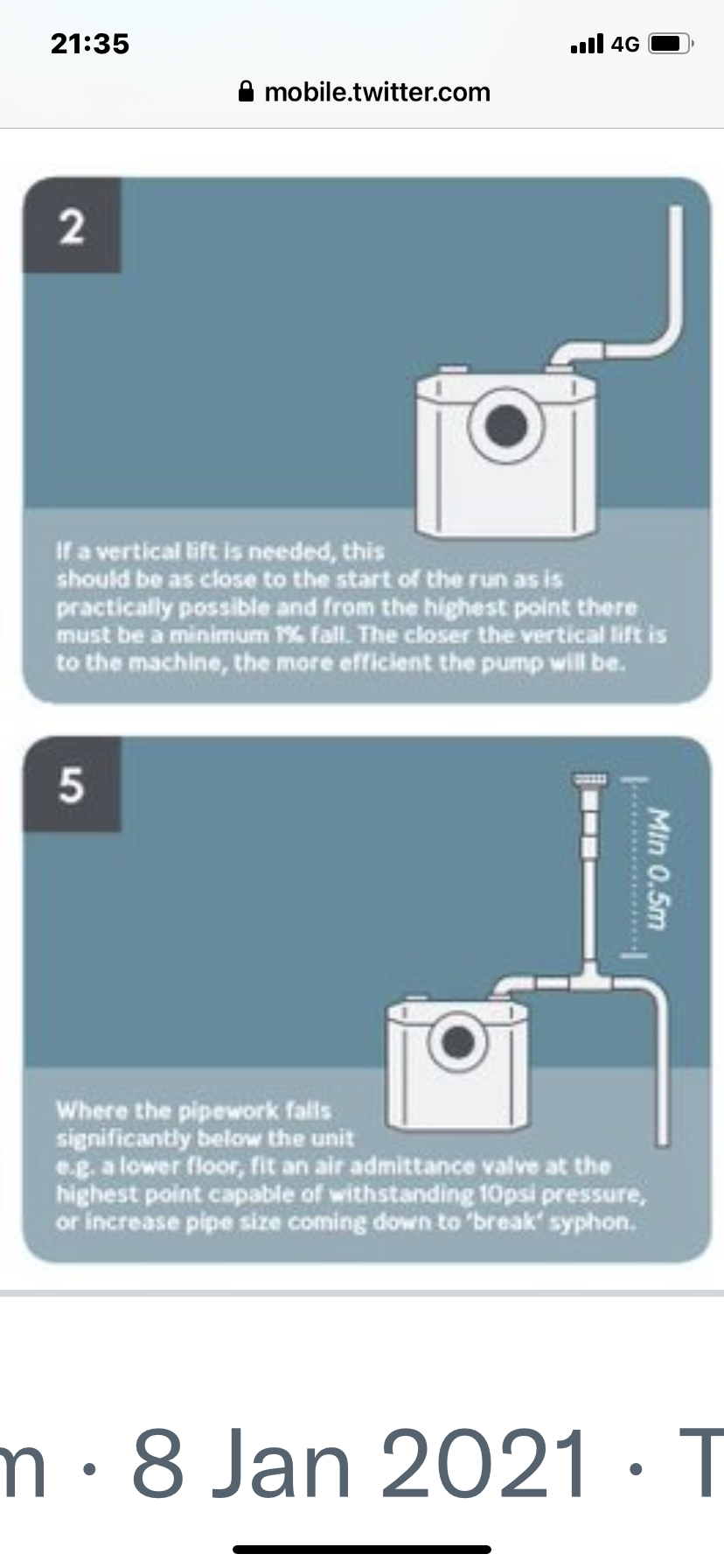
Like it says, if you can run a 32 or 40mm pipe from the point of invert it’ll allow a natural air break. How much of a drop from the muncher to the connection to the SVP?
-
-
If, my young crapprentice, you allow a fall on the discharge pipe, and you get it wrong, you’ll set up a perfect siphon tube. That’s where the contents of the pipe then suck the turd-scoffing device empty with loads of gurgling and slurping noises ( think of a fat kid on the dregs of his McDonald’s milkshake and you get the idea )…….
-
You’d be better off running it uphill to the point of termination as otherwise you have to put an air admittance valve on the pumped discharge line to stop siphoning.
-
It was a choice of; 1) read that 2) order another bottle of Shipyard hic…..
-
I’ve had Rubi cutters all the way from 400mm to 900mm and then a Sigma 900mm. Gave my Rubi one away to a mate starting out and I’ll be staying with Sigma. Outstanding bit of kit and far less effort to get a good cut. Literally couldn’t spot the difference between factory and cut edges.
-
MBC Frame - Windows - When to order ?
Nickfromwales replied to bob the builder 2's topic in Windows & Glazing
On my current clients build there were some delays, so we've pushed ahead getting the windows in before the full weight loading can commence. I've strategized this by asking that the fixings for the heads of the windows be left so that we can tighten / loosen these fixings retrospectively after 30 or so days after final loads have been applied. That will be sufficient time for the TF to 'relax' and the weight above to transfer down onto the ground floor window heads ( if any does at all i'll be surprised tbh ) where we can then adjust accordingly. -
This isn't an issue surrounding up / down stairs loo's this is whether or not your house is fulfilling its individual obligations to vent the communal sewerage system ( street network ) to vent the built up methane aka 'sewer gasses' to atmosphere. Your house is not doing this, but, with a neighbour either side doing so, I would almost instantly discount you having / suffering from any issues related to the excessive build up of said gasses. The smell you are suffering is, IMO, being caused by damp in the room. The only way sewer gasses would be able to get into the room spaces would be if the traps on the WC / bath / basin etc were being sucked dry by vacuum when the WC was flushed. As the WC is downstairs, I am confident that this can be ruled out.
-
Any way of knowing if that’s a combined sewerage + storm water connection you have? Prob no SVP ( soil vent pipe ) but as you’ve no 1st floor WC then doubtful it will make any difference. Are you the end of line, or do you have houses both sides of you? If the letter, can you see SVP’s on their houses?
-
Can you show where this pipe terminates down low please?
-
Do you really expect a new gas boiler to be this noisy?
-
Boiler leaking water drops since January 2021
Nickfromwales replied to plumbingo's topic in Boilers & Hot Water Tanks
Sounds like a blocked condensate trap / discharge pipe etc. The "smoke" will be "plume", eg the steam created when excess levels of moisture meet the hottest parts of the heat exchanger. The condensate water is acidic, so is chewing through the steel case of the boiler as we type. Google the manufacturers installation guide and in there it will tell you how the service the condensate trap. DO NOT run the boiler with the trap off, as that being removed opens a clear path to the burner chamber and there is a possibility that products of combustion may escape. I'm not entertaining the covid jibber-jabber, but you need a plumber in ASAP to repair this, or one or two a little later to replace the rotten out boiler with a new one. Time to stop bathing with a thermos flask and get some degree of reality and a pragmatic solution to resolve this now. -
Costs of Retro Fit v Dig up and re-screed UFH
Nickfromwales replied to Digger1's topic in Underfloor Heating
If this is going to attract big bucks, why ask the question? Dig it out and get on with it !! Agree 100%. Also, you’ll need to provide an EPC when selling and if the floor insulation is dire that will still be reflected there and your marketing will suffer. UK public are far more aware of energy ratings and the longer cost subsequence of buying a pig smothered in lipstick, or as we call them “Persimmon Homes”. Do the job properly, as it sounds like you’re looking to get your money back anyways, just not as much out of the UFH job as you’d like. If it increases the kerb appeal, with no rads etc, which also lends itself to a much more flexible furniture plan, then dig it out, do it properly, and move onto the next job. Allow a week to excavate, barrow out, and prep properly for insulation and membranes. You’ll need 2 men on 2 powered barrows to keep up with removing the spoil created by one digger. Allow another week to install insulation, pipes, edge insulation and screed. Screed should be a one day event, so 4 days of prep / UFH. If you need a very good screeder that travels let me know. -
Up to or over 3M you need to upsize with UK Bregs, so 50mm is required AFAIK. I've avoided push-fit waste for over two decades, hate the stuff. Certainly not reliably enough to bury anywhere imo. Can you get someone you know here to box up stuff and post it to you?
-
Yup. Same supplier too. If you have a single phase electricity supply ( the most commonly found type ) and no 3-phase then you cannot install that unit I’m afraid.