
Nickfromwales
-
Posts
30340 -
Joined
-
Last visited
-
Days Won
297
Everything posted by Nickfromwales
-
Just watched the videos!! Never seen that before, something seriously wrong here. Credit to the plumber, it’s a neat conscientious installation, but maybe technical / hydraulic issues are at play. Firstly, I would not have put all these segregated heating loads ( a couple are very small ) onto a gas system boiler without proper hydraulic separation. The 4 zone valves will all be sucking water at massively different L/p/m flow rates, and the UFH pump will be getting ‘pushed’ by the pump in the boiler. It’s all very hydraulically unbalanced. Yes there’s a bypass, but it’s not designed to be used in such an adverse way imo. Your plumber will need to install, firstly, a small buffer tank or large low loss header ( LLH ) to allow the boiler to fire > pump to that hydraulic separator > return back itself without ‘seeing’ any of the heating circuits directly. That will remove the push / pull factor here which I think is the start of the issues. In the boiler installation guidelines, most will state that the appliance shouldn’t be installed; where it would be subject to / unless measures have been taken to avoid, short cycling. With the segregation you have here, you’re on the borderline or just the wrong side of it. Next thing to do is to remove all the actuators and run the system again without them fitted. With the actuators removed the loops will be free flowing. The thing causing the water hammer ( loops and pumps to ‘jump’ ) will be the actuators ( I believe ) so I’d like to see them out of the picture to see what effect that has. So, @Lurchie, please do that and run the UFH on its own and report back. Turn all UFH stats to maximum and tell us what happens.
-

Combi boiler and unvented HW Cylinder
Nickfromwales replied to Edward's topic in Boilers & Hot Water Tanks
Why has a combi boiler been installed instead of the system version? -
Combi boiler and unvented HW Cylinder
Nickfromwales replied to Edward's topic in Boilers & Hot Water Tanks
Not if it's on 22mm pipework and it's in the attic? It'll take much longer to arrive from there. Is there just an unused pipe left at the underside of the boiler? -
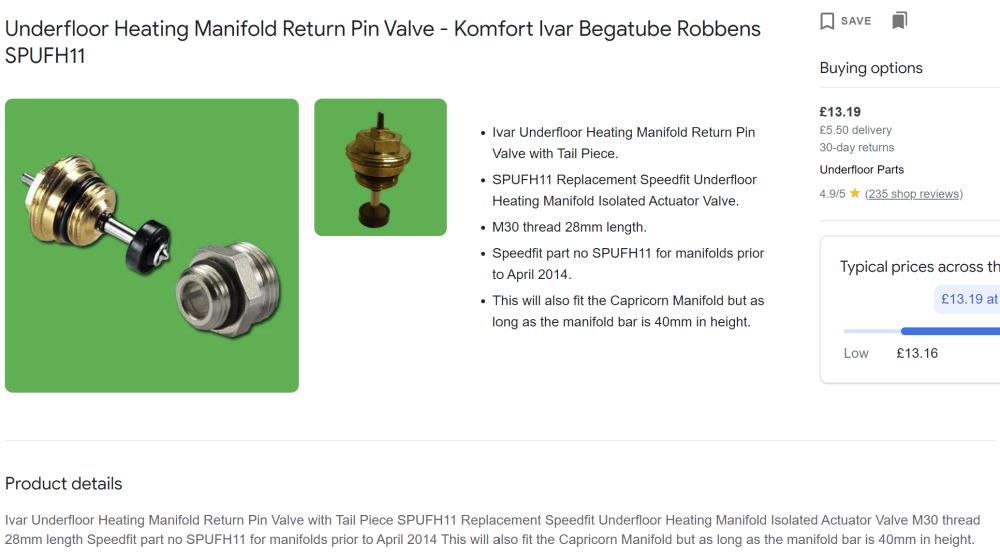
👎 Prior to 2014??
-
Looks different to the one I removed, but may be un upgraded replacement part?
-
It won't be wasted heat It'll be advantageous heat input within the heated envelope, and the sum of all inputs = your required heat demand met via whatever source ( albeit slightly indirectly from the buffer ). Lose the buffer into an airing cupboard and keep your under-crackers fresh.
-
First Floor UFH - Role of Subfloor Insulation
Nickfromwales replied to SanMan's topic in Underfloor Heating
Much higher flow temps. Problem being, is you’ll need to raise this incrementally in 2°C lifts until you’re at or around the max permitted temp stated by the flooring manufacturer. That’s usually 27°C. Beyond that, it’s failed by poor design / implementation. -
First Floor UFH - Role of Subfloor Insulation
Nickfromwales replied to SanMan's topic in Underfloor Heating
This will be down to a lack of physical contact between the diffuser and the upper floor. I see this christ knows how many times. Did you witness this being installed, and do you know if the deck boards are sitting snugly against the UFH system? If there's even a couple of mm gap the results ( unless it was a passive style dwelling ) would be dramatically reduced. -
I've just been called to a clients build where the Ivar blending valve is not letting the toasty hot water in the flow pipe to it, through to the loops ( even with the white TRV style head removed from the mixing valve. I drained down and removed the cartridge and it was firmly stuck, but in the fully open position!! I serviced the valve, proving free movement and that the pin returned to its "sticky-outy" position ( returned to that position by the spring ) and reinstalled it all. Set it to work, and fark all, still just a steady 20oC of heat which was keeping the dwelling at too low a temp. This setup has the ASHP pumping into a LLH and that is immediately adjacent to the UFH manifold / pump etc, so never needed a secondary pump to get from the LLH to the manifold. Conclusion, possible knackered mixing valve. I'm going to order a brand new one and install it as this is an inconvenience to my client, but this worked very well the first 2 winters, and I'm flummoxed as to why this has given up the ghost ( where others have been in elsewhere, longer, and are still working perfectly!?! Some houses I've fitted with 2x Ivar manifolds and still zero issues on those projects....... Could this be a few stray "Friday afternoon" valves perhaps?
-
Thanks. Do you know if the upper side of the insulated foil panels are in direct contact ( under slight compression ) with or are bonded to the underside of the wooden deck? If not, the heat transfer characteristics of this build-up will be poor.
-
Nope. The drips / bells on the render are set correctly, a tile would block them.
-
Are the pipes in aluminium spreader plates / screed / other? Can you give us more info please?
-
Yup. UFH is done badly more often than it’s done well, particularly when a general builder just comes up with a ‘good idea’. Look at the overlay system from Wunda, that may be your best option. If it was my house I would break out the existing floor and do it properly, as retro fit UFH done anything less than immaculately will likely not heat the room unless left on pretty much 24/7 with massive running costs to boot. Original question; yes no issues there. You can cut the up-stand back by 20mm if you’re worried, and bond a strip of Compacfoam ( 400kpa ) on top just where there’s going to be traffic etc.
-
Why aren’t you putting the pipes in the slab? Add 50mm more insulation ( EPS ) and reduce concrete. Lose the UFH panels and save some money. You’ll end up heating the slab regardless, so will have slow reaction times to shift room temp, so why this choice of floor arrangement?
-
Same size as I built. I just did 10x concrete pads, rubble full as a foot and concrete on top, then timber ‘legs’ holding a sistered 5x2 ring about 2-7” off the ground ( sloping plot as per yours ). Been there a couple of years now, and a little evidence of settlement ( it was on made up ground ) but the 2x 900mm wide fire door blanks I used to make an 1800mm barn door one end still open and close without a whiff of bother, which I’m surprised at tbh. Biggest regret is a non-insulated roof panel ( powder coated metal clad roof ) and not insulating walls / floors ( as this has a life of 6 years or so before the ground hopefully gets built on ) so didn’t think it worth the expense. As it’s now my office, I regret not making it much better regardless. It just gets heated by warm air blowers ( fan heaters ) which does heat it quickly, just not cheap! Screw pile option sounds good tbh, and if you want this there for a long time do NOT have any timber in contact with the ground / exposed at that level is my advice.
-
I'd mask up and inject with a closed cell foam such as Illbruck and then fit a strip of 25mm PVC D-section LINK from cill to frame to cover it over.
-
In the bedrooms I go a bit OTT, as once this is in it is in for good. So I would do 1x duct to 1x terminal ( x2 ) in there. Sleep is precious, so is sanity. I would not bust this down to 2x ducts to 1x terminal ( x1 ) in there as the flow rates will be a bit higher in there due to the volume of the room.
-
Higher velocity at the larger bore ducting, ergo the terminals coming off those primary runs from the machine have to be strangled back more which tends to make them ( albeit slightly) more audible, particularly when boosting. Also means you can’t target specific rooms or floors when tempering the air via an air handling unit. For 2 current Passive House clients, I have specified Brink Air Comfort units to provide heating / cooling to 1st floor rooms where there is no wet space heating. GF cooling is via slab cooling, FF tempering is via the BAC unit so thus requires segregation at the plant and radial runs to rooms as per my designs. Large bore series run systems do not allow that flexibility, so whatever goes in at the plant goes to every room.
-
Lounge yes, 1 terminal opposite corner to the door Agree on hall, maybe retain one? Kitchen defo, not for airflow but to keep things quiet on boost. I’d stick with 2 terminals in the bedroom for the least amount of audibility, but you could go at the head of the ceiling and do as you suggest.
-
The ducts are silent, with the only audibility ever being at the terminals in the rooms, and that’s only if it’s been designed poorly / with bean-counting. I use radial MVHR distribution for every single M&E project of mine, as the results are excellent each and every time. Larger bore primary ducts off series arrangements have much higher airflow, so would be the more problematic afaic.
-
Stupid question for boarding out bathrooms / tiling
Nickfromwales replied to Moonshine's topic in Plastering & Rendering
Yup. 100%. -
Stupid question for boarding out bathrooms / tiling
Nickfromwales replied to Moonshine's topic in Plastering & Rendering
The “cheap” kits are fine. Aquaseal / Mapei etc. Have a proper read of this thread. You may need to make a sandwich first and settle in. -
Stupid question for boarding out bathrooms / tiling
Nickfromwales replied to Moonshine's topic in Plastering & Rendering
I’ve only ever used MR PB, tanking the wet areas meticulously and sealing with CT1 where necessary. I’ve got a lot of 1st floor wetrooms under my belt, and still have the same mobile number, and nobody’s ever rung me to say they’ve got a leak ( or that any tiles have fallen off ). -
Gap between socket fronts and back boxes
Nickfromwales replied to Johnny Jekyll's topic in Electrics - Other
You really do not need to worry about 5-10mm gaps tbh. Any decent spark will see this and make sure the cables are installed to avoid one getting trapped between the faceplate and the lug of the box. Basic stuff, practiced regularly on many sites each day, and not anything to worry about. -
Lay some off cuts of sheet timber down as walking boards and get stuck in.