
Nickfromwales
-
Posts
31384 -
Joined
-
Last visited
-
Days Won
346
Everything posted by Nickfromwales
-
Only required if 2 differing RCD's are employed pre-CU? I've only ever installed an 80a switch-fuse at the meter when conveying tails of 3+m and above, and this is never a problem (no RCD required for the last few) but I'm not over the 18th edition like a rash tbh. If run in SWA there should be no requirement for RCD, but it may be requisite where the tails are sub 50mm from surface. You can screw into a live tail and make the fixing live, but with a SWA you'd have to short live to steel armour, so the tails need to be further away from 'attack' and the SWA less so.
-
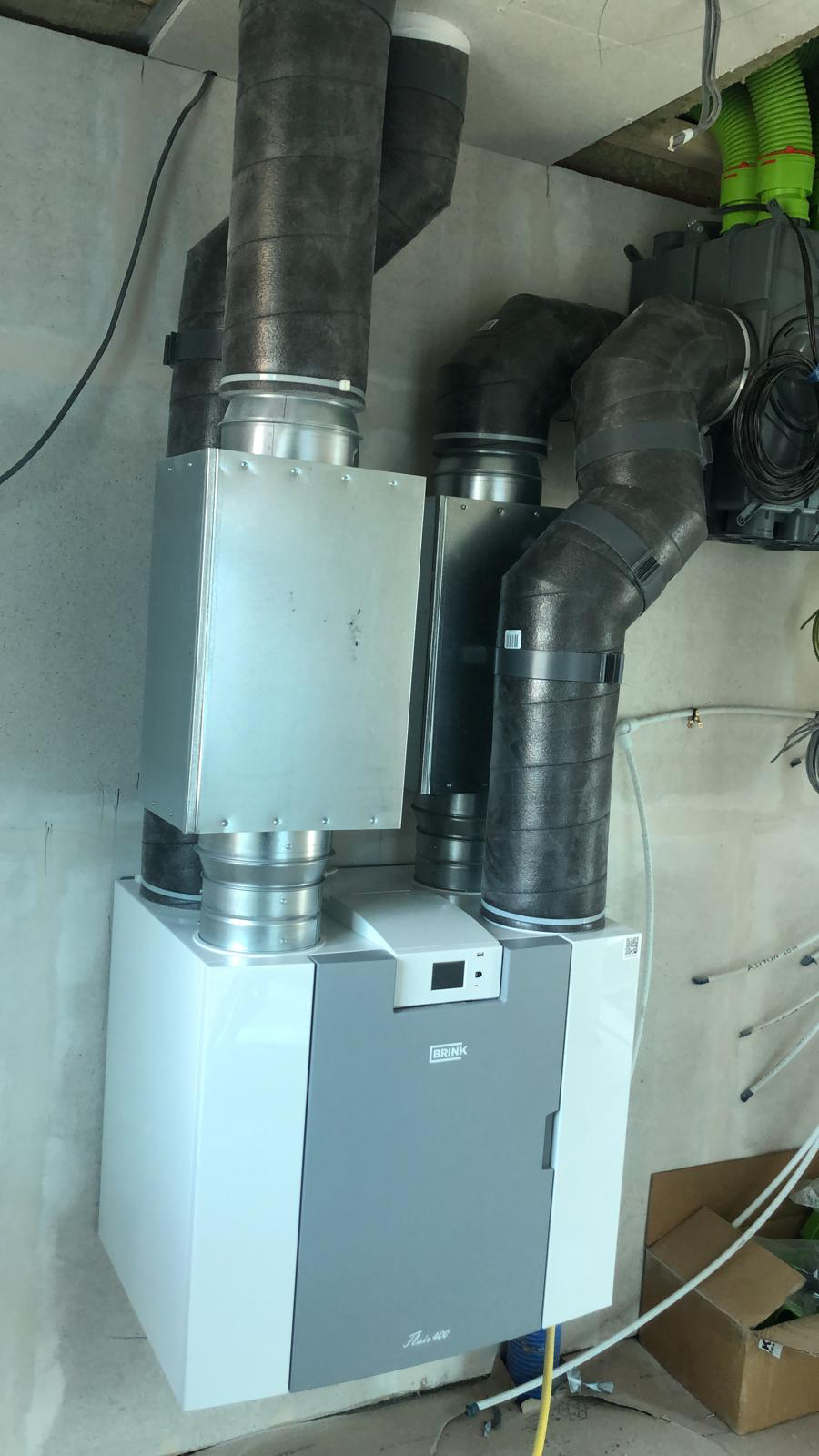
 You can get down to much lower speeds overnight. Possibly on a timer which diverts to a second controller. One very good 'box' attenuator may sort this, and I have NEVER installed an MVHR system without either 500mm long ones or 1000mm where I thought the job would benefit / there could be any chance of this type of issue.
 -
Basic Heating Control Understanding Help
Nickfromwales replied to Shaun McD's topic in Air Source Heat Pumps (ASHP)
It (requirement for defrosting cycle(s)) becomes prevalent when the ASHP is being asked to do things it doesn't like doing, and even more so when it's 'least best' to do so. The ASHP's I've fitted recently should literally almost never freeze. Retro-fit units into 1930's refurbishments will likely be defrosting a LOT, ergo I would never install an ASHP to such a property, (but where others would of course). Low flow temps and strategizing when (and how) to heat DHW will all add to the SCoP and longevity of the equipment. -
Basic Heating Control Understanding Help
Nickfromwales replied to Shaun McD's topic in Air Source Heat Pumps (ASHP)
This is a huge bone of contention. If an ASHP has been spec'd to go into a dwelling that sympathises with such a unit, then freezing should be deleted? If it's Baltic outside and humid, ergo defrosting is prevalent, then the owner should be heating the DHW by the immersion(s) for that period of the year. The maths defo work out, as I've stated recently, just with the huge labouring of the HP being eradicated, plus the extension to the longevity of the HP / ancillary equipment. If you have solar PV then you will be banking electricity tokens all summer to 'spend' on this pursuit, but at the time where this will be most problematic your CoP will be 2:1 if you're lucky, and much much worse if defrosting is repeatedly required and added to the maths. In the arse of winter I recommend that you heat DHW via a cheap rate electricity period via the cylinder immersion and only do the daytime heavy lifting at most eg maintaining the absolute lowest set point of say 50oC. I have been oversizing UVC's for years now, for exactly this reason. Bulk heavy lifting when the CoP has the advantage, and boosting up the temps (heat energy capacity) via the immersion to stay away from having to do this whilst low temp heat is being produced. The oversize also helps massively during summer where extra DHW can be stuffed into the same device (by "overheating" the UVC with 'free' energy). -
Basic Heating Control Understanding Help
Nickfromwales replied to Shaun McD's topic in Air Source Heat Pumps (ASHP)
Nope. The post refers to shoulder months where the heating may not be needed during the day, but instead where solar gain becomes problematic for E > S sunshine in the morning, with the S > W and N rooms then waiting to get the heat and balance out the slab / room temps. If the house calls for heat the HP will be fired by the heating controls, as will the manifold pump(s). With my preferred technique of running the manifold(s) pump(s) during sunlight hours the problem of each far side of the dwelling behaving differently, heat wise, is reduced significantly. -
PV on a flat roof, how far from the edge?
Nickfromwales replied to Smallholder's topic in Photovoltaics (PV)
One pasty too many for lunch? -
PV on a flat roof, how far from the edge?
Nickfromwales replied to Smallholder's topic in Photovoltaics (PV)
Nope, it was just down to it being a baaaaaaaaaaaaaaaaaaaaaaaaaaaaaaaah'd design. -
PV on a flat roof, how far from the edge?
Nickfromwales replied to Smallholder's topic in Photovoltaics (PV)
Just a matter of how well the membrane is bonded down under it though, I suppose. These plates go on retrospectively, after the membrane has been laid. -
PV on a flat roof, how far from the edge?
Nickfromwales replied to Smallholder's topic in Photovoltaics (PV)
They will grip like shit to a blanket tbh. Nothing stopping the plates being bonded also, FWIW. -
PV on a flat roof, how far from the edge?
Nickfromwales replied to Smallholder's topic in Photovoltaics (PV)
It would be a question for the manufacturer of the SIP panel, and for them to say if multiples of fixing locations would make this permissible tbh. -
PV on a flat roof, how far from the edge?
Nickfromwales replied to Smallholder's topic in Photovoltaics (PV)
Any space for a ground-mounted array or create a structure to take even 4kWp? 2kWp is better than nowt! -
PV on a flat roof, how far from the edge?
Nickfromwales replied to Smallholder's topic in Photovoltaics (PV)
Don't forget to plan how to get cables through the roof, as that needs to be stitched into the fabric of the build before the roof membrane goes in / on. Cable snorkels are available which can be made airtight and are water-weather proof. -
PV on a flat roof, how far from the edge?
Nickfromwales replied to Smallholder's topic in Photovoltaics (PV)
Roof goes down and gets proven as rain / weather tight. Then you install the plates and weld the skirts down atop the original covering. -
PV on a flat roof, how far from the edge?
Nickfromwales replied to Smallholder's topic in Photovoltaics (PV)
Another option. -
PV on a flat roof, how far from the edge?
Nickfromwales replied to Smallholder's topic in Photovoltaics (PV)
No idea off the top of my head; we give turnkey prices via my solar partner (and his designers). They are a brilliant solution, and for situations where you cannot punch the fixings into structure, you just add more plates to create more fixings / point of purchase eg into 18mm OSB etc. You wouldn't be allowed to fix these to 9mm OSB obvs. You should be able to get costs and a design from the company I linked to, or 'we' can price it? PM me if any use, but not if you want it doing in 2023, sorry!! The screws are specified by MCS, and are BFO stainless steel construction screws with large pan / flat heads. LINK - company chosen due to dragon logo lol. Standing seam clamps are OK, but somewhere where bean-counting cannot be the driver! One instance where staying away from the perimeter is a bloody good idea. -
Basic Heating Control Understanding Help
Nickfromwales replied to Shaun McD's topic in Air Source Heat Pumps (ASHP)
I think it was Jeremy who mentioned just running the UFH pump to circulate the water in the floor(s) without the HP engaged. Great idea, and one I've adopted for my projects. I am using a dusk - dawn photocell to override the manifold pump(s) so they only come on when the sun is 'up', plus it runs for free then if PV is included. -
PV on a flat roof, how far from the edge?
Nickfromwales replied to Smallholder's topic in Photovoltaics (PV)
You get extra material from the roofing company, and send that off. They then manufacture the plates with the skirt made from what you supplied, so you have have no mix / match / colour & type indifference. We supply a design to the clients so the builder / client / roofer can install in-house. The rails go atop and you're done and MCS compliant without the extra weight. Without the ballast being down first and the height of that, you can then drop the array low so it's 'less ugly' to look at . -
Rate my sub-floor!! (and can you help me insulate it?!)
Nickfromwales replied to larry's topic in Heat Insulation
Yup. -
PV on a flat roof, how far from the edge?
Nickfromwales replied to Smallholder's topic in Photovoltaics (PV)
Have you already installed the roof membrane? 'We' favour Nicholson plates LINK and rails vs ballast. That install may be too exposed to use Van Der Valk rails + ballast LINK, unless its with pre-stressed concrete lintels and you've the kg/m2 allowances in place for the huge extra weight? It looks like you have a parapet all round? The perimeter rule is from MCS iirc, and mostly for in-roof systems and not so much so for on-roof. With on-roof you have a roof which is 100% weatherproof, and then you overlay the array atop, and this will allow for "infinite" arrays which can go ridge to gutter and gable to gable flush fitting. The caveat is that the fixings and rails ned to be specified to cope, but many systems have gone in with an infinite install and have MCS so yes, it can be done. The 200-300mm requisite is simply to allow for a slate / tile / and a half to be fitted to the edges and be finished accordingly, eg so the in-roof trays can be part of a robust weatherproof install. FYI, a few installers put the bottom of the panels too close to the gutter and the rain overshoots the gutter. One issue to watch / mitigate against. -
What most with an ASHP + PV do anyways. When you add into that equation the stop-start of the ASHP, plus possible freezing, plus the moving parts, and then work out the reduction in longevity of all the kit outward of the cylinder, the maths really begin to shift further away from heating north of 50-55oC via the HP. Immersion is 100% efficient, zero moving parts, and is cheaper than shoplifting to replace.
-
Basic Heating Control Understanding Help
Nickfromwales replied to Shaun McD's topic in Air Source Heat Pumps (ASHP)
Yes, boss. Just the words "me" and "sensible" don't seem to work in the editor here. Keeps auto-deleting. -
Stop chopsing, and PLEASE go and put some clothes on.
-
Basic Heating Control Understanding Help
Nickfromwales replied to Shaun McD's topic in Air Source Heat Pumps (ASHP)
Flow temp will be affected either way, as the cooler return will reduce the output of the ASHP, so that's just moving the 'problem' from one place to another imo. Truth is it's not actually a 'problem', and if it's within the heated envelope all latent losses go towards the target temp anyhoo. 6 and two 3's. -
It had upstands, as I never fit anything less with students (aka dimwits) in the mix. The water was up over the frame of the cubicle and overflowing onto the bathroom floor all the time they were using it, so nearly 3" of water in the tray, and they carried on getting in/out, one after the other, stepping into the soup the last user had left behind 🤢🤮