
Nickfromwales
-
Posts
31371 -
Joined
-
Last visited
-
Days Won
345
Everything posted by Nickfromwales
-

Insulation upstand when not having skirting board?
Nickfromwales replied to flanagaj's topic in General Flooring
If bare walls, who gives a hoot about seeing a bit of PIR around the perimiter? -
Insulation upstand when not having skirting board?
Nickfromwales replied to flanagaj's topic in General Flooring
Mildly confusing, so which one is it? Are you having a floor covering? More info and less ambiguity please! -
30mm support strip? Erm, “No”. You install a DPC and use XPS against the inner face of the outer leaf. Use a semi dry concrete mix, topped with a layer of Marmox backer board, and then the concrete can take it’s tome to fully cure behind that shield. Do as uncle Nick says, and stop faffing about, please. Less yapping, more mixing and laying, as this can all be finished and done by 5pm tonight. Zero damp will pull up as you’ll be replacing (and reinforcing) your DPC/M with these works. FYI, your above ‘new’ plan is crap, sorry. My thumb is slowly wearing down, so heed, or don’t heed, up to you squire.
-
Have you bought a heat pump cylinder, or a regular cylinder?
-
UFH under show tray?
Nickfromwales replied to Super_Paulie's topic in Bathrooms, Ensuites & Wetrooms
-
UFH under show tray?
Nickfromwales replied to Super_Paulie's topic in Bathrooms, Ensuites & Wetrooms
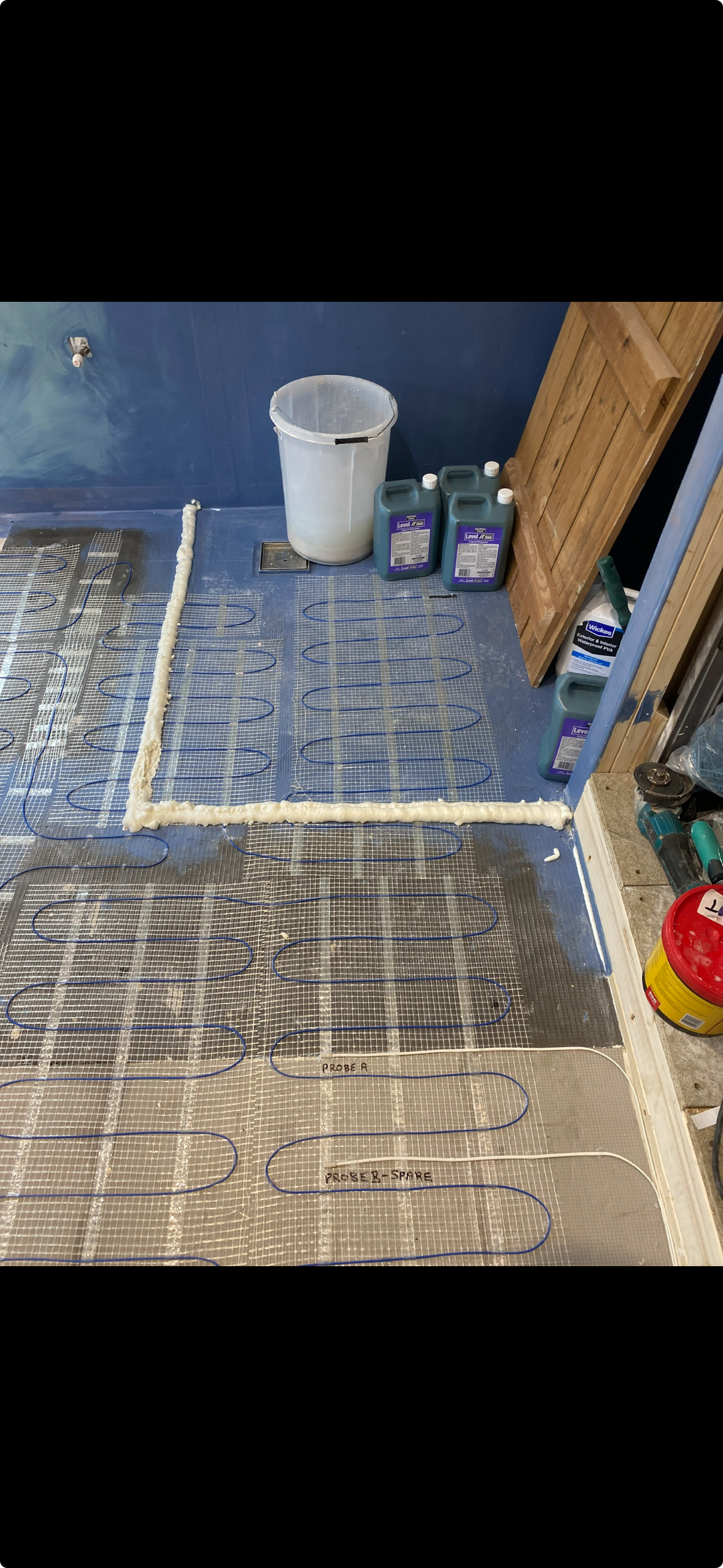
I do it on almost every job. Doesn’t dry the trap out, that’s a wife's tale, as you’d only do 2/3 of the dead end of the tray anyways; when you turn the shower on the hot water almost instantly warms the remaining 1/3, and the UTH is a 1/3 of the tray away from the trap. ”Do it”. 🫡🙂 -
Backer board or plasterboard
Nickfromwales replied to Super_Paulie's topic in Bathrooms, Ensuites & Wetrooms
Traditional dab is fine. Lots of smaller ones, vs a few bigguns -
Win win then. Great stuff.
-
Progress-is-a-making 🙂🫡
-
Indeed. I’m just waiting the hear the chink, from when the penny drops 👀
-
Amen, I know I can’t keep up with 20k+ members exact circumstances lol. Can’t remember what colour socks I just put on tbf.
-
If there’s a grout line near the transition you’ll likely see issues there over time. Delete the cavity, which is standard practice at openings. I may have mentioned doing this……
-
No such tool exists sir. One or the other
-
Shower tray, waste rough?
Nickfromwales replied to Super_Paulie's topic in Bathrooms, Ensuites & Wetrooms
I won’t wipe my arse with anything less….. -
Shower tray, waste rough?
Nickfromwales replied to Super_Paulie's topic in Bathrooms, Ensuites & Wetrooms
M&S. -
Shower tray, waste rough?
Nickfromwales replied to Super_Paulie's topic in Bathrooms, Ensuites & Wetrooms
Crack on and get it fitted boyo. 👍👌 Defo put a smear of CT1 on everything though, cheap insurance. Have cheap baby wipes to hand for clean up. -
The XPS board goes in the cavity, vertically, bonded to the inside edge of the outer leaf of block. Then you remove the inner leaf for the full width of the opening. Fix a piece of 30mm PIR, or more slices of XPS, as an insulation upstand. Then DPC, and then fill with a strong concrete mix with 10mm aggregate. Delete the cavity!
-
Supporting a sink with two bowls (1.5) ?
Nickfromwales replied to Spinny's topic in Kitchen & Household Appliances
Your quartz fitters should be pre-aligned to walk through this ‘issue’? They make small cuts in the underside of the quartz to accept stainless L section ‘tabs’. These are done and then the quartz cleaned, dusted and decontaminated. Then clear CT1 (NOT SILICONE) is applied to the mating surfaces of the stainless sink, where it marries up with the underside of the quartz. This should be with the quartz upside down and the sink sat on top. Once aligned the quartz fitters should be making up a mix of 2-part resin bond to set the tabs into the slots, maybe 6 or 8 of them for your sink. This takes no longer than 15-20 mins to cure fully, and then you’ll need a stick of Semtex to get that bowl back off. Very standard stuff, shocking that they’ve not explained this process to you comprehensively…. -
For a current (MBC PH TF) project, the decision has been made to go for fa refrigerant based setup for domestic heating / cooling (via UFH) plus DHW (all via a plate heat exchanger), and a second setup for all of the first floor space heating and cooling. There is some considerable distance between the external units (x2) and the internal units, and to overcome this it has been suggested that a manifolded system is utilised. This is outside my wheelhouse as I mostly do wet (hydronic) systems, so am learning here too, but this certainly overcomes distance issues without a problem. Sizeable dwelling, circa 400m2, but (apparently) the proposed Daikin setup will perform perfectly well here; I think the furthest 2/3 units are >20m from A-B. Going for remote mounted chassis tucked into newly (purposefully created) closet / plant spaces vs units on the walls.
-
Here you go with project #41, lol.
-
Congrats then!
-
Shower tray, waste rough?
Nickfromwales replied to Super_Paulie's topic in Bathrooms, Ensuites & Wetrooms
Which one are you fitting? The above is what I commented on, so are you using the two loose seals or the above? -
North facing does come into play for some of our proposals, but only when economy of scale (and sufficient irradiance) justify it; mostly on very large or commercial projects but almost never sensible on domestic.
-
Reed switches would work nicely, with the magnets rebated into the tops of the doors and the reed switches into the heads, just off centre of each side of the middle of the opening. https://uk.rs-online.com/web/p/magnetic-proximity-switches/5308927 Will need to switch the lighting via a small relay as these can only do 0.5a max, but these can be completely hidden and work for the double door arrangement.
-
Happy days. The UFH test kit is simple; connect it to the cold mains and let it rip.