AliG
-
Posts
3211 -
Joined
-
Last visited
-
Days Won
11
Everything posted by AliG
-
Self-Build first steps – advice sought
AliG replied to bpk101's topic in General Self Build & DIY Discussion
Often when trying to make a decision having too many possibilities makes it more difficult. You need to narrow down what you are looking for. I think a way to simplify your thought process is to work back from a finished house. For example assuming that you are looking at around a 300 square metre house, what would that cost in the areas you are looking at. People are finding that often a main contractor built house plus plot comes in at around the same cost as the value of the finished house, but you get the house that you want. It is at least a good place to start. Now in much of the south east a 300sq metre houses is going to cost you more than £5000 a square metre, so over £1.5m. This is above your budget. You can see this from the plots found by @Mr Punter which are often £600,000 or more. So if you want this size of house you will likely have to limit yourself to places where house prices are in the £4000 a square metre range. I really would start with, do you want to live in one of these places. There is a big difference between living in a small town/village or the countryside and London. Having lived in town all my life, I cannot imagine living in the countryside, some people on the other hand are in love with the idea. Most people start their search for a house with where they would like to live. Do you want space or to be near shops. How easy is it to visit family. Do you have kids, where is the local school and is it good etc. No point building your dream house if you don't like living there. Then there is what do you want from a plot - south facing garden, big garage and driveway, not being overlooked. Once you have a plot that you like there is a good chance that you can design a house on it that makes sense. There simply aren't that many plots so they tend to be the constraining factor. If you figure this out you can start to look for a plot and what it might cost. Then you can start to budget for the build. Your age does comes into it a little bit, in that if you are planning to build in 5 years you will be pushing 50. Banks will likely limit you to a 20 year mortgage. Also, and I just had this conversation with my best friend, maybe taking out the largest mortgage you can as you approach 50 is not a good idea. Maybe a slightly smaller house and retiring earlier would be a better plan. -
Dual flush toilets waste water
AliG replied to Ferdinand's topic in General Self Build & DIY Discussion
The toilet equivalent of the NEDC fuel consumption test. On paper they use less water, in reality they don't. -
Sorry, should have said 2 in 10 for the angle. I think my idea works if I get 70mmx45mm timber and notch it so it sits flat. Then I can screw the boards into that at one side and let them rest on the trusses at the other side. I was just going to use 330mm wide loft boards to give a platform to stand on when the MVHR and inverters need attended to.
-
That is a great idea @ProDave but the inverters and MVHR along with a load of pipes, cables etc run most down the centre, so I need to keep to one side.
-
A developer wants to put a drain through our land...
AliG replied to Conor's topic in Party Wall & Property Legal Issues
A few years ago I looked at a piece of land that had a old BT radio mast on it. I was checking that access was OK and when I spoke to the guy at BT he said that they used a formula based on what the land was worth without the access and with the access and then asked for half of the difference which I think was £80,000 in this instance if I remember correctly. It might even have been more. Can they build a soakaway if they don't have access to the drains or is there another route not through your land? If not, I know it sounds greedy but I guarantee that a developer would take you for every penny if it was the other way around. That land is presumably worth £1m with 4 large houses on it, so without drainage access it could be worth hundreds of thousand less. Certainly you must make absolutely sure that the drainage does not devalue your land because it cannot be built on etc. Again, I guarantee that if you signed a way leave and then came back and asked them to change it so you could sell a plot they would take you to the cleaners. -
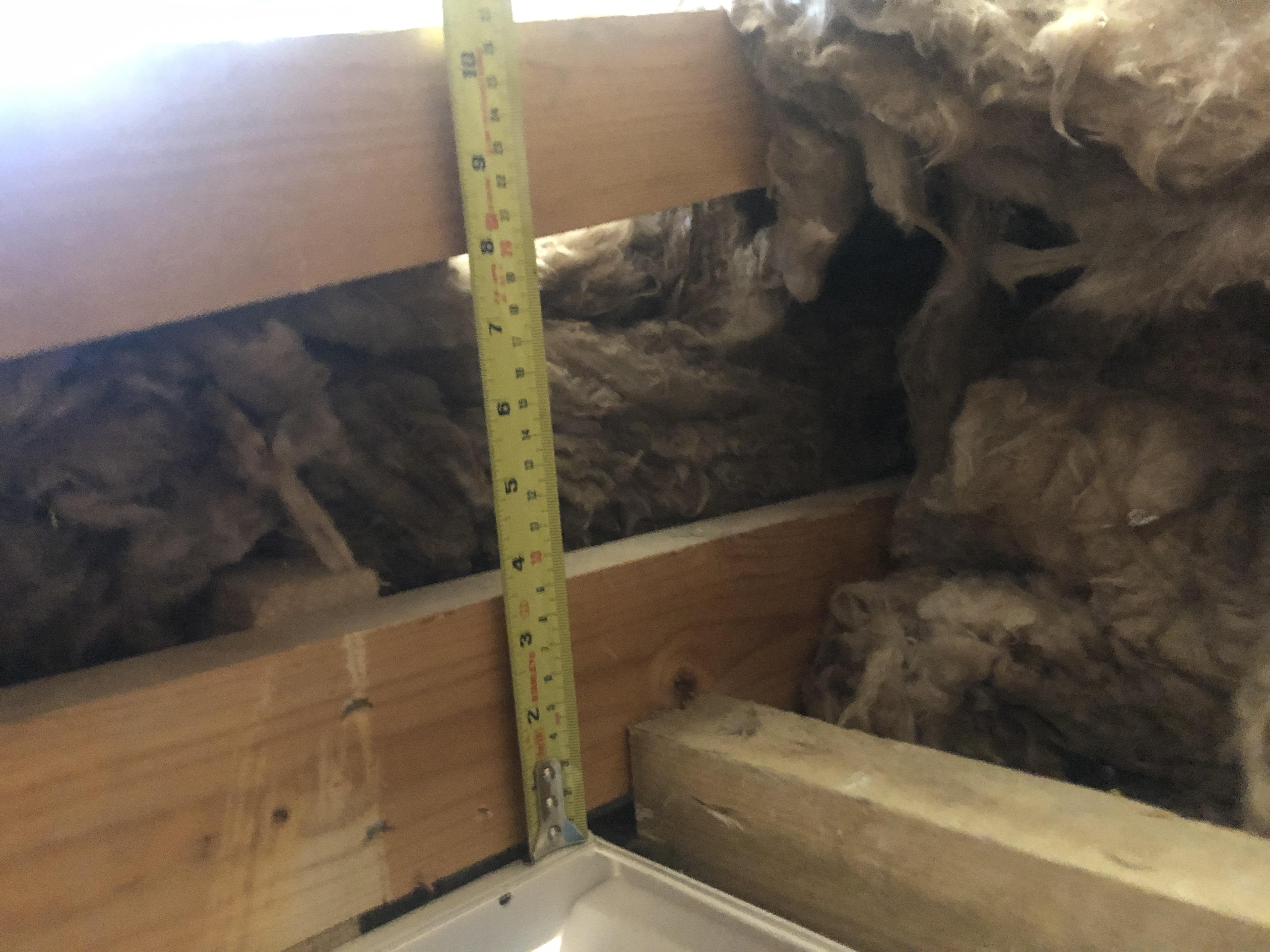
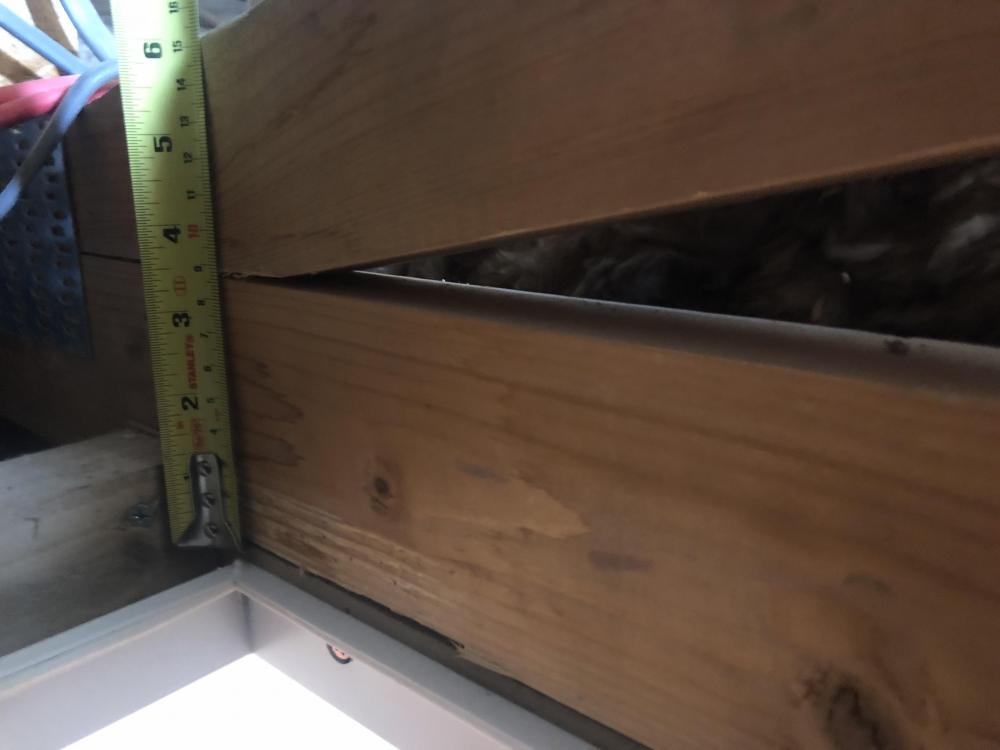
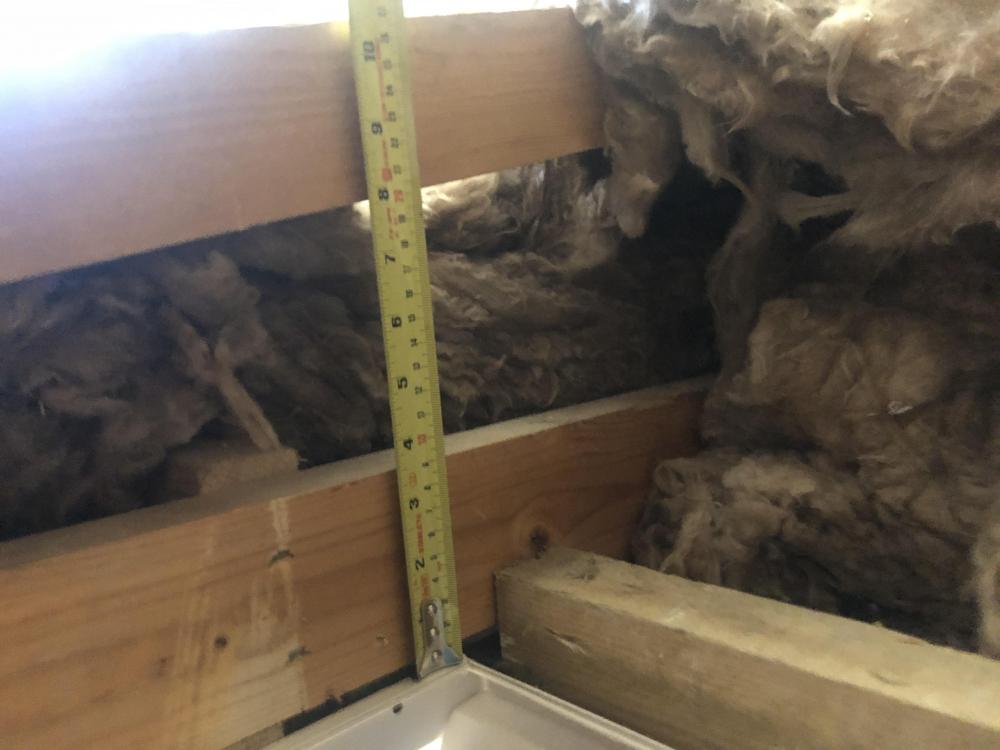
I have two MVHR units in different loft spaces. Really kicking myself for not sticking to my original plan that they should all be easily accessible. Anyway, I had to go up there to change the filters and also the PV is playing up and tripping the MBC. That is another story. We have angled trusses above the ceiling joists (see pictures). They run at an angle of roughly 4:10 Thus the depth of the loft insulation is a bit all over the place. In the centre of the loft near the MVHR and inverters it has been trampled down to the 150mm level. At the edges it is between and above the trusses and so it is over 400mm deep. Really I just want to put a couple of metres of board either side of the hatch to access the equipment. These are the areas most trampled. The loft is almost 30m long so it is a tiny percentage of the area. The builders have attached a small board next to the PV and another is just lying next to the MVHR on the slope. I would rather put something flat, it feels like it is quite easy to slip off. What is the best way to do this? Loft legs won't help. Maybe I buy a long piece of timber and try to notch it every 600mm to the angle of the trusses? In the other loft space the joists are flat. However they fitted the ducting too close to the MVHR to change the filters easily. I got them to come back to look and possibly move the ducts only for the guy to almost come through the ceiling. I found that due to the ducting there was only one place the hatch would go. When the builders put it in they clearly found it too difficult to get a frame around all 4 sides, so didn't attach it on the side where the guy tried to stand. I could make them come back and fix it but sometimes for small things like this I just feel like life is too short.
-
Kitchen layout options - an island too far?
AliG replied to Moonshine's topic in New House & Self Build Design
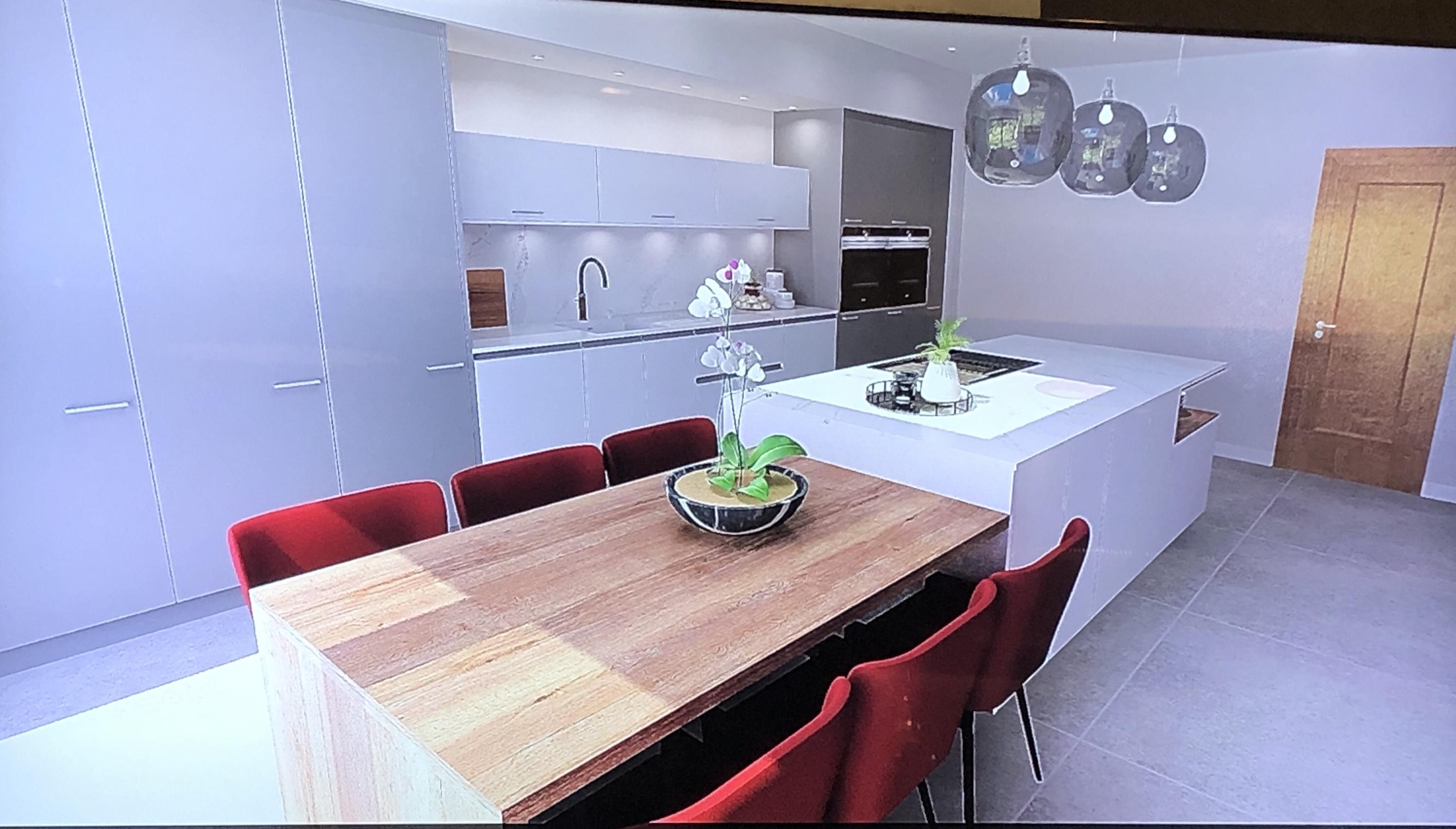
5C would work well, that is not too cluttered. I was hoping to get the hob round to face the breakfast bar, but it would need to be 3-600mm longer and there just isn't room. A 1.8m table with three chairs on each side would probably be a bit more space efficient. You could push one end against the wall to give more room between the peninsular and the table. -
Kitchen layout options - an island too far?
AliG replied to Moonshine's topic in New House & Self Build Design
I think Option 5 works the best. With this design, I would make the wall with the fridge/freezer on it a solid wall of cabinets(at least as far as the sink), put the sink where the hob is and put the hob facing the breakfast bar so you can look out of the window as you cook. This way you can have high mounted oven and microwave and a row of tall cabinets always looks more impressive. It does depend a little on how much worktop you would like. I would maybe go for three seats on each side of the table, it is more efficient with space than having a seat at the ends. Then you could turn the table through 90 degrees and maybe add an extra cabinet or half cabinet to the peninsula. -
Assuming planks plus screed plus possibly plaster underneath you would be heating around 250mm of concrete. This would be very bad for the response time of the heating. You would effectively be heating the ceiling the room below as much as the room above. This would reduce the efficiency of your heating. My compromise was to use EPS rather than PIR upstairs as it is a lot cheaper and I just want to separate the UFH from the concrete planks. It also provides a sound break. All of this means that with concrete planks and upstairs UFH and the suspended ceiling you are looking at a 400mm gap between floors.My architect had allowed for 350mm, hence our ceiling height ended up being around 2.75m rather than the 2.8m I had asked for.
-
Does this work because hotel rooms tend to have small spans so the camber is less of an issue?
-
We have concrete planks on the first floor. We had to frame them out with wood and then plasterboard them. Luckily we had enough ceiling height to deal with this. We had allowed for up to 2.8m ceilings. Over a length of 5 or 6m they have a considerable camber, the combination of this and the gaps at the joins would make it a bad idea to plaster the underside in my opinion. You could end up with places where the plaster had to be over 50mm thick. The space ended up being used for water pipes, cabling, downlight etc. What heating method are you planning for upstairs? We have EPS and then screed on top of the concrete planks for the UFH. This adds another over 100mm on top.
-
OK, I get it. I think it is not required, but recommended nowadays. I would be making sure any such areas are well sealed as they will be a considerable source of cold air. Where we have tiled floors I had then silicon the edge to the skirting board as it looks neater anyway. I also went around the house with an IR camera to see if there were any places where cold air was getting out under the skirting, thankfully there were only a couple of points where I used a thin straw to seal it up with foam. Sorry I cannot help on the cracks. Hard to say if the mortar is totally missing from those joints, or it is just how the picture has been taken.
-
Is that a picture of the back of the outside wall? I am no expert on bricklaying, I am more concerned as to how you could take the picture. Am I missing something, or where is the insulation in the cavity? Also if you can get access into the cavity from behind the skirting board you are going to suffer from very poor airtightness boosting your heating bills. Was there something specific that lead you to know you could access the cavity from here?
-
I really do like them and wish I had paid the extra for our front door where I don't like looking at the hinges. I think it was something like £400 there though. The only thing I notice is that they can sag a little over time and need to be adjusted back to straight. Also the builders have broken the adjuster screws in a couple of them and the there is no way to replace the screw, you have to replace the whole hinge. Other than that, no squeaks or breaks and I love the clean look. Would definitely go for them again.
-
Generally BC will not allow full fill cavity insulation in Scotland. Blown beads seem like they would be the most reliable fill option from my research.
-
They just started a new 40% off sale this week. We got our bathrooms from them at "trade" price which is basically at least 40% off, sometimes more. This brought their prices down to what I could have bought similar items for on the internet but I could buy everything in one place and they would design bathrooms too. List prices are indeed way too high.
-
£38k is still over £1000 a square metre. Does that include VAT? It doesn't seem suspiciously low to me. Does it include kitchen cabinets, floor tiling and so on? I know you didn't ask about this but I have to comment on the shown kitchen/utility room layout. Did the architect design the kitchen layout? Having seen numerous house plans where architects have put a kitchen layout on them, the conclusion I come to is they shouldn't be allowed near kitchen designs. In the utility room the washing macing is behind the door, as it is narrow, if you left the washing machine door open, the utility room for would bang into it. Indeed the front of the washing machine could well be 650mm off the wall by the time you allow for connections at the back leaving only 750mm for the door swing. You'd have e to go into the room and close the door behind yourself to access the washing machine. The washing machine should be directly next to the dryer to allow for the easy transfer of wet clothes from one to the other and also moving it away from the door. You would then position them so that the doors swung away from each other. Generally washing machine doors cannot have the handing changed but dryers often can. Does the kitchen plan propose a tall oven then a hob then a tall fridge and freezer then the sink? Or are the fridge and freezer under counter? That kind of up and down in cabinet height would be very strange. The dishwasher door opening across the cupboard under the sink is not ideal. I would have to think about it, but it just doesn't seem right. Do you need a breakfast bar with 4 seats right next to a table. My initial temptation would be to turn the breakfast bar around and attach it to the end of the table, but a lot depends on how you want to use the room. My personal preference is to put the hob on the bar island, if you can so you can look out into the room whilst cooking. Something like this
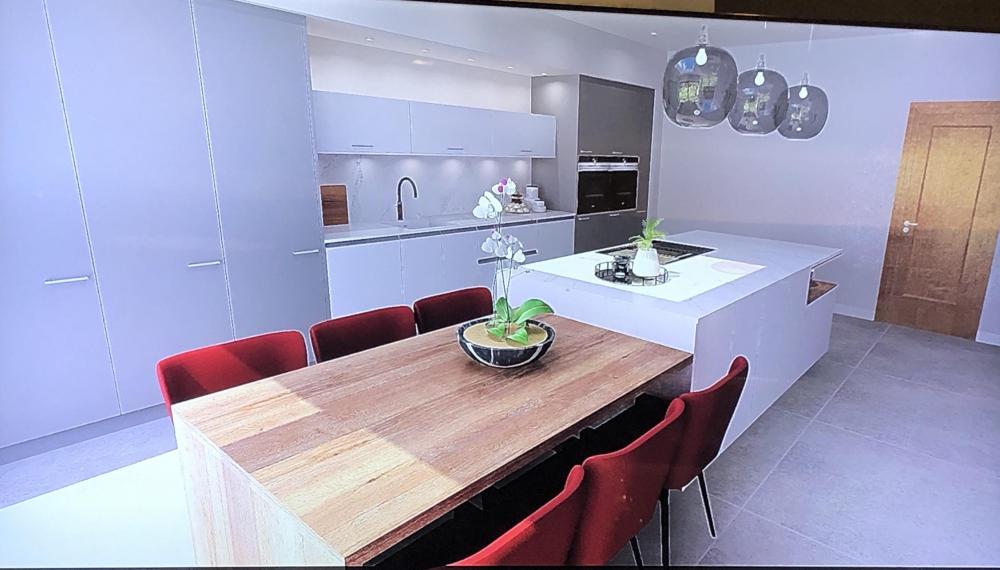
-
Hi @Steph188 they are having a laugh. "The mist coat will cover it" How do they expect a thin coat of paint to cover gouges, rough plastering etc. That is a much worse job than I was complaining about , in fact I think it is probably the worst plastering I have ever seen. We had two rooms that were a problem and one wall in another room. They were all replastered at no cost to me by a better plasterer.
-
I don’t think you have anything to lose. Is the procedure noted down anywhere? You should have a strong argument that the extension is over 200ft from your neighbour so has no impact on his amenity and there are many similar extensions in the area so it is in keeping. Did they put the reasons for not giving permission in writing? Irrespective of what he may have said on the phone you would only have to argue against the actual stated reasons for not giving permission.
-
It is better than this as you can reinvest all the income you make along the way, hence the right way to do is is to use an IRR calculation, which TBF I had not done.
-
I should have done an IRR calculation, the longer you own the panels the less the initial cost matters. If the total cost of the panels was £4000 and you saved £300 a year in electricity then the IRR would be 5.7% over 25 years if you assumed that the system was worthless at that point, in reality it will still be generating electricity and making a return. I have previously looked into the requirement to replace inverters. As far as I understand this is exaggerated and they may well last considerably longer, 10-20 years or even more for microinverters. If you want to assume that the inverter is replaced half way through the 25 years then the return would drop to 4.9%. If you assume that the price of electricity rises by 2% a year then the return rises from 5.7% to 7.7%. If you offset this by degrading the panels by 10% over 25 years then the return would be 7.2%. These numbers are based on using 2300kWh a year from the array. If you got 3000kWh then the returns would be considerably higher, 7.2% would increase to 10.4% for example. This is probably closer to the output you would expect but you might not use it all. The yield to maturity on a 25 year UK government bond currently is 0.7% for comparison. The yield on 5 year bonds is negative! The yield on a 25 year inflation linked bond is -2.3%. This includes the benefit of getting your money back at the end of the period and so is calculated in the same way. Another way to look at it is what mortgage payment could the income cover. £400 a year would cover the payment on £7000 of 25 year repayment mortgage at 3%. You can put in other numbers if you like, but the point is that relative to other low risk investments or to the cost of a mortgage this would be a very good return at today's interest rates. Where solar panels get weird is that despite the nice cash return they make it is difficult to get anyone to pay you for them when you sell your house, so these calculations make sense if you plan to live in your house for 20+ years, but not if you end up selling it and not getting paid for the panels.
-
I am assuming the sun isn't going anywhere and electricity prices inflate over time so it is pretty much a guaranteed return. *prices may go up as well as down
-
I'd like to know what investments your other half has access to. For £3-4k you get an index linked return of 7-10%. If you plan to move soonish then payback might be more relevant, but it isn't a bad return on the investment.
-
I agree with almost everything said. The planning officer seems to be being lazy and saying that if a neighbour objects under this scheme that is the end of it and not actually analysing it. If you apply for full planning permission that shouldn't happen. The vast majority of planning applications get some kind of objection that is not relevant and completely ignored by planning. Your neighbour thinks he is smart, but there is nothing can do to stop a full planning application. I personally don't think you would need a planning consultant as it should be straightforward, although you will need location plans etc drawn up. What direction is his house from your's? If you are south or west of him I would be planting a nice row of Leylandi along the fence to block out some of his light and so you don't have to look at him. There are high hedge rules, but a hedge can get very tall if his garden is 150ft long before it breaches the rules.
-
Window Design & MVHR
AliG replied to Oz07's topic in Mechanical Ventilation with Heat Recovery (MVHR)
The Dyson