


AliG
-
Posts
3211 -
Joined
-
Last visited
-
Days Won
11
Everything posted by AliG
-
Automatic curtain opener recommendations?
AliG replied to readiescards's topic in General Self Build & DIY Discussion
Yes I saw the same thing. the prices are insane. It is just a curtain track with a small electric motor. How do they get to hundreds of pounds. I found these on eBay which are a bit more reasonable but can't comment on the quality. Looks like they'd do the job. http://www.ebay.co.uk/itm/2-7-Meters-276-Remote-Control-Electric-Curtain-Tracks-Free-Fast-Delivery-/231807878284?var=&hash=item35f8d3848c:m:mGz0EjgWbi6Os-ZH9bKzqeA -
Re case storage, recently when I have been on cruise they have raised the beds so that you can shove cases under them. Makes a massive difference as they can take up a lot of room and you can just unfold a big case, leave stuff in it and push it under the bed.
-
Joe at The Media Factory did my current cinema room and they are doing all the media in my new place. Currently I have Octava HDMI over Cat 5 but as you say @Barney12 HDMI distribution is a pain/expensive and I am trying to avoid it in the new place. Previously it saved on Sky Multi room subs, but Sky Q doesn't charge extra for multiple rooms so I have moved to that and cheap Fire TVs
-
I don't know how much you have looked into it, so forgive me if I am repeating anything. These boxes can route the outputs over Cat 5/6 or HDMI. Generally speaking if the distance is over 10M Cat 5/6 is recommended. In this case they do not use IP, they simply carry the HDMI signal over the Cat cabling. So you will need a point to point ethernet connection between the box and wherever the TVs you are outputting to are. In thinking about the same thing for my house, I decided that for guests they could watch Freeview and that it was easier just to put an Amazon Fire or similar on each TV. Thus the only thing that needs distributing is Sky. I believe you can probably watch CCTV across an app also. I decided there was no point in distributing blu ray as I would have to go to another room and put a disk in the machine. If you went along this route then you can save a lot of cash on the Matrix. I can see the attraction of having everything available everywhere though and all the boxes in one cupboard, it depends on how many people are in the house and how they use the equipment. In this scenario, the matrix should work fine. I would still bring a coax cable to each point so people have access to Freeview and you don't all have to watch the same channel as well as an extra ethernet point for smart TV or WiFi extenders. As to recommending a specific Matrix box I think it might be a good idea to ask on avforums.com where people are most knowledgeable on this stuff. It is quite a specialised box.
-
I have a 4x4 HDMI switch at the moment. It is a few years old and I find it a bit slow changing between inputs/outputs. My AV guy tells me the newer ones are much better. It depends on what you want to do. I have various HDMI over ethernet solutions in the current house and they work fine, but I have decided to use Sky Q networked over ethernet in the new place as it is cheaper and simpler. However, currently you can only watch Q simultaneously on three TVs. A switch would allow you to watch simultaneously on more TVs but everyone has to watch the same thing or a couple of things if you connect two sky boxes to it. Everyone watching the same thing is what I had previously but I prefer the the Sky Q solution where people can watch different things in different rooms. The new Virgin V6 boxes allow this also and I believe they can also be networked using ethernet. Sky Q ethernet switches cost around £15 versus £2000! If you can give more detail on what you want to achieve it might help.
-
I guess it is only 1 bedroom so the table is going to be smaller than I was thinking. Like you say important to keep the sightline, it will be a nice effect. In a similar vein you could make the shower room smaller, but there is something nice about having a bit of space in a bathroom. If everything is up for grabs, I assume that the feeling is you want to take the WM out of the lounge and not use one integrated into the kitchen cabinets which will take up less room. Unless you move the WM into the bedroom you are going to end up doing the laundry in the lounge anyway as there won't be room to be fully in the cupboard. That is why I thought putting it in the bedroom side of the cupboard would help, the washing will be in there anyway and it will keep the sound away from the living room which is maybe the reason for putting it in the cupboard. You don't need to split the cupboard into three, simply have a double door wardrobe with the WM in the bottom corner. You'd maybe put a cabinet around the top and sides for neatness.
-
I saw what you had done there with the doors otherwise I would have suggested moving the door to the side of the bedroom where the en suite is and building a wardrobe along the wall between the lounge and bedroom. Now you have brought it up, two things - 1. Will people actually want to be in bed with the door open and the fire on all the way along at the other end. As it's a log burner they'll have to get up to put wood in it. 2. Do you plan to put a table in the lounge? I would think the natural layout includes a sofa that separates the kitchen area from the room. If you want to put a table in there the natural place is in the corner between the lounge window and the bedroom wall. The table will end up across the door. All in all, it is a nice feature but that door takes up a lot of wall space which is already in short supply in the living room. But I don't know your planned furniture layout so maybe just consider that as part of this planning.
-
I'd probably keep the original cupboard and add a small wardrobe in the corner of the bedroom between the window and door. A 450mm deep wardrobe will be almost impossible to use. Of course you could always just buy a wardrobe if you find you need the space once you are in and put it in that corner. The most effective way to put the washing machine in the cupboard is at the front and accessing it from the living room so that you can use the space behind it. You'd need to maybe build a box around it. I am struggling a bit, I can see it is nice to have away in the cupboard but if you put it right inside the cupboard the need to be able to work in front of it is going to waste a lot of room so I think you want it to be at the front of the cupboard. Edited - Actually how about this. If you don't mind the access to the WM being in the bedroom, make the wardrobe 650mm deep and put the washing machine in there. Then you have full length hanging at one side and half height above the WM. You also won't be doing laundry in the corner next to the front door. Then you have a smaller cupboard behind it unencumbered by the WM.
-
When I am at work in London I live in a similar sized apartment. It only has one wardrobe/cupboard in the bedroom. If I could change anything about it, it would be to have two cupboards. It depends on how many clothes you plan to have there and if you have a vacuums, ironing boards etc, but I would want a wardrobe plus another cupboard.
-
I got an infra red camera for the iPhone a few weeks ago. Tried it out on my garage door this morning. The garage isn't heated but gets heat from the room above. Looks like the thing to avoid is windows in the door!
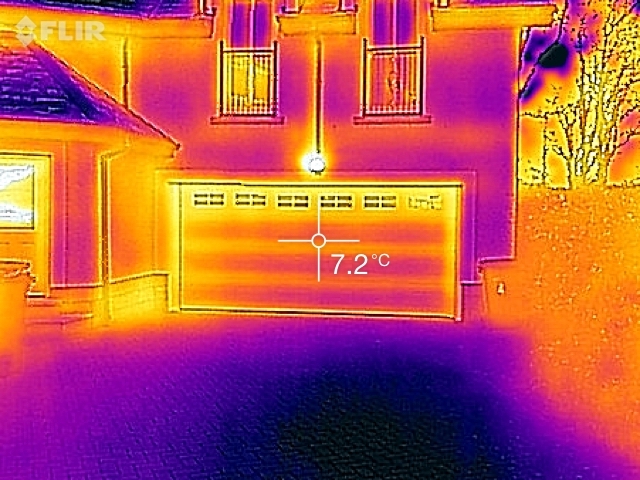
-
I used to use Vonage when we have Virgin cable in our last house. My wife is American so there was a big saving on international calls. They issue you with a phone number and a box which attaches to your broadband and you can then plug a phone into it. Alternatively you can now use an app.
-
See page 12 of Hormann brochure for pic of thermal seals, £257 according to price list http://www.hormann.co.uk/fileadmin/_country/hoermann.uk/kataloge/86 912-Sectional Garage Doors.pdf I am well informed re garage doors this week as I have spent hours pouring over catalogues to try and find someone to make a door which matches the finish on my windows. Should have thought about it when I ordered the windows. It looks like we will have to buy a door then clad it.
-
OK to answer your original question I find the worst point on my sectional door for tightness is the bottom seals. I can't see any light around the edges, but if rain drives into the door it can get underneath it. This is due partly to the threshold not being entirely smooth. I have purchased a rubber threshold seal for the door to seal down onto and stop this happening. It would also help airtightness. http://www.garagedoorseals.co.uk/c-garage_door_threshold_seal.htm You would want some kind of break under this. Even 20mm of PIR like they use around the edge of screed with UFH would be better than nothing at all. You could put this under the rubber seal and I think drive over it without worrying about the weight due to the small width. The rubber seal would span across it. I have a Hormann/Garador 40mm insulated sectional door. It fits very nicely and they are not excessively priced. There isn't much difference between the different sectional doors from what I can see. They do offer a thermal kit to better seal the edges. I agree, integral/attached garage is way more convenient.
-
Yes it would kill your SAP calculation. How often do you actually plan to use the garage as a workshop and will you frequently be opening the door to take cars in and out. Surely if so you are going to lose a lot of heat when you open the door. An insulated Hormann double door has a U-value of 1.4. That's going to be like putting a 10 square metre double gazed window in a room, one with poor draught proofing. The garage is going to have high constant heat losses. In winter the double door will lose around 200W per hour. It is also likely to be a big area. The heat losses from the fabric of the room will be 200W per hour if all of the floor roof and walls are external (assuming 6m x 6m garage) and they have an average U-value of 0.15. It sounds like it is maybe external but attached to the house by one wall. BTW if you are heating it and there is no room above it you'll need to insulate the roof or the heat losses there will be massive. So including air infiltration you are probably looking at 500W/hour to keep the garage warm in winter and a lot more if you open the door, although that will likely depend on the wind direction. Of course a lot of the time it won't need heating when it is warmer outside. So very roughly 12kW/day for half the year, call if 2000kWh. Around £70 a year, not drastic. I'd still be tempted just to run a fan heater when I am actually in there. If it's insulated you won't be heating up from too low a temperature and when you build up a sweet working you can turn off the heat. I find my integral , insulated but unheated garage rarely gets blow 11C no matter how cold it is outside, indeed it stays warmer than the conservatory! Edit - Forgot to mention a fan heater is a lot cheaper than UFH also unless it is already in the slab. Some people will tell you that putting a car in a heated garage will make it rust. Especially if you put a wet salt covered car in the garage in winter. Certainly heat speeds up chemical reactions but it won't be that hot and cars are pretty immune to rust nowadays. BTW I just assumed it's a double garage as it seemed in keeping with the size of your house.
-
Those seem very inexpensive. Am I being unduly suspicious to think they are too cheap. I have been thinking of using Fibaro z-wave switches partly for the same reasons. Switches for outside lights in particular would need routed to multiple rooms so it may be easier to have wireless switches and the cabling saving may pay for the nifty smart home capability. I see this product goes a step further in that the switch is self powered by the kinetic movement. Hence the name presumably! It does seem that often these devices often start to become unreliable after 5 or 6 metres despite quoted ranges. 433MHz is supposedly more prone to interference than 866MHz that z-wave operates on, Jeremy is the one with the real experience. I should get my electrical plans tomorrow from my architect. I will have to have a good look to see if my switches are too far apart for the z-wave devices to create a mesh network. The fact that my interior walls are blockwork and the upper floors are concrete won't help. It looks like I am going to need a Wi Fi repeater in almost every room.
-
Welcome to another Ali from Scotland. I'd just get on with it, the faster it is built, the faster you will be able to enjoy it. Sorry about the builder issues. Do you have permission for the new design all sorted?
-
Thanks, that explains why charging is around 2kW. Presumably a 3kW charger can be fitted where a 13A sockets existed without having to change the wiring and getting you a modestly faster speed. The Tesla wall connector page on their website suggests that it uses 3-phase. It says 7kW on 1-phase and 11kW on 3-phase which can be increased to 16.5kW if the car itself has the fast charger option. As an aside I recently had an overnight test drive in a Model X. It was lovely to drive but I decided against it for a few reasons, mainly price after the recent massive FX induced price increases. It is a shame as drove a left hand drive one which was awful before the price went up.
-
A 13A socket has a theoretical charge rate of 3kW, although the link to Chargemaster suggests that it probably charges at around 2kW which seems about right. I would think the most popular charging option is going to be 30A, 7kW. This would involve similar work to any appliance in the house requiring a 40A fuse. the 22kW option requires a three phase power supply as it can draw more than 100A. Renault provide a page showing charging times with different charger options here. https://www.renault.co.uk/vehicles/new-vehicles/zoe-250/battery-and-charging.html They offer 2 batteries, 22 and 40kWh. Roughly you can divide the battery capacity by the charging rate to get the charging time. The largest battery you can buy at the moment is probably the 100kWh Tesla. To this would take 33 hours on a 3kW supply, and 14 on a 7kW supply. Tesla max home charger is 72A or 16kW. Tesla superhcarger connect direct to the battery and can charge at a rate of over 100kW but have to slow down for the last 20% of battery capcity to protect the battery The charger you should install depends on your driving pattern, your willingness to pay for it, your patience and your electrical supply. 3-4 miles a day would be fine on a 13A socket, but there would be times when you drive 40 miles and then want to recharge quickly and do it again. A Zoe 22kW has a practical range of just over 100 miles and would take 11 hours to charge from a socket if it was empty. Personally I am going to be installing cabling for 30A chargers in my new place but for your use case you might not need anything.
-
I wonder if the 5 zones really is a sticking point. We have a 5 zone hob, I don't think we have ever used more than 3 at once. Most cooking is done in the oven. The wider hobs look more flash, I reckon that is why people buy them. A wide 4 zone hob is probably fine for most people. I discussed the Bora with our kitchen designer. She too mentioned that a Siemens product is imminent. The main issue of concern for me would be that the hob is 196mm deep so I would lose a drawer below the hob.
-
Drying Towels in an MVHR fitted bathroom
AliG replied to TerryE's topic in Mechanical Ventilation with Heat Recovery (MVHR)
+1 hand blade also Exactly the same in my house. I hardly get the towels wet, the other two members of the family soak them. My daughter also manages to leave half the contents of the shower on the bathroom floor. Until we get into the new house, we have no MVHR, just central heating. I just chuck the towel over the shower screen and it is dry the next morning. However, other members of the family tend to leave the towel rolled up and it stays damp. Thus a towel rail will help if it encourages the towel to be hung up properly. If it is stuffed into the towel rail all scrunched up it won't dry out. But it probably doesn't need to be heated, just a place to properly hang up the towels. -
You have piqued my interest in these products. Why is the Elica inferior? I cannot find any specs on the Bora website
-
There appears to be a similar product made by Elica https://www.youtube.com/watch?v=BrkLF-B3kE8 It is £1700-2500 depending on model
-
The Bora product looks interesting. I tried Googling Bora but they appear to be one of the annoying companies that don't allow people to publish prices. I found many suggested prices, there is a Bora Basic on Ebay at £4999. An article on House suggested a price of £2700 including VAT. This would be interesting as it isn't far off the price of an induction hob plus a large ceiling extractor. I find this extremely annoying. It is a standard mass produced product, thus there is no reason to keep the price some kind of secret. Surely any benefits in controlling the price are lost in way lower volumes. If resellers want to compete away their margins why should the manufacturer care. Sorry for my reaction, but it is a pet hate as I believe not publishing prices considerably wastes my time and am also very suspicious of the motives of people who don't publish prices.
-
That's a fair point, my PIR is in the cavity and a lot of the pieces aren't quite flat so the thickness varies. You can get away with this in the cavity but it would be a problem inside a timber frame. Not sure if 2x70mm would help this though. It is probably easier to bend back into place.
-
Other than the weight issue you have mentioned and any structural issues I might not be aware of- If you run the Celotex U-value calculator and change between standard blocks and thermalise blocks for the outer skin it only suggests a 0.01 U-value difference. I have the same issue, I am using Porotherm blocks. In reality I probably could have saved and used normal blocks for the external skin as it adds little insulation value.
