

Dreadnaught
-
Posts
1806 -
Joined
-
Last visited
-
Days Won
5
Everything posted by Dreadnaught
-
 Thanks to you all. To add: The purpose of this motorised sun shade is decorative and to reduce solar gain. But I am not interested in other solutions to reduce solar gain; my purpose here is to ask about how to build this motorised sun shade I am not keen on roller blinds. I am after a horizontal panel the slides over the skylight, powered by a motor and, I assume, sitting on rails This will likely be a DIY job reusing bits-and-pieces from other applications.
 -
From a cursory reading of the Wikipedia page on Aragonite (a term with which I was not familiar), it is clear that Aragonite is a solid crystalline form of calcium carbonate. Its a solid mineral, a form of stone, not a compound in solution. I conclude therefore that the use of the word, Aragonite, above by Polly seems to be a misuse of the term for purposes associated with commercial marketing. To me, this whole thing looks like an example of pseudo science.
-
Congratulations on this step in your publications journey!
-
Calling the ingenious engineers on BuildHub! I have a vision for a motorised sun shade for my skylights: The skylights are completely flat, about 900mm x 2000mm, and will sit on a flat roof above my living room The sun shade will be a sheet of thin metal (or other suitable substance) bigger than the skylight through which is cut a pleasingly random pattern of holes to allow dappled light effect beneath The sheet of metal itself would be suspended horizontally perhaps an inch or two above the glass of the skylight without touching Importantly, the sheet would be mounted on motorised wheels so could retracted at will to allow the light to pour in I wonder, what off-the-shelf parts could be cobbled together to make this? My own first guess was the parts used for motorised sliding gates but I suspect there are better ideas. What do you think?
-
EPS insulation everywhere. I would worry about summer over heating. Its perhaps not necessarily the right place to mention this but the decrement delay of EPS is inferior to, for example, blown cellulose, making it harder to design a building that will remain cool in summer throughout the day. Of course, the passive-house standard only requires a crude limitation of over heating (<10 of hours over 25ºC per year), which is too high in my opinion, and the standard is silent on the subject of decrement delay as it is agnostic in regard to any building material or system. Otherwise it looks like an impressive system.
-
Ceiling height for open-plan room
Dreadnaught replied to Dreadnaught's topic in New House & Self Build Design
At its closest the new house is is 5030mm from the chestnut tree. In all, about 2/3 of the new house's foundations are outside the root-protection zone. Cannot post a site plan to a public forum quite yet. Should be able to do so in a few weeks time. -
Ceiling height for open-plan room
Dreadnaught replied to Dreadnaught's topic in New House & Self Build Design
@jack good idea. But the neighbour/vendor is particularly concerned about light pollution. They have a raised patio at the house end of the garden, directly looking towards my plot and, despite it being in the middle of the city, the site is pleasingly dark at night. Thus any window directly pointing at them is to be avoided. Very good point. The roof lights need to be well designed to be a benefit and not a curse. I hope I am up to it. -
Ceiling height for open-plan room
Dreadnaught replied to Dreadnaught's topic in New House & Self Build Design
@PeterW, thanks, I would dearly love to do that. Unfortunately, I am no-dig over a large part of the site because of the roots of a chestnut tree just outside the plot boundary. As a consequence, and because of clay about 3m down, the foundations will be: screw piles and ring beam over a 150 mm void to passive-house floor cassettes. At least that's the current idea. I have changed my mind a few times already. Although its no-dig, I think that no-dig does not mean no digging at all. I think 200mm might be permissible in the context of preparing the site. If anyone else has experience of this, I would be very interested to hear. -
Ceiling height for open-plan room
Dreadnaught replied to Dreadnaught's topic in New House & Self Build Design
By window I mean a normal window in a wall, rather than the roof. It is because the plot is a garden plot and is overlooked by neighbours (one of whom has an effective veto on the design as he is the vendor). To compensate for the lack of windows in the walls I am planning multiple sky lights in the flat roof. -
Ceiling height for open-plan room
Dreadnaught replied to Dreadnaught's topic in New House & Self Build Design
Original poster (OP) here. Wow, thank you all for your contributions! I have read through them twice. The consensus is clear: go for height. And I am inspired to try and do something imaginative with the ceiling/roof, not just a flat-roofed box. -
@vivienz when I was speaking to PYC about scaffolding, they mentioned that they can erect a single story without scaffolding if needed, using a fork lift or something similar, and could place other safety features, such as crash mats and air safety mattresses, to protect any workers working at height without scaffolding. Hope you can find a similar solution. Great photos!
-
https://www.ecoledlight.co.uk/product-ranges/?
-
Ceiling height for open-plan room
Dreadnaught replied to Dreadnaught's topic in New House & Self Build Design
Yes, that is an interesting idea. I hadn't thought of that. -
My new build will have a large-ish open-plan room and I am wondering what ceiling height would be best. Its a perfectly rectangular room, 9515mm by 5174mm to contain, in a row: kitchen, dining table, sitting area. Its a modern bungalow and the roof above is flat. One unusual feature is that there is only a single external window in this big room, high on one of the short sides above the kitchen units. To compensate there will be at least two large roof-lights (each 2400 mm x 900 mm, flat glass), possibly three. Its a passive house so the roof will be thick (about 550mm). What ceiling height will give an airy feeling with a sense of good proportion and no sense of claustrophobia? The minimum of 2100 mm would feel too low, I think What about 2400 mm? What about 3000 mm? I had originally even contemplated 3600 mm but it looks like that will make the ridge height too high, so I will not get approval Advice appreciated.
-
And if they were blue-tinted glass, they could work even better. The 150 Cheapside building in London got there first… 150

-
Of course, blinds and overhangs can have the other advantage of allowing passive solar gain in the winter months, when it will be welcome, unlike film.
-
I wonder of its to do with ageing. With new film, @JSHarris point would be right. But what about some years hence, with potentially ragged and patchy film. Could the stresses from areas of hotter and cooler glass then cause a problem I wonder? Similarly, what if it was a poor quality installation of film, with areas of hotter and cooler glass, could the stresses be problematic?
-
The tale of the sale of our old house
Dreadnaught replied to Jeremy Harris's topic in General Self Build & DIY Discussion
@JSHarris "Greg Jackson. Greg is founder and CEO of Octopus Energy." Might he benefit from hearing from you? -
Off the top of my head: 180º - (45º - 15º) = 150º ?
-
Here it is:
-
Iresa have ceased trading
Dreadnaught replied to Jeremy Harris's topic in General Self Build & DIY Discussion
From http://www.iresa.co.uk … Iresa Limited will be ceasing to trade. Ofgem, the energy regulator, is appointing a new supplier for its customers. Customers need not worry, their supplies are secure and credit balances are protected. Ofgem's advice is not to switch, but to sit tight and wait until the new supplier has been appointed. This will help make sure that the process of handing customers over to a new supplier, and honouring credit balances, is as hassle free for customers as possible. Customers can find support and advice from Ofgem here. Or alternatively if they need additional support they can call Citizens Advice on 03454 04 05 06 or email them via webform, or get in touch through Ofgem’s facebook or twitter feed @ofgem -
Addendum: Fibaro, the maker of the above sensor, has instructions for using a 2-way normally open solenoid for turning off the water supply if a sensor detects a leak… https://manuals.fibaro.com/knowledge-base-browse/homekit-close-the-water-valve-if-leak-detected/
-
There are these flood sensors. £65-ish. But they would only catch a leak in one location and not turn off the supply (unless you had home automation for doing so). https://www.apple.com/uk/shop/product/HLPS2ZM/A/fibaro-flood-sensor-homekit-enabled

-
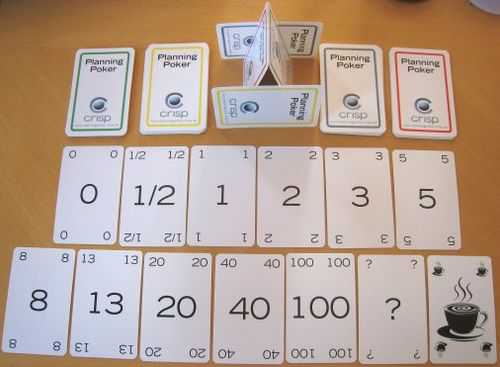
For the uninitiated, this is planning poker for estimating work. It should be along side the drill bits in every toolbox?
-
I would be fascinated to see agile principles used in a building project. I was tempted myself, even just in my current design phase. But I have mostly shied away from deviating from the standard ways. I did choose my team (architect, etc.) while looking for evidence of at least some affinity for agile-style working practices. Even now I struggle to get anyone involved to value saturated communication. The culture is a million miles away form anything agile.