


Dreadnaught
-
Posts
1819 -
Joined
-
Last visited
-
Days Won
5
Everything posted by Dreadnaught
-

ASHP 101, how does a reversible heat pump work?
Dreadnaught replied to Dreadnaught's topic in Air Source Heat Pumps (ASHP)
Thanks @JSHarris. Four-port reversing valve the magic words that makes it all make sense. Does anyone know of the relative efficiency in each of the two directions, heating and cooling. I have read somewhere that heat pumps are optimised for one direction, either heating or cooling, and quite majorly so. -
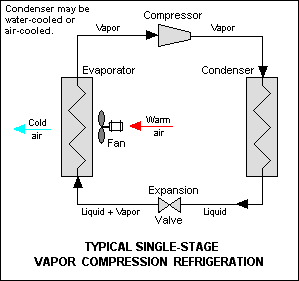
Beginner's question. How does a heat pump reverse to both heat and cool? Is the following correct? Simply put, a split heat pump comprises: outside: a heat-exchanger coil and a fan, which is connected to… gas piping, with a compressor, which is connected to… Inside: if it is air-to-air, another heat-exchanger coil and fan if it is air-to-water, a plate heat exchanger which is connected to liquid piping and a one-way valve, which is connected to (1) above to close-the-loop (Circulating from outside to inside is not water but refrigerant.) From Wikipedia: So far so good. For cooling it makes sense. But how does the system go in reverse to heat the inside? It would seem to me you would need to physically swap the circuit around. I am sure this is just a problem of over simplification but is there someone who can explain it in simple terms?
-
How much of a difference does 3g make over 2g?
Dreadnaught replied to Juj's topic in Windows & Glazing
Beware, west-facing windows can still be a problem for overheating because the sun is lower when it is in the West and so the sunlight penetrates more deeply into the thermal envelope. Westerly (early evening) sun is also more of a problem than easterly (morning) sun because by the evening the building is already hotter. (I learnt this by reading about shading affects for passive houses and modelling my own build in PHPP.) On the subject of 3G vs 2G, for me its a philosophical decision of whether to adopt the principle of a fabric-first approach. Fabric-first prizes comfort above all, as does 3G. -
That's a shame. Surface rust on tools can generally be restored. In the right hands of course. My father, as a minor hobby, buys boxes full of rusty tools and takes pride in restoring them to as-new condition.
-
Both FIT AND export payments to be cancelled next year
Dreadnaught replied to Jeremy Harris's topic in Photovoltaics (PV)
Would the use of such solutions for boats and RVs meet Building Regulations and electrical safety standards required for UK buildings? -
Adding to this, the original innovator was Toyota and the Toyota Production System (TPS) in the 1960s. For those interested, this Wikipedia page lists the principles that emerged, https://en.wikipedia.org/wiki/Toyota_Production_System, the main headings for which are: Continuous improvement Respect for people Long-term philosophy The right process will produce the right results Add value to the organisation by developing your people and partners Continuously solving root problems drives organisational learning Of these six, I suspect that the UK building culture follows none of them. Culture in organisations and industries is a fascinating subject. Culture is hard to change. Jeffery Liker's classic book called The Toyota Way does the whole subject justice. (Out of interest, the TPS directly led to the advent of both the agile software-development approach and the lean (just-in-time) production approach, both of which are now widely adopted across many fields. I am part of a company that follows the agile software-development approach.)
-
On the subject of doors, @lizzie you've also got those rather lovely magnetic door latches. I liked those. Nothing protrudes from the door.
-
@richi Could you spell out those abbreviations for the uninitiated?
-
Both FIT AND export payments to be cancelled next year
Dreadnaught replied to Jeremy Harris's topic in Photovoltaics (PV)
Out of interest, what might those typically be? -
Both FIT AND export payments to be cancelled next year
Dreadnaught replied to Jeremy Harris's topic in Photovoltaics (PV)
I was under the impression that the use of backup batteries during a power cut was prohibited to protect power-line workers. Has the situation changed? Or would your system be isolated from the grid? Or perhaps I was just mistaken. -
Both FIT AND export payments to be cancelled next year
Dreadnaught replied to Jeremy Harris's topic in Photovoltaics (PV)
What are the all PV fitters, used as they are to grabbing the FIT benefit from the customer, now to do? -
Welcome, what part of the country is your house?
-
Congratulations! Lovely plot. Perhaps a spot of rewilding? Native broadleaf? Beaver? Perhaps even lynx?
-
Ventilation Rates Issue
Dreadnaught replied to worldwidewebs's topic in Mechanical Ventilation with Heat Recovery (MVHR)
Could there be a control system that attempts to anticipate when the windows are open (exceptionally low back pressure) and reduces fan speed? I have seen a heating systems that tries and identify when a window is open and reduces the heating load to save energy. Just a guess. -
At the risk going off topic, I was in CostCo today. Do we really need all built-in appliances any more. For an oven, a worktop halogen oven (<£40). For a hobb, worktop portable induction pads (<£50 each, have a few). Perhaps not for everyone but I'm tempted. A positive article on halogen ovens: https://www.independent.co.uk/life-style/food-and-drink/features/how-i-fell-in-love-with-halogen-ovens-2098619.html.
-
Water connection
Dreadnaught replied to recoveringbuilder's topic in General Self Build & DIY Discussion
Ben Adam Smith, of the House Planning Help podcast and coming towards the end of his own build, posted this on twitter yesterday: -
PC (or PC sum) = a prime cost sum is an allowance for the supply of work or materials that will be nominated by the client.
-
I am no expert but you might find this podcast interesting. Ruth Butler, the owner of the building but also an architect herself, discusses her contracting approach, which was to allow the contractor are margin but not give him any flexibility to choose items. You could possibly use her approach. By the way, I have visited her finished home in Sussex. Well worth a visit if you are in the area. http://webuildacademy.libsyn.com/ruth-butler-why-ruth-went-passivhaus
-
TMV = thermostatic mixing valve: a valve that blends hot water with cold water to ensure constant, safe shower and bath outlet temperatures, preventing scalding.
-
House Cooling ideas
Dreadnaught replied to mike2016's topic in Energy Efficient & Sustainable Design Concepts
Don't have a house yet. My house is on the drawing board. Need to decide what to buy for it. Oh? What does £20 buy? -
House Cooling ideas
Dreadnaught replied to mike2016's topic in Energy Efficient & Sustainable Design Concepts
Some thoughts on enthalpy heat exchangers: Inside humidity typically only really becomes a problem in the heights of summer or the depths of winter In the depths of winter, the cold conditions lead to very low amounts of water in the outside air I have heard of people rejecting the entire Passive-House concept because of low inside humidity in the depths of winter, causing nose-bleeds with family members, etc. This is often caused by too much air flow and nothing to do per se with not having an enthalpy heat exchanger. Once air-flow rates are adjusted the problem usually goes away For sensible heat, efficiencies of heat recovery can be as high as 95% for good normal models. For an enthalpy heat exchanger, the efficiency of sensible heat exchange is reduced, often to around 84% For an enthalpy heat exchanger, the efficiency of latent heat recovery is only about 65% in the best cases as far as I have seen, not higher For an enthalpy heat exchanger, the combined efficiency figures often exceed 100%. That is, it reduces the consequent evaporative cooling indoors required to re-atain an equilibrium level of humidity An enthalpy heat exchanger will reduce fluctuations in the inside humidity level in relation to that outside, nothing more But, based on what I have said, this increased stability will only lead to more perceived comfort at the extremes And its not a magic bullet. Internal humidity will still be a complex product of the changing balance of sources and sinks of moisture combined with the effects of moisture added or removed by ventilation Given all this, I am unsure whether its worthwhile getting an enthalpy heat exchanger. As always I am concerned foremost with comfort, not energy. And the cost does not matter either. Will I notice a difference with having an enthalpy heat exchanger or not? Is it worth it to cater for the occasional day in mid winter or mid summer? I don't know. The geek inside me wants one; the realist resists. Views? -
House Cooling ideas
Dreadnaught replied to mike2016's topic in Energy Efficient & Sustainable Design Concepts
I will need to do all my drying inside the house. I'm adding one of those ceiling drying rails in my laundry room. I have limited outdoor space. I considered a MVHR linked drying cupboard and would still like one. My PHPP assumes 3.5 kWh of useful energy per drying event and 57 such events per year. About 200 kWh in total of cooling per year. Not much. -
House Cooling ideas
Dreadnaught replied to mike2016's topic in Energy Efficient & Sustainable Design Concepts
My observation was from this quote "Usually activates based on automatic external temperature point e.g. 21°" from this document from Zehnder, https://www.zehnder.co.uk/download/102348/en_uk-63373.pdf. They might have been simplifying. -
House Cooling ideas
Dreadnaught replied to mike2016's topic in Energy Efficient & Sustainable Design Concepts
To swap the heat exchanger is quite a few hundred quid I think but if you buy the enthalpy exchanger when you buy the MVHR, the marginal cost is a lot less, about £2 - £300 I think. Some models, like the Paul Climos 200, come with the enthalpy exchanger as standard. Swapping by the way is usually a trivially easy procedure. I am exploring how enthalpy-exchanger-based MVHRs are treated by PHPP. For sensible heat, an enthalpy heat exchanger is less efficient than a normal one. Say 84% compared with 94% for a normal one. But once latent heat is included, overall energy efficiency of the enthalpy heat exchanger exceeds that of a normal one. I am not sure whether that is fairly represented in PHPP. Commonly, humidity (the moisture content of the air) complicates simple energy calculations and is often overlooked. -
House Cooling ideas
Dreadnaught replied to mike2016's topic in Energy Efficient & Sustainable Design Concepts
In reading the specification of some MVHR units, some seem to trigger the summer bypass solely on the basis of an external temperature. Some seem to be based on a algorithm linked to internal and external temps. I wonder if any take notice of humidity or other characteristics. (And, as mentioned before, some don't have a summer bypass at all. And instead say they have a "simulated" one, which as far as I can tell means simply turning off the extract fan).

