
Dreadnaught
-
Posts
1819 -
Joined
-
Last visited
-
Days Won
5
Everything posted by Dreadnaught
-
Scratching my head about what to get on with now that the World has stopped. My timber frame and foundations are being designed as I write. All well there. The council, slow even before Covid-19, has basically now stopped altogether so my submission for discharging-of-planning-conditions has not even been validated after a week. And I don't have permission to start anything as some of the conditions were prior-to-commencement-style conditions. What about digging the service trenches in the access road? It is an ideal time with no traffic. It is a 40-metre water pipe. And two sewer connections (storm and foul). Can I at least get on with those? By the way, is trenching in the access road any concern of building control? The access road is not my property and is not an adopted road. Its not owned by anyone. (I have not appointed building control as yet as I haven't got my building regs drawings.)
-
Following with interest as I am thinking of a similar long run. Pre-insulated pipes?
-

architect; AT and SE near cambridge
Dreadnaught replied to Balraj Appadu's topic in Surveyors & Architects
Welcome @Balraj Appadu. I am building in Cambridge. You can't throw a stone without hitting an architect in Cambridge it seems. Loads of them to choose from, although they tend to be at the top end price-wise. It depends if your after full service and expensive (£75+VAT per hour and upwards), in which case you have lots to meet and review. I am sorry to say I haven't come across an independent AT in Cambridge. For my build, my architect lives in Wales. For SE, sadly I can only tell you which engineering firm not to use (the one I used for my drainage calculations). In my experience, an SE will generally come with the architect or AT you choose. They usually have their favoured ones to use. And SE's don't need to be local as they don't visit the site but instead work from drawings (again from my experience). If you can describe what service you're after and the type of project, I might be able to give you a few ideas to start you off. -
Marching as quickly as I can toward starting. Planning permission received last November. Just submitted docs to discharge the planning conditions. That submission times-out mid May. It will be interesting to see how quickly the planning department responds. I offered the LPA Tree Officer to have a Covid-19-suitable conference call rather than the site visit specified by the planning condition.
-
That's helpful, thanks @joth. I had assumed all my PD rights were removed but now I see that is probably not the case. Thank you!
-
Any other ideas on my three questions would be welcome.
-
Thanks @joth. This is the condition in my planning approval letter: "14.Notwithstanding the provisions of Schedule 2, Part 1, Class A of the Town and Country Planning (General Permitted Development) Order 2015 (or any Order revoking and re- enacting that order with or without modification), the enlargement, improvement or other alteration of the dwellinghouse(s) shall not be allowed without the granting of specific planning permission. Reason: To protect the amenity of occupiers of adjoining properties (Cambridge Local Plan 2018 policies 52, 55, and 57)." The way I read that, is that if wish to add an ASHP then it required specific planning approval as it is an "alteration". Am I wrong?
-
At the very least I can thank you for your kind contribution . (And I amended my poor phrasing too.)
-
yes, Ferdinand. I did know that. Hence trying to squeeze a few extras under the one fee ?.
-
Is it necessary - Cooker Extractor Hood
Dreadnaught replied to canalsiderenovation's topic in Kitchen & Household Appliances
To be honest, I am not sure I do either. I am mainly installing one in case I sell-up and a buyer wants it. -
Is it necessary - Cooker Extractor Hood
Dreadnaught replied to canalsiderenovation's topic in Kitchen & Household Appliances
This is what I am planning to install. Not a hood: -
I am getting close to starting. My latest job is to discharge the planning conditions. I have nine to discharge and I think I have now written drafts for all nine of them (including copying bits from when a neighbouring boathouse discharged their conditions for a rebuild about a year ago). But I also have a few non-material amendment (NMA) items to get through. And I have no idea when, or indeed if, to do these. Question 1. The NMA items I have are: slight resizing of a few windows and rooflights, some tweaks to the drainage runs disclosed to the SUDS people, and the addition of an ASHP. By the way, I know its a bit of a stretch to get an ASHP through on a NMA but perhaps its worth a try. What does everyone think? Question 2. (By the way, my permitted development rights were removed as I am in a Conservation Zone). Here's question 3. To save money on the fees (£114 per go on a group of discharges), could a sneak these NMA items through as a discharge of Condition 2, which reads: "2.The development hereby permitted shall be carried out in accordance with the approved plans as listed on this decision notice"? See what I mean. Any comments or thoughts gratefully received.
-
@LA3222, forgive all my questions but I am very interested in your experience: What is the red sheet? Is it just a thick grade of polythene? How are joints handled with it? Mandated overlaps? Just taped? And how are penetrations handled? What did you use for bonding the EPS? Approximately whereabouts in the country are you? Its a good and innovative Tanner raft-design as you show in your other post (hope you don't mind me linking to it to help others), nice and thin concrete profile. EPS cut by Kore.
-
Perhaps the key question is whether your build progressing more slowly than planned, or even stopping for a period, would be a problem for you. For example, if your works mean that you both your kitchen and living room might stand open, exposed to the elements for an extended period, then that might be a problem if you were still living there. In my case, with a new build, slowness will be fairly un-problematic.
-
Difference between Kingspans Thermafloor and Thermawall
Dreadnaught replied to dnb's topic in Heat Insulation
The compressive strength of PIR is an interesting one. Speaking to Hilliard Tanner he was saying that PIR is not used for load-bearing foundations, not because it could not take the weight but because it has not been thoroughly characterised. Its physical properties under load are not sufficiently well defined for it to be used. Unlike for EPS. (I am going to use PIR to insulate my insulated reinforced-concrete-raft foundations because the insulation will not be load bearing as I will have screw piles). -
Very informative, @LA3222. Thank you! Water goes out of the house for what reason? Just an outside tap? Will you have any drop-downs in the slab for door mats, door thresholds, shower wastes, etc? Any cables or conduits going through the slab to floor boxes or to a kitchen island? Are you having a heat pump? Where do those pipes go?
-
Really nice job! I'm looking very closely as I'll be doing mine before too long. Those photos are before the installation of the UFH pipe? Is that 3x stack pipes? And what looks like three service conduits (green, blue and black), presumably in the area of a kitchen/utility?
-
Groundworks quote: prices OK?
Dreadnaught replied to Dreadnaught's topic in General Construction Issues
Thanks for asking. Yes, all is well. Long story short: I had to change the design of my bungalow to have a green roof and pay for some expensive water calculations to convince the local SUDS-officer to agree to me being able to discharge storm water to the local drain. Quite a palaver but got there in the end! -
Groundworks quote: prices OK?
Dreadnaught replied to Dreadnaught's topic in General Construction Issues
Photo of the plot to give an impression of how overgrown it is. (Ignore the two small trees, I'll have someone else take those down).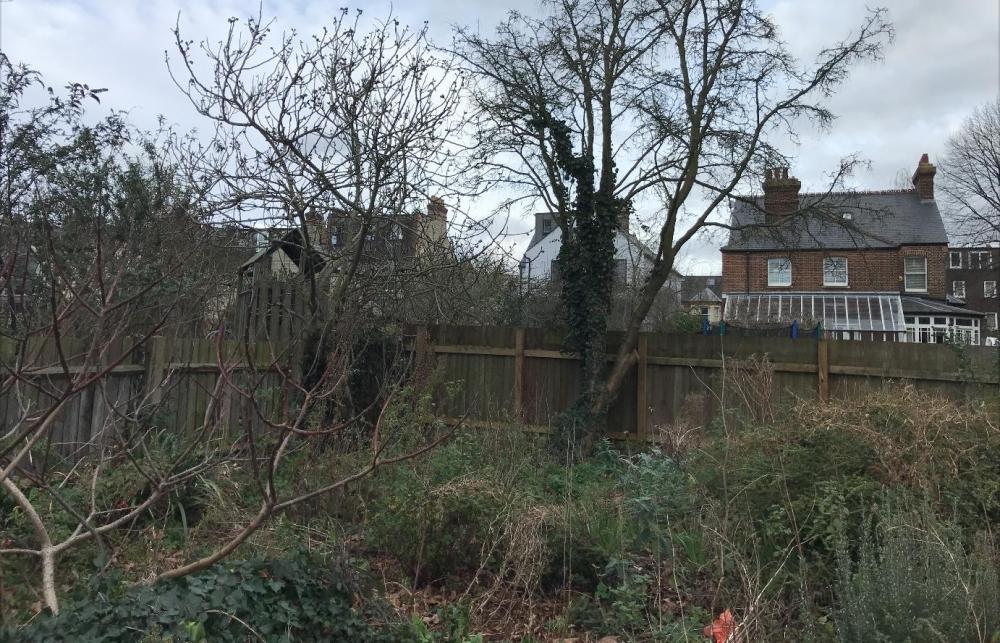
-
Groundworks quote: prices OK?
Dreadnaught replied to Dreadnaught's topic in General Construction Issues
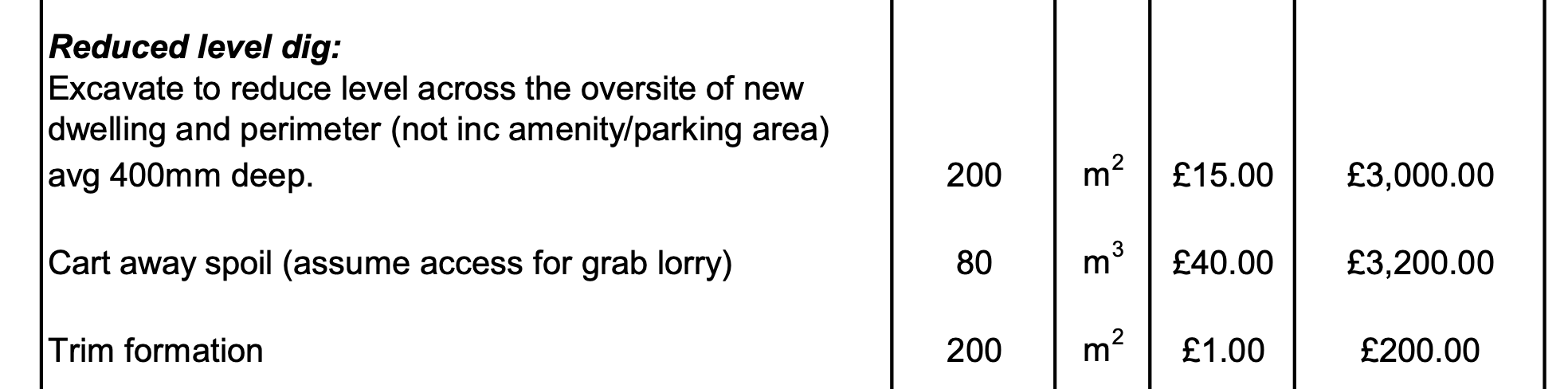
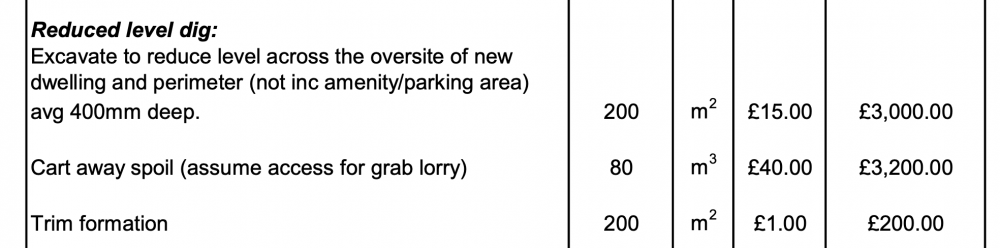
Thanks @Drunkenmunkey. Very helpful. Not heard of NEC contract before. Looking at it now. Thanks for the warning on those items. Hand't noticed they were "allowances". No not level yet. Just a back garden, photo below. The site does undulate by about 400 mm because it has the concrete foundations for an old greenhouse. That's 200 m squared not cubed I think. No traffic management needed. -
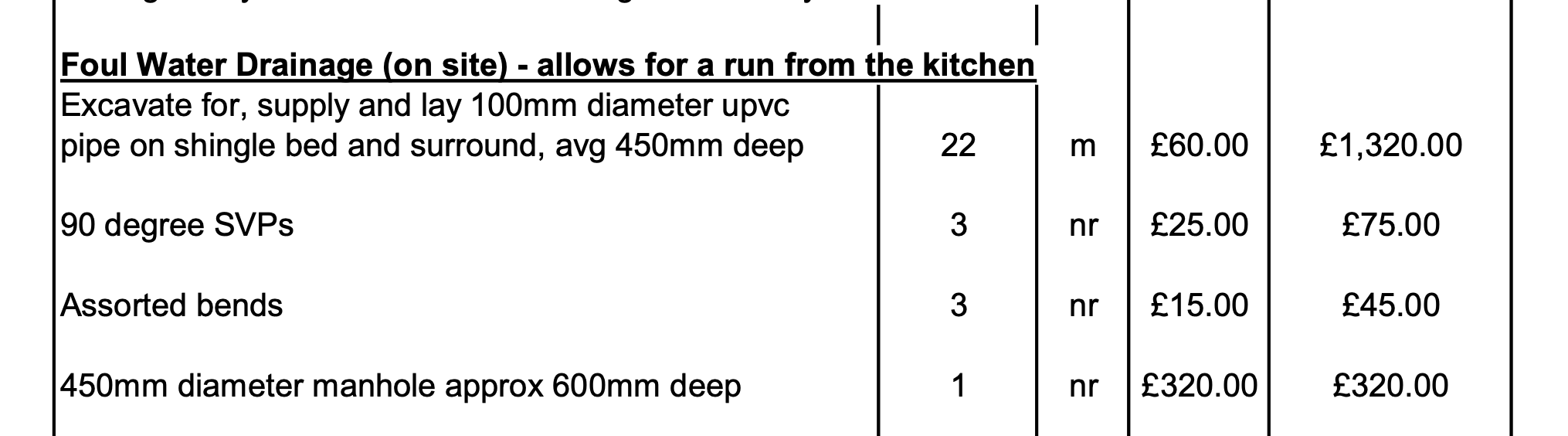
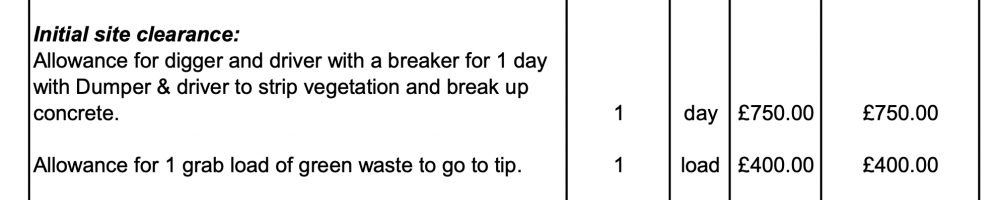
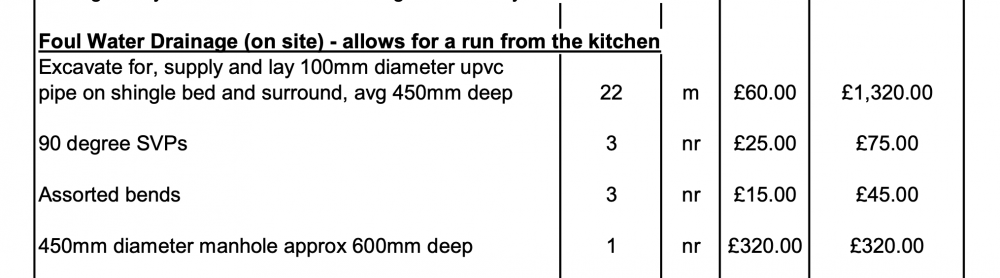
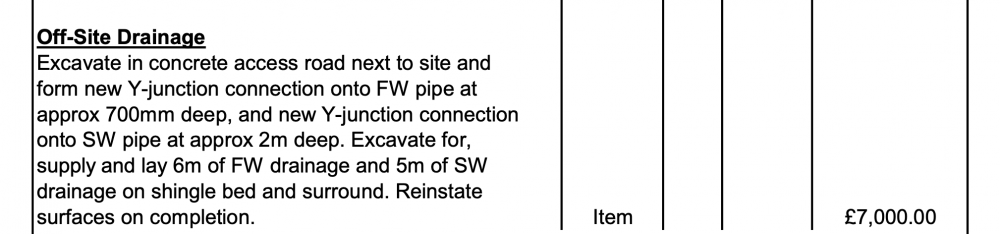
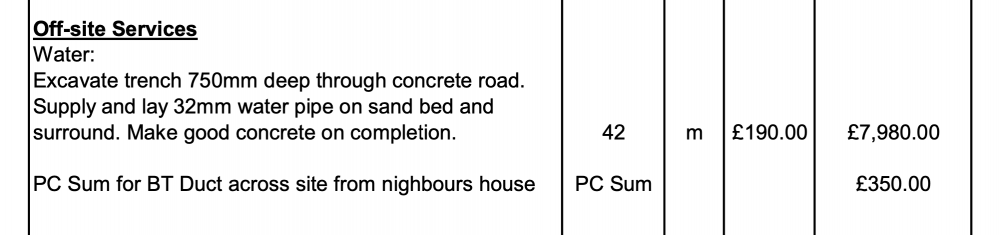
Getting close to starting now. Could anyone who knows about groundworks, or has had theirs done recently, have a look over this quote for groundworks and give me an indication of any areas where prices look high? I'd be grateful. (Note the inevitable South-East premium: Cambridge plot). (Prices assume 0% VAT.)

-
What's the pipe through the exterior wall for?
-
Changing the colour temperature of LED lighting in the evening
Dreadnaught replied to Falesh's topic in Lighting
My tuppence on this subject. Smart lighting is currently developing at a huge speed. Strong rumours about Apple suggest in their next OS upgrade, scheduled for release to the public in the autumn, will include a feature to change the visible temperature of smart lights throughout the day as a standard feature (in Apple HomeKit, so called "Night Shift" for lights). Combined with this, as has been mentioned on BH before, there are initiatives to dispense with those little connected boxes needed to control smart lights (Project Connected Home over IP) which is supported by all the big technology companies, even including Philips lighting and Ikea. Thus within a year or two I think it will be cheaper and much easier to have lights that change their colour temperature throughout the day. In my case, with an Apple HomeKit home that works reliably combined and with a bunch of Philips Hue bulbs all running from HomeKit (not controlled from Philips own app), I wrote some routines using Apple's Shortucts app to make the temperature change. I works flawlessly. But I do look forward to it becoming a standard OS feature in the autumn. (Before others reply, I know that here on BuildHub some prefer not have any outgoing connections to the cloud for smart devices. My own view is that the privacy-first approach taken by Apple and the encryption levels inherent in Apple HomeKit are sufficient to allay such fears. Others may disagree.) Just my tuppence. -
Vaillant high(er) temperature ASHP?
Dreadnaught replied to Nick1c's topic in Air Source Heat Pumps (ASHP)
Miles off topic.@joth I think I recognise Half Dome in Yosemite as your avatar. Been up it? -
@Weebles, sorry meant to say "I have noticed you have not named the supplier". My bad typing. Makes sense. Hope it works out well for you. As I say, I don't see any limitation on consequential loss in their standard T&Cs (from a quick read).