


Roger440
-
Posts
2171 -
Joined
-
Last visited
-
Days Won
7
Everything posted by Roger440
-
 Ok, here you go. Dont know roof angle exactly, but very shallow. Typical modernish ag building. I think the wind turbine would be pushing it. Way to visible. Someone will complain. Some will complain about anything. Ground based solar is potentiall possible. Maybe.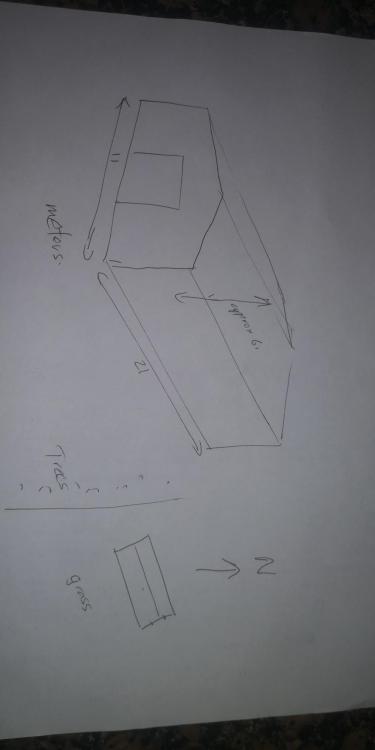
-
Thats as may be, but realistically there is nothing i can do about it. Short of digging up the flor and starting again. Thats defintely not happening! My understanding was circa 15% loss downwards without insulation. But that just what i read. That i cant do anything about it makes it all the more important that the solution is cheap to operate in the longer term
-
Some good points as always. With regard to the pre existing slab, yes, tricky. Putting another concrete/screed layer is probably not a great idea, though i couldnt see why i cant chase the floor for the pipe and fill with expoxy. Noisy, messy, but should work. i think! Yes, a bit of heat loss as slab not insulated. But i can insulate everything else. With regard to my ground loop idea, i see where you are coming from. I'll work on the basis you know more than i do. What if the same lops went via solar panels? Or just solar panels? Again, no heat pump, just a circulation pump? The cost of electricity is the killer. As Radian above suggested with the air to air heat pump, i could get my consumption down to 5KW, but thats going to be north of £10 a DAY. £300 a month. Just on heating. Not going to happen. Steamy says i want free heating. Whilst im not expecting zero cost, £100 a month was more my target, excluding any capital costs, ie insulation. Ive avoided the wood burning idea, because it a) produces a bucket load of fine particulates which im nott keen on, b) its labour intensive and requires it to be got started before any actual work takes place, and c) i dont have a supply, though thats not to say i couldnt potentially find one. But accept that its a potentially cost effective way of injecting a lot of heat quite quickly. Or with a gasifaction boiler i gues i could still heat the slab? What does a lorry load of freshly cut down timber cost? Direct from the forest? Ive no idea. Still feels like an ecological catastrophe though. As you observe, the cost of electricity is only going one way, so my focus has been on reducing its consumption in my stream of (mostly) impractical or impossible ideas. Im still taken with the idea of solar thermal into a milk tanker to use in winter, but still have no idea if thats remotely enough hot water to have any useful impact? Edited to add, i dont mind spending my own time on stuff to save money rather than buy an "off the shelf solution and will give most things a go, so long as the electrical side doesnt get too complicated.
-
TBH, not that interested in the legal angle, though im aware of it. But a good regular supply of oil isnt something i have any more. Theres also the recent prosecution of a garage who let someone take away waste oil, who, through his own stupidity killed himself. But the garage we found culpable. Strangley enough, there an increasing reluctance to do so, aside from the lack of being a licensed waste carrier.
-
Indeed. Thats where i am. Insulation will work upto a point. but its big, very big. Solar is free (once its built) and with enough, you could overcome some of the losses. Maybe? Dont really know. Just how big an array would i need to work in winter?
-
A good solution. But would be circa £10k doing it myself. If i knew what i was doing! Knauf 20mm space blankets supported by netting would be sub £2k. Which at the moment looks the best option on the insulation front.
-
Yes. Its just a hobby, not work. I intend to do just this for the "off car" stuff. Which will probably be 30% of the space. But its the rest.
-
Clearly insulation is a key part of whatever i do. The good thing is i understand that. What i dont really understand is my solar, gshp or ashp options, and the likely cost to instal and/or run them on a building this size. Hence my question about power consumption on the heat pump you posted. Munching heaps of electricity isnt something i can really afford to do long term. Likewise with infra red. Have a couple at work. 3kw each. Thats not going to fly if im paying the bill. I know this can never be free, but i do need to get the running costs down. Happy to make and adapt stuff, I liked my idea of circulating water from underground through the slab at 10 degress or so. So just a pump to circulate. But im not finding any info on this. That could be because its a crap idea, or that for most peoples applications, 10 degrees is no use at all. But for a workshop a background 10c from the slab would be most welcome and a useful addition to any heat inputs.
-
Yes, huge. Though in the afternoon, it gets progressively shaded by the trees. The roof less so. I saw you post one of these, but cant find it now Is this really going to work on a british cold wet december?
-
240v only on site Nowhere on that link does it say what the power consumption is. One presumes a lot. My old waste oil burner is 180000btu and struggles to heat it.
-
Off to google. Didnt know that was a thing.............................
-
Do that already. The thing is, its an out of control hobby, not a business. If i have to suffer to do it, its no longer enjoyable.
-
It is the plan to do that to an extent. Smaller spaces will of course be easier to heat/insulat.But as its mostly cars involved, theres a limit. And having ramps, there is a resonable height requitrement as well, circa 4.5m min.
-
Lime Plaster for breathability and insulation
Roger440 replied to robot enthusiast's topic in Heat Insulation
Or dont tell them. I find this approach much easier. -
Ok, yes, got those at work. Like work, you need some heat to begin with. We never use them at work in winter as there is no heat to move about. But yes, can see benefit, no doubt. Im on a vertical learning curve here!
-
No idea what you mean?
-
Humour me, are you guys talking air souce heat pumps here?
-
What materials though. Had the idea of using washed sheeps wool, bagging it and holding it against the roof with wires. Yanks do this with bagged rockwool. Farmer has a lot of sheep. Couldnt give the wool away last year. Like the ide on the secondary roof? Novel!
-
I dont think a heat pump is viable here. It would cost a fortune in electricity to run. Happy to be proven wrong, but a 2500sqft 6m high building?
-
Am i missing something? How does that work if its -5 outside?
-
Up until recently, ive tended to ignore solar, gshp, ashp, so im well beind the curve here. But ive a problem that needs solving. Large workshop, circa 2500sqft, was agricultural building. Concrete block infill, steel insulated cladding above that, but only 25mm, cgi roof, unisulated. Previously used a waste oil fired burner, when i had a free oil supply. Though that would do 20-40 litres a day if it was cold. Obviously, insulate. But thats a LOT of surface area to cover. Probably a seperate post? Much as id like it at 16c, if it was a permanent 10c over winter, id be resonably happy. So ive spent hours looking at solar thermal. The yanks seem to build there own panels, which appeals because, lets face it, id need a LOT of them. Buying commercially available panels isnt an option. But a week of cloudy days in winter is going to yield little useful heat. I did see @onoff on another thread talking about milk tankers as a thermal store? I cant really get to grips on how long 16000 litres of water, heated during the summer would contribute to my winter heat? Then i though about using ground source heat, but rather than use a heat pump, simply circulate the water from say 10ft down through the slab. If its 8-10 degrees at that depth than surely the slab would be too? As i say, iver perused various, mostly american forums, but still not really sure, what, if anything might do some good. All thoughts, whatever they are, welcome
-
Lime Plaster for breathability and insulation
Roger440 replied to robot enthusiast's topic in Heat Insulation
They sell much the same as mike wye, but rather more info on the website: https://www.lime.org.uk/products.html -
Ive recently started looking at this. But there are things im yet to understand. How does the above cope with the thermal solar circuit overheating? The oil boiler input is half way up the tank. So in the event that solar is producing next to nothing, will the heating circuit get hot enough? It shows rads which would need to be rather higher temp than underfloor. Or is it underfloor?
-
You will find that the manufacturers of sewage treat plants say DONT use a saly based softner. Someone cleverer than me will explian why.
-
Insulating a pebbledash solid wall and damp concerns
Roger440 replied to Ben Weston's topic in Heat Insulation
No idea! Didnt worry about it as using PIR and concrete was not ever a consideration. But expensive i think is the right answer. I prepped it, they put the glass and membranes down, i fitted the heating pipes, then they came back and laid the limecrete. With hindsight i could easily have done the glass and membranes too.

