


SteamyTea
-
Posts
23865 -
Joined
-
Days Won
200
Everything posted by SteamyTea
-

DIY scaffolding: wind - the enemy
SteamyTea replied to ToughButterCup's topic in General Self Build & DIY Discussion
I found Dibnah just an annoying northerner. So can happily ignore these links -
About time for this
-
Bath Surround / Boxing In, and concealed pipework
SteamyTea replied to Onoff's topic in Bathrooms, Ensuites & Wetrooms
Oh, looks almost as red as my Mother's eye after her cataract operation last week. Man up, I used to work with polyester resin a lot, it can splash a fair bit. We used to wash it out of our eyes with acetone. I had my cataracts done at age 47!! -
I used to by Candy Washer Dryers, they were excellent, both last over 10 years each and were probably repairable, but so cheap it was not worth the bother. Have a Bosch now, cost about the same as the Candy and is good.
-
DIY scaffolding: wind - the enemy
SteamyTea replied to ToughButterCup's topic in General Self Build & DIY Discussion
I still aspire to be a grown-up in my twenties. Would know not to waste money on a pension that has lost more cash than I ever put in. How can that happen. -
Is just because water is the 'universal solvent' and the purer it is, the better it is at dissolving 'stuff' (stuff is a scientific term for anything you are looking at). I hated chemistry, was just a form of stamp collecting, but if there is free oxygen is water, does that make it more reactive. I am convinced that there is something 'free' in my pipes as even after changing the ballcock on the header tank, it is still noisy.
-
You may find that it is a basic condensing dryer. They do take longer. Do a comparison between two identical sets of drying and see what the energy usage difference is. The few times I have used my drying, time is not an issue as I usually get the machine to start at 3 AM and it is all washed and dried by 6 AM.
-
I better get you a monitor knocked up soon then.
-
Generally they are a thing of the past. The argument goes that less energy is used in heating just the water needed, rather than water that is in a pipe. Modern machines use less water too. I personally think that you could put in water at 34°C as it is not excessively high, so should not be any mechanical reasons not to. The machine manufacturers may have other idea and stop the rinse cycle or some other nonsense.
-
What about cooling
SteamyTea replied to Visti's topic in Mechanical Ventilation with Heat Recovery (MVHR)
Our old mate @DamonHD monitored a school (think he borrowed @JSHarris, monitor), when I looked at his data, there was a pretty good correlation between RH and CO2. CO2 has to be really high to become a real problem, RH control would probably be better and you can do that though the MVHR to a certain extent. Just up/down the temperature with a post heater/cooler. -
You will be amazed how fast things dry on a line in a force 9 (8 is the usual). It can even stand the odd spot of rain and still dry. And as you have probably found out, it can be raining on one corner of your garden and not on the opposite one.
-
This is the important thing, but even with figures it is hard to know what to do. One day, when I break a hip again, I shall sit down and work it out. I think on my usage, and lack of opportunity to add a decent amount of PV, I am better off minimising my day usage and hunting around for a better overall E7 deal. Of just swap my baths for a shower. Minimising usage is really the easy way.
-
Just remembered to ask my Mother what softener she has. Will have to wait till Friday as I will be caller her on her 90th Birthday then.
-
My standing charge is 18.9p/day, so £70/year once rounded up. That does not seem to change with different payment methods. The unit price does. The cheapest is 22.54p/kWh day, 8.46p/kWh night on the cheapest and 24.12p/kWh day and 9.07p/kWh night on the most expensive. So not a dreadful difference really. But I have always found EDF clear and reasonable. Yes I know I could shop about and save a penny or two somewhere, but that is all really, hard to find a very large discounts.
-
I started off monitoring my usage in detail, several years ago, to answer just that question. I am still not sure. Much of it depends on your total usage. If I was forced to have only standard rate, I would probably change the DHW to a large instantaneous water heater to reduce storage losses (these are about 2.5 kwh/day on a normal 200lt cylinder). I think the best way to model your energy usage is to pick an ideal scenario and see if the different rates can fit in with it, rather than look at the times the rates change and see if you can fit your kit to work within those bounds.
-
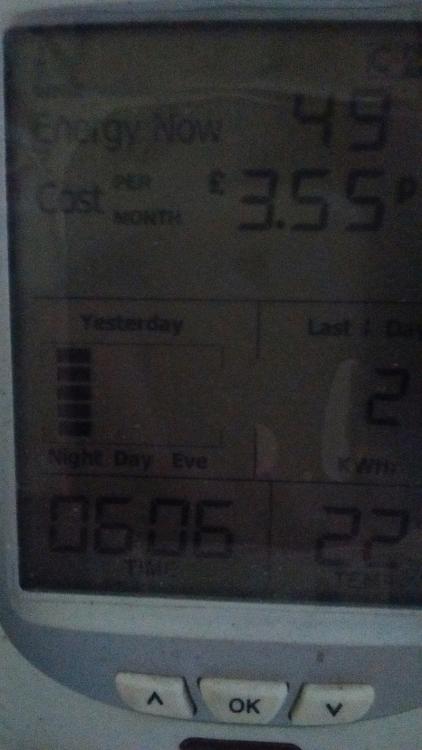
Is that just the depreciation cost though. E7 night rate is now about 9p/kWh and the day rate is about 24p/kWh. For the last two days I have used less than 0.5 kWh during the day rate period (since I have got my new DHW cyclinder). So I would be better off getting a couple of kWh of storage as the unit cost would be 17p/kWh. Having said that I cam currently using about 25 kWh/day, so I have a bit of tinkering to do on the DHW temperature and heat losses, and the one night storage heater I am using to get my usage back down to my target of no more than 10 kWh/day. I have been a bit lazy about this, this year. The secondary cylinder lagging is going back in place today.
-
You not read your Tolkien then.
-
Is it as satisfying as punching out a politician. There should be a day set aside for that, April 1st is coming up.
-
I also do the cleaning, cooking, shopping, gardening, DIY, the lot in fact. But, 30+ years ago I worked at a really horrible company with a bunch of bigoted wankers who assumed that because I lived on my own I must be gay (though I was called a b*mmer then). I think it was Max Planck that said something along the same lines. "New ideas take hold when the old guard die off".
-
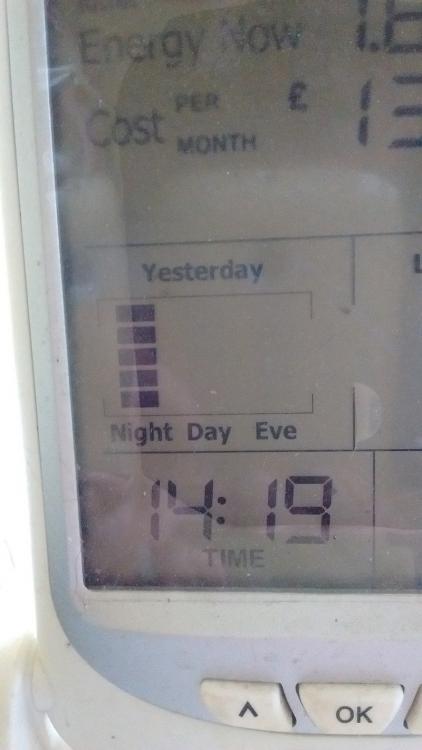
Well worth it. This is what it is like now I have fixed my water heater
-
Hot tub waste water - where can it go?
SteamyTea replied to readiescards's topic in Waste & Sewerage
Pressure times Volume divided by Temperature is a constant. So if you cool the exhaust gas down to ambient, you cannot do any work, and as the old song says 'work is heat and heat is work, repeat after me'. -
Hot tub waste water - where can it go?
SteamyTea replied to readiescards's topic in Waste & Sewerage
It has to, C = PV/T tells us that. -
I can imagine there are problems with a large family. I also have the advantage that I am at home during the day and can always bring washing in quickly when it rains. When the weather is bad, like it has been since November, I put my damp clothes on hangers, then hand them from the curtain rail. I find the windows being open a crack deals nicely with the condensation.
-
Just about everything is done at 40°C, talking 99 out of 100 washes. Not used the dryer (condensing one) on the machine for almost 2 years. My best energy saving device was a 2 quid washing line, and I have half of it left.
-
Hot tub waste water - where can it go?
SteamyTea replied to readiescards's topic in Waste & Sewerage
Is the concept behind condensing boilers really just flue heat recovery?




