SteamyTea
-
Posts
23718 -
Joined
-
Days Won
198
Everything posted by SteamyTea
-

Estate Car to carry house doors inside, flat
SteamyTea replied to Ferdinand's topic in General Self Build & DIY Discussion
Steptoe, have you ever thought of having a Dagenham Dustbin scrap yard as you already got the stock.- 77 replies
-
- 1
-

-
- estate car
- load capacity
- (and 2 more)
-
Estate Car to carry house doors inside, flat
SteamyTea replied to Ferdinand's topic in General Self Build & DIY Discussion
Tax has run out- 77 replies
-
- 1
-

-
- estate car
- load capacity
- (and 2 more)
-
Estate Car to carry house doors inside, flat
SteamyTea replied to Ferdinand's topic in General Self Build & DIY Discussion
Odd that, the Focus Estate is larger in the back than the C-Max. Neither is a nice place to be though.- 77 replies
-
- 1
-
-
- estate car
- load capacity
- (and 2 more)
-
Estate Car to carry house doors inside, flat
SteamyTea replied to Ferdinand's topic in General Self Build & DIY Discussion
Make something up that is hinged in the middle that will fit in your existing car. I know doors don't fit into a Ford C-Max. But being sensible, renting a van is the easy and cheap way as you are not going to move doors that often. Or a trailer.- 77 replies
-
- 2
-
-
- estate car
- load capacity
- (and 2 more)
-
Legend without a loincloth !!
-
Well I have no idea how long it has been since my last post, but I have now connected via my spare router, which is also connected to the interweb via my laptop, and I got the BME280 working. Managed to find some code that someone had done. So all that is left to do is get a real time clock set up. Really nice little device, shall get some with the memory card slot next.
-
If we say that it is 0.1m and has an R-Value of 0.6, then that is a U-Value of 16.6 I think, but I may not be thinking straight as it is late and I have been struggling with my ESP2866 all evening.
-
How thick is the existing slab and is it just regular cast concrete. Concrete has an R-Value of between 0.43 and 0.87 m.K/W
-
It is a freebie for the Kindle
-
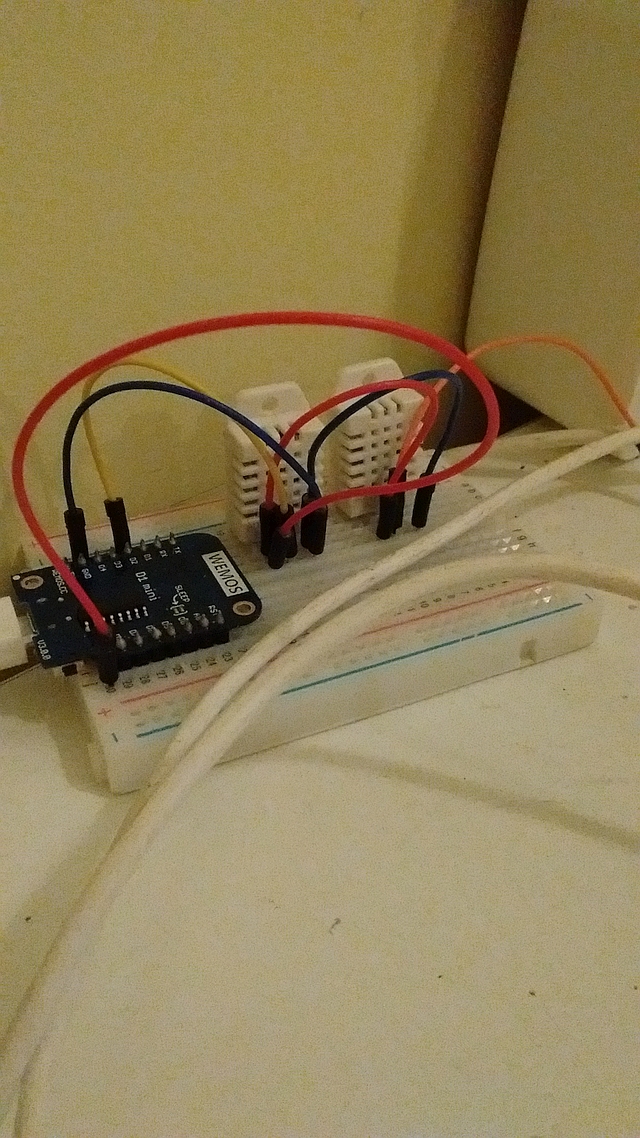
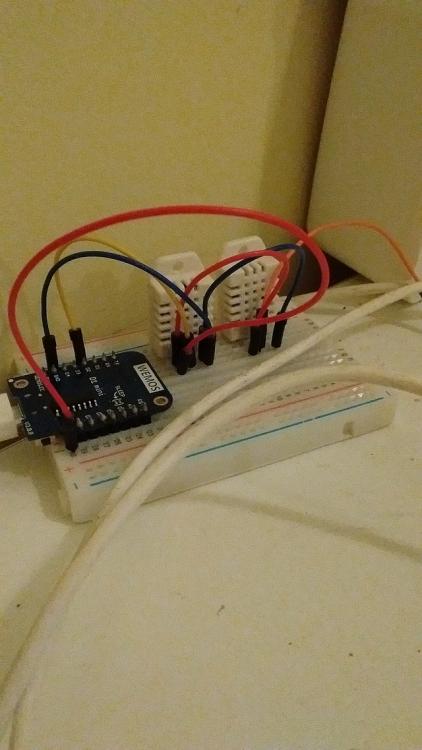
How are you getting on with the WEMOS I have managed to get mine connected to my router, then access via WebREPL or a USB Serial connection on PuTTY. It reads the DHT22s ok as well. That is as far as I have got. To connect to the router, I modified the boot.py file: # This file is executed on every boot (including wake-boot from deepsleep) #import esp #esp.osdebug(None) import gc import webrepl import network import dht import os import machine webrepl.start() gc.collect() def do_connect(): import network sta_if = network.WLAN(network.STA_IF) if not sta_if.isconnected(): print('connecting to network...') sta_if.active(True) sta_if.connect('XXXXX', 'XXXXX') while not sta_if.isconnected(): pass print('network config:', sta_if.ifconfig()) Next is to work out how to get the Wemos to send temperature data to a network drive. How much 'stuff' and you put into the boot.py file, or is it best to use a main.py file (think that runs at boot too) and use the os commands to run separate micropython files
-
Can you park a 2 tonne car on it, repeatedly. 150 kpa is about 22 lb to the square inch isn't it.
-
Could mould in some spikes, that should get the message across
-
You can make GRP look like brick, or just about anything else. Could make the whole thing from GRP/PU. I think the gutters are parallel to the cars, but I really have no idea. But that is detail that can be solved.
-
You went to a CofE school then. How about calling up the local metal detectorists, or archaeologists saying you found some treasure. Or the police and saying you burred the Brinks Matt millions there. Ground penetrating radar is another things to try as the diviners are already crying off
-
I am going to Bucks in a months time, so we can all meet up in MK and I can be proved wrong
-
Some say that water divining works. Now here is a real test.
-
Could you get the underside/inside sprayed with PU foam, then put in a VCL if needed. Then you can pour a secondary reinforced slab onto the existing one. Seems to me that the GRP/EDPM is just there to protect the insulation/chipboard.
-
-
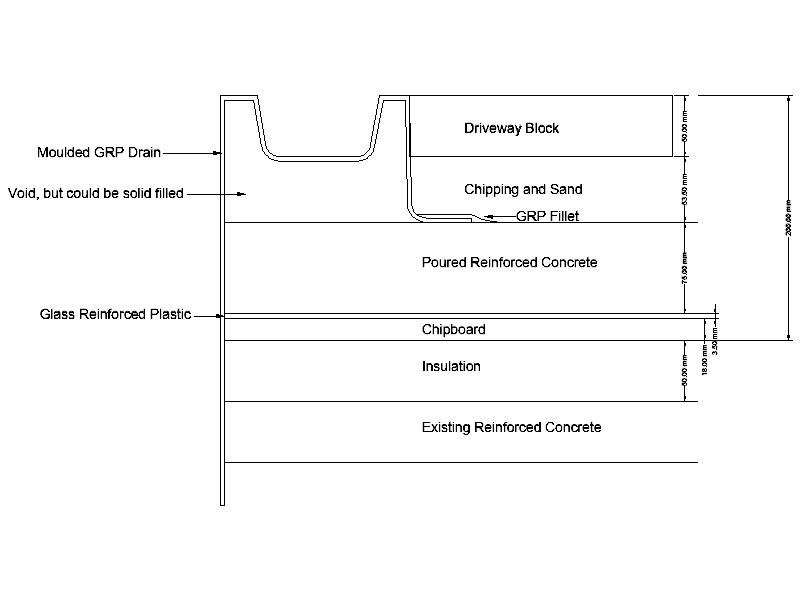
Is it something like this?
-
The way I see it then is that the GRP is just waterproofing. So can be put directly onto the insulation. If that insulation is glass tissue covered. 3 layers of 450 gm.m2 matt with a flow coat will do that as the strength is in the reinforced concrete pour above it. There will need to be some detailing for the drainage channels, but that would need some more information as to what you want it to look like. With the final reinforced slab being 75mm thick, bolting the balustrade to it may be a problem. Is it possible to have some plates with threaded studs fitted into the correct place (I was a toolmaker, not a builder so working to 1000th of an inch is normal to me). Or you could have plates fitted and then drill and tap after (probably safer). That would need a structural engineers input. At the interface of the drainage channels and the reinforced concrete below it I would fit a pre moulded section. Probably make the interface and the 'gutter' as one, then lay some GRP over it. I am not sure how they would detail with with a rubber sheet, sorry EDPM, but suspect that they would do something similar. What are the overall dimensions? Some consideration may be needed for thermal expansion.
-
Just had a look at your build up, any change of putting some measurements onto it. I am envisaging a platform to park cars on. The platform is built over something. Is that right? As the GRP is only for waterproofing, it could go onto thinner board, possibly 3mm ply. It is really only to make the lay up easy and stable. I don't think it is there to add anything structural. I can see where the wall is and the drain challenges. It would be usual to have the drainage built into the platform. Is there walls either side of them and that is why are two of them. A 3D sketch may be more useful as I am struggling to understand it. How high up do the skylights stand. As long as there is 100 mm, then bonding to that should not be a problem. Does depend on the radii at the corners. There are ways around that though.
-
@pocsterI am a bit tied up at the moment, but shall come back and give my thoughts on how to do your layup. Any chance that you can post a picture or sketch up of the two run off areas and any these up stands. It may help clarify what you are trying to do. Basically GRP is easy to put into a corner/edge, harder to put over a corner/edge.
-
Not for GRP, which stands for Glass Reinforced Plastic, sometimes known as FRP, Fibre Reinforced Plastic. Even been called composite or laminated. I think when we refer to GRP on here, most of us are thinking about a glass fibre matt (not Fibreglass as that is a trade name) which is impregnated with a liquid resin, usually polyester, but may be vinyl ester (better strength and longevity as long as it is out of sunlight) or epoxy resin (more expensive and often harder to do right). There are some newer acrylic resins that are water tolerant, but I would have to investigate them more. There are also polyurethane resins that have some good characteristics, but for roofing, polyester (cheapest and most widely used) or vinyl ester if you need extra strength and are worried about long term submersion in water.
-
I am half tempted to set up a new business sorting out flat roofs. Only trouble is, I hated running my own business last time, I went quite odd.
-
As this is going to be a buried barrier, I would GRP it. If there are areas of high load, or point loads, then extra layers can be placed there. One advantage of a buried layer is that there are no UV problems to worry about, so a vinyl ester resin can be used.