SteamyTea
-
Posts
23865 -
Joined
-
Days Won
200
Everything posted by SteamyTea
-
Which brings me back to thinking about foundations. What would be s suitable, and DIYable system to use. If you look at what @recoveringacademic got up to at his place, you will see some of the problems he encountered.
-
True But that is like buying a small 2 seater and then getting a trailer to get your shopping home. If the ESP2866 can fit analogue ports on for a couple of quid, I am sure the Raspberry Pi Foundation could do the same. SATA would be nice, but don't see it happening.
-
How hard would it be to manufacture a basic wall module that could be knocked up in a shed/garage/shipping container but just about anyone that also complies with the thermal, structural and safety elements that are needed for a house. Thinking that some basic jig would need to be made and people then just slot in the OSB and timbers, then glue/nail together. How hard can that be?
-
Still don't have the two things that would be really useful though, a real time clock and analogue ports.
-
Is there enough kinetic energy in a moving raindrop to make it worthwhile? You can work out the potential energy from PE = Mass x Gravity x Height. If you take the rainfall from a very heavy shower, so 40mm/hour, ready to roll down a standard module of 1m by 1.6m at 30° inclination, that is: PE = 0.056 [kg] x 9.81 [m.s-2] x 0.8 [m] PE = 0.436 [J] The Laws of Energy Conservation state that energy can be neither created or destroyed, but only change form, so how does this changing from potential energy to static electrical energy create anything useful? Is there some magic PR going on? Edit: Thinking about it, the average height of a module should be used, so that is half the energy available to convert to static electricity.
-
Pop-up Pocster, all very scary, there are cartoon characters on this site
-
How much energy are you looking to store. I can understand trying to reduce fossil fuel usage, but you have to be realistic about the variance of PV over an hour, day, week, and then balance that with the capital cost of storage.
-
You will find that the humour on here can be a bit strange and pop up in the most unexpected places. And a lot of teasing goes on too. @Ferdinand has the best lines
-
Just powered up my ESP2866 and I can ping that from the PC, but not the with WedRPL for some reason (changed the IP to the ESP's one 192.168.1.101). Can ping it from the RPi as well. So that is all good. Just need to join it all together now so I can send a Bash command to the ESP2866 to send some data to the netdisk which is sitting on 192.168.1.3 and I can get to from the RPi, but not my PC for some reason.
-
Probably every 6 minutes, except the energy monitor which is every 6 seconds (captures the kettle that way). I have had a look at a few webpages about bridging, but none seem to make sense. But I have got an RPi set up to connect to my neighbours wireless and to my old router via an Ethernet cable. Can ping things from my PC happily. 192.168.1.100 is the Ethernet, 192.168.1.30 is the Wireless. My old router is on 192.168.1.2 on the Ethernet and 192.168.1.1 on the Wireless. That is as far as I have got so far. What next? C:\Users\SteamyTea>ping 191.168.1.100 Pinging 191.168.1.100 with 32 bytes of data: Reply from 191.168.1.100: bytes=32 time=305ms TTL=50 Reply from 191.168.1.100: bytes=32 time=275ms TTL=50 Reply from 191.168.1.100: bytes=32 time=280ms TTL=50 Reply from 191.168.1.100: bytes=32 time=280ms TTL=50 Ping statistics for 191.168.1.100: Packets: Sent = 4, Received = 4, Lost = 0 (0% loss), Approximate round trip times in milli-seconds: Minimum = 275ms, Maximum = 305ms, Average = 285ms C:\Users\SteamyTea>ping 191.168.0.30 Pinging 191.168.0.30 with 32 bytes of data: Reply from 191.168.0.30: bytes=32 time=350ms TTL=50 Reply from 191.168.0.30: bytes=32 time=313ms TTL=50 Reply from 191.168.0.30: bytes=32 time=574ms TTL=50 Reply from 191.168.0.30: bytes=32 time=538ms TTL=50 Ping statistics for 191.168.0.30: Packets: Sent = 4, Received = 4, Lost = 0 (0% loss), Approximate round trip times in milli-seconds: Minimum = 313ms, Maximum = 574ms, Average = 443ms
-
I agree, it was a long run back to the house. I suggested that they double up the cable size where they could. Was a dreadful installation. The inverter was in a greenhouse.
-
When I did my teacher training, a book called 'Inside the black box' was often quoted. I said, in my usual deadpan way, 'what box' and some of the teacher's teachers though that funny. Like law, a good monkey could learn the skills needed to practice.
-
Has anyone calculated the losses in a long DC cable run. Bit hard I know as the power is varying, but maybe at 5 power settings, with one being maximum and one at 500W and the others spaced between. I don't think it is a problem, but have seen it give a 10%ish loss at 4kW on a ground mount system.
-

Advice on DHW & heating please.
SteamyTea replied to Moira Niedzwiecka's topic in Other Heating Systems
That is enough for a bath, or 2 decent showers. Though some days you will have to have none and catch up on others. -
If it is only a year to wait until the gas is connected, then buy 50 quids worth of fan heaters. 50 litres of hot water would cost around 50p to heat by electricity. 50 lt of 65°C water is enough for a bath. (now there is an easy thing to remember, litre of hot water costs a penny)
-
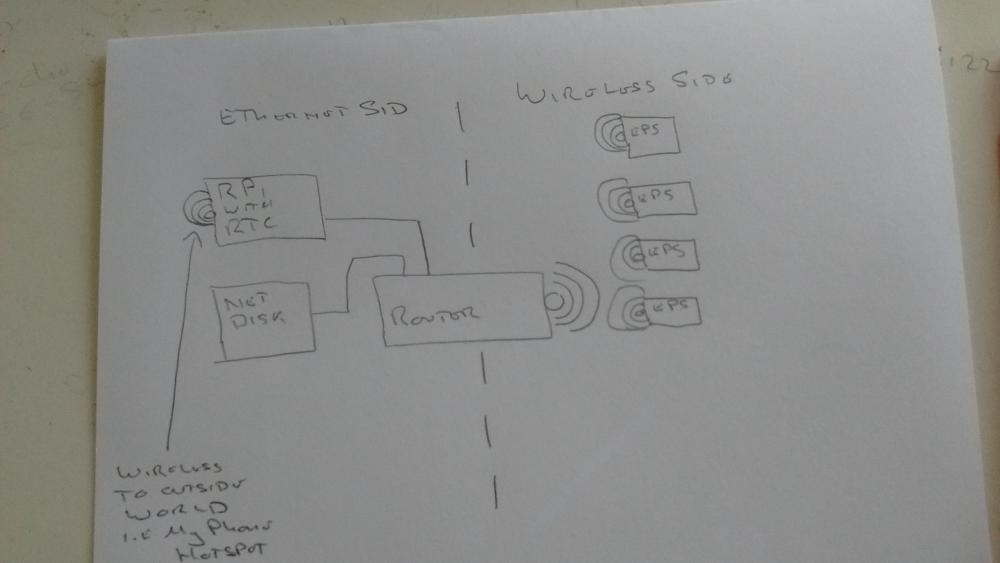
Right, been having a play with my ESP2866. Managed to screw it up a few times, but have also managed to get it working again. Now because it does not have much memory, nor does it have a real RTC, just some fake one, and I do not have a Linux box apart from my RPis, so usually working from my Windows 10 machine. Now this is fine for getting into it with PUTTY, or WEBRPL, but not much use for anything else. Now I have an old router or 3 kicking about. So I thought I could make up a simple wireless network for my home monitoring. My thinking is that if I set up the router, plug in a RPi that has an RTC on it via an ethernet port, then set up the ESPs to connect to the wireless side of the router. If I can bridge between the RPi and the router so that everything is connected, I can use the RPi to send out commands to the ESPs and grad the data I want, then timestamp it and save it all to a network disk. Does that sound feasible? Something like this:
-
I am about to start a new thread about home monitoring as I have an idea.
-
Not on the RPi or ESP2866 it isn't. Eentually found out what was wrong with my original BME, they were just that temp and pressure, no RH.
-
I may reply to this when I have finished the housework
-
Welcome I am interested, purely from an academic point of view, about foundations. We only tend to hear about them being a problem, but not the science behind them. Seems to me that they are often very over engineered. Is that true? @MikeSharp01 My very first post 'over at the other place' was about open source house design. A decade on and still not much is happening. I find it hard to believe that we still use labour and energy intensive building materials and techniques on site.
-
Bit more involved that that in reality. Under our MCS rules, an ASHP needs to supply enough energy for space heating 99% or the time. This is not as bad as it sounds as it is best to oversize an ASHP anyway. There is not a direct comparison between the output of a traditional boiler say 30 kW and an ASHP oof the same size. Others that have ASHP would be better placed to comment, but my feeling is (and a little bit of thermodynamics) you have to take into account the lower delivery temperature of an ASHP when calculating the peak power.
-
That one I think.
-
When I was at university, they gave out a load of coursework on USB sticks. Made a mess of the MACs
-
Check he has the right paperwork or you could be liable. Or just flytip it yourself and save some cash.
-
All a bit tricky, but 4 things to know first. The energy demand of your house The energy split e.g DHW and Space heating The installation costs Energy prices. Energy pricing for NI is here: Electric https://www.nihe.gov.uk/latest_tariffs Oil http://www.consumercouncil.org.uk/energy/home-heating-oil/#recent Gas (with a lot of digging) http://www.consumercouncil.org.uk/energy/gas/ You also asked about the difference between an ASHP and a gas boiler installation. It really just comes down to the different temperatures that are delivered. ASHP has a lower temperature delivery to keep the efficiency high, a gas, oil or electric boiler delivers at a higher temperature. All that means in practice is that you need different surface area for the emitters (radiators). Lower the temperature, larger the area. For space heating via under floor heating it may just come down to a different size buffer tank and a few valves. Plumbers can give better detail on that.