SteamyTea
-
Posts
23863 -
Joined
-
Days Won
200
Everything posted by SteamyTea
-

"....heat it with a candle, mate" - thoughts?
SteamyTea replied to Piers's topic in Underfloor Heating
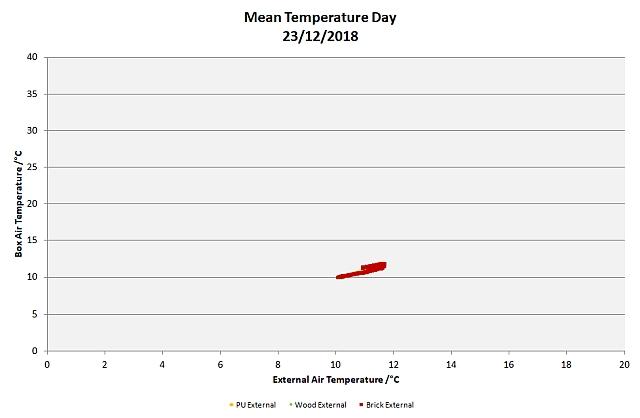
Just to highlight the variation of 'normal days'. The charts below all have the same external air mean temperature, within 0.1°C. I shall restate, this is not modelling a house.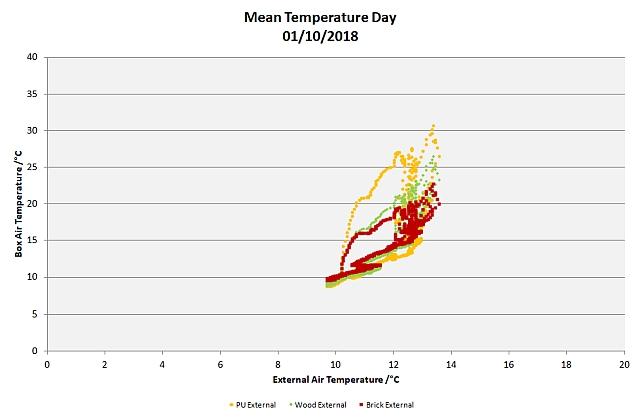


-
"....heat it with a candle, mate" - thoughts?
SteamyTea replied to Piers's topic in Underfloor Heating
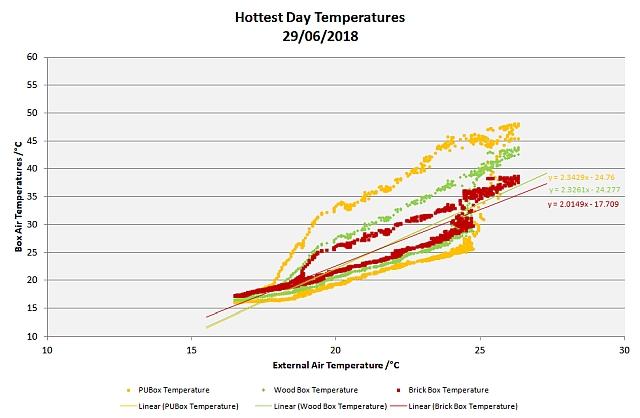
I have been running an experiment for over a year now, just three boxes, exposed to the weather, with the same volume of different masses in them. This does not model a house, but shows that during cold spells, there is effectively no difference. Hot spells are a bit different. Mean temperature days are so variable that it is hard to draw a conclusion from temperature differences alone. Below are the coldest day and the hottest day charts. Lots of variation on the hottest day.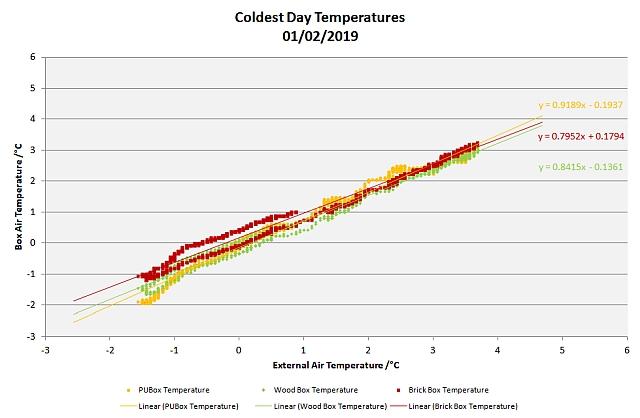
-
"....heat it with a candle, mate" - thoughts?
SteamyTea replied to Piers's topic in Underfloor Heating
I haven't. I did think of getting one, as @JSHarrissent me a link to a Panasonic one that was pretty cheap. But when I sat down and worked it all out, I decided that I would stick with my storage heater for a little longer. Storage heaters are just so reliable and I only need them for 6 to 10 weeks of the year usually. Some years I have just used a £10 fan heater. The only thing with an airthight house is that if you go away for a few weeks and leave the heating off, damp can become a problem. I fancy fitting MVHR, so that would sort the problem out. -
Sooner or later you will be.
-
Probably get away with half of that. If you can get some local weather data, you can see how often it will not supply all your space heating needs. The MCS rules is that a heat pump needs to be able to supply 99% of all heat load. It i a reasonable rule to work to as it builds in oversizing, which improves the CoP. Thing is about using an ASHP for space heating only, is that it may only be needed for 3 or 4 months of the year (though Kent has a cold wind), so may be worth considering using to to heat water during the other times of the year. Just needs more detailed modeling.
-
Interesting that EON said that undersizing inverters was an industry practice. It is not unusual to undersize an inverter as this often gives better performance at lower light levels. It all depends on the performance curve of the inverter. It will be hard to tell if you are taking a performance hit during the winter months. Also worth noting that PV production is also affected greatly by hours of daylight and not just intensity. A little for a long time can give the same yield as a lot for a short time. Temperature can also have an affect, this is why systems can often give better daily performance in March/May and September/October. Though that does depend on the azimuth and module angles. You also did not mention the 16A/phase limit that most people have, or how you got special permission to have a larger system. Did EON sort all that out for you?
-
"....heat it with a candle, mate" - thoughts?
SteamyTea replied to Piers's topic in Underfloor Heating
Air to air heat pump, get some cooling too. My house is just a bit smaller than yours, but terraces, and in the warm SW. I use storage heaters in E7. Don't usually need more than about 10 kWh/day. Small A2A would easily do that. -
Noise. You should be able to get a dB meter on your phone for this. Need to see how noisy it is at full chat as well. Worth looking at the MCS guidence. Then there is start up current. There is a bit of a myth that they still draw a lot. Rather than flow rate, worth looking at temperatures. Compare current and noise at different output temperatures. Then there is general sturdiness, can kids lean bikes in it without a brake lever hitting the collector coils. Size and mass are useful too. Easy of setting up would be very helpful. Are the default setting good, do you need to buy a command unit separately, can you access data via a laptop or phone. Going to be quite a challenge to do a meaningful report on one. Good luck.
-
Alcohol ie Surface Cleaners
SteamyTea replied to Ferdinand's topic in General Self Build & DIY Discussion
Think it is acrylic, we used to use tonnes of the stuff. Smells nice, but makes you dizzy. -
That does seem to be the way small ones are made now. Block and liner was all the rage in the late 80's. They were cheap to install and cheap to remove. Depending on size, you can get GRP moulded ones. They can be tricky to install correctly. Insulation, which was not considered much when I was dealing with them, is now considered much more important. All domestic pools end up cloudy. Thankfully the chemical dosing is pretty easy these days, unlike a spa bath. Is your pool indoors? If it is, then make sure that anything holding your house together is rust proof. Don't rely on the AC/Heat Recovery to stop the chlorine rusting everything.
-
Which features of your house bug you?
SteamyTea replied to puntloos's topic in New House & Self Build Design
I bet they still don't eat curry and kebabs. -
Which features of your house bug you?
SteamyTea replied to puntloos's topic in New House & Self Build Design
There is a similar trick to play at Christmas. Collect dog shit, gift wrap if, place on neighbours door step, set fire to it, ring doorbell. Hide and watch as they stamp it out. Makes me grin every year. -
Alcohol ie Surface Cleaners
SteamyTea replied to Ferdinand's topic in General Self Build & DIY Discussion
I was, when young and foolish, stripping wallpaper off the walls, while drinking vodka with a mate that was helping me. The challenge was to see who was the last one standing. We had to go out that night to meet other friends, we peaked a bit early I think. I won the challenge, but rumour has it, I am still banded from Weymouth seafront unless fully clothed. So I suggest best to avoid all alcohol, or Weymouth, and WPC Wright. Not that she will remember my face, she never looked at it once, saucy mare.- 13 replies
-
- 1
-

-
- pickle my bones in alcohol
- degreaser
- (and 2 more)
-
Getting broadband
SteamyTea replied to Russell griffiths's topic in Networks, AV, Security & Automation
And steals all your data, worse still, it may confuse BuildHub with another, much more popular Hub. I still wonder why we need ISPs, why not a large mesh network that is decentralised. Most of us live close to another house, and then you can put relays in phones and vehicles. For to be better than the system we have, eventually. Seems crazy to me that they are launching thousands of satellites just so I can get access to my email. -
Getting broadband
SteamyTea replied to Russell griffiths's topic in Networks, AV, Security & Automation
Does that allow you to connect to other BT customers WiFi when you are out and about? -
Getting broadband
SteamyTea replied to Russell griffiths's topic in Networks, AV, Security & Automation
What do you actually mean by this. Do you want a reliable connection, a fast connection, or one that can be used to download lots of data. You can have any combination, except the first one. You can also check out the local exchange to see what you can actually get as a maximum. My neighbour pays for a 20MB line, be we can only get 5MB. Keep telling him, but he thinks he is on a good deal. I use my mobile phone for all my internet stuff, except when I steal my neighbours. There are times when it is a bit slow, but generally better than when I was hard wired. I say hard wired, actually they swung about so much in the wind, that it was not unusual to loose connection 50 or 60 times a day. As they use the OpenReach stuff, they had the same problems, old creaking infrastructure and even older, more creaking technicians. I found the pricing good. Much better than my neighbours on Sky. If you have a problem with TalkTalk, they tell you to pull the junction box apart and disconnect your phone. Pillocks. -
This makes me sick at heart
SteamyTea replied to ToughButterCup's topic in General Self Build & DIY Discussion
My boss was a government inspector on the EU fishing fleet. The first boats he saw that took H&S seriously were the Spanish ones. There was an incident down here a few weeks ago, fisherman fell off back of boat, caught his own net. Luckily the boat hit the harbour wall at Newlyn. https://www.telegraph.co.uk/news/2018/12/28/fisherman-clings-boat-autopilot-five-miles-falling-overboard/ Not so lucky: https://www.bbc.co.uk/news/uk-england-cornwall-16984521 -
Which features of your house bug you?
SteamyTea replied to puntloos's topic in New House & Self Build Design
My living room is really a corridor between the kitchen and the stairs. Light switched set up for entry via front door, car parking is at the back. Bosch washing machine bleeps, says it can be turned off, never managed to do it. Airtight terraced houses have a problem when neighbours slam their back doors. The whole house shakes, even when the door slammer (have moved now) are two doors away. Noisy plumbing, just can't seem to find out why. Bloody windy and very wet. Good things, cheap as chips to heat, close to A30, so can get places easily, 2 miles from beach, mile from the woods (not many trees in Cornwall), in Cornwall. -
I have not read all this thread, and my suggestion is never popular with plumbers. Have you looked into installing a small VENTED cylinder. You may get away with having 2 kW element in it. And you can do a lot of the work yourself. And no certification on the water side. I have a 200 lt E7 cylinder, way to big really. Could get away with half the volume, even running it at 50°C. Could get more storage if I ran it hotter (when guests come). I have a pumped shower, flow rate is about 11 lt/min. No one has ever complained and a few have commented how good it is.
-
Pay on a credit card, the bank takes the risk then.
-
That's interesting, never thought about it. Probably no more than 3.68 kW or 16A. But I suspect smaller. But they are not off-grid or islanding systems.
-
Wireless Internet connection
SteamyTea replied to lizzie's topic in General Self Build & DIY Discussion
If I set up a hotspot, offered a registration via email, I wonder how many people would set up a password that is the same as the email one. -
Wireless Internet connection
SteamyTea replied to lizzie's topic in General Self Build & DIY Discussion
I was thinking: "Got noisy kids, go elswhere" If that is too many letter, I can change the 'elsewhere' to away. If that is still too many, maybe "F_Off" -
All dodging the floods. 18.25°C at 31/07/2019 14:44
-
Wireless Internet connection
SteamyTea replied to lizzie's topic in General Self Build & DIY Discussion
It is interesting this group of mixed devices connecting. I got for a coffee and steal the internet. Usually my Android Phone and Kindle connect just fine. Now the summer is here, but even when cafe is quiet, it takes a while to connect both the devices. As an aside, I am thinking of changing my phones hotspot name. It is a rather boring one at the moment. Not sure if I should just give it a rude name, humours name, or a rant. Is there a word limit?