SteamyTea
-
Posts
23850 -
Joined
-
Days Won
200
Everything posted by SteamyTea
-

How does your garden grow?
SteamyTea replied to recoveringbuilder's topic in Landscaping, Decking & Patios
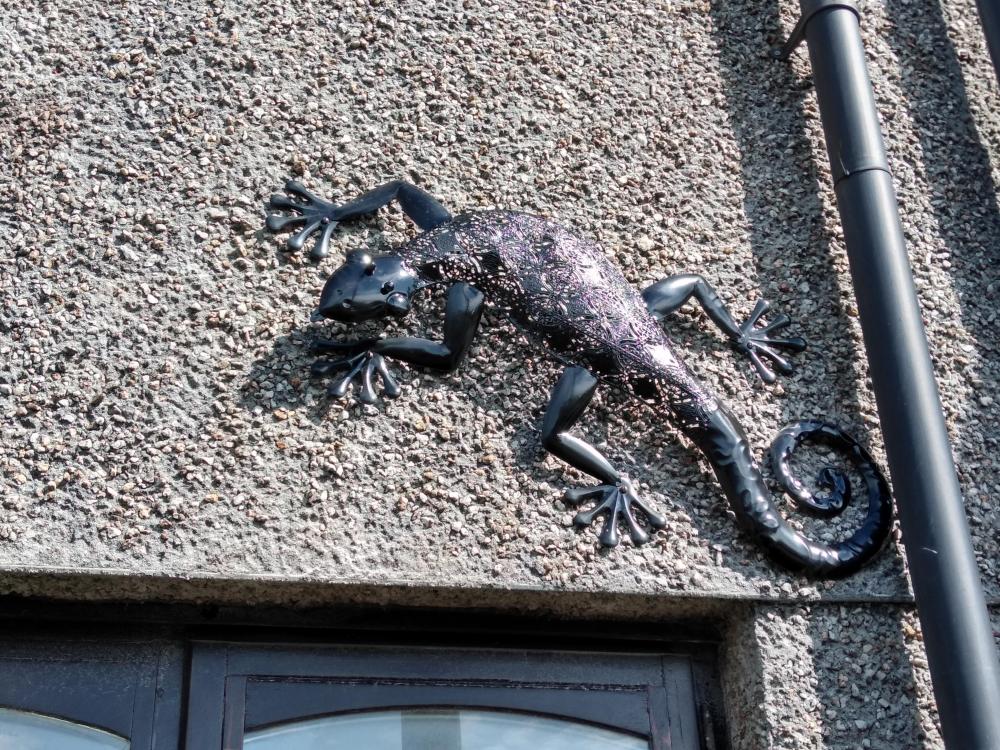
Some veg are now planted. Slugs are in already. Maybe my geko will eat them.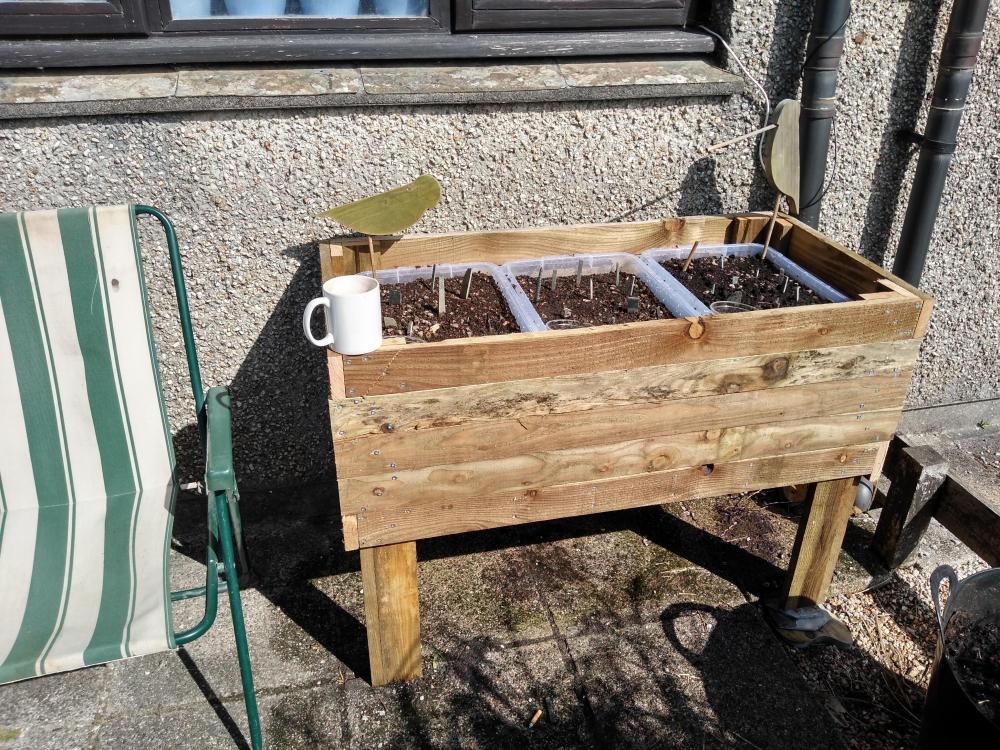
-
Living in a passive house?
SteamyTea replied to Rubecula's topic in General Self Build & DIY Discussion
As many of you know, I am an extremely low user of energy (car not included). Was sub 4,000 kWh last year. My annual estimate came in from EDF, 3,600 kWh. Should be doable. The only big differences I have are no TV (got 5 radios), no freezer, and I use a washing line. -
Trying to find the right click on my mobile.
-
Made me hungry now
-
♫ Pick a switch Give it to Mitch He will wrap a cover That looks like no other ♫
-
Or wrap it.
-
Yes, bigger, by 28 m2. So allowing for my upstairs, about the same size.
-
Science and Art of specifying ASHP
SteamyTea replied to severnside's topic in Air Source Heat Pumps (ASHP)
We all struggle. The y-axis is the probability (or time, occasions, count), the x-axis is the classes (usually called bins) that demarcate the data (temperature, speed, wind direction). Taken at their most basic, all they show is the probability of something happening, and how often. This does not mean that something will happen, and if it does, it will last the same amount of time as it did previously. If you want to do that, then the usual way is to divide the time series into blocks i.e. 4 hours, pick the mean temperatures of the two previous blocks and see what those mean temperatures where. Then see if there is a correlation i.e. if it is 10°C now, what were the temperatures 4 and 8 hours ago. You can, if you want to get really predictive, look at historical data and see what the temperature are during the following two blocks. -
Looks bigger than my house.
-
Science and Art of specifying ASHP
SteamyTea replied to severnside's topic in Air Source Heat Pumps (ASHP)
Generally no. There has to be a distinction between oversizing for the worst case, and over sizing the the most likely case. This is why knowing your local weather profile is important. An example, based on the Central England Temperatures for January and July shows several things. January is, on average, colder than July (3.5°C, 16°C. January has a larger spread of temperatures than July (19.5°C, 16.5°C). Both months are pretty evenly distributed around the mean (0.91, 0.89), but the kurtosis is visually quite different, with January being flatter (platykurtic) than July (leptokurtic), though the number, which really measure the tails, not the peaks, are not so different (0.3, 0.2), showing that the distribution is normal. So to get 99% heating via an ASHP, you need to find a model that does not drop below a CoP of 1 down to -6°C for your given flow temperature i.e. 35°C. DHW heating will have a different (higher) flow temperature i.e. 55°C. That is where you may struggle.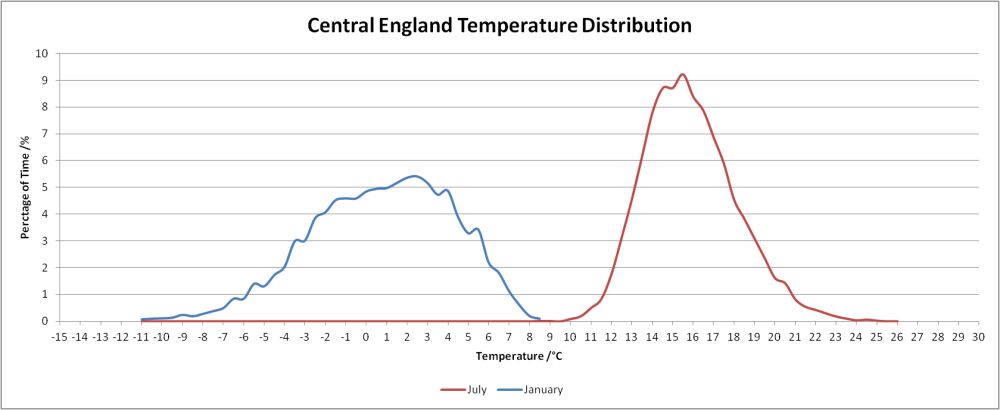
-
We used to wrap some plastic mouldings to get colour consistency, was pretty hard wearing. Better than paint.
-
https://www.ebay.co.uk/itm/273904901278
-
Solar PV & battery installation on the cheap!
SteamyTea replied to Solarexploits's topic in Photovoltaics (PV)
Bit hard to tell what is going on. Can you discharge the batteries tonight and see what happens when they start charging up. I think it may just be fooling itself into thinking the batteries are full because if the voltage and the MPPT is just checking to see if there is any room for a bit of charge. To attach files
-
Science and Art of specifying ASHP
SteamyTea replied to severnside's topic in Air Source Heat Pumps (ASHP)
So about 26 MWh. Do you know that mean outside air temperature you turn your heating on at? Mine comes on when it is less than 10⁰C for a week. DHW on E7 is going to be quite costly now, but you can add extra insulation to the cylinder, heat to a lower temperature, and use less, though a bath with a showers worth is never very appealing. -
Change plumber.
-
Science and Art of specifying ASHP
SteamyTea replied to severnside's topic in Air Source Heat Pumps (ASHP)
Weather Underground had plenty of contributors in most area, find one local and then look at the daily data, collected every few minutes. I have often wondered if Bristol gets warmer in the winter when the tide comes in. Regarding the size if an ASHP, generally the fan size is similar with just more fans added to a larger radiator area. So doubt it makes that much difference. 16 kW is a large unit, can your current electrical supply satisfy it? Remember that a combi gas boiler is usually sized to the DHW supply, not the space heating. -
How does your garden grow?
SteamyTea replied to recoveringbuilder's topic in Landscaping, Decking & Patios
West Cornwall. Think the picture was a house in Camborne. They are pretty good here. It is generally the spoil that is the problem, though the occasional shaft gets missed. Hard rock mining here, so very different to coal, salt, potassium ect. Still get quite a few tremors from collapses. Though I see the last one, on the 5th Feb was 33 km deep, so not a mining one. -
Science and Art of specifying ASHP
SteamyTea replied to severnside's topic in Air Source Heat Pumps (ASHP)
Thanks. -
How does your garden grow?
SteamyTea replied to recoveringbuilder's topic in Landscaping, Decking & Patios
Our mining spoil gets flattened, eventually. Then left for decades. Along comes a developer and buys up the cheap land for housing. Then finds that houses fall though it. Ventilation shafts were often capped with timber sleepers. They rot and houses fall into them. -
Science and Art of specifying ASHP
SteamyTea replied to severnside's topic in Air Source Heat Pumps (ASHP)
Is that the external dimensions of the unit? Not heard of this rule. Only the concealment could be considered art. You must already have a lot of data, get your old bills out and see what you have been using. -
That is all a person needs. Oh, good idea, can I burn seaweed. I am semi rural, and right by one of the worse roads for air pollution in the country. It was number three, but seems to have dropped down the rankings. No gas, so the cars and topology get blamed. "Come to Cornwall and enjoy the fresh sea air" It smells of creosote.
-
I have just got my 'new and improved' prices from EDF. Even I am wondering if I should buy an old stove with a back boiler, rig it up outside, then start burning the shed I want to replace. Standing charge 30.40p-->57.86p Day Unit 26.46p-->35.00p Night Units 14.04p-->18.57p
-
Solar PV & battery installation on the cheap!
SteamyTea replied to Solarexploits's topic in Photovoltaics (PV)
Can you do a sketch of the wiring, and where/how, you are testing it. I am wondering if, when the amps go to zero, the voltage showing is the battery voltage, rather than the charge controller voltage. -
It would be dreadful, after all this work, if domestic solid fuel, combustion devices, were outlawed.
-
Self installing solar modules and inverter
SteamyTea replied to Radian's topic in Photovoltaics (PV)
Just had a look at the National Grids revenue, about £15bn in 2021. Natural gas was around 551 TWh and electric around 653 TWh. Taking away conversion and transmission losses we get 489 TWh for gas and 308 TWh for electrical. So that is almost 800 TWh shifted for £15bn. So less than 2p/kWh. (All the data is from the latest DUKES)