SteamyTea
-
Posts
23848 -
Joined
-
Days Won
200
Everything posted by SteamyTea
-
 It is higher than timber, brick and stone. You are talking about volumetric heat capacity. You can order the list by mass or volume. https://en.wikipedia.org/wiki/Table_of_specific_heat_capacities
 -
Mine was done 3 years ago because the seal had gone. Noting wrong with the actual thermostat. That is on a car that was then 11 years old and about 140k miles.
-
If they are that important, you really should have a UPS fitted to them. Built into laptops, unless like mine, it stopped working off battery power a while back. Still, it is several years old so may treat myself to a new 'cheapest I can find' one.
-
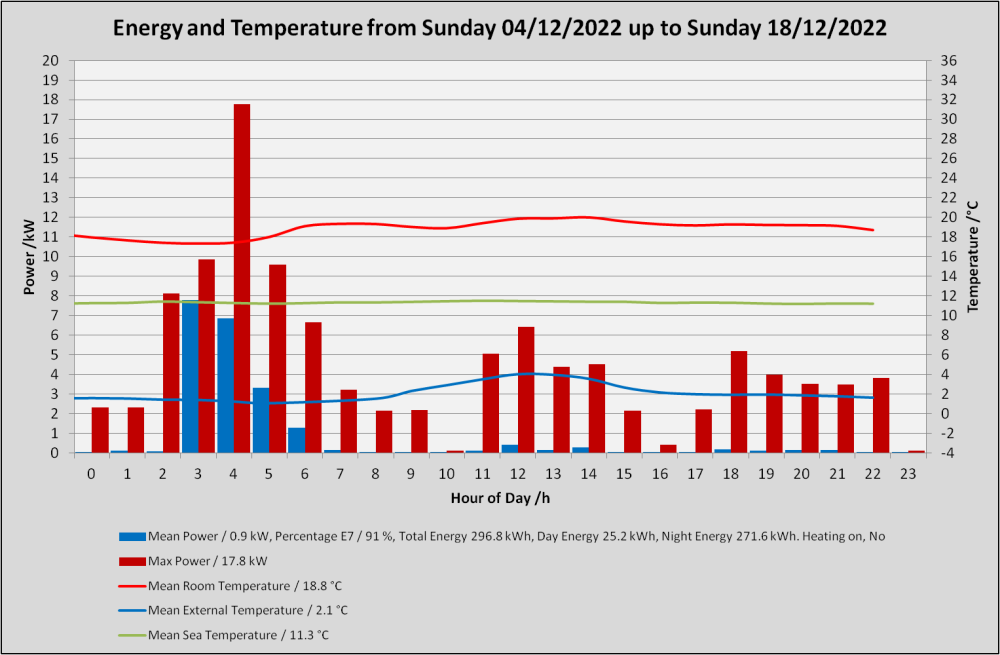
Right. Here is the last two weeks data. I know that I live in the warmest part of the country, but for here, it was artic. Work out at 4.6 kWh/m2 for that periods space heating. As my heating season is about 12 weeks, that will be 28 kWh.m2. Not too bad, especially as the mean temp was only a gnats over 1°C down.
-
VAT of the energy price?
-
PV 12v. DC panel supply, earthing question
SteamyTea replied to Marvin's topic in Photovoltaics (PV)
No. Unless the manufactures instructions say so. And that would almost certainly be the inverters MI. -
Where is the kWh price heading in 2022?
SteamyTea replied to epsilonGreedy's topic in General Self Build & DIY Discussion
I make the cream on yours at home. -
Where is the kWh price heading in 2022?
SteamyTea replied to epsilonGreedy's topic in General Self Build & DIY Discussion
What is there to moan about, with my usage pattern, I should be saving 20p. -
That is quite interesting. I have storage heaters and I limit the time they can store energy to between 3 AM and 7 PM. So 3 hours. The other 21 hours of the day, they are discharging. The mean temperature did drop a couple of degrees over the cold spell (just working out the data now). But not too much and I only used the fan heater about 4 times for an hour at a time.
-
That is quite interesting. I have storage heaters and I limit the time they can store energy to between 3 AM and 7 PM. So 3 hours. The other 21 hours of the day, they are discharging. The mean temperature did drop a couple of degrees over the cold spell (just working out the data now). But not too much and I only used the fan heater about 4 times for an hour at a time.
-
Where is the kWh price heading in 2022?
SteamyTea replied to epsilonGreedy's topic in General Self Build & DIY Discussion
Just had a letter from EDF about next years prices. So from Jan 1st. Day rate is going up from 46.25 to 54.16p/kWh Night rate is going down from 16.14 to 13.01 p/kWh Rental is staying the same at 59.10/day. They estimate I will spend £46.88 less next year, but if I want to change tariff, then I can save £262.46, which I am very dubious of as that is on an estimate yearly spend of £840.74. May chase them up as they are claiming I have to have a smart meter, but I seem to remember that this is not actually true, they want me to have a smart meter, not I must have one to take advantage of better deals. -
They use them in airports to look at my todger.
-
There is still an air gap for cooling with inroof systems. And they look so much better. When I went to see Jeremy's house, even though I knew it had 6 kWp of modules on the roof, I did not notice them at all. Building on what Terry has said, factory built houses are much better. You would not buy a new car if it was built on your drive. Or a fridge that came in bits. I do find the whole airtightness detailing a bit strange. Almost as if the industry think it is an afterthought. It as to be designed in like everything else. The production manager at Frame UK (company that make hundreds of TF houses down in Redruth) said an interesting thing to me when he took me around the factory. "We design in all the services, then the plumbers come along and drill holes tough the walls" Now I suspect your Architect is not that up on site work practices, so it comes down to you to enforce the design ethics and the quality control. Not a nice task as it can easily alienate a crew (I know how hard it is to change work practices), but it has to be done right, there is, realistically, no second chance.
-
Not really, the efficiency is not affected that much. In roof an also change the SHC and the thermal inertia times.
-
No, the opposite. PV at say 20% efficiency at 1000 W/m² input means that only 800 W/m² can get through to heat the roof up. So you can get away with a bit less insulation.
-
kWh you (expletive deleted).
-
Just make sure you use kW and kWh the right way around. Modeling is very useful and Jeremy initially used what-if scenarios to work out where best to spend money. One think that a lot if people do is overglaze a building. Southern aspects are generally not too much of a problem, but East and especially West facing can be. Also worth remembering when it comes to overheating that PV can suck up a fair bit of energy. So that is worth modelling. My view is that it is worth setting a target for energy usage, then see if you can achieve it, got to be better that initially setting up all the components and then changing the values to see what happens. Nay have to have a play with that once the holiday week is over. Also try not to fall into the trap of using just W or kWh per metre squared as the ultimate aim (which is really the same as not initially setting a target). Volume to energy use on s important, especially if air losses start to dominate. And keep an eye in the architect, make sure you know of they are talking about total area or habitable area. It can make a big difference.
-
Does to me.
-
An ultrasonic scanner. Could pick up your weener when you were in the womb. Oh how they all laughed when you came out a boy.
-
Mine does. Can set it up, then go back and chech in the same place and the stud must have moved.
-
New member - stuck for what to do next to warm the house
SteamyTea replied to Sparrowhawk's topic in Introduce Yourself
They are the same thing. There are a number of different ways to describe it. ACH, air changes an hour, This is sometimes described as m³/m².h, where the m² is the surface area of the building and h is the time in hours. When testing, the building is depressurised by 50 Pa, which is quite small in pressure terms, 0.0005 bar, or 5kg/m². Wind speed changes the air leakage, but generally not as much as people think. When I look at my energy usage, plotted against windspeed, there is only a very weak correlation, and that is really down to the odd easterlies that are fairly strong. If I include south westerlies, I actually use less energy the windier it gets. But not all houses are the same. -
Just had a Chinese takeaway with my mother, who knows what was in it. Pat Eddery lived nearby, so they are probably still clearing out the stables.
-
1.4 to save any confusion
-
Misread that as four horses to render. Need a big pot to get them into.
-
I got one from Lidl. Not that good at finding cables, or studs.