SteamyTea
-
Posts
23383 -
Joined
-
Days Won
190
Everything posted by SteamyTea
-

First year Heating Energy Use in Passive(I hope) House
SteamyTea replied to Iceverge's topic in Boffin's Corner
It is a crude tool, though useful for year on year comparisons. From my weather and energy usage analysis, OAT is the biggest driver by far, but much of that is to do with my house being a mid terrace. -
Ptarmigan Homes in Liquidation
SteamyTea replied to MR10's topic in General Self Build & DIY Discussion
@ToughButterCup started writing up what can be done. -
First year Heating Energy Use in Passive(I hope) House
SteamyTea replied to Iceverge's topic in Boffin's Corner
Have you check it at the temperature you actually turn your heating on. My minor improvements dropped the temperature by about 1°C. I used to turn the heating on after the first full week when the OAT was 10°C, now do it at 9°C. HDD use a standard distribution (near enough) for OAT temperature, dropping a degree may seem small, but may be a lot of hours in reality. -
Anyone know where I can find jumbo sized MDF shelves
SteamyTea replied to Adsibob's topic in General Joinery
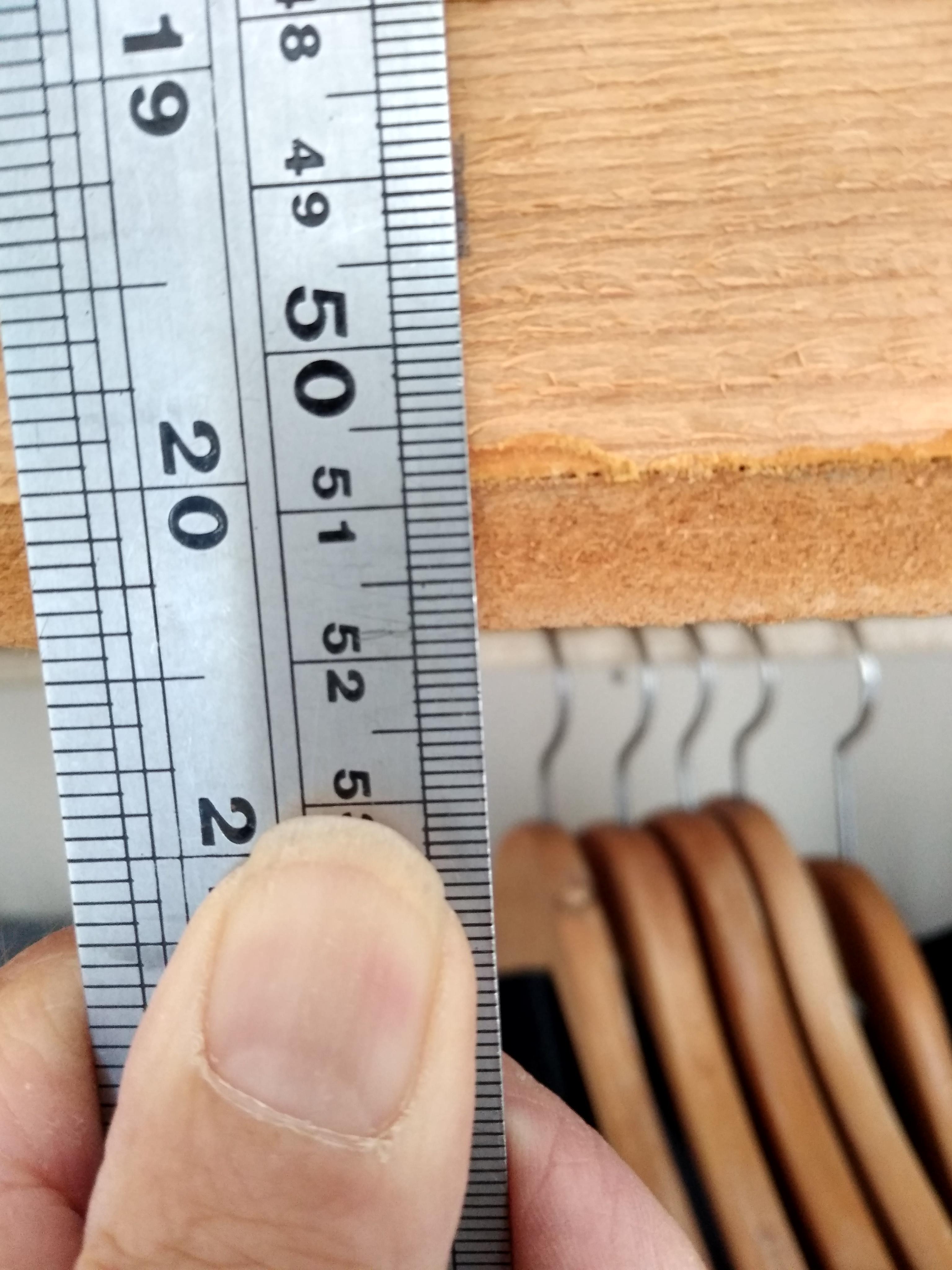
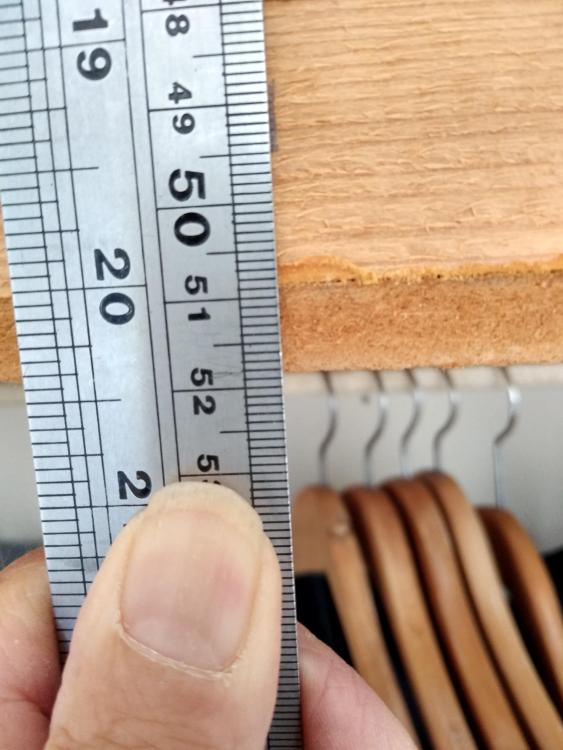
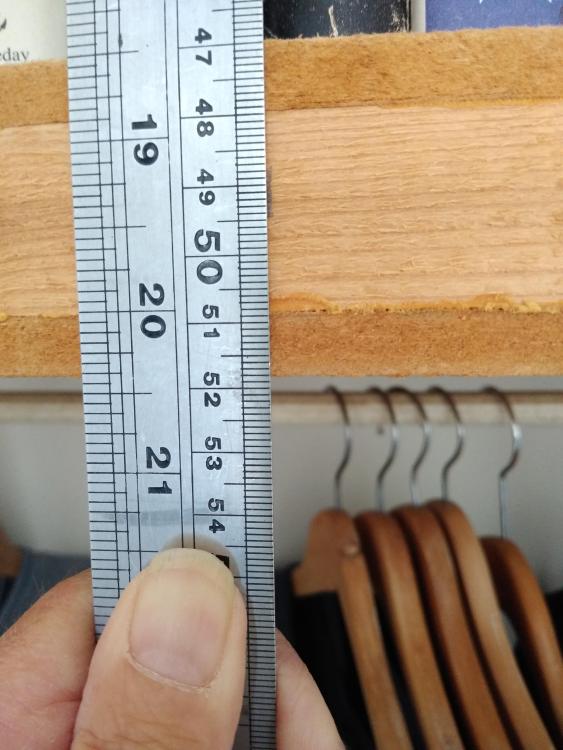
@Adsibob I made a shelf a while back. It is 0.88 m wide, 0.47 m deep. It is made from two sheets of cheap 10 mm MDF, with a bit of 40 mm by 30 mm (I think) rough sawn pine separating them. The same sized timber strips are screwed into the wall in 3 sides and the shelf slid over them. I think there are 4 timbers inside the shelf, one each side close to the wall supports, and two more evenly spaced. So to see how much it moved when loaded I measured from the ceiling to the bottom of the shelf at the mid point. 518mm. Then I stacked it with 10.85 kg of books in the middle, at the front. 519 mm. So 1 mm drop. I then spread the books out like a proper library, 518.5 mm. So basically with an 11 kg load, no movement. I may have the pictures in the wrong order, but as there is so little movement, it don't matter. No load Stacked books. Spread out books.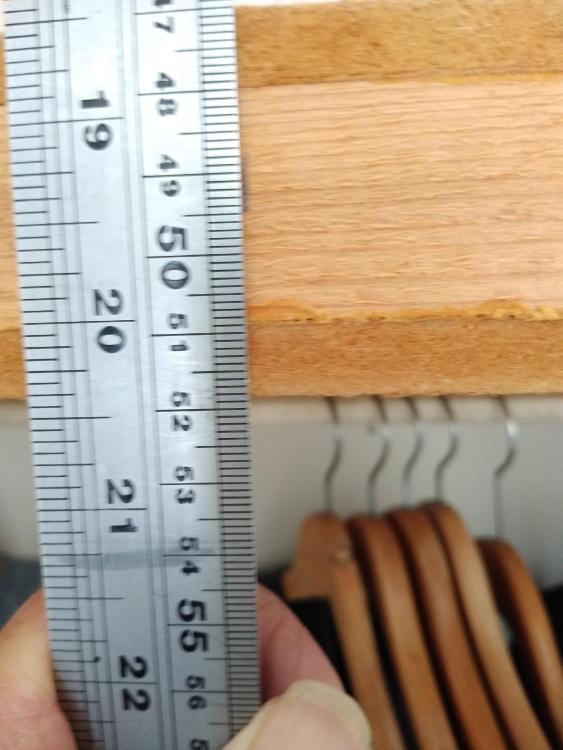
-
Converting into 10 student flats (meters)
SteamyTea replied to PropertyOwner1682's topic in Electrics - Other
Probably not worth skimping on, just put in 10 sub meters, each with there own fuse and isolator. -
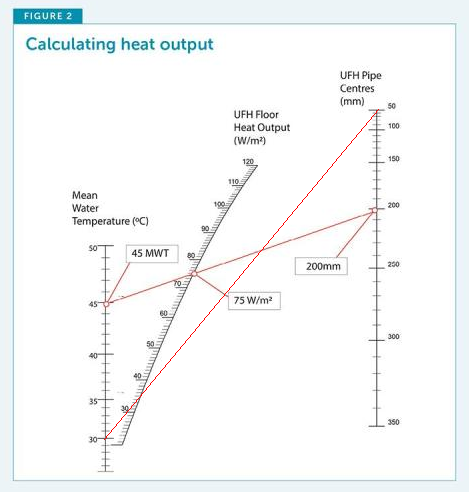
Something like this then. 35 W.m2
-
You can model the tank as a small house. So calculate the surface area, then the u-value of the glass, then the temperature difference. Just to make it more fun you can calculate the evaporation losses. https://www.engineeringtoolbox.com/evaporation-water-surface-d_690.html Then treat the fish tank as a heater and see how it affects the room heat losses. Or just go to the local park and nick some goldfish.
-
Oily massage always works for me. Don't matter if I am grubby or no.
-
National grid, improvements discounted thread?
SteamyTea replied to Andeh's topic in General Self Build & DIY Discussion
Ask @pocster he was looking into it. -
There's no real typical value While not typical, @JohnMo has a chart with pipe spacing and temperatures on it. So should be able to design for 30°C, might just mean that most of the floor is sitting on pipe, but you get the idea.
-
ICF How much more expensive ?
SteamyTea replied to Dave Jones's topic in Insulated Concrete Formwork (ICF)
An interesting engineering problem. I wonder if you could cast/encapsulate the appropriate parts in an airtight resin. I think radon barriers are thick polyethylene, which is a bugger to adhere to, but there is generally a way around joining dissimilar materials. I am only thinking aloud, and not knowing the details it is hard to imagine the problem. But it is only an engineering problem, and as Ken Tyrell said "An engineer is only someone that does for a penny what any damn fool can do for a quid". -
ICF How much more expensive ?
SteamyTea replied to Dave Jones's topic in Insulated Concrete Formwork (ICF)
Can you put a sump and air blower in? -
What the SCoP is for. It tells you the expected performance over a typical metrological year. Then divide the price of electricity by the SCoP to get the running cost. The heat demand of the house is blind to the technology used to heat it.
-
They can physically be at the same locations as the weather stations, at the same time, just to alive.
-
Are the easy things like low energy lighting, controls on heating, double glazing already done. What does the EPC say are any weak points. Do they still recommend a wind turbine?
-
There is a lot to be said for doing that. Electrical Engineers seem to design to the minimum they can get away with, that is why it is usually difficult to put wires in easily, then screw up the terminals tightly.
-
ICF How much more expensive ?
SteamyTea replied to Dave Jones's topic in Insulated Concrete Formwork (ICF)
-
ICF How much more expensive ?
SteamyTea replied to Dave Jones's topic in Insulated Concrete Formwork (ICF)
There is only one way, Dave's Way. Don't question it unless you want to be belittled. -
Say, after 20 years you redo it. Worth staying in the house, will end up as sexy as this once all the cracks, holes and wrinkles are filled. Might be PVC in the image, but you get the idea.

-
GRP Roof Internal Down Pipe Leaking or Condensation
SteamyTea replied to GrantMcscott's topic in Flat Roofs
Looks a little dry in places to me. Really, then why do they sell it, what do they claim it is for? -
GRP Roof Internal Down Pipe Leaking or Condensation
SteamyTea replied to GrantMcscott's topic in Flat Roofs
That may be your problem. Water can easily find a path though the matrix, especially if there are some dry patches i.e. too much mat, not enough resin. Sand well and get the top/flow coat on. Then see what happens. -
There is a fair bit on emulsion polymers here, I say a fair bit, I cannot be bothered to read it.
-
What would you do differently if you could do your PV install fresh?
SteamyTea replied to Gill's topic in Photovoltaics (PV)
Why I mentioned it, I don't have an EV. But it seems that, with the Teslas, if you leave some features on, then it is quite a high standing loss. Would be nice if you could measure it though, say when you park it up for a few days without usage. -
If you look at the Met Offices' Central England Temperature data set (just happens to be the longest in the world), between 1900 and 2023, there has not been one full day when the temperature has been lower than -9°C. The distribution starts at -8.7°C, and that has 1 instance, or one full day. For temperatures below, for a full day, 0°C, there has been 1177 instances out of 44908. That is 2.62% of the days. Now if we look at the last 30 years 1993 up to 2023 then the lowest temperature is -7°C (1 full day), below 0°C is 175 days, or 1.59% of those days. Now non of us can actually live at the CET location, but it shows that we remember exceptionally cold weather because it is exceptional, not because it is common.