Ferdinand
-
Posts
12213 -
Joined
-
Last visited
-
Days Won
41
Everything posted by Ferdinand
-
 I can confirm that the 650g loaf of bread I just made has used about 0.8 kWh of energy to make 🙂.
 -
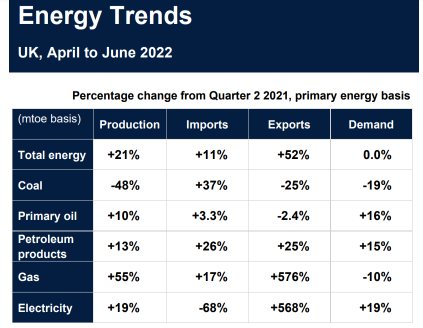
The short answer is no, we won't run out in any serious way unless it is a 1 in 100,000 case. Our media take a 1 in 100,000 case, and go "this *could* happen to all of you" - Panic. Panic. Panic !!!. That is a problem with an almost universally tabloid and political media. Did the forecast £6500 energy bills happen? All this happened last year. and there were hysterical articles then. Extensive power cuts did not happen then either. Example: https://www.theguardian.com/environment/2021/oct/07/risk-of-uk-power-cuts-this-winter-has-increased-says-national-grid With ref to @Billit's National Grid outlook reports, the Gas ones are here: https://www.nationalgrid.com/gas-transmission/insight-and-innovation/winter--outlook and the Electric ones are here: https://www.nationalgrideso.com/research-publications/winter-outlook It's worth reading one of each at least once to appreciate how they do the modelling. When I looked at the early outlook reports back in August (ish), the risks of cuts were about the same as last year, and it did not happen then. They measure to something like "five times this winter a few people may have short power cuts at peak demand time if it is a really, really cold day". ie Not very likely. Then the media go ape for clicks / attention / to poke the Govt / whatever; just a problem of the UK media. AFAICS the risks are not much different to last year, though supply is perhaps better in that we have much more renewables and interconnectors on stream than last year. Plus our main North Sea Continental Gas field has not been under maintenance this year. In 2022 over 2021 UK domestic oil production is up by 10%, and gas by 50%. See the most recent Energy Trends report: https://assets.publishing.service.gov.uk/government/uploads/system/uploads/attachment_data/file/1107461/Energy_Trends_September_2022.pdf Gas demand is down on last year by 5-10%. And we have been happily exporting huge amounts of both gas and elec to the continent to prop up the European Grid throughout the year, because we have 20% of Europe's LNG import facilities, and a whole fleet of CCGT Electricity Stations currently producing Elec for France and the continent. The UK has been a net exporter of electricity this year for the first time since 2010. The shift in terms of trade is around £5-10bn - not small. Plus Rough gas storage came back on line last week at 20% capacity - increasing our storage capacity by 50%. From small to rather less small - but we have domestic production so don't likely need to cover 100% of our usage. So what if Mr Putin sends his subs to wreck all our offshore infrastructure? I'd say we are resilient to interconnectors going off, as we are exporting. And taking all the offshore wind off stream would be quite an ask, but would be more of a potential disruption. So me, I'm fairly relaxed, but I do have a Super SER in the garage. F
-
I think herb lawns end up taking more effort and maintenance than you would prefer, though Herts sounds possibly quite benign a place to do one. There is a National Trust version of one at Sissinghurst in Kent after the experience of Vita Sackwille-West *. There is an article about it here. They found it tricky and have now replaced with something more like a big stone paving patio with Thyme in the gaps: https://sissinghurstcastle.wordpress.com/2015/03/12/the-thyme-lawns-revisted/ https://www.facebook.com/SissinghurstNT/posts/vita-was-a-great-lover-of-bringing-the-indoors-outdoors-and-her-desire-for-this-/2814891468540481/ Ditto chamomile, aiui. We have one of their two large herb gardens near here at Hardwick Hall which I visit regularly, which is a bit windswept and I have never seen any thoughts of trying one here. My suggestion if you do not want a feature needing maintenance is to consider how green roofs are done, which need to be hard wearing and tolerant, or look for what the dominant creeping plants are on your local soils similar to your potential lawn. F * I do hope Sackville-West was the inspiration for the Sackville-Bagginses in Tolkien. Perhaps as an aristo she was in the habit of stealing spoons. Too young, probably, however.
-
Heh. Personally I bought a couple of gallons of surgical spirit to clean everything during Covid, and I still have a fair bit left. Technically, Absinthe would do the job 🙂 .
-
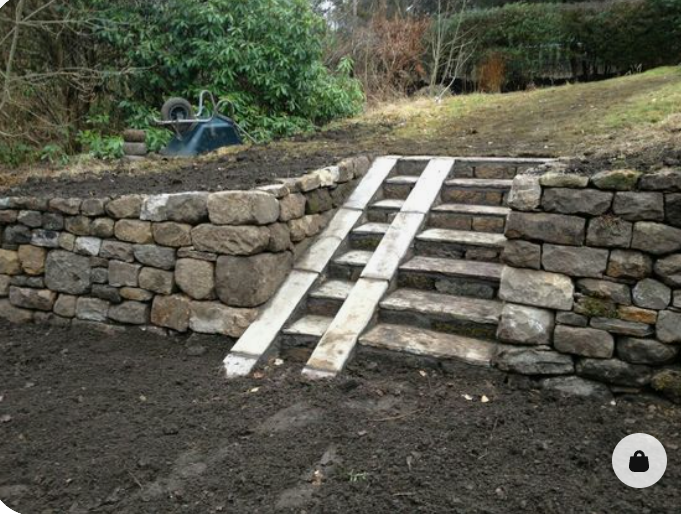
I think this is getting close to an answer. I would make 2 points: 1 - Fit something at the front to prevent cars on their own or drivers with slippy feet-on-pedals entering your lounge window by accident. It needs to be aesthetic and discreet, but strong. Options are something like a lowish fence with strong posts, which would also help with the falls issue depending on the level change, or just posts. I wonder about knee high lighting posts? You need ones that are hoon-proof, and will stop the car. Perhaps the place to look is at attractive products from bollard-suppliers. eg https://www.lighting-direct.co.uk/outdoor/post-bollard-lights.html Or you could do something like a slightly ornamental bike stand so that visitors could lock their bicycle there. 2 - That set of step look to be 1.6-1.8, wide, so their should be space comfortably to incorporate a set of wheel ramps for your bin, and letting you trolley or slide big items into the house. This sort of concept but adapted for your dimensions and style. I think it needs to be at one side, so normal pedestrians have a clear path. You get a bonus wheel ramp for bikes, and potentially wheelchairs and prams and pushchairs if your dimensions and slope are suitable. F
-
I put it on the bottom half of a kitchen window when there were 2 kitchen windows facing across a path. I used a product by the Rabbitgoo people: https://www.amazon.co.uk/gp/product/B00RDVE71W/ref=ppx_yo_dt_b_search_asin_title?ie=UTF8&psc=1 Up 4 years. OK so far. The important thing is a clean, product-free window (use eg rubbing alcohol as your cleaning agent to remove any detergent etc left). F
-
Land grab of unregistered land
Ferdinand replied to JonC's topic in Party Wall & Property Legal Issues
I'd get a Statement of Truth from the existing users, dated, documenting their use and the period over which it has been used. Make copies for each user - just to spread it around. That will help if anyone moves away, and you find yourself in need of evidence at a later date. If you wanted to you could even get it notarised inexpensively. You can also play proof games such as getting a sealed copy filed with your solicitor etc. There is also stuff around Mitigation of Obstructions, but that risks becoming a touch confrontational. Can you dismantle the fence without damage, or take the gate of its hinges? This is a good question for the Gardenlaw Forums if you need more. Ferdinand -
Does the fan have a backdraft shutter in it? If not you have a hole in your wall, Dear Soapstar, Dear Soapstar ... 😉. Fix is a replacement fan with a backdrafts shutter (from about £30), or even an HR fan - which I think would be justified in a utility. F
-
What is Rear Elevation?
Ferdinand replied to Jonathan M's topic in House Extensions & Conservatories
You could try putting in an FOI to your Council for records, and that might smoke something out. Or go and visit the Planning File. (WIth adanced earnign and an appointment). -
This pole https://cpc.farnell.com/nilfisk/128470040/telescopic-roof-cleaner/dp/SI19150?ost=si19150 and this brush https://www.amazon.co.uk/gp/product/B001U3X9Q8/
-
-
<visits thread out of respect> How goes the DIY plumbing? Do you hate it yet?
-
What is Rear Elevation?
Ferdinand replied to Jonathan M's topic in House Extensions & Conservatories
Though iirc if it is not part of the original house, you are perhaps more likely to need PP - as I think extensions that poke out both to the side and behind (ie cover the bit that is on the diagonal from the corner) require PP. @DevilDamo may know on that. From what we have on this thread, I think your way to avoid the paperwork costs is to put it behind the main section of your house at dimensions of say 4.7ma cross by 3m front to back. But the paperwork costs may be small enough just to swallow. -
What is Rear Elevation?
Ferdinand replied to Jonathan M's topic in House Extensions & Conservatories
Just a check - are you sure it is an extension? The check would be that there are others that are identical, but without the extension. Back then a looks-like-an-extension utility / loo on the side would not be unusual. I suspect that it may not make much difference, though. F -
What is Rear Elevation?
Ferdinand replied to Jonathan M's topic in House Extensions & Conservatories
I think you are answered on the PD question. My comment: make sure that your roof form is maintainable, that you can get where you need to get, that the form you chooses takes leaves and muck towards the outside not the inside, and that there are no inaccessible corners that catch material. -
Weeping Willow, should it stay or should it go?
Ferdinand replied to MDC's topic in Landscaping, Decking & Patios
For amenity value, it would be remove the willow and keep the oaks, as the willow ha a short lifetime and the oaks should last hundreds of years. Is there a survey indicating remaining lifespan? Also weeping willows have a habit of growing sideways substantially. F -
Via a not very expensive CO2 meter, which is reporting values up to the 000s in the kitchen. Reduction is slow ie hours - but quicker when ventilation applied, such as an open window or a cooker hood on max. Humidity has been normal. I have RH meters in the room as routine. It reads roughly that - 440. Will try it outside. It is one of these, which is cheap so I mogjht be inclined to get a better one before I commit to spending money. However, ventilation is arguably inadequate anyway - there is no kitchen extractor other than the cooker hood: https://www.amazon.co.uk/gp/product/B09MJ8KPZK F
-
Yes - but it's not one with the hall and landing stacked in the same space. Staircase runs off at right angles to the hall.
-
I, and my regular tiler for decades, have always used a regional supplier called Tiletown, who are based in the Midlands with an online presence. But I have always valued being able to go in to the place and ask lots of questions. So I would suggest look for a trade supplier you can talk too candidly. So I suggest go for who to ask, as well as a brand. Find your tiler by local recommendation from clients for past good work, and then take their advice once you are confident in the person. F
-
Rear extension permitted development in Scotland
Ferdinand replied to Y555SLD's topic in Planning Permission
In the quotes above we also have no clarity with the definition of curtilage This 2021 version links to a definition on the Scot Gov website. Curtilage curtilage is not defined in the 1997 Act or 1992 Order but it is accepted to mean land which is used for the comfortable enjoyment of a building and which serves the purpose of that building in some necessary or reasonably useful way. It need not be marked off or enclosed in any way. Normally the curtilage would relate to the property boundary of the dwellinghouse. The 2020 version - rejected by the Chief Planner for the other point - is different. I think the second one was a summary written by someone who did not have enough knowledge on this point, too. So we should use the first, although that is itself ambiguous in its use of 'private space', which puts a small time bomb under regulations which we have (at least in England and my LPA) about required private amenity space * for a dwelling. It looks to me as though using that definition one could argue that private amenity space can be in public view, with a fair shot at winning. Ferdinand * I used that to stop one of my tenant harrassing neighbour from recasting his bungalow as a row of 3 flats when he was moneygrubbing. -
Price to Reduce / Cap a Chimney - Sanity Check
Ferdinand replied to Ferdinand's topic in Roofing, Tiling & Slating
The roof is actually quite strong - it is 2-ply chipcutter polyprop across 6x2" joists, and can be walked on with care (I always do them robustly). The plan is to put a couple of 8x4 sheets on it, which seems OK. I hadn't considered acros - that would be a good idea if we need to do that. That chimney pot will come down in bits. It is perhaps less difficult to access than it looks - the front to back outside dimension of the house is 3.8m, so the roof is *really* small. Thanks all. Ferdinand -
I need to improve my ventilation, and I am thinking about options. My house is a 2010 extended-upwards-sideways-and-backwards bungalow with three bedrooms and a bathroom in the warm roof - and I only have a limited number of remaining triangular roof spaces to play with. The house is reasonably well insulated, but was not targeted for near passive renovation or similar standards. One driver is checking C02 levels, which in a couple of places go up quite high, and do not come back down again swiftly (==> more ventilation should be considered). I do perhaps have room for the MVHR unit in the garage or planned to be extended utility, but also have limited spaces in which to put the ductwork etc. downstairs. Clearly an MVHR needs balancing etc, but how much benefit will I lose by not installing one in all rooms, if I can get to say 2/3 of the house? Perhaps an alternative is to adapt a strategy of a PIV upstairs, and constant HR low volume ventilation downstairs. I'm going to need to spend some time thinking about this, so I'll welcome any thoughts from anyone who has not quite been able to do a full MVHR, or has installed one in an older house. Cheers Ferdinand
-
Price to Reduce / Cap a Chimney - Sanity Check
Ferdinand posted a topic in Roofing, Tiling & Slating
Just after a sanity check on a price and job proposal. Meet my chimney which has been dropping bits of mortar for a few months. I need to have a chimney reduced to just below the protruding course and above the flashing, and capped / ventilated as per usual. As you can see access is a little awkward, and will ideally need to be done from a roof ladder, since scaff would require the leanto roof to be dismantled or finessed. I couldn't easily find a roofer willing to do such a repair job. I do have a a pro-handyman who has just done a good job removing ivy growth from a roof (so I have reasonable confidence) offering to do the job in one day with one colleague for £450. He confirms he has the proper insurance. I'd expect a bit of incidental expenses on top, but does anyone have any comments. Is this a decent price. The chimney is low at approx 20ft height. Any comments would be welcome. Cheers Ferdinand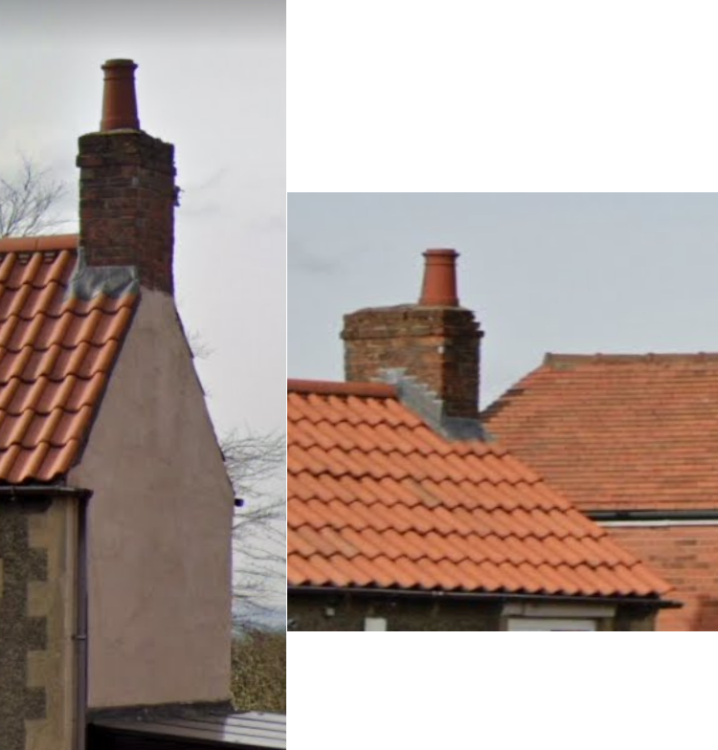
-
PIVs usually have an minimum inlet temperature at which they cut out to prevent making the house much colder. Likely to be something like 5C. Alternatively, some have a heating element in the airflow that can be switched on. I presume that may also be triggerable on the temperature, but I have not checked any models. F
-
Electric ovens with lower peak energy demand
Ferdinand replied to Nick Thomas's topic in Kitchen & Household Appliances
That sounds like an argument for *precisely* why they will use complex electronic control. :🙂 Now having read the spec, the max power usage of this Combi Microwave is listed as 3.25 kW, which is a lot.