


Marvin
-
Posts
2389 -
Joined
-
Last visited
-
Days Won
3
Everything posted by Marvin
-
All interesting stuff. This bungalow's temperature rises and falls slowly so the difference between the day and night temperature ( set on a separate digital thermostat to turn the heating circulating pump on) is very little about 2 degrees. Hi @Wil the only thing I have altered is the Weather Compensation Ambient Temperature / System Water Temperature, and the temperature differential and stop, at present as I do not understand what effect changing the compressor frequency or pump speed will have. I believe that turning the settings to a small difference between the outside temperature and the temperature required to heat the building is important, however I have also witnessed the fact that during the early stages of the ASHP start up (cycle) a lot of energy is used to get going in the first few minutes with what seems to be little result. I think this is why it is suggested that the ASHP unit should come on for at least 10 minutes. I am presently fiddling with these parameters to find our best result. As a yard stick: From Sunday at 8 am to Monday at 8 am we used 7.25 kWh. About 5kWh on heating and 2.25 on hot water for 2 people. The average temperature over the whole day taken at 3 hour intervals was about 9C and the floor area is about 100m2, at an average internal temperature of about 20C during a dryish sunny day with about 14mph wind speed So we are achieved about 50Wh per day per m2 floor. However there was cooking being completed which adds to the warmth. M
-
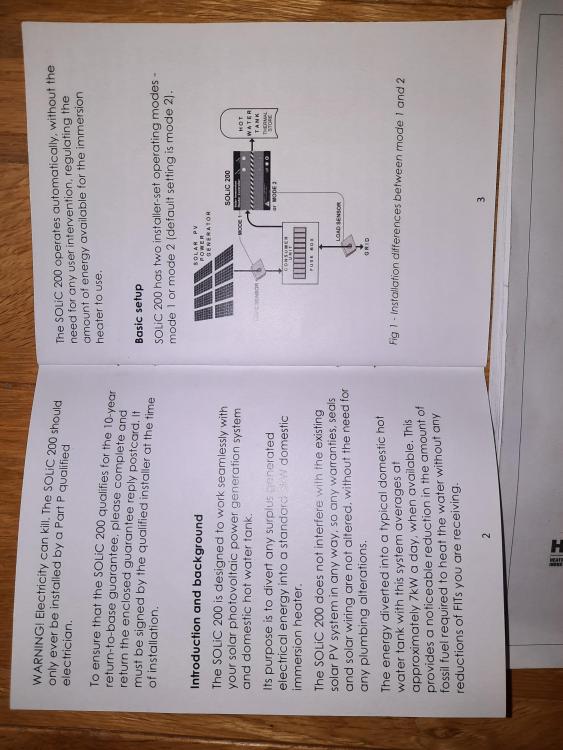
How are you charging the batteries? Hi @ReedRichardsI think it will work in mode 2 if the CT clip is connected to the cable running to the mains.
-
-
This is all about the set up of the Weather Compensation option on my ASHP Yes. I have changed the hot water set point in the Weather Compensation to a constant temperature. Thanks @dpmiller.? Whilst working on this I will adjust the heating temperature and outside temperature set points because once the outside temperature is above about 8C our home requires very little heat (we have run the buffer at 35C when the outside temp is 5C with no problem.) **** For those thinking they can do the same***These changes are in response to the location, BUILDING orientation, construction and use of our property and I would doubt that yours would be exactly the same.
-
We are trying to achieve this: The minimum hot water tank temperature required to produce enough hot water to meet our daily needs. An increase in the hot water tank temperature as a result of excess PV energy which can reduce the necessity of the ASHP heating the hot water tank the next day. The heating of the hot water tank over 60C after the hot water tank being below this for a consecutive 10 days. To achieve 2. we have installed a SOLiC 200 Model AF2.1 To achieve 3. we have a 10 day delayed relay, which is wired to reset if the hot water tank reaches over 60C, and heats the tank if this is not achieved.( and then resets) To take advantage of cold bright days where excess PV is generated which can heat the hot water tank, we are aiming to keep the tank to our minimum hot water temperature requirement. Also the ASHP is less efficient at producing hot water in the colder weather.
-
I'm confused with this. I assume your saying build up is joist, flat PIR, firings, boarding and final top coat? If that is correct, it doesn't sound right to me. I'm with @Radian M
-
Depends also on what is at the top level.... I thought geotextile and planting was about defence against erosion not the possibility of land slip.
-
Ah! Sound down pipes from other rooms! Rearly hear it but live in a quiet area. No. Not for us. Wife says no noise unless on boost and then only a low hum with ours far far quieter than the fridge Freezer!! Toothbrush charging makes more noise! HOWEVER we followed the installation instructions to the letter. Our unit is 2 meters from the bedrooms above the ceiling. Wife is noise sensitive!
-
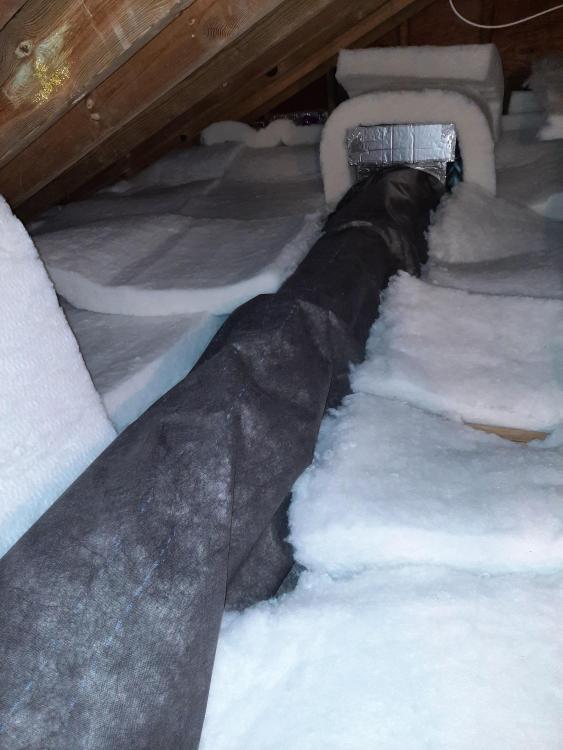
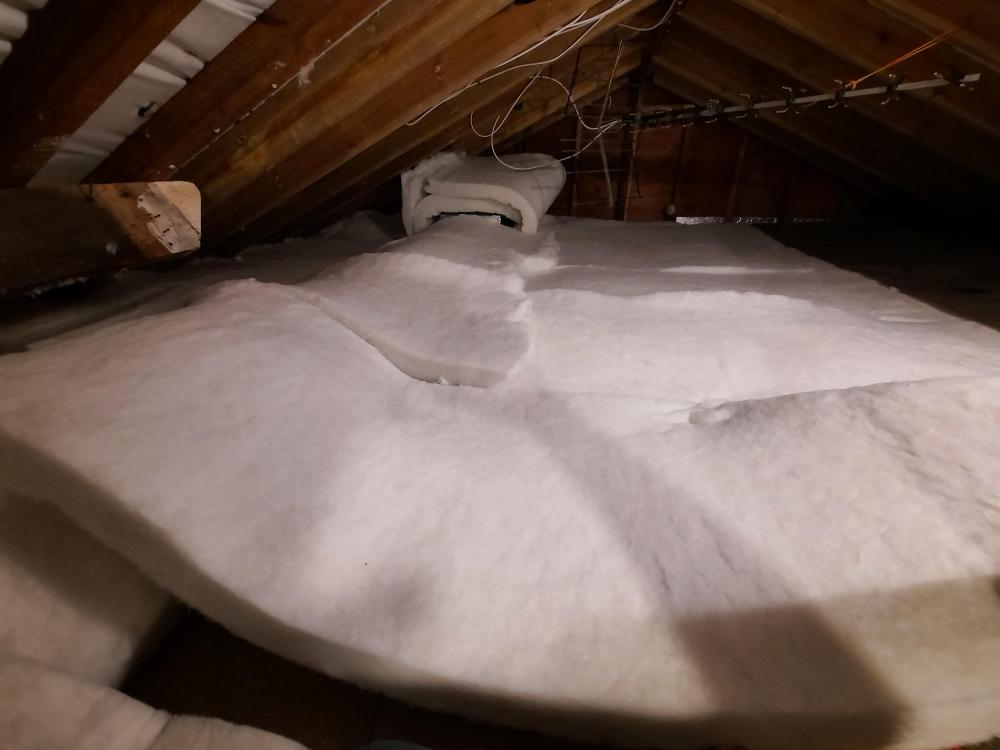
Hi @Si3 It's different than before we had one. No trickle vents. An almost unobservable flow of fresh air. Sometimes noise travels down the rigid ducts.The boost function clears the air. Never hear the MVHR at normal speed. Air temprature outside this morning 1.7C. Fresh air temprature entering living room after heat recovery, 15C. Definetly keeps the place warmer in the winter. Sometimes feels dryer but we only have 100m2 floor and the humidity from showering seems to compensate even though we have automatic humidity sensors that boost the MVHR. Cooking can be a challenge if you don't boost the system enough when cooking as the smells can linger. Even in the summer we now leave the MVHR on to avoid any problems with the pipes. Usually look at the filters once or twice a year. It has been a tricky process because we retro fitted the the system and had to super insulate the ducts in the exposed loft. Good luck M
-
+1 on both worth it and that its harder to do later. We have 100m2 floor area and our MVHR runs at 17 Watts normal and 25 Watts on boost, so it would cost us £40-45 a year to run but we have PV so even less..... That's 45 pence per year per m2 flooring.
-
+1
-
Thanks for the info @Iceverge. It would be nice to have it broken down to cost per m2 so I can relate that to my home, and probably others would too. How many m2 was this over?
-
If your planning to stay in your new home for years and years then the thicker the better. We have about 200mm but in a timber suspended floor. AND if your are going to have UFH the thicker the better. Good luck M
-
Well the combo is coming together and my wife insists that I make the controls as clear as possible "in case your not here". I wondering what she means. Still a lot to do though..
-
Hi @SteamyTea Thank you for your trials, but not so fast. I cannot understand your conclusion. Surely the 242080 Watts: (Notice I'm now using the capital W in Watts...) used in the test used less energy than the other alternatives (although it took longer which was not part of the problem.) But even so, is there not a scientific calculation that will identify what the answer should be? When the induction ring is fully energised, is the energy all used up producing and electromagnetic field, and therefore no more, or less, energy is used when heating the pan? Someone must know the scientific answer.
-
I think there are too many variables for this to qualify as an answer to the question.
-
I suppose the question is: When the induction ring is fully energised, is the energy all used up producing and electromagnetic field? And therefore no more, or less, energy is used when heating the pan?
-
There are two views about what happens when you use a large induction ring and a smaller pan. Assuming everything is equal and the pan is large enough to turn the ring on. Will the ring use the same amount of electricity if it was a large pan or a small pan. I.e. as the pan does not cover the entire ring, will the same amount of electricity be used even though the whole ring is not covered. Whilst it seem easy to answer I have found many conflicting opinions.
-
 A kW per what? Is that a Cornish idiom?
 -
What are you using as the most extreme cold weather? -5C outside??
-
Remember the nearer the temperature of the water compared with the outside air, the more efficient an ASHP runs. So ASHP works on "low n slow" So the more surface of emitter the lower the water temperature needs to be to meet the same temperature. Hence the increase in radiator sizes if swapping form Boiler to ASHP.
-
Correct
-
Not sure that's rubber.. looks like PVC to me, unless its well oiled
-
+1 same location. Same result.
-
Well, I fear that it has the potential to go over the threshold of the maximum allowable, and therefore you need to apply to the DNO before connecting to the mains. Although my inverter could supply 6kW - my panels only 5.12kW, and the CT clamp system would restrict it to below the limit, the DNO still assessed the system by the inverter maximum output. This being said I can only comment about my experience with Scottish and Southern Electricity DNO. M



