Marvin
-
Posts
2382 -
Joined
-
Last visited
-
Days Won
3
Everything posted by Marvin
-
 And heat only?
 -
Hi @thefoxesmaltings If your going to have it installed under MCS standards, you should look closely at the requirements like the dBA (sound) level. Just in case you haven't done it yet I would suggest you read all of the below installation file. This should reassure you more. (there's a bit on how to ensure the sound level complies with requirements) https://mcscertified.com/wp-content/uploads/2021/12/MIS-3005-I-Heat-Pump-Installation-Issue-1.0.pdf Good luck M
-
Plus one. Heat sump? Hot water tank? Buffer tank? I suppose a design could incorporate it as any of theses, but I cannot see the benefit unless you have spare PV energy used to for water heating, or used as a hot water tank because you have many people in the property. Perhaps someone will educate me....
-
Use kitchen roll or tissue to find the source of the leak as it leaks. then sort out.
-
New member - stuck for what to do next to warm the house
Marvin replied to Sparrowhawk's topic in Introduce Yourself
Hi @Sparrowhawk The below is my overview. Whilst I know you are going for a new boiler, the process below would still be the same. You will save a lot more over time fixing airtightness, the insulation and installing mechanical ventilation. Triple glazing is the most expensive element to install per m2 with the least energy saving(although important when everything else is high spec). Get yourself a heat loss calculator ( I use an excel spreadsheet for this ) and play with the elements and you can work out what gives you the best money spent/ money paid. Normal double glazing with a U-value of 1.2 versus your triple glazing say high spec 0.6 U-Value. Inside temp 20 centigrade, outside temp zero C will give a saving of about 10.6Watts per square meter. (ignoring any non air tight issues with the old double glazing window installation or the rest of the building) Aim to go APE It worth considering all the AIM and APE elements before making decisions. That is Airtightness, Insulation, Mechanical Ventilation with Heat Recovery OR Heat pump Ventilation, and Air Source Heat Pump, Photovoltaics and Electric Vehicle. Some of these will not work properly without the others, and some will complement others: A MVHR will not work properly without Airtightness. An Air Source Heat Pump will have to compensate for the lack of Airtightness and/or Insulation to the degree that the benefits become questionable, especially during winter, without them. An ASHP uses electricity and Photovoltaics can supply a little during winter and a lot during summer when cooling can be a problem and an ASHP can supply cooling. PV can supply a little to an Electric Vehicle during winter and plenty during summer if your vehicle is at home during sunny days. Extending a property and only doing AIM works to the extension will be no good, you have to do all the property within the thermal envelope. And thinking of running costs: a) Airtightness and Insulation should have no running costs and last (Well, loft insulation lasts over 40 years, in our experience) with the exception of UPVC units for windows and doors, but that being said it will last 30 years? b) Our MVHR unit servicing 100m2 floor sized home uses about 260kWh a year; far far less than would be used to heat incoming cold fresh air in winter, and we clean the filters twice a year. c) ASHPs are, in my opinion, still in their infancy but we are now in the second year of use here. We were very careful to follow best practice in the design and installation of our system, did a lot of bespoke tweaking, and we now have an upgraded 1970’s timber framed bungalow that uses less than 25kWh per year per m2 of floor for heating. d) PV would be a lot less attractive if there is no ASHP or EV (or battery backup) or diverter to the hot water immersion. In my humble opinion, if you have a suitable roof you should install as much a physically possible. Electricity production costs (cost per kWh) are difficult to evaluate because it depends how much is used and how much is supplied to the grid. We decided to go with the PV cost divided by 7 years, which for us works out at £1.60ish per day. Yesterday the PV produced 12kWh all of which we used. Remember, 5kW of PV panels will not produce 5kW because you would have to have: i. No shadowing of any of the panels during sunlight hours (like trees, buildings or chimneys. ii. All the solar panels face exactly the right angle in relation to the summer solstice midday sun for their position on the planet. (Perfect angle facing south and perfect slope) iii. solar panels completely clean iv. the sun is completely unobscured v. the Inverter is 100% efficient vi. all the other losses due to cables, and equipment, and so on. e) Knowing the above PV limitations professional installers often add extra panels to make up for these losses. (Our inverter allows us to add roughly 28% more panels than its kW rating) f) PV panel installations will produce about one fifth of the power in the winter compared with what is produced in the height of summer. g) The electric vehicle and charging from the PV only really works if you can have the vehicle plugged in during the day and supply over 3kW from your PV (or a large proportion of that). This is why we went for the biggest PV that would fit on the roof. We then installed a system which only charges the when the PV is on and generating over 2kW in winter and 3kW in summer. (we have a 13amp charging system). So, if finances cause you to have to consider only a few in my humble opinion AIM first and go APE later. (But prepare the property for the APE works as much as you can). Best of Luck Marvin -
Efficiency - help required for an amateur, please!
Marvin replied to EdieCampbell's topic in Air Source Heat Pumps (ASHP)
Hi @EdieCampbell This may help to start with: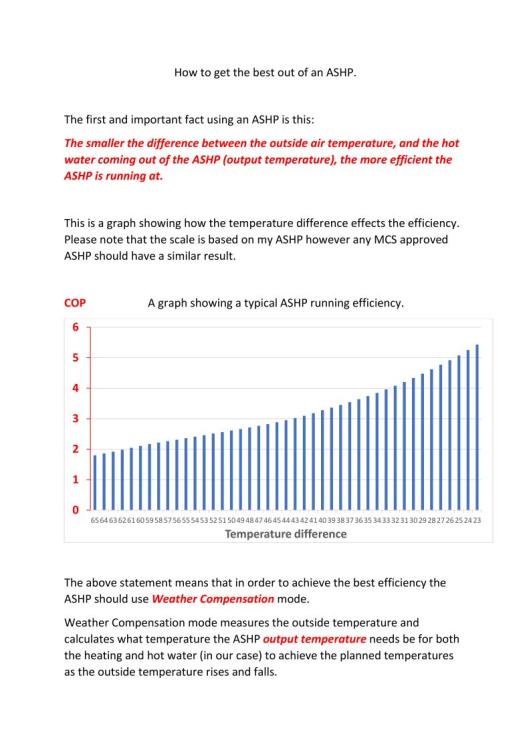
-
Scot Gov to change to passivehous for new build homes
Marvin replied to Tennentslager's topic in General Construction Issues
Why the Scottish government wants to tweak the passive house standard is mad! How much will they spend faffing about fixing something that is not broken! Can't they just copy and paste off the internet like every other kid does with their homework?* Passive houses started in Germany. Scotland is very temperate and nowhere near as cold. Even countries further south in Europe, such as Germany have much colder winters than Scotland! *Ok maybe translate into English, sorry Scottish. -
Scot Gov to change to passivehous for new build homes
Marvin replied to Tennentslager's topic in General Construction Issues
Yes. consulation first, then, as the Scottish Governments statement says: seeking the laying of amendment regulations in mid-December 2024. https://www.parliament.scot/-/media/files/legislation/proposed-members-bills/written-statement-from-patrick-harvie-under-rule-91413.pdf -
Hi @Rupe30 I'm sure we will be able to help but we're going to need a bit more help from you on this... When you say the first floor, do you mean the ground floor or the floor upstairs? You speak of a screed ( which makes me think you mean the ground floor as I would call it) could it be 60mm thick? I am also confused by what you mean by buffer tank. Usually a 300litre tank would be your hot water tank. My buffer tank is 60litres.... Any pictures of the equipment or names of equipment installed would help M
-
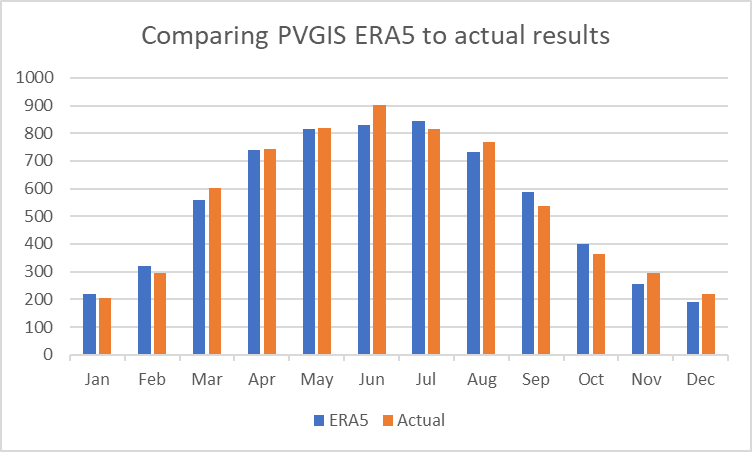
If you want to know what sort of amount of energy you could produce if you were to install PV then the PVGIS tool is a great start: https://re.jrc.ec.europa.eu/pvg_tools/en/tools.html Comparing the PVGIS PV estimate to our PV results Although December is not quite over, the PVGIS PV estimator seems to work well. However the inputs have to be accurate. We had to adjust the overall system loss down from 14% to 5% and think this is because inverters are much more efficient than they were. Our meter used is, a proper meter, just before the energy connects to the grid. For our PV PVGIS estimates a year to year variance of 157kWh. We expect to end up about producing about 71kWh more in the year than the PVGIS calculation, so within tolerances. Our PVGIS settings: Type ERA5 PV 5.12kW Loss 5% Roof added angle 22 degrees Azimuth +5 The graph shows the amount of kWhs per month, with about 200 being produced in January and 900 in June 2022
-
- 1
-

-
Considering there are over 280,000 ASHPs installed in the UK its a small percentage, however the recent cold weather and high electricity cost has put the issue at the forefront of everyone mind.
-
The next design being tried out! Will these work? Is this the next generation? https://businessmanchester.co.uk/2022/11/03/bellway-installs-uks-first-roof-mounted-air-source-heat-pump-in-pilot-project/
-
Hi @Moggaman I've just re read this thread and to be clear, our home is a 104m2 floored bungalow. So we have about the same rate of usage per m2?
-
Yes. You said your building was very well insulated which means ours is super insulated? And others here are super super insulated. Having tinkered with our system (playing with your toy she calls it) and completed a few major alterations it's alot better than it was. There are reports that indicate recommendations to ensure the best result from an ASHP installation and we were very careful to follow them and improve them when installing the system including extra insulating any pipework or tanks and so on. This alone can make a good improvement. We also meddled with the weather compensation settings and now that has helped improve results.
-
We have 100m2 with more insulation than you. Here's December use. (minutes converted into percentage of hour) last night average -1 ASHP power Reading Reading Use Time Date Reading kWh diff 8.50 01/12/2022 2,467.40 2.92 17.00 01/12/2022 2,471.11 3.71 10.00 02/12/2022 2,478.40 7.29 23.00 02/12/2022 2,484.17 5.77 8.00 03/12/2022 2,486.72 2.55 23.25 03/12/2022 2,494.77 8.05 22.75 04/12/2022 2,501.00 6.23 10.75 04/12/2022 2,505.81 4.81 8.50 05/12/2022 2,508.68 2.87 22.45 05/12/2022 2,516.31 7.63 8.25 06/12/2022 2,520.08 3.77 22.45 06/12/2022 2,527.08 7.00 8.00 07/12/2022 2,530.31 3.23 22.60 07/12/2022 2,539.92 9.61 8.05 08/12/2022 2,543.33 3.41 22.50 08/12/2022 2,553.06 9.73 18.30 09/12/2022 2,567.02 13.96 22.50 09/12/2022 2,570.27 3.25 8.10 10/12/2022 2,573.59 3.32 18.00 10/12/2022 2,580.59 7.00 10.25 11/12/2022 2,589.35 8.76 22.70 11/12/2022 2,599.28 9.93 8.00 12/12/2022 2,602.92 3.64 22.70 12/12/2022 2,613.59 10.67 8.00 13/12/2022 2,614.40 0.81 22.90 13/12/2022 2,626.27 11.87 8.66 14/12/2022 2,630.05 3.78 22.75 14/12/2022 2,641.64 11.59 8.20 15/12/2022 2,648.26 6.62
-
Mandatory Electric Vehicle home charging points.
Marvin replied to Marvin's topic in Electrics - Other
Ours is governed by our PV generation but overridable if necessary. -
As has been in the press: From the 15th June 2022, new homes and buildings in England will be required to have EV charging points fitted. BUT now more: From December 30, 2022, new laws will be introduced to help electric car drivers charge their vehicles at home. The latest Schedule 1: Security compliance regulations are being applied at the end of the year, following on from the Electric Vehicles (Smart Charge Points) Regulations that came into force in June 2022. It will seek to ensure that any charge point should provide appropriate protection to the electricity system, the relevant charge point and the personal data of the owner. The EV charger must have smart functionality, including the ability to send and receive information and the ability to respond to signals to increase the rate or time at which electricity flows through the charge point. The charge point must have a unique passport and is not set by owner, in a bid to protect people’s personal information. New charge points will be pre-configured to avoid charging during peak hours, between 8am and 11am and between 4pm and 10pm on weekdays. https://www.express.co.uk/life-style/cars/1706612/electric-car-home-chargers-new-laws-december-2022
-
I have deep retro insulated floors in 5 properties ( all with suspended floors) and every one expresses surprise as too how much warmer the floor and rooms feel.
-
Good time to start diggin... in the middle of winter keep you warm. Sure SWMBO can find some buckets....
-
Damn proper job there @Onoff!
-
dirt around mvhr outlets
Marvin replied to Patrick's topic in Mechanical Ventilation with Heat Recovery (MVHR)
Nor do ours. -
dirt around mvhr outlets
Marvin replied to Patrick's topic in Mechanical Ventilation with Heat Recovery (MVHR)
No problem here. Four years now and no marks. Is the insulation tight against the ceiling and pipe? What are the filters like? Where is the MVHR drawing fresh air from? -
First Floor UFH - Role of Subfloor Insulation
Marvin replied to SanMan's topic in Underfloor Heating
Notice in the diagram the Insulation is fixed up tight to the underside of the floor makeup -
First Floor UFH - Role of Subfloor Insulation
Marvin replied to SanMan's topic in Underfloor Heating
Yes heat travelling down through chipboard or up through chipboard, underlay and floor covering... If the thermal resistance of these layers is more that the insulation below, and the underside of the routered chipboard is not touching all over the insulation below, then I think lots of heat will go down. Yes Celotex or similar underneath (touching the routered chipboard) is best. Another thing that can cause problems is if the joist ends are not sealed into cavity walls properly and the insulation below has a gap between that and the routered chipboard allowing air to flow... -
First Floor UFH - Role of Subfloor Insulation
Marvin replied to SanMan's topic in Underfloor Heating
Good picture to see detail: https://www.first-traceheating.co.uk/blog/what-floor-type-is-best-for-underfloor-heating