


Marvin
-
Posts
2389 -
Joined
-
Last visited
-
Days Won
3
Everything posted by Marvin
-
Hi @Johh When you upgrade the insulation to a building including the floor, walls and roof, a far greater percentage of the heat loss is caused by poor air tightness. If we were to turn off our MVHR and use trickle vents in winter our energy requirement to replace the heat lost through the air changes (at 6C outside, 20 inside) would rise from 175Watts to 875Watts causing a 67% increase in the energy required to heat our home. (not counting the energy used to replace the warm air extracted by the fans needed to wet rooms and kitchen) IMLHO (in my less humble opinion based on my experience) once the building fabric is highly thermally resistant, airtightness becomes more and more important when calculating heat loss. If you are not fanatical about sealing the building...... Good luck M P.S. When "guiding" the builders when completing the airtightness works on our renovation this sort of phrase was often heard: "What? you want to seal between (whatever) and (whatever) ??? Bewilderment, and a polite-ish look at me like I'm either stupid or nuts. "Never done that before!" Luckily I was on site so it was done.
-
Nothing has been mentioned about airtightness and wood burners: Are the wood burners room sealed?
-
Wish I got paid for quoting for work.
-
Make and model of inverter would help
-
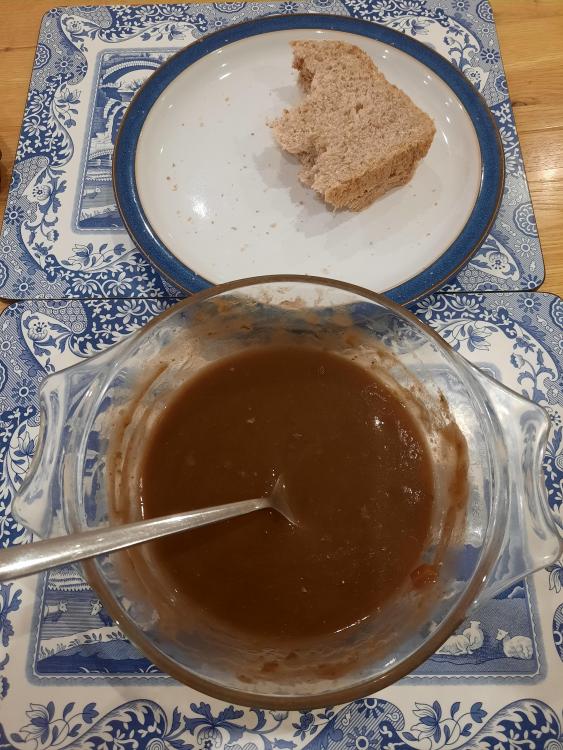
I don't know what you're all winging about I have it tough! I have a bowl of cold broth and bit of old bread.. Beer! I could only dream of beer. I used to work on site for 10 hours in all weathers with rain dripping down me neck, filling me boots, and when I hit my thumb and went to the foreman (as he was called then) he asked could I wiggle it . Upon showing him I could he bollocked me for not hammering hard enough! Teriyaki? Oo very lar-de-dar Sweet corn I should be so lucky. Southern softies pahh! I'm off to see if there's any gruell left.
-

Do I need planning permission for converting my Garrage ?
Marvin replied to Achu's topic in Introduce Yourself
I think what was meant is that a property no more than 6 homes away from @Canski's home has gone through the same situation. -
Battery inverter and immersion heater divert together
Marvin replied to BMcN's topic in Energy Storage
Hi @Christiano Interesting. It sounds like an iBoost is more complicated (technologically advanced) than a solic. Unfortunately our solic is in a different building from the batteries and our battery system is off grid. -
New member - stuck for what to do next to warm the house
Marvin replied to Sparrowhawk's topic in Introduce Yourself
Hi @Sparrowhawk At my brother in law's home I turned off the power to the sockets unscrewed the sockets to get to the back box, unscrewed the back box (screws usually screwed in sideways), mixed up some bonding quite thick, cleaned all the dust from the hole, dampened the sides of the hole, carefully filled the back and sides and coated the back and sides of the box and wiggled it into the right position with the wires sticking out the right length and left to dry. Scraped out excess bonding once dry, siliconed any air holes, tidied up the wall finish as required, refixed the socket when all dry and turned the power back on. I used a bag of very old bonding which goes off quick. Sometimes adding bits of block or brick to the hole if required. I think if you use hot water with fresh bonding it will go off quickly. @nod will know. Mix small amounts and practice until it works. Good luck M -
Do I need planning permission for converting my Garrage ?
Marvin replied to Achu's topic in Introduce Yourself
Your local council planning department. Some records are held in files in the offices, some are on the Internet. I would also look at properties near by and see if anyone else has converted their garage. You can then check planning on line for that. Also how did the external appearance change? -
Do I need planning permission for converting my Garrage ?
Marvin replied to Achu's topic in Introduce Yourself
Have you looked up the original planning permission for your property: reference ? -
Battery inverter and immersion heater divert together
Marvin replied to BMcN's topic in Energy Storage
Hi @BMcN I looked up an iBoost. Its exactly the same as a solic200 except the CT clamp on our Solic is hard wired. Here is one example of an adjustable relay clamp. 04K-SD-NO-AL Normally open-type current sensing switch current over-limit output closed switch signal. The power passing through the hole in the clamp drives the CT to switch. making some kind of magnetic field? I don't know... Above I assume you are meaning CT clamps. You have to have a bit of thought about the system.... Firstly you are dealing with two different types of equipment using electricity 2 different ways: Heating element are resistive loads Battery chargers are inductive loads As far as I understand, a pure heating element will run with less than full power, only taking longer to heat up, but a resistive load needs all the load to work properly. So the iBoost using the CT clamped will monitor excess loads being produced and will divert any amount of excess load to a heater and it will work. However, as far as I understand, a battery charger (say 240V AC to 12V DC) will not work without the full load being supplied. The bonus about the CT clamp above is that it will trigger a switch inside that will connect the 2 terminals, depending on how much power is running through it but just like a normal CT clamp it is not connected to the mains power. So what we did was set the power requirement on the clamp to the minimum house running amperage plus the amperage required to charge the batteries, and fixed the clamp on the positive from the PV. This meant every time the supply from the PV went above what the CT clamp was set to the charger would come on. Your iBoost would still work as it monitors any excess to the grid. (usually on the wire from the consumer unit to the main meter) What happens to your excess power when the hot water is fully heated? -
Fitting shower trays - sand& cement / tile backer / tile adhesive?
Marvin replied to Moonshine's topic in General Plumbing
I use tile adhesive if levels need to be made up on the resin stone shower trays. If on wood I always seal the wood first. -
Battery inverter and immersion heater divert together
Marvin replied to BMcN's topic in Energy Storage
Hi @BMcN I do not know how an iboost works. We have different equipment installed: We use CT clamp relays as the best fix. When the PV is producing over either 2kW or 2.5kW or 3kW (depending which CT relay clamp is chosen) our 10amp electric vehicle charger energises. When the car is charging the CT relay clamp on tge EV charger cable stops the batteries from charging. Likewise, when the PV produces over 1.6kW the battery charger energises, but not if the EV is charging. Our Solic200 diverter energises any time there is excess power. Once the hot water tank is up to temperature, during the winter any further energy is diverted to storage heaters. We have not exported any power since October. Good luck Marvin. -
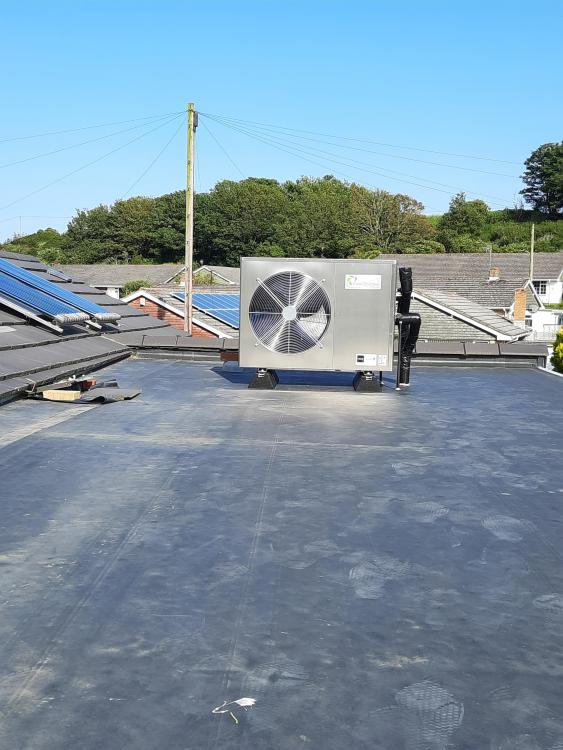
Hi @JamesPa Below is the utility room housing the buffer and hot water tank etc, and the end of the kitchen. Its been up there about 18 months. No vibration problems at all. Went for widest rubbery feet to absorb any vibration (but I must say even when running there seems to be none) and to distribute the load of a wide area. Wife considers the noise level to be similar to the old gas boiler. Marvin
-
https://www.planningportal.co.uk/permission/common-projects/heat-pumps/planning-permission-air-source-heat-pump#main-menu
-
Only about 88kg though.
-
Well, good luck with that! Yes. These are the main factors I see you have to take into account when calculating. If the extension looks like a cube then there are 6 sides you will have to take into account all 6 sides thermal resistance, identified for each type of surface (windows, roof or what ever) and the air flow, all related to the temperature the other sides of the 6 sides, including any shading and or wind exposure, over the extremes of your local climate, all against the temperature required inside over various times of the day, as well as the room use and occupancy. Good luck Marvin
-
Flat roof top coat EPDM, GRP, Liquid Polyurethane?
Marvin replied to Warrentdo's topic in Flat Roofs
Personally I would/have used several times EPDM. (we have our ASHP on it). Unfortunately/fortunately I will not be around to see if it lasts 50 years (5 so far), but if there's a problem with it, I'm sure I'll whinge. -
Replacement of domestic steel gas pipe between gas meter and kitchen
Marvin replied to DaveAF's topic in Gas Pipework
Hi @DaveAF Yes, your right about the mains pipe ownership, however what I was wondering was, if the insurance company is worried about your steel pipe being an insurance risk, do they not consider the steel main pipe the same risk? It all seems strange to me. -
Because we sometimes have high temperature water storage all our hot water supplies from the tank are regulated to a max of 45C.
-
Replacement of domestic steel gas pipe between gas meter and kitchen
Marvin replied to DaveAF's topic in Gas Pipework
Hi @DaveAF Is that a steel pipe coming into the building from the mains in the road? There happy for that to stay?? -
Hi @ToughButterCup Yes I remember our delight at the first 1, 10, 100 and 1000kWh!!! Most exciting next was charging the car, then the hot water via a diverter. I am keenly looking forward to the first 10,000kWhs! Camelias @SteamyTea? No, not out yet. But soon...
-
I would expect the drain to spill over when used. look at all the marks on the wall the moss. If that's a rainwater down pipe, next time it rains have a look or pour a bucket of water into the down pipe and see what happens. I bet it bounces off the concrete bottom of the drain and goes everywhere...
-
Hi @Brinners I think the first pictures were the UPSTAIRS bay window. Roof problem?? I would check the roof look in the loft. Lots of ceiling cracks upstairs... Take pictures.
-
We have a radiator for heating and an electric towel radiator for spring/autumn coolness. 90W is plenty for us on a timer....




