


saveasteading
-
Posts
11094 -
Joined
-
Last visited
-
Days Won
98
Everything posted by saveasteading
-
OK time for my input. Serious subjects need long and derailed discussions The dimples are the bottom. The other face could be flat or have pretend stone profiling or other patterns... including dimples. In this case they are utility slabs, the small dimples on the top face I'm guessing are caused by stacking the product too soon after manufacture. If you like the dimples for some reason (grip) then it's OK to lay them upwards but they will wear off, and if the slabs are taper edged then there isn't space for grouting. Dimples down.
-

Wiring an outdoor switch....basic question
saveasteading replied to saveasteading's topic in Power Circuits
Apologies. Not the fuse or circuit breaker for the circuit in question , but the RCD serving half of the house. I'm thinking now I will put the swa in from one junction box to another. That will make connections easier and solid. From there I can put in a switch, or not, in cable that is easier to handle. -
Can you glue it and cramp it tight? then replace?. the tongue will be gone presumably, but it will match.
-
Vat claim
saveasteading replied to nod's topic in Self Build VAT, Community Infrastructure Levy (CIL), S106 & Tax
These queries seem fair. The sort of thing that could be fiddled. Forged/ different versions of invoices. Mirrors bought for somewhere else. I had a VAT inspector sit opposite me for 3 days, as there was no other desk space. At the satisfactory conclusion he told me he was looking at our books for inconsistencies but also taking notes of subcontractors. He went off with several photocopies of their invoices, and was going to compare them to what these contractors were claiming. ie often a contractor will pay some of the VAT due and use the rest for cash-flow, especially an unusually high sum as 'the vat people won't notice'. the same inspector doesn't investigate them, but flags it, and files these invoices. Perhaps an inspector has checked with your suppliers. -
Vat claim
saveasteading replied to nod's topic in Self Build VAT, Community Infrastructure Levy (CIL), S106 & Tax
Welcome to the Hernia repair club. I expect they are all different but I had no side effects or long term discomfort or weakness. Available for BH questions to keep your mind alert. Here is one. On your VAT reclaim were there any pro-forma invoices and were they accepted or require prof of payment or perhaps more than that? -
Ideal drainage pipe gradient advice needed.
saveasteading replied to SteeVeeDee's topic in Waste & Sewerage
More information needed. You have told us that you have 1.5m of distance between the existing fixed points, but not the height difference. The best slope depends on the gradient and the water quantity....you say it is combined, so we also need to know if you have a huge catchment for rain. Plastic is very much easier to work with than clay. I wouldn't dream of using clay unless I was building a motorway or the liquid is nasty. -
Wiring an outdoor switch....basic question
saveasteading replied to saveasteading's topic in Power Circuits
I found one in my box of bits. Upmarket of insulating tape. I've got some wagos too. Yes. The light is currently disconnected at the adjacent junction box. I can't remember why! Switch in the house was left on in error. Fuse tripped during a huge downpour. Not tripping now the ground had drained. But nothing is ever certain. Whatever, it should be swa not the present cable. It is 23m to the house as photo, but 35m to the front door. -
Wiring an outdoor switch....basic question
saveasteading replied to saveasteading's topic in Power Circuits
That was the plan. I should have explained better at the start... in series. @-rick- the issue is with thd power cable being faulty. The fuse trips afteg heavy rain. I'm still none the wiser about what outside switch to buy. This is top of the search from screwfix. Same words as @ProDave used earlier. British General IP66 20A 1-Gang 2-Way Weatherproof Outdoor Switch with Neon (54649) Will I need to tie the neutrals together inside it? What is one if those wind- on plastic caps called? Presumably this switch is OK for swa. One more question. 1.5mm2 swa costs £43 for 25m . 2.5mm2 costs £53. Any reason not to invest that £10 in case of future upgrades? -
Wiring an outdoor switch....basic question
saveasteading replied to saveasteading's topic in Power Circuits
Another thing learned today . I hadn't heard of this. From a quick read up, this would be ideal for the face of the wall, but not underground. -
Wiring an outdoor switch....basic question
saveasteading replied to saveasteading's topic in Power Circuits
OK thanks. Understood. But if I have a cable that clearly works, including the switch, can't I simply find a nice condition part of it in the attic and join a new cable to it? I appreciate it's not perfect or professional, but will be much better than what is here now, for the interim. And circumstances do not permit pulling down walls and ceilings at present. I have spoken to a couple of really sound electricians and they want to spend thousands on exploratories, tests and rewiring. And of course I'll still end up putting the swa in. My interim switch idea was partly so that I can do this diy bit, while ensuring it is ready for a proper job when funds and circumstances allow. ie new swa cable 25m fixed to post and wall. Switch. Short (7m) cable from switch into house, joining to the existing in a new junction box indoors. That will be much easier to handle too than 32m swa. Then later the link from there can be surveyed and completed. Which doesn't resolve my original question ..what is the outdoor switch called? 3 wires in, 3 wires out I assumed. Or it is live in and out of the switch, and join the neutral ends within the box? I've looked at screwfix and other specs, and instructions within the switches I have already, and indeed they throw around the terms switch/gang/ way/ pole as if they are interchangeable. @joth thanks to you too. The circuit you show doesn’t apply as my existing is a simple switch. But I think you havd provided the beginnings of an inkling of how L1 to Com works and doesn't go bang. -
Wiring an outdoor switch....basic question
saveasteading replied to saveasteading's topic in Power Circuits
Here is the existing treble switch. Very congested, so I hope you can "read" it. To complicate it, the left hand switch is 2 way. AND in turning off fuses i find that the right hand switch, the one that does the floodlight in question is on a different circuit to the other 2 switches. And yet I only see 2 cables.... over to you Mr Electrician.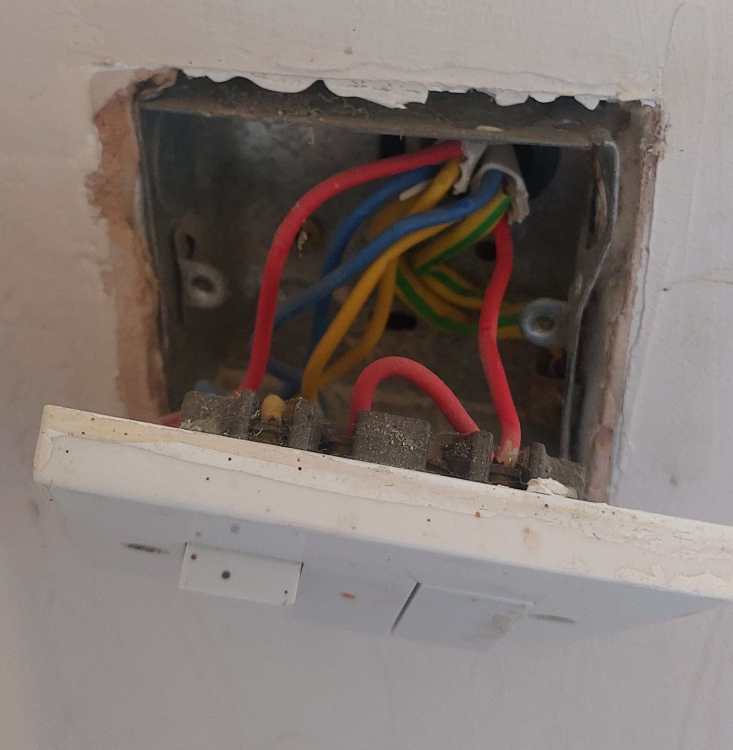
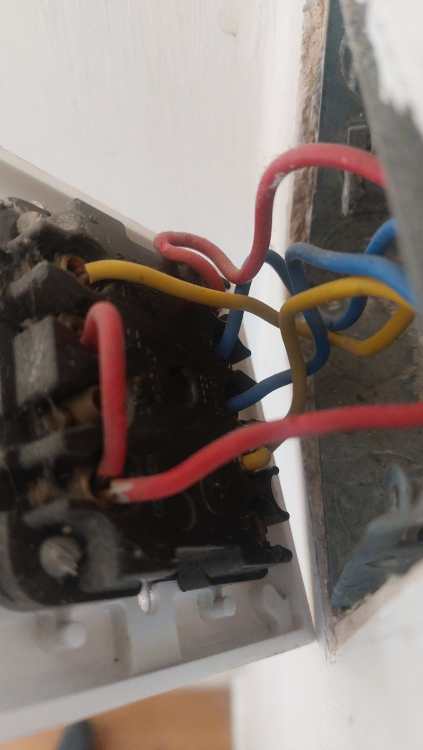
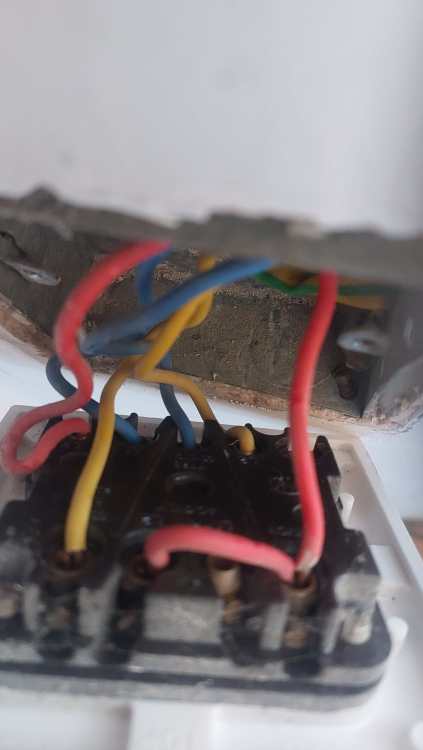
-
Wiring an outdoor switch....basic question
saveasteading replied to saveasteading's topic in Power Circuits
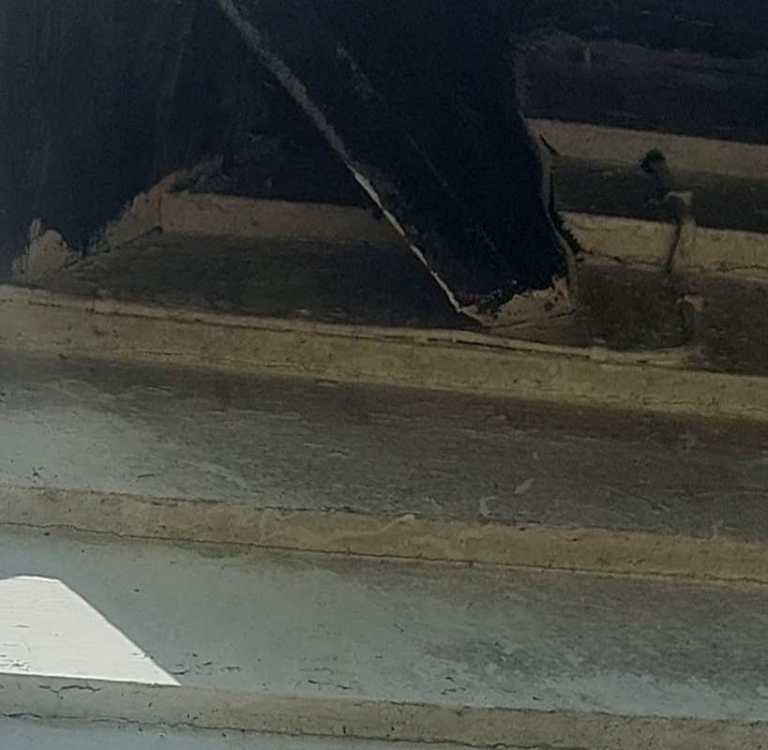
Pictures show the existing cable up the wall. Should that be swa into the house or will normal cable in a duct suffice? I will take the internal switch face off ...but isn't it simply going to be 3 cores heading off into the attic which are either on or off? I will ask annoying questions later about gangs, switches and poles... it seems unnecessarily confusing. Eg 3 gangs means 3 switches. But 2 gangs means... not 2 switches but what you said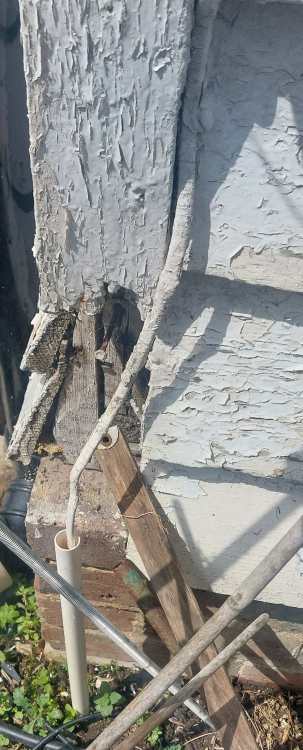
-
Wiring an outdoor switch....basic question
saveasteading replied to saveasteading's topic in Power Circuits
Ok, so i put in swa with a junction box both ends. Are you saying that i should also use swa from there into the house? I'm happy (prefer) to keep the switching simple, so either switch works independently and both have to be on for it to work. Being of simple mind I like to connect 3 cores in and 3 cores out (or 2, and link the earths) but will take instruction if there is a better way.. What is such a switch called? Double pole double throw? -
Wiring an outdoor switch....basic question
saveasteading replied to saveasteading's topic in Power Circuits
Thanks. And you even anticipate the reason for doing this. There appears to be a fault in the underground cable as it fails in wet weather. It must be 30 years old and prob put in by ultra-amateurs / as cheap as possible. It used to work a 250W floodlight but is only about 30W now with a replaced light. I suspect the underground cable is domestic, indoor, 3 core, so intend to replace it with armoured from the post that has the light, to the house wall. Here I will put the new switch. Perhaps good practice also dictates a junction box? I could just join the existing cable but it has been in the sun and weather for decades. So I then intend to take a 2.5mm domestic cable into the house and there make a new connection (it is in the attic so easy to access and adapt.) I would encase that outside cable in ducting. Tracing the existing indoor cable back to the indoor switch is likely to be very convoluted and messy. It is a 3 gang switch at the front door, operating the lobby, an adjacent outdoor wall light and the distant light which is the issue. Just one of these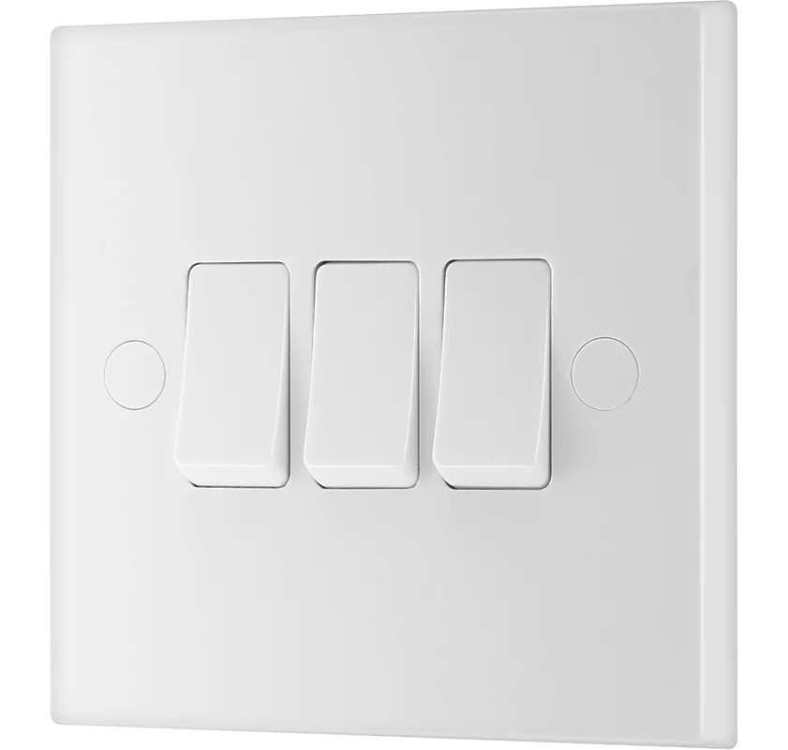
-
I have an outdoor floodlight. The cable is on the outside wall and there is a normal indoors switch inside the front door. I want to add a switch inline on the outdoor wall, to make it easy to switch off the light there. I find I have suitable external switches in my box of bits. For wiring there is one connector in and one out. So do I put live wires into them, and join the neutrals inside the box with a connector ? One of these screw over the end ones, or a connector block? Ditto with the earth I assume. With indoor light switches there are connectors for every wire, (in and out , in basic terms) so I'm confused why external switches should be different.
-
It is worrying indeed. Fortunately we Engineeers (capital letter but not a protected title) include quite a lot of overdesign for unforeseen loads, including idiocy. Hence the ceiling has deflected but not fallen down yet. But a certain amount of intelligence and knowledge is expected of any trade, and they are liable and must not only straighten the ceiling but ensure that the roof remains strong enough for wind, snow, storage. They should be getting either the original designer or another to report and advise.
-
What thickness is agreed. I ask because I once had a drive dressed. He quoted an inch but it was half of that....his excuse being it was an inch before rolling. He had to go to buy some more, and formally cursed me after I paid ( in full). And what specification? Is your sub- base laid to the necessary fall, so that thd tarmac is all the same thickness?
-
If anything, in this hot weather it will dry too quickly, and that causes weakness and cracking. 5mm of pure water would probably evaporate.
-
Grohe Concealed Cistern - Very very slow weep into pan
saveasteading replied to steveoelliott's topic in General Plumbing
I did the turning over and regretted it. Mine is Roca. I removed the rubber washer, cleaned it, reversed it and refitted. What was a strong trickle was improved to a slight trickle. It could be stopped by jiggling the flush to give it another chance to reset. So I bought a new washer and it's fine now. It wouldn't be a big deal but it's such a fiddle fitting in there....and I dropped a very particular connecter in and lost it. (Expanding plasterboard plug to the rescue). My ongoing concern is that the washer 'mates' with an outlet that may get mucky with lime but is unreachable. -
wrong technique screed drying?
saveasteading replied to Post and beam's topic in Floor Tiles & Tiling
Doors about windows will do all the air movement you need, in dry weather in June. -
Change proposed Graf One2Clean to Tricel Novo?
saveasteading replied to flanagaj's topic in Waste & Sewerage
Does it not say " or similar". Perhaps your application stated this model and the planners are simply repeating it. They cannot make you use a particular model if another can be shown to work as well and meetscrequired standards, so get looking at the other options. I'm surprised. Water in equals water out in quantity and rate, doesn't it? I'm puzzled at why it should bubble noisily. -
Comparing Thermals of Laminate Flooring Underlays
saveasteading replied to MortarThePoint's topic in Wood & Laminate Flooring
Plus, assuming you've been a good customer, that also gets through to the new trade party. Bad customers will be a constant worry. Will they pay and promptly? Are they nagging? Chatting? Do they want free extras along the way? Recommendations work both ways. -
wrong technique screed drying?
saveasteading replied to Post and beam's topic in Floor Tiles & Tiling
Often said but never by experts. This would only apply with thick concrete with far too much water in it (so that it flows for the builder's convenience but also greatly reducing quality.) ie stated as if it was science whereas it is as an excuse. An industrial slab of 200mm does not take 7 months, but about 2. A 60mm screed does not take 2 months, but 2 weeks. -
If it is on a concrete slab then the tank can be pinned or lashed to that. Some tanks have the bases designed to ease the interlinking of base concrete with the tank. Gaps allow bars to be pushed through or cables over the top. I'd like to hear other users experiences of pumping out. Hoe ling have you sared keavd it? Any ptobitms? My personal feeling is that it can be left for years. The biggest problem would be toilet stuff that should not be flushed. I guess that floats for ever in the first chamber.
-
More of the district trench runs allows the water to find fissures or areas of higher permeability. Eg ancient tree roots. Joiningbtgem all up, in any wat at all, let's it flow all over for temporary storage, thence to soak away. Remember that gravel is 2/3 stone and 1/3 air or liquid. Re big areas though, when you flush a toilet and 3 litres goes to digester tank, then 3 litres comes out. That will usually disappear in the first few m of drain and will never reach the middle of a big expanse of gravel. A bath load will reach further of course. 10m? I'd rather like to meet the people who designed these complex drainage field principles. I might establish is it me or them who don't understand the reality. OP: don't worry. It's overdesigned so any will work.




