
saveasteading
-
Posts
10897 -
Joined
-
Last visited
-
Days Won
94
Everything posted by saveasteading
-
A local SE will know the makeup of the ground, and if that material found, provides certainty of what is beneath. eg If they have hit stone and stopped, is the stone there in bands or solid. The survey company might have stopped in this kinowledge.
-
What do you want from an architect?
saveasteading replied to CharlieKLP's topic in Surveyors & Architects
A full kit of dumpy and legs and staff costs £200. but you need an assistant. Good fibre tapes, £30 to £50. -
true. There is nearly always a wind even in harbour. but on a shed roof in the right spot, just to run the led lights.
-
If the survey is inconclusive then the survey may be at fault. But they have stopped testing when the ground becomes hard enough for a pile. Of course it could be different lower down! But a local SE will know what to expect.
-
Seeking FD30 Doors in traditional designs
saveasteading replied to Paene Finitur's topic in Doors & Door Frames
I'm sure it will melt off in seconds, and be of no consequence but can't prove it. BCOs want to see a certificate. If you are buying a £700 door you would expect some help from the manufacturer. -
What do you want from an architect?
saveasteading replied to CharlieKLP's topic in Surveyors & Architects
Exactly. I have had to help many an otherwise respected Architect to measure on site. It is sums, and some geometry. Using a base line, triangulating, measuring past obstructions.....should be in year 1 at architect school. Similarly getting in other consultants for quantities, contracts, trees, wildlife, and so on, at client's expense. With a little knowledge of each they are often avoided. I had one tender where I was asked how to half the expected cost...and could, but there were 10 consultants resisting any change with being a 'hard landscape architect' (that was some paving slabs and some blocks). Basically all mates of the original architect who had put in too low a quote. The school had to find another million. So some more tips there. Learn more about that stuff and do the lot, within reason. Individual housing is easy to measure. Oh and be seriously good at mental arithmetic so you can work out approx quants on site. 190m2 at guide price £1900/m2 is about....... That will really be a USP. That isn't meant to sound mean. I love working with a good Architect, with me insisting that we have to be practical and him calling me a philistine, but coming to a solution better than either of us would have found alone. -
What do you want from an architect?
saveasteading replied to CharlieKLP's topic in Surveyors & Architects
Anyone who calls themselves an architect with big or small A gets in trouble. Hence 'Architectural' . But the term Engineer is not protected, and neither is Civil Engineer which groundworkers like to call themselves, or Mechanical Engineer etc. It does not help in having the public understand what the profession is or does, hence lost of people think Architects design bridges and dams, and power stations etc. That's all. -
They bring the right lengths of piles to site, and chop off any sticking up once it has reached a set. They are banged in until the correct resistance is reached, which is encouraging.....unless they keep going down.
-
I am suggesting them specifically because they do the precast edge and cross beams at the same time, and that recovers some cost relative to dug foundations. The others may offer something similar, I don't know. No, There is a big lump for turning up, perhaps £10k. take that off, pro-rata what is left, and add it back. Doesn't make sense, as that is what piles are for. Anything more than 3m and piling is the answer. I have one other suggestion but will PM you if you don't mind.
-
What do you want from an architect?
saveasteading replied to CharlieKLP's topic in Surveyors & Architects
They vary as much as builders, and electricians. Capital A: They are taught to be artists, and discouraged from practicality. Some are very disappointed to be living off extension work and hoping for the project that will make their name. Many are perfectly good. Some are a pleasure to work with and team players. Only 10% have the faintest idea of value for money. They nearly all accept any project offered, regardless of skill-set. Like any career....some people are simply very good and provide good value..others may take longer and get it wrong, and want to charge for their time. References, interviews, and trust....although they will never, ever accept responsibility for cost changes. As a newby you won't have a portfolio so must find some other way of getting business. That means taking small projects at stupidly low fees, and working up. In a lot of cases you will have to accept that you are getting planning, and then others will take over, and change it. You must set out your USP, whatever that may be. btw if you are qualified, you should use Capital A. One thing I am jealous of. In fairness I should say that I am not the average amateur self-builder, so you need some more from them. -
Average number of trench concrete blocks per day
saveasteading replied to iMCaan's topic in Bricklaying, Blockwork & Mortar
Can we see a photo for context? Sometimes the first course is a pain if the concrete isn't very level. -
Seeking FD30 Doors in traditional designs
saveasteading replied to Paene Finitur's topic in Doors & Door Frames
Intumescent in the middle? Ouch. I have heard of that but thought it was for very special circumstances. Explains how a panelled FD30 is £150 and a half glazed one is £700. -
If I was to get one it would be for an outbuilding where the noise was far enough away and power demand low, rather like the ones on yachts that can power 3 lights and a radio.
-
Glass gable ends. Looking for examples..
saveasteading replied to Olly P's topic in General Self Build & DIY Discussion
I have used Sadolin onto 'normal' , tanalised t & g on several jobs. Oak colour is almost invisible as it goes on but has a nice sheen, and that colour then remains for many years (10 and counting) instead of going faded grey. The other colour here is very dark and it fades in the sun in 10 years but can be recoated, but lasts well in shade. Either coat the timber before fixing or leave it up for a month to shrink and twist, or you will see 'tan-lines'. This photo was after 6 months, but other jobs prove the figures above.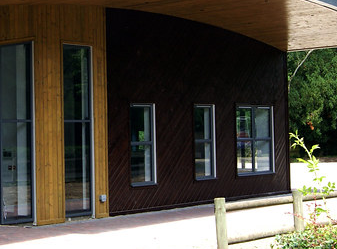
-
Seeking FD30 Doors in traditional designs
saveasteading replied to Paene Finitur's topic in Doors & Door Frames
They are sold in huge numbers, but it is very difficult to pass the furnace test so local companies can't make them. I have attended a furnace test and the heat on the 'outside' is worryingly unpleasant, while the glass cracks and wood on the inside burns. I'm still surprised at these big panes and was hoping someone knew and could explain how they pass, when other doors only have small panes. If I recall, behind the bead the glass is set in a fire resisting channel so the timber bit doesn't matter. -
In my experience the developers or housing associations seem surprisingly remote from any such issues, and regard such instances as a nuisance to them, rather than to you. They will blame the builder. As above mitigate and write formally, but then keep at it, and keep a file. As well as catching the leaks, keep a diary of the amount of water (not litres, just mugs/ buckets) and the weather. Write to them by recorded delivery, demanding immediate remedy, and copy as much as you like...local councillor, MP. but save the newspapers until it has become an utterly unreasonable delay. Be reasonable at all times even when despairing. It may take a long time, but you will probably get there. Do the developers care? If it affects their reputation locally then they do care about that.
-
In my considered opinion, which may be out of date, screw piles are suitable for huts and decks where loading is low, and deflection isn't a great loss, and short term use eg site cabins or injection stations. Also I can see they are ideal for pylons, masts etc where access is difficult. For 'proper' buildings, they are too near the surface, don't carry enough load, and then there is corrosion. I did look into this seriously as the reps were saying what they could do...but they couldn't really. For a house I would first look at a precast driven pile system where they also install the edge and cross beams, and I would be immediately out of the ground. Can be to odd shapes easily enough. Bullivant is one, and the project we did with this system went very well.
-
How to fix a breathable membrane to a block wall
saveasteading replied to GaryM's topic in Brick & Block
£50 for a roll of good breathable membrane, and one chance to do it.... -
Is the roof all too flat? Theoretically you could screed over this area with bitumen and take up all the puddle, then a bit more to create a slope to the outlet. Messy and perhaps unnecessary. Or can the outlet be altered? Cant really see it in the pic.
-
Was the roofer responsible for the structure underneath being to appropriate slopes? How much fall is there other than this problem area?
- 59 replies
-
- 1
-

-
- flat roof fall
- firring
- (and 2 more)
-
Takes less time, but is more expensive?
saveasteading replied to GC1's topic in Insulated Concrete Formwork (ICF)
When pouring mass concrete it is sometimes essential to use chilled aggregate, so that the concrete doesn't get too hot when the heat of hydration kicks in.. I don't know at what temperature though. I assume that it would be mentioned if that applied in this case. -
If no recommendations? The local paper or free ad paper. Or electronic yellow pages. A small contractor is probably fine. This is one job on site I have never 'helped' with. The small groundworker we used for years always brought in a particular mate just for this, as it needed an 'eye' for the thicknesses, and handling the rake, and the others barrowed and shovelled as instructed. Then rolled it.
-
Takes less time, but is more expensive?
saveasteading replied to GC1's topic in Insulated Concrete Formwork (ICF)
Interesting. Curing concrete gives off heat so they are allowing that this is contained within the blocks. Might even get too hot in summer. Is he available? -
Agreed. It is more like surfacing than a building, and is effectively a temporary structure.
-
Takes less time, but is more expensive?
saveasteading replied to GC1's topic in Insulated Concrete Formwork (ICF)
Interesting thanks. £1500 at say £200/day is 2 workers for 4 days approx. Is this concrete pour only? 40 days at £200 is another £8,000 Plus 3 degrees and rising is the normal rule. Freezing of concrete is disastrous. Or do they say that the polystyrene is enough insulation to keep the warm concrete warm?
