
saveasteading
-
Posts
10892 -
Joined
-
Last visited
-
Days Won
93
Everything posted by saveasteading
-
When it was new I met some of the people who set up the SAP and EPC processes. That made me realise that a lot of it was illogical and rushed through. Worse was that they didn't understand a lot of what they were doing. In fact the excuses for anything wrong was that these were temporary settings and would be changed. But they usually weren't. We bought the calculation programme and played with it, and it is easy to improve figures by illogical decisions. Any use of electricity was penalised. Air conditioning is programmed in to any epc, whether installed or not. And so on. Also it is clearly quite easy to get any epc assessment to say what you want. (This based purely on personal opinion and inspection of a property as compared to the certificate on the wall). Whether this was ignorance or worse I can't say. Solar panels will score points whether in sun or shade, so I generally showed the ones that the client would be fitting in due course. Fortunately I never had a project where the client demanded any particular figure so we only had to do what was best for the project and then find a way to meet the minimum pass mark without spending their money pointlessly. The same logic applies to SBEM, where there are points for fluffy animals on site, or a bus stop being near, which are not usually in our control. All very annoying but hey, just make a good building.
-

Decking paint failure, why and what to do about it?
saveasteading replied to ProDave's topic in Decorating
I have noticed a big change in timber preserver treatment. Traditionally, tantalised timber was quite oily, and it penetrated several mm into the pores due to vacuum treatment, even on side faces. Then it became less toxic, and more water based, but still penetrated. Recently (based on what we have received) it seems only to have a surface treatment. Perhaps you have a variety of these, including the original which is least accommodating to paint. -
How to achieve this soffit colour/effect?
saveasteading replied to Andeh's topic in General Self Build & DIY Discussion
I didn't emphasise perhaps, that we used standard pine, tanalised. 1/4 the cost of red cedar (which you have to be careful with re fixings/damp etc). A timber merchant (client , so knew well) pointed me to a report on red cedar saying it doesn't perform well in maritime, warm, damp conditions. They copy it to specifiers to avoid future claims on staining. So it will depend where you live. -
Dampness is nearly always a big problem and should be resolved. But to avoid it coming up in the inspection, spray with bleach and the colour may disappear temporarily.
-
The stone base, as in PD, allows the water to spread over the whole area. so it all works. This is a good solution as it avoids any pipe being lower and taking all the waste. Easier to build too, without trenches, muck falling in, fiddly membrane.
-
The air stops pumping or the wheel stops turning, but the microbes carry on munching and gravity makes the liquid flow. Then the power comes on again. Nothing to worry about. I think human waste and the air contain plenty of microbes and the additives should not be necessary , but wont do any harm. Just avoid the first deposit being after a curry night.
-
Fair enough: not his shout on fire risk. Good point. I was thinking attic with insulation over, and shouldn't have.
-
With most lights being LED now, the heat is vastly reduced and we don't have hot heat sinks in the ceiling space. The remaining risk is in there being anything highly flammable near the lights. Rockwool isn't, and timber isn't likely to burst into flames. Paper very close though just might. Everything on its merits: don't take risks but neither waste money when not necessary. But if the BCO requires a fire consultant report, then a few hoods would be pragmatic. They should not be expensive, but some are for no good reason. Ahhh just done a search. My favourite fire protection company charges £2 each.. Envirograf.
-
Drainage practical: down the trenches
saveasteading replied to saveasteading's topic in General Self Build & DIY Discussion
I think the one we used was too powerful as it ripped through the plastic very quickly, and we ended up with a series of slices. Then straightening and bevelling was easier. Also the DeWalt doesn't appear to allow right-handed use, according to the proud owner. Improved with practice of course. -
Drainage practical: down the trenches
saveasteading replied to saveasteading's topic in General Self Build & DIY Discussion
I've never seen it. I guess chop-saws don't fit well on large muddy sites, which have been my territory. Groundworkers just get out the disc cutter for everything. -
Drainage practical: down the trenches
saveasteading replied to saveasteading's topic in General Self Build & DIY Discussion
Of course! -
I think most try to be fair, and they cannot be expert in everything so I will give the benefit of the doubt at first. One BC told me of deliberate cheating by a contractor ('The reinforcement is on its way'). He went back and the suspended slab had no steel in the just-poured concrete. He said this sort of thing was common and worst with big contractors with multiple subbies. The other big issue is straight ignorance by diy-ers and small builders. They expect to see issues, but if they are not expert on a subject they need the proof. On the other hand.... some in my experience (always local authority) have been arrogant along with their ignorance. It can be very difficult to get them to back down (But they do). I put this down to the contractor normally doing whatever the bco instructs, blaming the designer, and charging the client. So the bco sees themselves as a bit special. Some of my examples may emerge on BH over time.
-
How does your garden grow?
saveasteading replied to recoveringbuilder's topic in Landscaping, Decking & Patios
I'm pretty sure we used to call them turnips, until the posh and tasteless white ones became more available. When Safeways arrived, it was a thing of wonder to see the exotic offerings such as peppers. How are the haggae coming along to go with it? -
Drainage practical: down the trenches
saveasteading replied to saveasteading's topic in General Self Build & DIY Discussion
Have always used a saw but I was expecting there to be a tool for it, which would be worthwhile with 50 or so cuts to do. We wouldn't cut a copper pipe with a hacksaw when there are rotary cutters. Or a saw guide big enough for a 110 pipe? The slight variation I always get results in the longest dimension being against the stopper in the connection, and a gap elsewhere of 1-2mm. doesn't matter esp if away from the base. But in a slip coupling situation the error is doubled and a likely catcher for any slow moving stuff, running out of energy. Perhaps two factory ends would be wise. ToughButterCup you appear to be testing a single pipe, hence testing the equipment. We had to do that as it failed after a few uses, due to its own hose connections (there are 6). A replacement kit works much better as it has more rubbery hoses. How can that little collection of plastic (factory cost £5??) be so expensive at between £40 and £60? The dearer one, though better, didn't include a water dripper, which is essential. I guess most kits are used once and so out multiple tests were too taxing. We invited them but they told us just to carry on, as they have since the start. We had sent some photos at various stages including pre-backfill drains, so presumably that was enough. I wonder if they trust self-builders more than contractors, as it will be their own problem hence QC. -
new windows just fitted but with issues...
saveasteading replied to New home's topic in Windows & Glazing
In writing. I have only one experience of dealing with an HA, on behalf of about half of the tenants. It was not encouraging. Build quality and was very poor in several areas. To me the problems were obvious and had solutions but they didn't want to sort it or pursue consultants or contractors for some reason. Too cosy a relationship perhaps. Your HA must be better by default. On that basis, my advice is to persist and not to allow delays, even if you have to suffer some disruption, as getting anyone back becomes ever more difficult with time. (The HA holds retention money which the contractor will want to receive, and won't until the whole contract is complete). If the house will be open to the elements then they must accommodate you elsewhere for as long as it takes, and should also bung you some discount for disruption and extra heating. -
Drainage practical: down the trenches
saveasteading replied to saveasteading's topic in General Self Build & DIY Discussion
Yes it is slippy stuff: we used the official lube and it is even more so. As a single handed operation it required wiping off then a hand application of sand (like home made swarfega) before any grip was possible. I always thought of slip couplings as being for repair, and a little gap in-between the pipe ends was the accepted compromise. The couplers we have used (Brett Martin) all had a central stop, which continues the running surface. But i see that Floplas don't have a continuous ring, but some tabs. Thus Floplas must all have a little gap (and object catcher) at each joint. Anyway, it does look like the best solution , with minimal gaps if the pipes are cut beautifully. -
How does your garden grow?
saveasteading replied to recoveringbuilder's topic in Landscaping, Decking & Patios
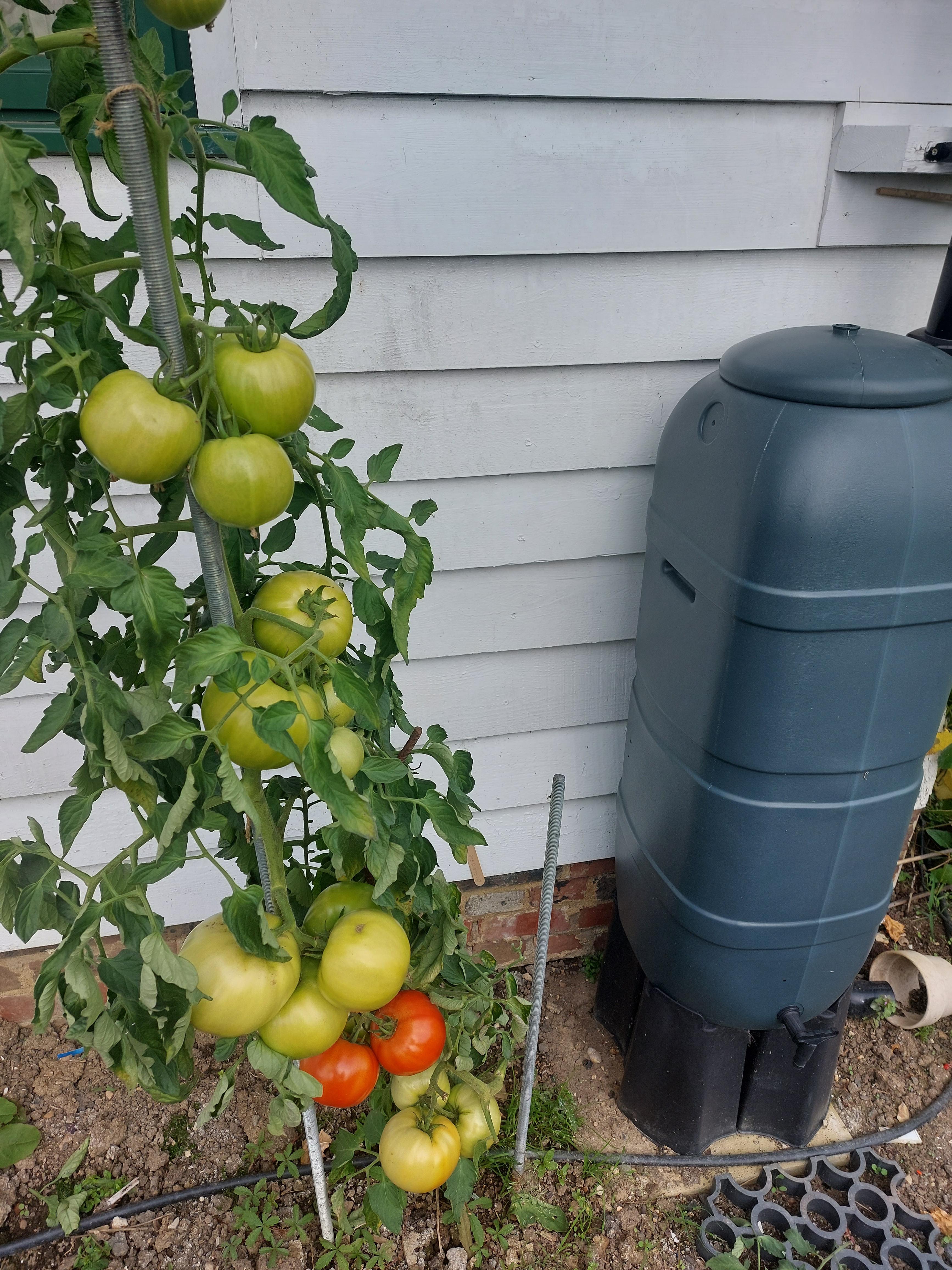
The beans are poor, with insufficient pollination / too hot being the issues I think. The tomatoes are mixed, but one is stunning. This confirms my strategy of having several varieties, one of more of which will do well according to the circumstances. These are all about 75mm and 4 already harvested. And note the threaded rod for support.. recommended.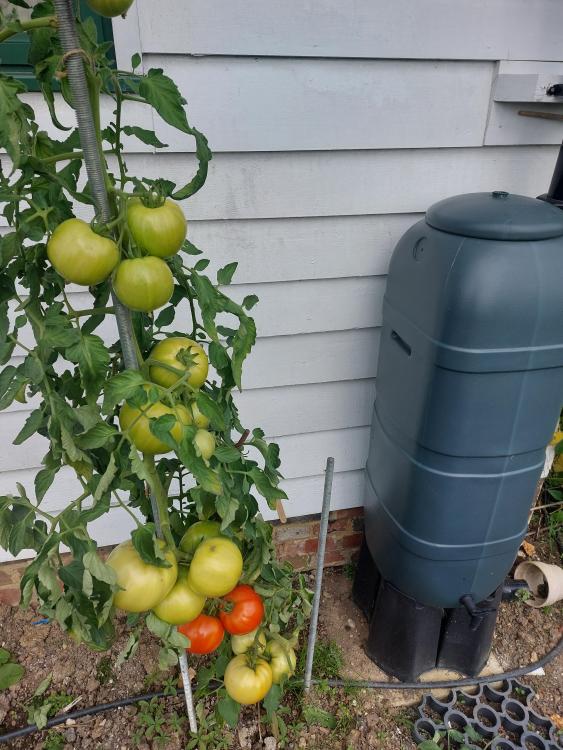
-
I had one of these once. It was really only useful during a big cooking session where surfaces were needed, but then only room for one person. So I started off thinking it was a great idea, but hardly used it, while it took up 2" of limited space when folded.
-
Drainage practical: down the trenches
saveasteading replied to saveasteading's topic in General Self Build & DIY Discussion
Yes we did that. Put on a long timber at dig stage, then directly on the pipe at laying. Plus we used an optical level for spot checks along the trench, for up a bit/ down a bit guidance...but that depends on the ability and willingness to do lots of arithmetic on the hoof. Laser pipe level discounted for cost. The designed levels went out of the window, to suit some fairly random stubs out of the building, and these drops at corners. ended up 250mm lower than designed, just working to the constraints and strictly to the falls required. I don't know how often I said to do this. Good for so many reasons. Ouch. as we were laying at 1:80 the gravel was essential. Quality control was exemplary, with no over-digging allowed. I was saying the opposite to our team, that a groundworker will use all the gravel available if the client is supplying it, and not worry about over-digging or over-filling. But perhaps that is better than shoddy work that will fail unless it is very steep. It is worrying how little care appears to be the norm. This appears to be worse in small scale domestic works, which is not where I come from. Questions: 1. One pipe to install , linking the final manhole to the digester tank. Is there any way of doing this with the connections all fully home? All I can think of is keeping the pipe slightly short and sliding back, but that leaves a gap in which stuff will stick. I know it s normal, but perfection would be nice if there is a trick. 2. Sampling chambers seem to be very expensive for what they are. And we need it 1.8m deep. where to find an offcut of large pipe, (or any other idea.) -
lightly off subject, in B and Q today I saw oven and hob on offer together for £295. Lots of staff standing around and not showing interest...then I found why: I asked for help and they knew nothing. I wonder how skilled their 'designer' is. Back on subject: we rented a place last week with a narrow kitchen. When the oven door was open it had to be accessed from the side. Only one person could sensibly use the space at a time.
-
Drainage practical: down the trenches
saveasteading replied to saveasteading's topic in General Self Build & DIY Discussion
Some photos later. Lessons learnt first. 1. Supposedly experienced groundworkers don't necessarily know a lot. But they think they know a lot so don't read drawings or take instruction. a) Ignore the gradients stated and put them in at 'on the line' of a spirit level for surface water, and 'over the line' for sewage. Or is that reversed? b) Dig the depth that suits you and disregard the cumulative depth downstream. c) Rodding junctions can face in either direction. d) Joint lubricant is 'rubbish' and detergent is much better. The 'professionals' were let go. The amateurs took over. 2. Plastic junction chambers have a drop of 60mm from the branches to the 'through' pipe. Thus there is a 60mm drop at the first junction and then at every 90 degree bend....we lost 240mm this way and that mattered a lot when digging deep trenches and the digester tank hole.. 'Level' chambers are available but not in stock. (As I didn't know this, my previously lifetime of designed drains have obviously been fiddled in by 'joining the dots', and are flatter than intended. This can be see in the ToughButtercup pic. 3. Plastic junction boxes are designed narrow to avoid children falling down them....even if screwed shut. 4. 300mm chambers have tight seals, but 450s wobble about unsealed. 5. a) constructing soakaway trenches is a pain. The membrane won't stay in place while the gravel is shovelled in. b) perforated pipes want to return to the coil shape they came in. 6. People don't understand bulking of excavated ground. (a: Leave lots of room for the excavated material. b) It won't go back in the hole however well compacted. 7. 'Nobody' puts down a proper slab for a digester, or levels accurately: according to the digger driver (to whom multiple thanks for getting the tank in the ground, through skill and experience). 8. Some pipes simply slot into the socket while others need serious force. 9. 450 wide trenches may save money but some of us can't fit in them. -
Having spent 2 weeks in the trenches installing the drains, I am at your service for the differences between theory and practice. After 40 years of designing drainage, but never afraid to get down there, I learnt a few things. Also about Chemfloor.
-
How to achieve this soffit colour/effect?
saveasteading replied to Andeh's topic in General Self Build & DIY Discussion
Here is one I did, using extreme ends of the colour range from Sadolin Extra: Light Oak and Dark Palisander. The oak barely changes the colour of white pine but 'freezes' the colour for many years instead of going grey. Gives it a sheen too. Your colour is available, 'mahogany' probably. As pine will probably shrink after fixing, you should either stain beyond any overlaps before fitting, or give it a while to settle in before coating in situ, otherwise annoying 'tan lines' may appear. Horizontal (on another wall) , vertical, diagonal and overhead all on one building....Cross Referring to another discussion, I can see hiccups in this but nobody else has ever commented.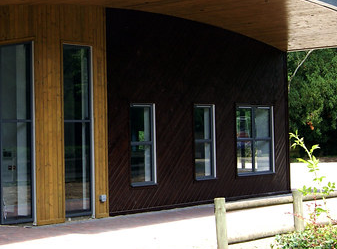
-
Discount Offers of the Week
saveasteading replied to Ferdinand's topic in General Self Build & DIY Discussion
Good value at £299 and glad we bought it. Has now compacted 200m2 of sand floor base, and 150m, several passes, of trench fill. It is narrower than the similar variation at over twice the price elsewhere, but for own use that is fine, and in trenches probably preferable. -
How does your garden grow?
saveasteading replied to recoveringbuilder's topic in Landscaping, Decking & Patios
I've just been reading about this. I'm not disagreeing with the article as such, but putting a different slant. Woodland lives on very low nutrient levels provided by fungi breaking down leaves and fallen timber. Adding any extra nutrient encourages alien plants and kills the woodland very quickly, then it takes 300 years to recover. Taking leaf mould away from woodland is a bad thing. Meanwhile, leaves similarly provide negligible nutrient to a garden, as the trees have already sucked back the sugars etc. The fibre isn't that useful either but is better than throwing the leaves away, or burning them. Leaves in woodland...leave them alone. Leaves in garden: I have given up on leaf mould, and just add them to the compost, and they will be broken down by the spring.