saveasteading
-
Posts
10890 -
Joined
-
Last visited
-
Days Won
93
Everything posted by saveasteading
-
OK. Misread. So an email to the council, confirming what has been done and the expense, and asking them to confirm that the survey is complete. They might not answer but you tried, and that can count.
-
 Stopping or slowing water going to runoff is a very good thing. Do it for the greater good. Water butts, yes. Ponds are good too. Rainwater into the house is not usually justifiable in cost or on sustainability (carbon) grounds.
 -
Never discount the bloody mindedness of housing developers. Trees down, land pinched etc then "our lawyers are bigger than yours". And appeals. The fence discussed earlier may be worth the investment. And photos of the existing.
-
New windows - huge cold spots & draughts
saveasteading replied to SanMan's topic in Windows & Glazing
The brochures are very vague, but no mention of this option. . The windows are sitting on site anyway. No more to be done I think. -
You write a polite but firm letter saying that they have had enough time and opportunity, and already been paid £4,500, and that this appears to be not so much a service as an open ended opportunity. And whag is thd process for disputing this? Have a word with their competitors if necessary.
-
"Slide pir in" confused me. So no need for the very long screws? There are fixings for every purpose. A specialist supplier can advise what will grip osb (a wide screw with a coarse thread i would think) and also seal the hole. Very good roof screws have integrated washers that not only cover the hole, but wind down the thread to make the seal. As to the vcl...the long screw could rip it and you wouldn't know. But if your weight is on the area, the load should keep it all in place.
-
Ok i see. The grp is already there and the rest is being squeezed in? Why does the grp need new fixings?
-
Pitched roof mounted ASHPs next?
saveasteading replied to Marvin's topic in Air Source Heat Pumps (ASHP)
In a small garden it is intrusive. Lots of houses don't have land at all. In the attic so accessible. Picks up heat from the roof, (facing south?) Outlet oposite face to avoid short circuit? But stopping it vibrating through the ceiling will be a challenge. -
All these warehouses you see have about 10 screws per m2. Occasionally you might see one leak, easily fixed, out of 20,000 or so fixings. They are fully sealed for vapour, water and air. Make sure you use the right screws for the purpose. Roof cladders mark the fixing line on the cladding to ensure they start at the right point. 290mm is a long screw and, yes, likely to miss. What about fixing the top osb to the joists, then the grp to the osb?
-
New windows - huge cold spots & draughts
saveasteading replied to SanMan's topic in Windows & Glazing
The catalogue just shows hollow chambers. "6 chambers and 3 seals" is the proud quote. My special interest is that we are currently putting Rehau in. As we are leaving some stone exposed, this minor bridge is relatively insignificant, but it all adds up.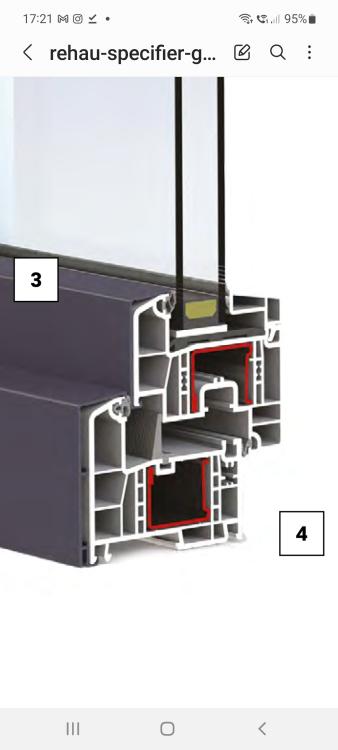
-
2cm is a lot more than nothing. How about covering it with a 4mm board (cement board for example) rather than plasterboard? Thicker insulation where you can.
-
New windows - huge cold spots & draughts
saveasteading replied to SanMan's topic in Windows & Glazing
Physically insulated or air cells? -
Yes. In the steading we are converting. We have the advantage of not living in it, and also that the ground is dense sand. The main concern was exposing the very shallow footings. There are tales of buildings falling down, and this is a real concern. In your case I would work in small areas, perhaps 1m or 1 .5m wide across the room so as to minimise the exposed area of wall. Then you can dig out to the chosen depth, smooth and compact, lay dpm, lay pir, and screed over. Then move on, taping the dpm at laps. I wouldn't dig below the footing level. However you could jncreaze the depth away from the wall. Loads spreading at 45 degrees is a decent assumption. I would also place pir vertically over the edge of the screed. Even 10mm is worth it, but I would suggest 20mm if a skirting or quadrant can cover it. Meanwhile in my own house with solid concrete floors....I have not done this because of the work and disruption involved. I do have 100mm pir in most of the walls though so am not in your position. How thick are your walls?
-
Update on Timeshifting to Minimise Heating Costs.
saveasteading commented on TerryE's blog entry in The House at the Bottom of the Garden
Agreed...i looked at the picture again. When brand new, the building was available for industry visits, but I never managed to go. Since then, I think silence. -
Stupidly we allowed the design to have a zinc roof
saveasteading replied to CalvinHobbes's topic in Roofing, Tiling & Slating
I agree with Iceverge. I have done many a roof in sensitive locations, using steel, either grey coated, or aluzinc, and the planners have been happy that it looked like traditional zinc. The magic words were 'wide pan, low profile'. I.e. Not crinkly. I never used standing seam either because of the cost, and being difficult at joints and junctions. The screws are visible but a minor thing. Also, if ever damaged, standing seam requires specialist repair, wich simply won't happen, and it gets patched up. Does your design brief cover economical design? That would concentrate your architect's mind on getting this changed. Beware of him being prescious of the zinc, and not being very convincing with the plannners....I have had that and taken the discussion on myself. Don't tell the planner it is about cost though. Sustainability....less material, easier maintenance and repair, longer life...whatever. -
There really should be a very simple contract covering the principles. Anybody used 'JCT minor works'? Many years ago there was an 8 page contract (*) that covered all the 'what happens if...' stuff, and listed correspondence. Easy to understand, and just in case of a big issue. Our construction lawyer said it was very sensible, but also best not to use it as it was not industry standard. * Federation of Small Builders, or some such.
-
New windows - huge cold spots & draughts
saveasteading replied to SanMan's topic in Windows & Glazing
I think if we were to draw one of the above windows in the context of masonry outer skin, cavity etc, it would show a weakness, a relativd cold bridge bypassing some of the window construction, so it will be colder round the edges. I think windows are tested in an ideal jig in the laboratory; not in real walls. -
Update on Timeshifting to Minimise Heating Costs.
saveasteading commented on TerryE's blog entry in The House at the Bottom of the Garden
And that is with prearranged units being tested, so some quality control. I can't remember the detail unfortunately but a bco once told me that a big volume can have falsely good air pressure tests. That was because we were testing a warehouse of some 100,000m3 with a very big fan and the result was far better than required. Subsequently kit has got smaller and they want to close off sections where possible. Operators have asked me 'what figure are we hoping for'. Also i have observed some constructions with interest and been dubious about the published pressure results and epc. No further comment. Re the arched house (which I have driven past after a wrong turning) (the turf had slid a bit at that time) : the external area will be relatively small which helps A/V. And it is covered in turf which won't insulate so well when sodden or frozen as when dry. It would be interesting to see the real life energy figures. -
Kitchen design advice re hob extractor or recirculator
saveasteading replied to KayleyH's topic in Ventilation
Yes it is laid out in the regs. We have been looking at cooker extractors. The extraction volume is much more than the recirculation for the same machine. Is your priority to get rid of the smell and oils, or to avoid discarding the warm air when cooking? Our view is that it uis there to catch and dispose of the fumes.. and anything else is secondary. -
Phase change insulation: what to think of this?
saveasteading replied to Garald's topic in Heat Insulation
I believe it is still available in some ceiling panels, in little capsules or grains. The size doesn't matter and doesn't change significantly. It is a solid changing to a liquid by absorbing energy in daytime then returning it to the space by turning solid again. Rather like ice changing to water and water to steam, but using resins, large amounts of energy can be stored in small volumes. More realistically it will be useful as large stores of heat....I think I saw it proposed as 100mm dia tubes of resin stored under house floors. 5 years ago it was coming soon.... I am not commenting on the product mentioned....more study required to get up to date. -
Retaining wall details, is this ok?
saveasteading replied to PXR5's topic in General Structural Issues
Some background to your situation is useful, but keep in mind that all our discussions on BH are public and come up on search engines. Hedge roots will probably help hold the ground in place while excavated, but further growth could be a problem. It is well known that you can cut back any growth overhanging your land, but I have no idea the legal position if your side of the hedge was damaged by, for example severe cutting or accidental weedkiller damage. The fact that the fill has been there for several years msy not help much...it takes literally 'ages' for ground to become dense and stable. -
Waiting Times to be Work Done
saveasteading replied to Triassic's topic in General Self Build & DIY Discussion
It sounds as if you have all the strength you need, and the tarmac is only for tidiness and smoothness. So the tarmac can be much thinner. 100m x 3?= 300m2 × 150mm = 45m3 X 2tonnes x £100(?) £9,000 for the material. You should at least half that and also save on sundries and labour. -
In theory yes, as the sun and energy has entered the room. In practice it can help a lot if it fills or covers the window opening. I haven't seen it discussed, but I think simply containing the heat allows a proportion to conduct back through the glass. Plus, a light colour will reflect some light back outside...if you can see it from outside, that is reflected energy.
-
architect vs. architectural designers
saveasteading replied to TryC's topic in Surveyors & Architects
I'm a CE, and there is a very sensible 'retired' option for about 1/3 annual fee. I have to declare that my annual income is under a certain, quite low, amount. So it keeps me chartered and in touch, in case of a return to action. Very civilised I think. Engineer, and Civil Engineer are not protected terms unfortunately hence anyone with a van and a shovel..... I suspect Architects are paying more for the committees that protect the name. -
New windows - huge cold spots & draughts
saveasteading replied to SanMan's topic in Windows & Glazing
As opposed to aluminium?